
On this page
Start here
Quick answer
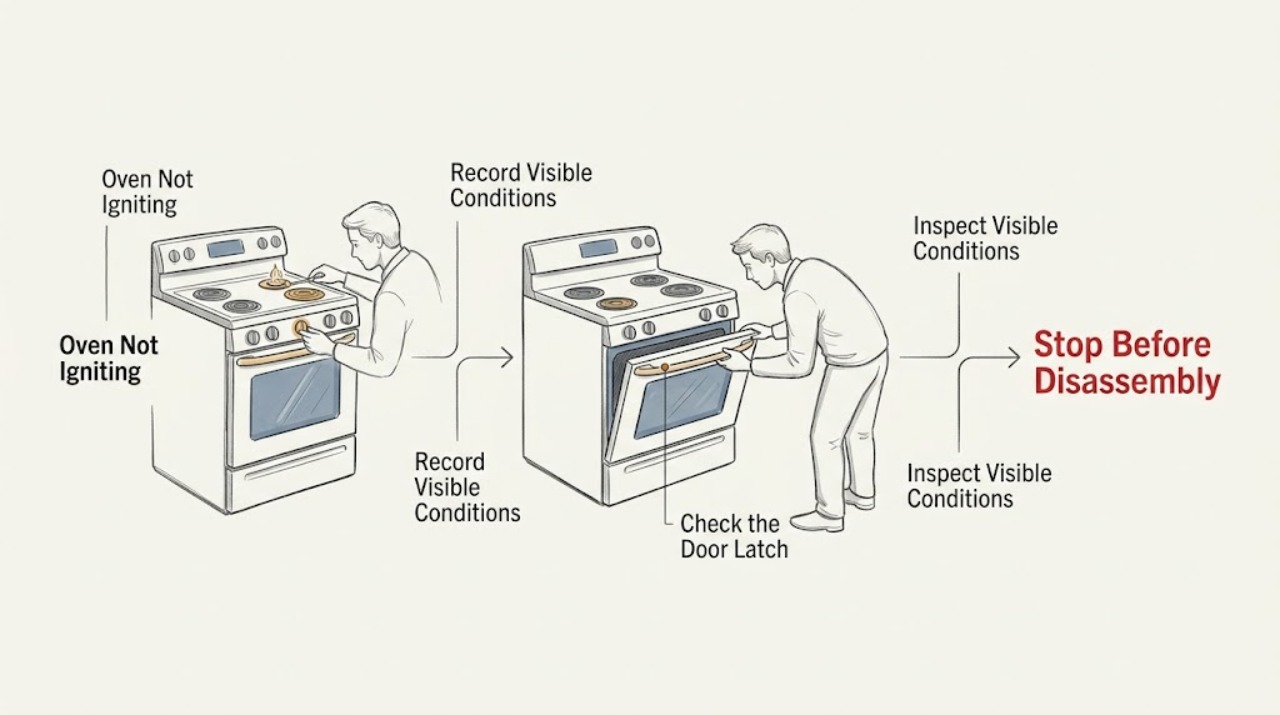
First identify whether the Monogram appliance is a gas, electric, or dual-fuel oven and whether it has no power, no heat, or a gas oven that never establishes ignition. For a gas model, check the selected mode, household power, gas shutoff state, self-clean latch, and any model-approved visual igniter indication without manually lighting the oven or opening panels. A gas smell, delayed ignition or boom, abnormal flame, smoke, carbon-monoxide alarm, arcing, or repeated electrical trip is an immediate stop-and-leave situation. If the controls, supply, and one documented reset do not restore ignition, preserve the model and symptoms and arrange qualified service.
Work through in order
Diagnostic checks
Use only checks that match the exact appliance or system and its official guide.
-
Check 1
With the oven off, cool enough to approach, and free of any gas odor, record the model and determine whether it is gas, electric, or dual fuel. Note whether the clock or display works, whether the oven control accepts Bake or Broil, whether surface burners work on a range, and whether the symptom is no power, no heat, or no gas flame.
Expected result: The display is blank, the controls respond but no heat occurs, surface burners work while the oven does not, or the oven is not a gas model.
Next step: Follow the matching gas, electric, or dual-fuel branch. If the appliance type or model cannot be confirmed, stop before testing ignition and retrieve the exact manual.
Why this matters
Why: A gas oven needs both power for its ignition/control system and a gas supply; an electric or dual-fuel oven must be diagnosed through its electrical heating path. Surface-burner behavior alone does not prove the oven ignition path is healthy.
-
Check 2
Check the user controls without forcing them: select the correct Bake or Broil mode, confirm the temperature or function control is in the expected position, and check that a self-clean latch is fully unlocked on models that have a mechanical latch. If controls were removed for cleaning, compare their positions with the model manual.
Expected result: The oven was in the wrong mode, a knob is misplaced, the self-clean latch is not fully unlocked, or the settings were already correct.
Next step: Correct only the visible control or latch state described in the exact manual, then make one normal start attempt if there is no gas odor or abnormal behavior. If the controls were correct or the latch will not move normally, arrange service.
Why this matters
Why: GE's gas wall-oven guidance lists incorrect Bake/Broil settings, misplaced controls, and a locked self-clean latch as reasons an oven may not come on; the exact Monogram control layout can differ.
-
Check 3
Check the household electrical supply from a safe position: look for a tripped breaker or fuse and, on a range with an accessible plug, confirm only that the plug is fully seated without moving the appliance. Do not touch a wet or damaged cord, outlet, breaker, or appliance, and do not use an extension cord as a workaround.
Expected result: The breaker or fuse is tripped, the display is blank after a known outage, the supply appears stable but the oven still will not start, or there is heat damage, moisture, or a repeated trip.
Next step: Do not repeatedly reset a breaker or handle damaged equipment. If the supply is stable and the model permits it, perform one documented control reset; otherwise have the circuit and appliance assessed by a qualified professional.
Why this matters
Why: Even a gas oven needs electrical power for its control, igniter, and gas-valve sequence. A repeated trip, wet equipment, damaged cord, or heat-damaged outlet is an electrical safety issue rather than an ignition experiment.
-
Check 4
For a gas model only, and only when there is no gas odor, check the accessible household gas shutoff position as described in the installation instructions. On a new range installation, note whether the oven alone is affected while surface burners work; do not open a drawer to reach hidden controls, adjust a regulator, loosen a connection, or test for a leak.
Expected result: The shutoff is visibly closed, the oven is affected after installation while surface burners work, the supply appears normal, or gas odor/abnormal sound is present.
Next step: If the accessible shutoff is clearly closed and the installation manual identifies it, use the manual's safe valve-position instruction; otherwise stop. For odor, hissing, or an installation-related supply concern, leave the area and contact the gas supplier or qualified service from outside.
Why this matters
Why: GE notes that a gas shutoff or regulator state can prevent the oven from heating even when top burners work. Gas odor, hissing, or an uncertain connection cannot be safely resolved by a homeowner trial.
-
Check 5
Only if the exact model manual and current conditions permit a visual check, start the gas oven in the documented mode and observe from outside the normal opening for the model's igniter indication; do not touch the cavity, burner, igniter, or valve and do not continue if any gas odor, popping, delayed response, smoke, or abnormal flame appears.
Expected result: The documented igniter indication appears and a stable normal flame follows, no indication appears, gas is present without ignition, or the response is delayed or abnormal.
Next step: Turn the oven off after one observation. Do not manually light the oven or repeat the test. Preserve the result and arrange qualified appliance service for no glow, no ignition, delayed ignition, abnormal flame, or any returning symptom.
Why this matters
Why: GE describes a red glow from a Glo-Bar igniter as a visual clue on applicable gas ovens. No glow can point toward an igniter, control, or electrical issue; gas without ignition or a delayed/abnormal flame requires professional diagnosis.
-
Check 6
If the oven has an electronic display, record any exact error text and whether the failure follows a power interruption, cleaning cycle, or control reset. Perform no more than one reset using the model manual; then make one normal start attempt only if the oven is dry, odor-free, and otherwise stable.
Expected result: The oven resumes normally after the documented reset, the same fault returns, the controls remain unresponsive, or the oven heats without a normal ignition sequence.
Next step: Stop using the oven, keep the code and model information, and arrange qualified service. Do not remove panels, bypass an interlock, adjust gas pressure, or substitute parts based only on a symptom.
Why this matters
Why: A reset can clear a temporary control state but cannot repair an igniter, gas valve, regulator, wiring, burner, sensor, or combustion fault. A returning code or no-heat condition needs model-specific service diagnosis.
Use your observations
Decision map
Find the observation that best matches what you see, then follow the next safe action.
-
PATH 01Next step
What you see
There is no display, a breaker/fuse is tripped, an outlet or cord is damaged, or the failure follows an outage.
Do this next
Do not repeatedly reset protection or touch wet/damaged equipment. Have the household circuit and oven supply assessed; a gas oven cannot operate its ignition and valve sequence without power.
-
PATH 02Next step
What you see
Bake or Broil can be selected, but no normal ignition occurs.
Do this next
Check the documented control, unlocked-latch, and accessible gas-supply states. A one-time visual igniter check is the limit; no manual lighting or panel removal.
-
PATH 03Next step
What you see
On a gas range, surface burners operate while the oven remains cold or never ignites.
Do this next
Confirm the oven controls, self-clean latch, accessible supply state, and model-approved visual igniter clue. Do not assume that working surface burners clear the oven regulator, igniter, valve, or control path.
-
PATH 04Next step
What you see
The oven has no gas ignition sequence, or its oven heating system is electric despite gas surface burners.
Do this next
Use the exact Monogram manual for the electrical oven and check only mode, power, door/latch, and displayed fault conditions. Do not apply gas-igniter advice to the electric oven.
-
PATH 05Next step
What you see
There is a gas smell, popping or boom, soot, smoke, yellow or unstable flame, or gas seems to flow without prompt ignition.
Do this next
Turn the appliance off if it can be done without approaching danger, leave the area, avoid switches and flames, and contact local emergency or gas authorities from outside. Do not retry the oven.
-
PATH 06Next step
What you see
The code returns, the igniter clue is absent, the oven still will not heat, the latch will not release normally, or the model instructions do not cover the symptom.
Do this next
Stop using the oven and arrange qualified Monogram/GE appliance service with the model, code, appliance type, and observed sequence. Do not dismantle the ignition, gas, or electrical system.
Helpful context
Understand the symptom
Do not treat every no-heat symptom as an ignition fault
A gas Monogram oven may have power to the clock while its burner never ignites. An electric oven has no gas ignition sequence, and a dual-fuel model may use gas surface burners but an electrically heated oven. Start by recording the model and identifying whether the oven is gas, electric, or dual fuel. Then note whether the display works, whether a mode can be selected, whether a gas smell is present, and whether any flame ever appears.
The safe limit of a user check
The official gas-oven guidance allows checks of controls, power, the accessible gas shutoff state, and a visual glow indication on models that use that igniter. It does not make burner, valve, wiring, regulator, or combustion adjustment a user task. Never try to light an oven burner with a match, repeatedly release gas to see if it catches, remove a panel, or bypass a safety control.
Gas odor and carbon monoxide change the response
If gas is smelled or a carbon-monoxide alarm sounds, do not continue diagnosis. Leave the area and contact the local emergency or gas authority from outside according to local guidance. A failed ignition can leave an unsafe fuel condition, while a visible flame with soot, smoke, or abnormal color can indicate a combustion or ventilation problem that needs qualified assessment.
Safety boundary
Stop conditions
- Stop immediately and leave the area for a gas odor, hissing, delayed ignition, boom, uncontrolled gas, abnormal flame, smoke, soot, carbon-monoxide alarm, or symptoms that could indicate carbon monoxide exposure. Contact local emergency or gas authorities from outside.
- Stop for visible arcing, burning or electrical odor, a hot plug or outlet, damaged wiring or cord, moisture near electrical parts, repeated breaker trips, or any control that cannot be turned off normally.
- Never manually light a gas oven, repeatedly release gas to test ignition, bypass a flame or door safety device, adjust a regulator, open a gas connection, remove an appliance panel, or work on live wiring.
Only after diagnosis
Potential parts
- oven igniter
Consider this category only when the exact model manual or a qualified technician confirms an absent or failed igniter indication and the gas supply is otherwise safe.
Igniters differ by Monogram model and fuel configuration. Confirm the complete model and manufacturer fit information before ordering; do not install or test a gas ignition part without qualified procedures. - oven gas valve or ignition control
Consider this category only after a qualified diagnosis confirms that the control or valve is not completing the documented ignition sequence.
Gas controls are model-specific and safety-critical. Do not select a component from a symptom alone or alter gas pressure.
When checks do not resolve it
Need a professional?
Arrange qualified appliance service when the oven still will not ignite after the correct controls, stable supply, and one model-approved reset/check; when the igniter indication is absent; when gas is present without ignition; when an error returns; or when the appliance is electric or dual fuel and its heating path needs internal diagnosis. Use the gas supplier or emergency authority for a gas leak or suspected carbon monoxide event.
Common questions
FAQ
Can I light a Monogram gas oven with a match during a power outage?
No. GE states that the gas oven igniter and gas valve require power, so the oven cannot be used during an outage. Do not attempt a manual oven-lighting workaround.
Why do the surface burners work while the gas oven does not?
The oven has its own controls, gas path, igniter, valve, and safety sequence. GE lists oven settings, the installation gas-regulator state, self-clean latch, and the visual igniter indication as separate checks.
What does no red glow from the oven igniter mean?
On models that use a Glo-Bar, GE describes no red glow as a clue for a possible igniter, control, or other electrical fault. Do not remove a panel or test the gas valve; arrange service.
Should I keep trying if the oven clicks but does not ignite?
No. Turn the oven off after the limited observation. Gas odor, popping, delayed ignition, an abnormal flame, smoke, or a returning failure requires leaving the area and contacting qualified help from outside.
Could the self-clean latch prevent the oven from igniting?
On models with a mechanical self-clean latch, GE says the latch must be in the unlocked position for normal operation. Check it only as the model manual describes; do not force it.
When is an oven ignition problem an emergency?
Treat gas odor, hissing, delayed ignition or a boom, abnormal flame, smoke, soot, a carbon-monoxide alarm, visible arcing, or repeated electrical trips as an immediate stop condition. Leave the area and contact the appropriate local authority from outside.
Read the exact guide
Official sources
- Responding to Residential Carbon Monoxide Incidents - Guidelines for Fire and Other Emergency Response PersonnelU.S. Consumer Product Safety Commission · Fuel-burning appliance and carbon-monoxide emergency safety boundaries
- Range, Cooktop & Wall Oven - Power Outage Tips and OperationGE Appliances · GE/Monogram-family gas, dual-fuel, and electric oven power-outage behavior
- Gas Range - Oven Does Not Heat, But The Burners HeatGE Appliances · GE/Monogram-family gas-range oven no-heat and igniter guidance when surface burners work
- Gas Range & Wall Oven - Oven Will Not Come OnGE Appliances · GE/Monogram-family gas range and wall-oven controls, power, gas supply, igniter, and reset guidance
- Frequently Asked Questions About GE Ranges and Wall OvensGE Appliances · GE/Monogram-family range and wall-oven operating and fault-code context
- User Manual & Care for ZET2SHSSMonogram / GE Appliances · Monogram wall-oven owner manual and model-specific support resources
Community feedback
Share a repair observation
Share a plain-text repair observation. Accepted observations are published automatically; this page may take a moment to update.