
On this page
Start here
Quick answer
If a Panasonic refrigerator is not making ice, check whether ice making is enabled, the freezer is cold enough according to the exact manual, and the water supply/tank is correctly installed. Look for a stuck or overfilled tray without forcing it. Panasonic says model descriptions vary and directs unresolved ice-maker faults to its service centre; do not disassemble the ice maker.
Before you begin
Safety first
- Do not reach into moving mechanisms, remove panels, or loosen water/refrigeration connections.
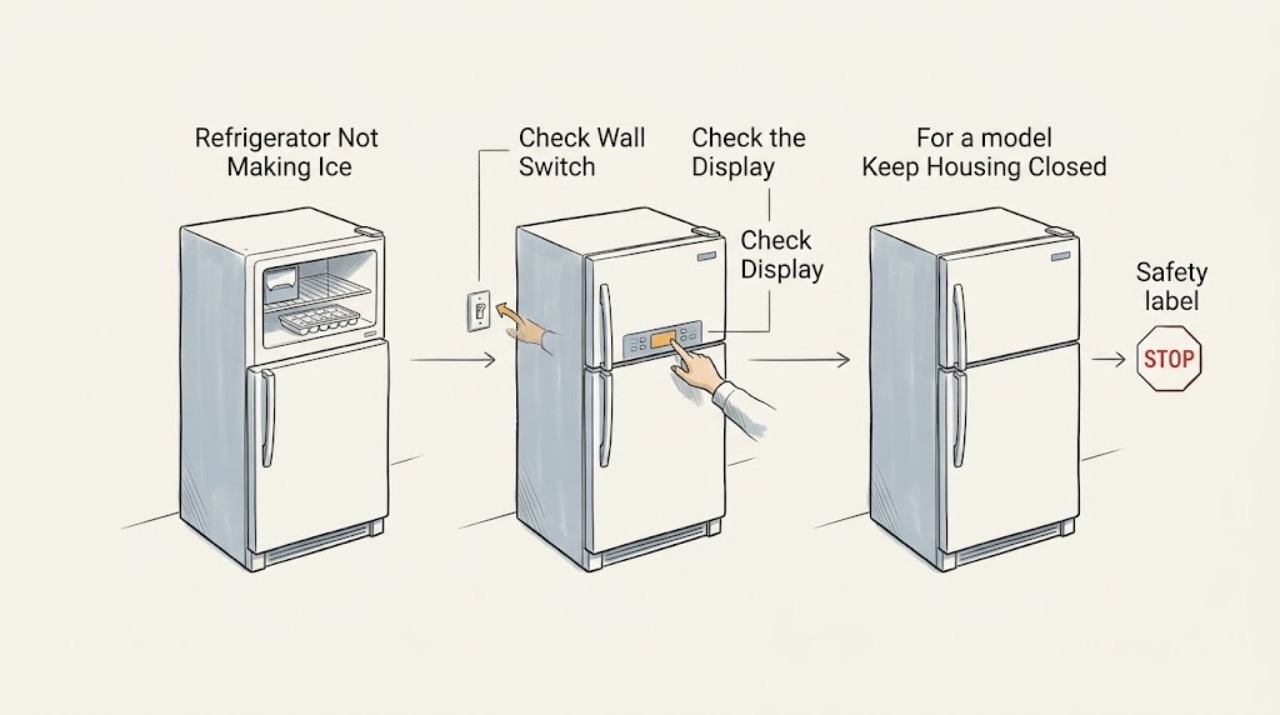
Work through in order
Diagnostic checks
Use only checks that match the exact appliance or system and its official guide.
-
Check 1
Check the ice-making switch or mode and confirm the ice tray/bin is seated correctly; use the exact Panasonic manual for the control sequence.
Expected result: Ice making is disabled, the tray/bin is misseated, or the controls are already enabled.
Next step: Correct one obvious setting or seating issue according to the manual and monitor; do not force the tray.
Why this matters
Why: A disabled mode or misseated tray can prevent production without an internal component failure.
-
Check 2
Check the freezer temperature display or food condition and keep vents clear of packages; do not infer a precise target unless the model manual provides it.
Expected result: The freezer is warm or airflow is blocked, or temperature and airflow appear normal.
Next step: Correct loading only and monitor. Request service if temperature is abnormal or continues to rise.
Why this matters
Why: Ice production depends on the freezer reaching its model operating range; a warm compartment shifts diagnosis to cooling or airflow.
-
Check 3
For a model with a tank or plumbed supply, verify the water tank is filled and seated or the supply valve is open, with no visible kink or leak.
Expected result: Water is absent/restricted or the supply path looks normal.
Next step: Correct only an obvious tank seating or valve issue. Do not loosen pressurised tubing.
Why this matters
Why: Without the model's water supply, the ice tray cannot refill; a normal supply leaves the inlet/control path in scope.
-
Check 4
Inspect the tray/bin for a solid bridge of ice or a visibly jammed ejector without putting fingers near moving parts.
Expected result: Ice is stuck/overfilled or the tray is empty and free.
Next step: Follow only the manual's safe release procedure and arrange service if it does not clear.
Why this matters
Why: A stuck tray can stop a new harvest cycle; a free tray with no fill points to supply, sensor, or control diagnosis.
Use your observations
Decision map
Find the observation that best matches what you see, then follow the next safe action.
-
PATH 01Next step
What you see
Ice production resumes after enabling the mode, seating the tray, or restoring an obvious water supply
Do this next
Monitor several cycles and service a recurrence.
Why this path and its safety boundary
Why it matters: A setup or supply condition was supported.
-
PATH 02Next step
What you see
The freezer is warm or ice repeatedly melts and stops forming
Do this next
Arrange refrigerator service rather than replacing an ice-maker part first.
Why this path and its safety boundary
Why it matters: The ice symptom may be downstream of a cooling or airflow fault.
-
PATH 03Next step
What you see
Water and temperature are normal but the tray remains empty or jammed
Do this next
Provide the model and observations to Panasonic service.
Why this path and its safety boundary
Why it matters: A model-specific ice-maker, sensor, or control fault remains.
Helpful context
Understand the symptom
No ice does not automatically mean a failed ice maker
Separate ‘not producing,’ ‘not filling,’ and ‘ice stuck in the tray.’ Record the last time ice was made and any indicator or alarm before changing settings.
When checks do not resolve it
Need a professional?
Keep food cold and use only model-documented external checks while arranging service.
Safety scope: Do not reach into moving mechanisms, remove panels, or loosen water/refrigeration connections.
Have this ready
- Provide the model, last ice cycle, temperature, ice-mode state, tray/bin position, water supply result, and any alarm.
Common questions
FAQ
Can I force a Panasonic ice tray to turn?
No. Inspect only from the outside and follow the exact manual. A jammed tray or ejector that does not clear safely needs service.
Why is my Panasonic refrigerator not making ice when it is cold?
Check the enabled mode, tray/bin seating, and water supply. If those are normal, an inlet, sensor, or control fault requires model-specific service.
Read the exact guide
Official sources
- Panasonic - Official Consumer Product SupportPanasonic North America · Panasonic refrigerator manuals, service locator, and support routing
- TroubleshootingPanasonic · Panasonic refrigerator model-specific temperature, panel, light, and ice-related operating guidance
Community feedback
Share a repair observation
Share a plain-text repair observation. Accepted observations are published automatically; this page may take a moment to update.