
On this page
Start here
Quick answer
A hissing or dripping sound when a portable air conditioner is first used can be an operating sound, but the sound alone does not prove that the unit is broken or leaking refrigerant. LG's portable-AC guidance says an early water-dripping sound can come from moving louvers and may reduce as the unit runs. Check the louver area, level surface, drain hose or tank, and the exhaust path from outside the cabinet. If water is leaking onto the floor, cooling is weak, ice appears, or the hissing becomes loud and persistent, stop using the unit and arrange model-specific service.
Work through in order
Diagnostic checks
Use only checks that match the exact appliance or system and its official guide.
-
Check 1
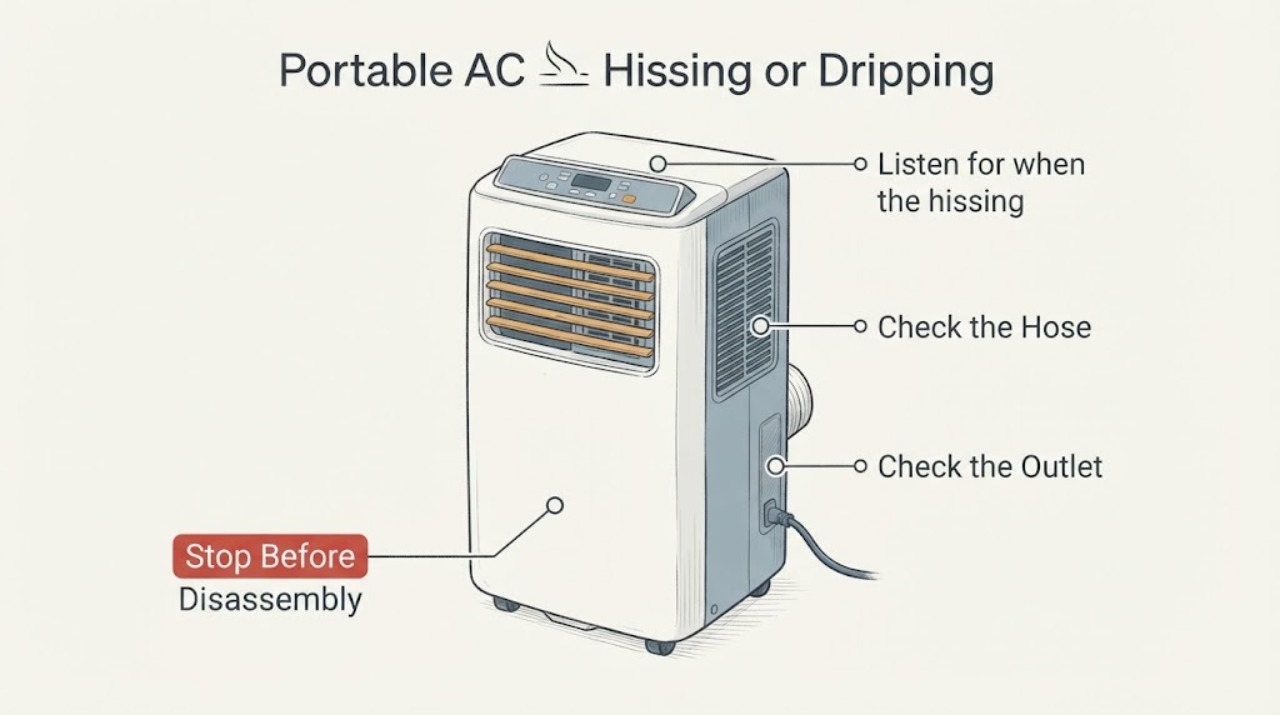
Listen for when the hissing or dripping occurs and compare it with cooling startup, louver movement, and the first minutes of operation.
Expected result: The sound is brief and reduces as operation continues, or it is loud, continuous, or becoming more frequent.
Next step: If the sound is brief and there is no water outside the unit, continue with the external checks. If it persists or worsens, stop and use the service branch after checking for visible leak or airflow symptoms.
Why this matters
Why: LG says that on portable ACs an early water-dripping sound can be produced as the wind-direction parts move and can reduce as their position settles; a worsening sound is not covered by that normal-sound explanation.
-
Check 2
With the unit off, inspect the louver and air-outlet area for leftover protective film or a foreign object, without removing the cabinet.
Expected result: The louver path is clear, or packaging/foreign material is visibly obstructing the moving parts.
Next step: Remove only loose, accessible packaging or material, then test once. If the louver is damaged, rubbing, or inaccessible without disassembly, stop and request service.
Why this matters
Why: LG identifies protection vinyl or foreign material in the louver operating area as a possible cause of the early dripping-like noise.
-
Check 3
Check that the portable AC is on a stable, level surface and inspect the drain hose, drain port, and water tank from outside the cabinet.
Expected result: The unit is level, the drain hose or tank is correctly positioned, and there is no visible blockage; or water is collecting, the hose is displaced, or the tank is full.
Next step: Follow the exact model manual to empty the tank or restore the drain connection. Do not drill the cabinet or improvise a drain fitting; if the leak continues, arrange service.
Why this matters
Why: Danby identifies level placement, correct hose/tank position, hose blockage, and regular tank emptying as external checks for a portable AC water leak.
-
Check 4
Verify that the supplied exhaust hose and window kit are installed as the model manual shows, with the hose vented outdoors and not sharply restricted.
Expected result: The hose is connected to the supplied kit and vented outside, or it is absent, kinked, extended, or routed into an indoor space.
Next step: Restore the supplied vent arrangement and keep the hose as straight and short as the model instructions allow, then retest. Do not operate the AC into an attic or other indoor space.
Why this matters
Why: GE says portable ACs need outdoor exhaust to remove heat and humidity, and that an extended or sharply bent hose can restrict airflow and reduce cooling.
-
Check 5
After the external checks, observe cooling, the floor around the unit, and the coil or air outlet for ice or continuing water.
Expected result: The unit cools normally with no external leak or ice, or it has weak/warm airflow, visible ice, water around the unit, or a persistent hissing/whistling sound.
Next step: For normal cooling and no leak, follow the exact manual for continued use. For ice, weak cooling, visible leakage, or a persistent abnormal sound, turn the unit off, allow safe drainage/defrosting, and arrange qualified service rather than opening the sealed system.
Why this matters
Why: Midea identifies hissing/whistling together with freezing symptoms as possible airflow restriction or pressure-change signs and says refrigerant-leak confirmation requires a professional; Danby directs persistent leaks to support.
Use your observations
Decision map
Find the observation that best matches what you see, then follow the next safe action.
-
PATH 01Next step
What you see
The sound occurs only briefly during first use or louver movement, becomes quieter, and there is no water outside the cabinet or loss of cooling.
Do this next
Keep the louver path clear and continue to monitor the unit under the exact model manual; do not replace a part based on the sound alone.
Why this path and its safety boundary
Why it matters: This matches the normal early-use/louver movement explanation documented by LG for portable AC noise.
-
PATH 02Next step
What you see
Water is pooling on the floor, the drain hose or tank is displaced or blocked, or the leak continues after the external drain check.
Do this next
Turn the unit off, follow the model manual's drain procedure, and contact service if the leak persists. Keep water away from the cord and outlet.
Why this path and its safety boundary
Why it matters: The symptom is no longer only a sound question; Danby treats hose/tank position, blockage, level placement, and persistent leakage as conditions requiring correction or support.
-
PATH 03Next step
What you see
The hissing or whistling is persistent and is accompanied by weak or warm cooling, ice, or repeated water around the unit.
Do this next
Turn the unit off, do not add refrigerant or open the cabinet, and arrange a qualified model-specific inspection after the unit is safely dry and defrosted.
Why this path and its safety boundary
Why it matters: Midea associates this combination with possible restricted airflow, freezing, or a pressure/refrigerant issue, but the opened guidance does not establish which internal fault is present on an unknown model.
-
PATH 04Next step
What you see
The exhaust hose is missing, routed indoors, extended, or sharply bent, or the unit is on an unstable surface.
Do this next
Stop the test, restore the supplied vent and level placement according to the exact manual, and retest once before seeking service.
Why this path and its safety boundary
Why it matters: The installation can restrict airflow or prevent heat and humidity from leaving as designed, which can make operation abnormal without proving a refrigeration leak.
Helpful context
Understand the symptom
Separate sound from a water leak
The task has no brand or model, so the checks below stay at the portable-air-conditioner level and do not assume a particular drain layout, refrigerant circuit, or replacement part. A short-lived sound during first operation can be normal. A wet floor, repeated water accumulation, poor cooling, ice, or a sound that grows louder changes the decision toward stopping and obtaining the exact owner's manual or professional inspection.
Do not open the refrigeration system
No opened official source supports a user measurement, refrigerant recharge, sealed-system repair, or internal electrical test for an unknown portable AC. A hissing sound combined with ice, weak cooling, or persistent water requires the exact model manual and qualified service rather than a guessed refrigerant or part diagnosis.
When checks do not resolve it
Need a professional?
Arrange qualified service when the hissing persists after the external checks, cooling is weak or warm, ice returns, water continues to leak, or inspection would require opening the cabinet or refrigeration system. Provide the brand/model from the rating label, the operating mode, when the sound starts, a description of any water, and whether the exhaust and drain paths match the manual.
Common questions
FAQ
Is a hissing or dripping sound on first use automatically a refrigerant leak?
No. LG documents an early water-dripping sound from moving louver parts that may reduce as operation continues. A persistent hissing sound together with weak cooling, ice, or water requires professional inspection because the sound alone cannot identify the cause.
What should I check if the sound seems like water?
Check the level surface, the external drain hose or tank position, blockage, and the model's drain instructions. Danby advises emptying the tank regularly and contacting support if a leak persists.
Can I run a portable AC without the exhaust hose while testing it?
Do not assume that is safe for cooling operation. GE says a portable AC must be vented outdoors to remove heat and humidity, and that a restricted or extended hose can reduce airflow and cooling. Follow the exact model manual for fan or other modes.
Should I add refrigerant or open the unit?
No. The available official guidance supports external airflow, drain, and installation checks. It does not support a user refrigerant recharge or sealed-system repair on an unknown portable AC; persistent symptoms need qualified service.
Read the exact guide
Official sources
- Portable Air Conditioner - FAQsGE Appliances · Opened official GE portable-AC FAQ; used for general portable-AC installation and water behavior with explicit model-manual qualification.
- The portable air conditioner is leaking water. How can I fix this?Danby · Opened official portable-AC FAQ; used as a general portable-AC water-path check while preserving the unknown brand/model limitation.
- Portable Air Conditioners FAQsDanby · Opened official portable-AC FAQ category; used for general operating distinctions and not as a model-specific manual.
- [LG Air Conditioner Noise] [Portable] A cracking and water dripping noise is heard from the air conditionerLG Electronics USA · Opened official portable-air-conditioner help article; used for a model-agnostic normal-sound comparison and accessible louver check, not for the unknown unit's internal diagnosis.
- Portable Air Conditioner - Exhaust Vent HoseGE Appliances · Opened official portable-AC hose guidance; used for the general principle that supplied hose routing affects heat removal, without transferring a GE-specific part or dimension.
- What to do when the air conditioner freezes upMidea Canada · Opened official Midea guidance; the article uses a mini-split example, so only the explicitly portable-AC airflow note and general symptom/service boundary are applied to this no-model task.
Community feedback
Share a repair observation
Share a plain-text repair observation. Accepted observations are published automatically; this page may take a moment to update.