
On this page
Start here
Quick answer
Unplug a portable air conditioner that trips the breaker and stop repeated resets. Check for heat, damage, moisture, or burning odor, then confirm it is connected directly to a suitable wall outlet rather than a power strip, smart plug, or ordinary extension. Reset the breaker once only when the circuit and appliance look safe; if it trips again, leave the unit unplugged and call qualified HVAC/electrical service.
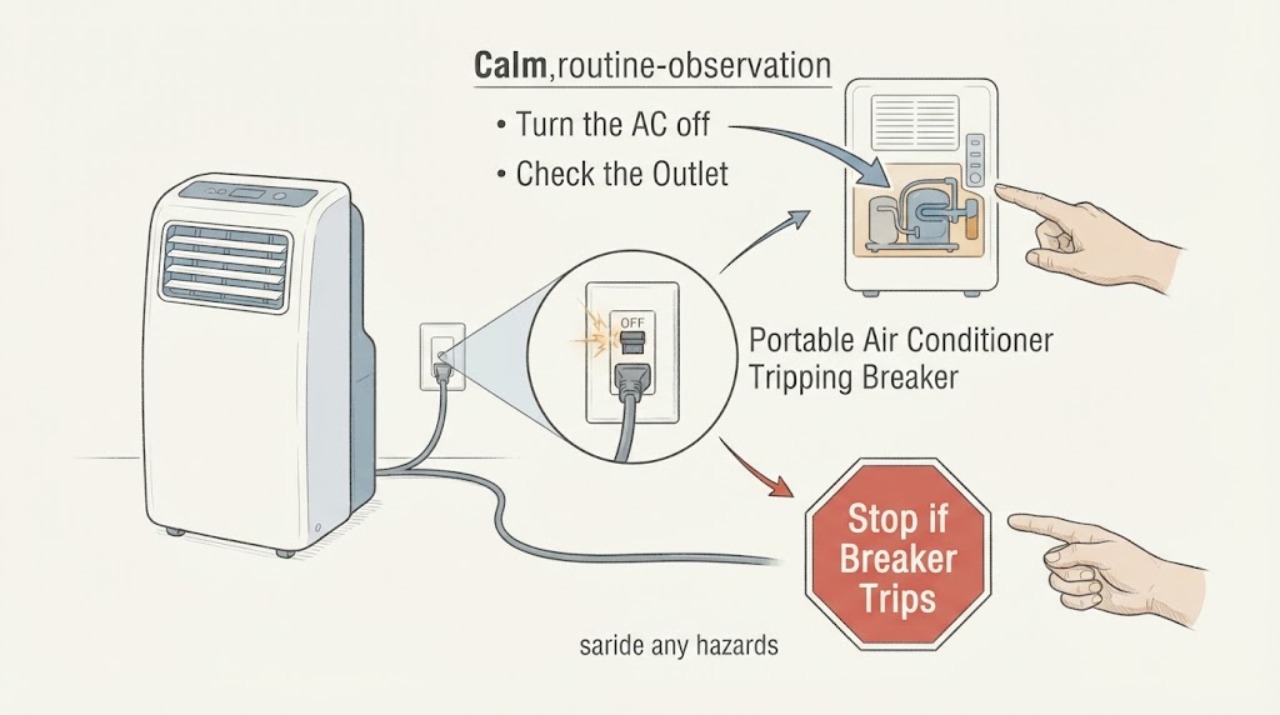
Work through in order
Diagnostic checks
Use only checks that match the exact appliance or system and its official guide.
-
Check 1
Turn the AC off and unplug it. Note whether the breaker trips at plug-in, compressor start, after several minutes, or only when other loads run.
Expected result: The trip is immediate, start-related, delayed, or shared with other loads.
Next step: Keep the unit unplugged while checking the external setup; stop for heat, odor, sparks, moisture, or cord damage.
Stop if: Do not retry a hot, damaged, wet, or smoking unit.
Why this matters
Why: Timing helps separate supply/connection concerns from an operating-load fault, but cannot identify an internal component.
-
Check 2
Inspect the cord, plug, outlet, and any adapter from a dry position; remove power strips, smart plugs, and ordinary extension leads from the setup.
Expected result: The unit used an intermediary or visible damage exists, or it was already on a direct sound outlet.
Next step: Use only the power arrangement specified by the exact manual; have damaged outlets/cords serviced.
Stop if: Do not tape a damaged cord or continue with a loose outlet.
Why this matters
Why: An unsuitable connection can overheat or trip; direct connection still requires circuit and appliance evaluation.
-
Check 3
Test the wall outlet with a known-safe load and check whether another high-load appliance shares the circuit.
Expected result: The outlet/circuit is dead, overloaded, or stable with the AC disconnected.
Next step: Have circuit changes handled by a qualified electrician; do not add an extension to “solve” the trip.
Stop if: Do not keep resetting a breaker that trips.
Why this matters
Why: A circuit issue may be upstream; a stable circuit with the AC connected points toward the unit or its starting load.
-
Check 4
If the setup is safe, reset the breaker once and make one normal start attempt, remaining nearby.
Expected result: The breaker holds and the AC runs, or it trips again or the cord heats.
Next step: Unplug it after a repeat trip and arrange HVAC/electrical service with timing and connection details.
Stop if: Stop immediately for burning smell, sparks, smoke, or water near electrics.
Why this matters
Why: A repeat trip meets the manufacturer stop boundary; a single successful run does not prove the fault is gone.
Use your observations
Decision map
Find the observation that best matches what you see, then follow the next safe action.
-
PATH 01Next step
What you see
The AC trips only through a strip, smart plug, or ordinary extension.
Do this next
Remove the intermediary and follow the exact manual’s direct-outlet requirement; service any damaged accessory.
Why this path and its safety boundary
Why it matters: The connection is unsuitable for a high-load portable AC.
-
PATH 02Next step
What you see
The outlet trips with other high-load devices but holds with the AC disconnected.
Do this next
Use qualified electrical help to assess the circuit; do not continue combined use.
Why this path and its safety boundary
Why it matters: Circuit loading or protection is likely involved.
-
PATH 03Next step
What you see
The breaker trips again with a direct suitable outlet and no visible damage.
Do this next
Leave the AC unplugged and arrange qualified HVAC/electrical service.
Why this path and its safety boundary
Why it matters: An appliance or circuit fault remains likely.
-
PATH 04Next step
What you see
The cord is hot, damaged, or there is odor/sparking.
Do this next
Disconnect power if safe, clear the area, and seek qualified or emergency help; do not retry.
Why this path and its safety boundary
Why it matters: There is immediate electrical/fire risk.
Helpful context
Understand the symptom
What to check first
Portable ACs draw substantial starting and running power. TCL and Honeywell guidance emphasize a direct suitable outlet, cord/outlet checks, and a stop boundary for heat, odor, sparks, or repeated trips. The safe diagnosis is whether the event follows the unit, the outlet/circuit, or an unsafe connection; it does not justify opening the sealed refrigeration circuit.
When checks do not resolve it
Need a professional?
Arrange qualified appliance or electrical service when the safe external checks do not resolve the symptom. Provide the exact model and what you observed; do not open sealed, gas, high-voltage, or refrigerant systems yourself.
Common questions
FAQ
Can I use a heavy-duty extension cord?
Only if the exact manufacturer manual explicitly permits that arrangement. TCL and Honeywell guidance favor a suitable direct wall outlet for portable AC power.
How many times can I reset the breaker?
One controlled reset/retry is the boundary used in the cited guidance. A repeat trip means unplug and service.
Could a dirty filter cause a breaker trip?
Maintenance affects airflow and operation, but it does not make repeated electrical trips safe to ignore. Resolve the power fault first; service persistent trips.
Read the exact guide
Official sources
- Portable Air ConditionerHoneywell/Jmatek · Honeywell portable air conditioners
- Troubleshooting Guide TCL Air Conditioner Not Powering OnTCL · TCL air conditioners including portable units
Community feedback
Share a repair observation
Share a plain-text repair observation. Accepted observations are published automatically; this page may take a moment to update.