
On this page
Start here
Quick answer
A portable air conditioner that is not cooling should be checked for the cooling mode and setpoint, a correctly installed exhaust hose, closed windows/doors, clean filter and coils, and a full drain tank if the model uses one. Do not vent into an indoor space or extend the hose. If airflow and venting are correct but the unit still does not cool, arrange service.
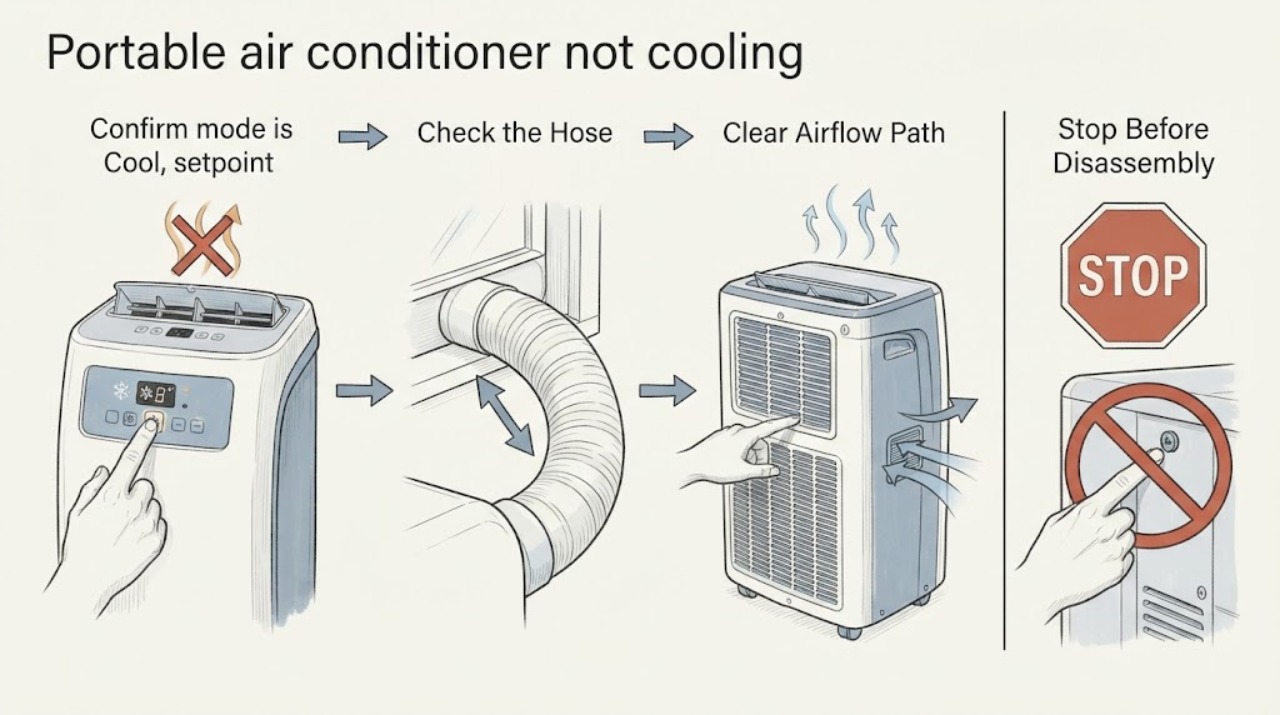
Work through in order
Diagnostic checks
Use only checks that match the exact appliance or system and its official guide.
-
Check 1
Confirm mode is Cool, setpoint is below room temperature, and the fan/compressor response is visible or audible.
Expected result: Unit is in fan/dehumidify, setpoint is not calling for cooling, or cooling mode is active.
Next step: Use the exact control instructions and retest once in Cool mode.
Why this matters
Why: A mode/setpoint state can produce no cooling without a hardware failure.
-
Check 2
Inspect window kit and exhaust hose from outside the unit for disconnection, kinks, leaks, extension, or venting indoors.
Expected result: Hose is disconnected/blocked/extended or correctly vented outdoors.
Next step: Reconnect and route only as the model manual permits; do not vent into an attic/room.
Why this matters
Why: GE says the exhaust path must remove heat and humidity outdoors; improper hose setup reduces or prevents cooling.
-
Check 3
Check windows/doors, front/rear airflow, filter and accessible coils for open gaps, blockage, dust, or ice.
Expected result: Room is open, airflow blocked, filter/coil dirty/iced, or paths are clear.
Next step: Close openings, clean the filter/accessible coil, and allow ice to thaw without scraping.
Why this matters
Why: Heat gain and restricted airflow reduce capacity and can cause icing.
-
Check 4
Empty the drain tank if the model indicates it, then run one supervised cooling cycle and record room/outlet temperature trend.
Expected result: Cooling improves, unit runs but air remains warm, or it stops with a code/water warning.
Next step: Stop repeated tests and contact qualified AC service for persistent no-cooling.
Why this matters
Why: Improvement supports setup/maintenance; persistent warm output with correct setup needs service diagnosis.
Use your observations
Decision map
Find the observation that best matches what you see, then follow the next safe action.
-
PATH 01Next step
What you see
Mode/setpoint or window/vent setup is incorrect and cooling returns after correction.
Do this next
Keep hose configuration and room sealing within the manual.
Why this path and its safety boundary
Why it matters: An operating/setup condition explains the complaint.
-
PATH 02Next step
What you see
Hose is connected but filter/coil is dirty or iced and airflow is weak.
Do this next
Clean/dry as directed and let ice thaw; arrange service if it returns.
Why this path and its safety boundary
Why it matters: Airflow restriction or icing is more likely than immediate compressor failure.
-
PATH 03Next step
What you see
Correct mode, outdoor vent, room sealing, airflow, and drain state still produce warm air.
Do this next
Keep the unit out of use as needed and arrange qualified service; do not open the sealed system.
Why this path and its safety boundary
Why it matters: A fan, sensor, refrigerant, compressor, or control fault may require diagnosis.
-
PATH 04Next step
What you see
Water leaks near electrics, cord is hot/damaged, smoke, burning odor, or repeated trip occurs.
Do this next
Stop, unplug/isolate only if safe, and obtain qualified service.
Why this path and its safety boundary
Why it matters: Immediate safety boundary.
Helpful context
Understand the symptom
Portable AC cooling depends on removing condenser heat outdoors; a hot exhaust hose is normal, but a disconnected hose or indoor vent defeats cooling.
Separate setup/airflow conditions from a sealed-system or compressor fault.
When checks do not resolve it
Need a professional?
Arrange portable-AC service when correct mode, venting, filter/coil, room sealing, and drainage checks do not restore cooling or a sealed-system/control fault is suspected.
Common questions
FAQ
Why is the exhaust hose important?
A portable AC must send heat and humidity outdoors. A disconnected, extended, or indoor-vented hose reduces or prevents cooling.
Can a dirty filter make a portable AC stop cooling?
Restricted airflow can reduce cooling and cause ice. Clean the accessible filter as the manual allows and let ice thaw naturally.
When should I call service?
Call when setup and accessible maintenance are correct but air remains warm, or for leaks, electrical warning, or repeated fault codes.
Read the exact guide
Official sources
- Air Conditioner - Not Cooling Well / Running ConstantlyGE Appliances · portable/room air conditioner cooling checks
- Portable Air Conditioner - Exhaust Vent HoseGE Appliances · portable AC exhaust hose and outdoor venting
Community feedback
Share a repair observation
Share a plain-text repair observation. Accepted observations are published automatically; this page may take a moment to update.