
On this page
Start here
Quick answer
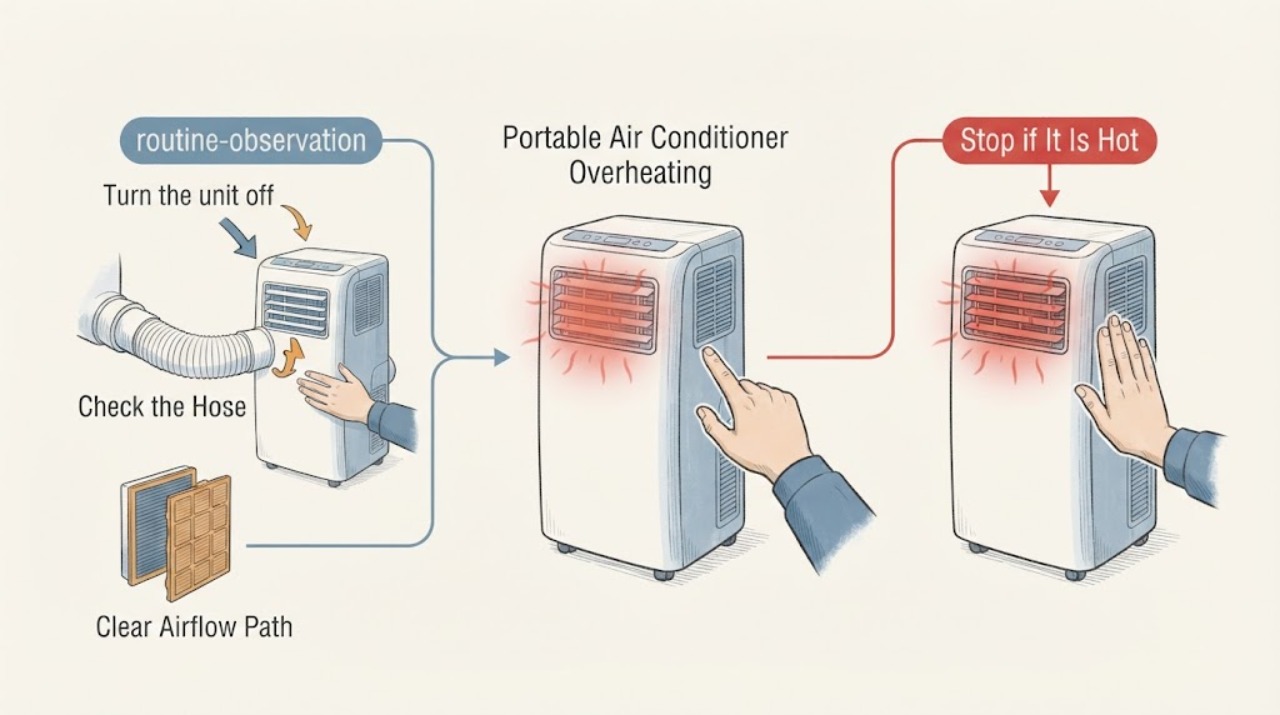
A portable AC exhaust hose normally feels warm or hot, but cabinet overheating, shutdowns, or much hotter exhaust suggest restricted heat rejection, airflow, or water handling. Unplug before cleaning, clear the intake/discharge, clean the filter, and keep the supplied exhaust path unobstructed and outdoors. Persistent overheating needs service.
Work through in order
Diagnostic checks
Use only checks that match the exact appliance or system and its official guide.
-
Check 1
Turn the unit off and unplug it if safe; check for smoke, burning odor, melted plastic, water near electrics, or an untouchably hot cabinet.
Expected result: Any fire/electrical sign or uncontrolled water exists.
Next step: Keep disconnected and arrange qualified HVAC/electrical help; seek emergency help for smoke/fire.
Stop if: Stop if there is a safety hazard or internal access would be required.
Why this matters
Why: This is a safety event rather than airflow maintenance.
-
Check 2
Inspect exhaust hose and window connection; confirm hose is not crushed, blocked, or improperly extended.
Expected result: Hot air cannot leave freely or hose is correctly short/open.
Next step: Restore the supplied outdoor vent path; do not improvise extensions.
Stop if: Stop if there is a safety hazard or internal access would be required.
Why this matters
Why: GE says restricted exhaust can reduce performance and cause overheating.
-
Check 3
With unit unplugged/cool, clean the user-accessible filter and clear intake/discharge openings.
Expected result: Filter is dirty or airflow clear but overheating returns.
Next step: Refit dry filter and make one supervised run; stop if heat returns.
Stop if: Stop if there is a safety hazard or internal access would be required.
Why this matters
Why: A dirty filter can restrict air; recurrence with clear airflow points to fan/sensor/refrigeration service.
-
Check 4
Check water-full indicator/tank and drain only as the model manual directs.
Expected result: Tank is full or unit remains hot with normal drainage.
Next step: Drain safely if permitted, then arrange service if overheating persists.
Stop if: Stop if there is a safety hazard or internal access would be required.
Why this matters
Why: Excess condensate can stop the unit; no water explanation leaves heat rejection/internal fault.
Use your observations
Decision map
Find the observation that best matches what you see, then follow the next safe action.
-
PATH 01Next step
What you see
Exhaust hose is blocked/badly bent
Do this next
Restore outdoor vent path and test once.
Why this path and its safety boundary
Why it matters: Heat is not leaving efficiently.
-
PATH 02Next step
What you see
Filter/intake is clogged
Do this next
Clean and dry filter, then test once.
Why this path and its safety boundary
Why it matters: Restricted airflow can raise temperature.
-
PATH 03Next step
What you see
Overheating recurs with clear airflow and normal drain
Do this next
Stop use and arrange service.
Why this path and its safety boundary
Why it matters: Internal refrigeration/fan/control fault is possible.
Helpful context
Understand the symptom
How to read the result
A portable AC exhaust hose normally feels warm or hot, but cabinet overheating, shutdowns, or much hotter exhaust suggest restricted heat rejection, airflow, or water handling. Unplug before cleaning, clear the intake/discharge, clean the filter, and keep the supplied exhaust path unobstructed and outdoors. Persistent overheating needs service.
When checks do not resolve it
Need a professional?
Arrange qualified HVAC service for recurring overheating after clear exhaust/filter/drain checks, smoke, burning odor, water near electrics, or damaged parts.
Common questions
FAQ
Is a hot exhaust hose automatically a fault?
No. GE says warm/hot exhaust is normal; increased heat with restriction or shutdowns needs investigation.
Can I extend the hose?
Do not improvise an extension; GE says it can reduce airflow and cause overheating.
Read the exact guide
Official sources
- Portable Air Conditioner Hot Exhaust Vent HoseGE Appliances · portable AC exhaust heat
- Portable Air Conditioner - Cleaning & MaintenanceGE Appliances · portable AC filter/drain maintenance
Community feedback
Share a repair observation
Share a plain-text repair observation. Accepted observations are published automatically; this page may take a moment to update.