
On this page
Start here
Quick answer
First verify that the portable air conditioner actually has a Heat or Supplemental Heat function; cooling-only models cannot produce heat. On a heating-capable unit, select Heat, set the target above room temperature, allow time for warm air, and keep the filter, inlet, exhaust hose, window kit, and clearances in the model’s required configuration. Supplemental heat may raise a room only modestly. Stop for burning smell, smoke, electrical heat, refrigerant/oil leak, or repeated trips and arrange service.
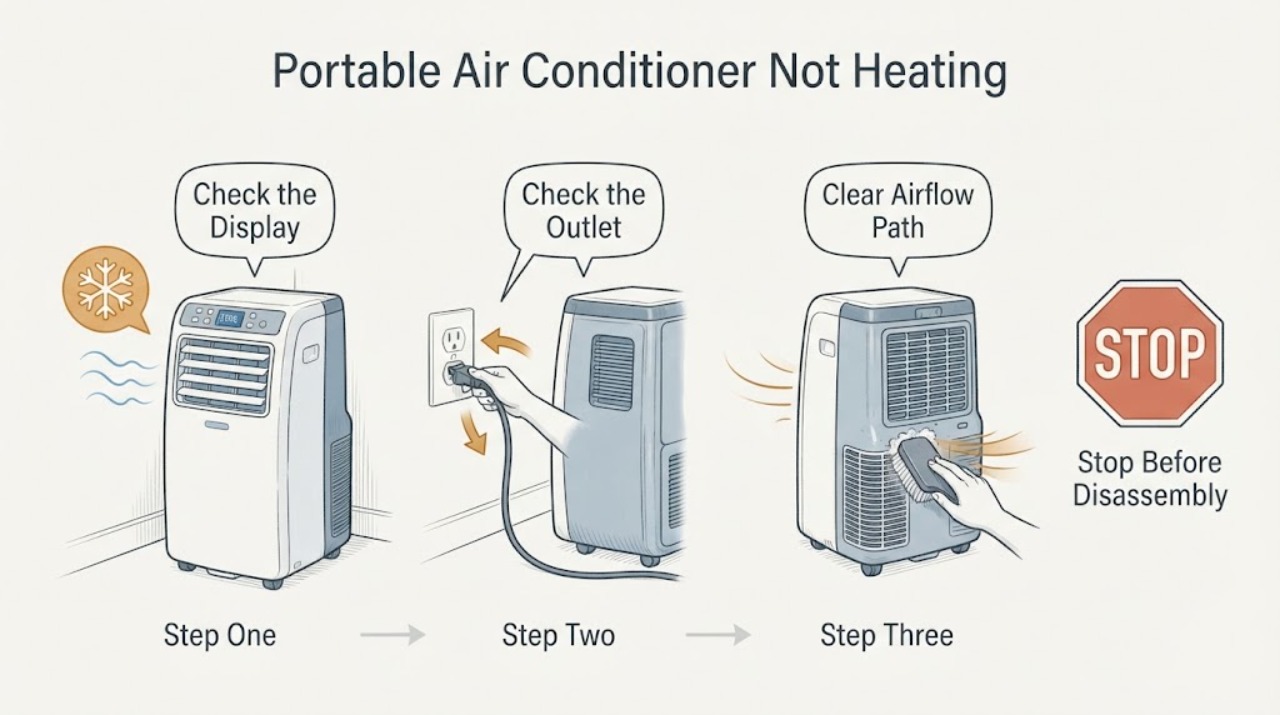
Work through in order
Diagnostic checks
Use only checks that match the exact appliance or system and its official guide.
-
Check 1
Read the control panel, product label, or manual and confirm that the portable AC has Heat or Supplemental Heat; note any heat icon or error code.
Expected result: Heat is available, only Supplemental Heat is listed, or no heat function is documented.
Next step: If no heat function is documented, stop treating this as a heating fault and use an appropriate primary heater or seek model-specific guidance.
Why this matters
Why: Only a heating-capable model can produce warm air; supplemental heat has limited output by design.
-
Check 2
On a heating-capable unit, select Heat and set the target several degrees above the room temperature, then wait through the model’s startup period while observing the outlet air.
Expected result: Warm air appears, the fan runs without heat, or the unit displays an error/does not start.
Next step: Record the mode, setpoint, room temperature, outlet-air behavior, and error code for model-specific service.
Why this matters
Why: Correct mode and setpoint are prerequisites; fan-only output or an error after a valid call for heat suggests airflow, sensor, or heating-system trouble.
-
Check 3
Inspect the intake filter, inlet/outlet grilles, exhaust hose, window kit, and surrounding clearance with the unit off and cool.
Expected result: Filter is dirty, grilles/hose are blocked or kinked, or the installation is clear and correctly fitted.
Next step: Clean the filter and restore the exact model installation without covering grilles; do not open the sealed refrigeration circuit.
Why this matters
Why: Restricted airflow or incorrect exhaust installation can reduce HVAC performance and cause protective behavior.
-
Check 4
Check the outdoor/room conditions and whether the unit is supplemental heat, a heat pump, or only a cooling appliance.
Expected result: The room is very cold, the unit is supplemental-only, or conditions are within the documented operating range.
Next step: Use a primary heat source when required. If the unit should heat under its documented conditions but does not, continue to service.
Why this matters
Why: Heat output depends on design and conditions; supplemental heat is not a replacement for a primary heat source.
-
Check 5
Stop and isolate the unit for burning smell, smoke, hot plug/cord, repeated circuit trips, refrigerant/oil evidence, water damage, or an error that returns after a restart.
Expected result: A safety symptom is present, or the unit still produces no heat after capability, mode, setpoint, airflow, and installation checks.
Next step: Disconnect power if safe and provide model/serial, error code, room conditions, and observations to service.
Why this matters
Why: Safety symptoms and persistent failure require qualified HVAC/appliance service, not repeated resets or opening the unit.
Use your observations
Decision map
Find the observation that best matches what you see, then follow the next safe action.
-
PATH 01Next step
What you see
The label/manual shows cooling-only operation.
Do this next
Use a suitable primary heating appliance and follow its safety instructions.
Why this path and its safety boundary
Why it matters: The appliance cannot provide heat; this is a capability mismatch rather than a fault.
-
PATH 02Next step
What you see
Only Supplemental Heat is listed and the unit raises temperature only modestly.
Do this next
Use the unit to support a primary heat source and keep airflow clear.
Why this path and its safety boundary
Why it matters: Limited heating output is consistent with Frigidaire’s description of supplemental heat.
-
PATH 03Next step
What you see
Heat mode and setpoint are valid but airflow is weak or grilles/filter/hose are blocked.
Do this next
Power off, clean the filter, correct the hose/window installation, and retest once.
Why this path and its safety boundary
Why it matters: Airflow restriction is a plausible user-correctable cause.
-
PATH 04Next step
What you see
Heat is selected with valid installation but no heat, an error, burning odor, smoke, or electrical symptom occurs.
Do this next
Disconnect power for safety symptoms and arrange service; do not open the sealed system.
Why this path and its safety boundary
Why it matters: The issue needs model-specific qualified diagnosis.
Helpful context
Understand the symptom
“Not heating” can mean the appliance has no heat function, Heat mode is not selected, the setpoint is too low, airflow is restricted, outdoor conditions exceed the heat-pump range, or the unit has a fault. Confirm product capability before treating it as a failure.
Confirm heating capability and operating state
A portable AC designed only for cooling cannot heat. A supplemental-heat model is intended to support primary heat and may not make the room feel like a standalone heater.
When checks do not resolve it
Need a professional?
Stop using the portable AC for smoke, burning odor, hot/damaged plug or cord, repeated electrical trips, water near electrical parts, or evidence of refrigerant/oil leakage. Disconnect power if safe and obtain qualified service.
Common questions
FAQ
Can every portable air conditioner heat?
No. Confirm a Heat or Supplemental Heat label. A cooling-only portable AC cannot produce warm air.
Why does Supplemental Heat feel weak?
Frigidaire describes supplemental-heat models as supporting a primary source and raising room temperature by about 10°F, so they are not intended to replace the main heater.
What should I check before calling service?
Verify heat capability, Heat mode, setpoint above room temperature, filter/grille cleanliness, exhaust/window installation, clearance, and any error code. Do not open the sealed refrigeration circuit.
Read the exact guide
Official sources
- Room Air Conditioner - Not CoolingFrigidaire · room/portable air-conditioner airflow and installation
- Troubleshooting Your Portable ACFrigidaire · portable air-conditioner troubleshooting and settings
- Room Air Conditioners - No HeatFrigidaire · portable/room air conditioner heating behavior
Community feedback
Share a repair observation
Share a plain-text repair observation. Accepted observations are published automatically; this page may take a moment to update.