
On this page
Start here
Quick answer
For a Profile refrigerator that is not making ice, confirm the ice maker is enabled, the freezer is at the model's recommended temperature, the water supply and filter allow flow, and the mold is not blocked by ice. A newly installed unit may need time to fill. If the ice maker still does not cycle after these checks, stop and arrange service rather than forcing the mold or opening the control area.
Before you begin
Safety first
- Do not pry the mold, access live controls, use sharp tools or concentrated heat, or disconnect pressurized tubing.
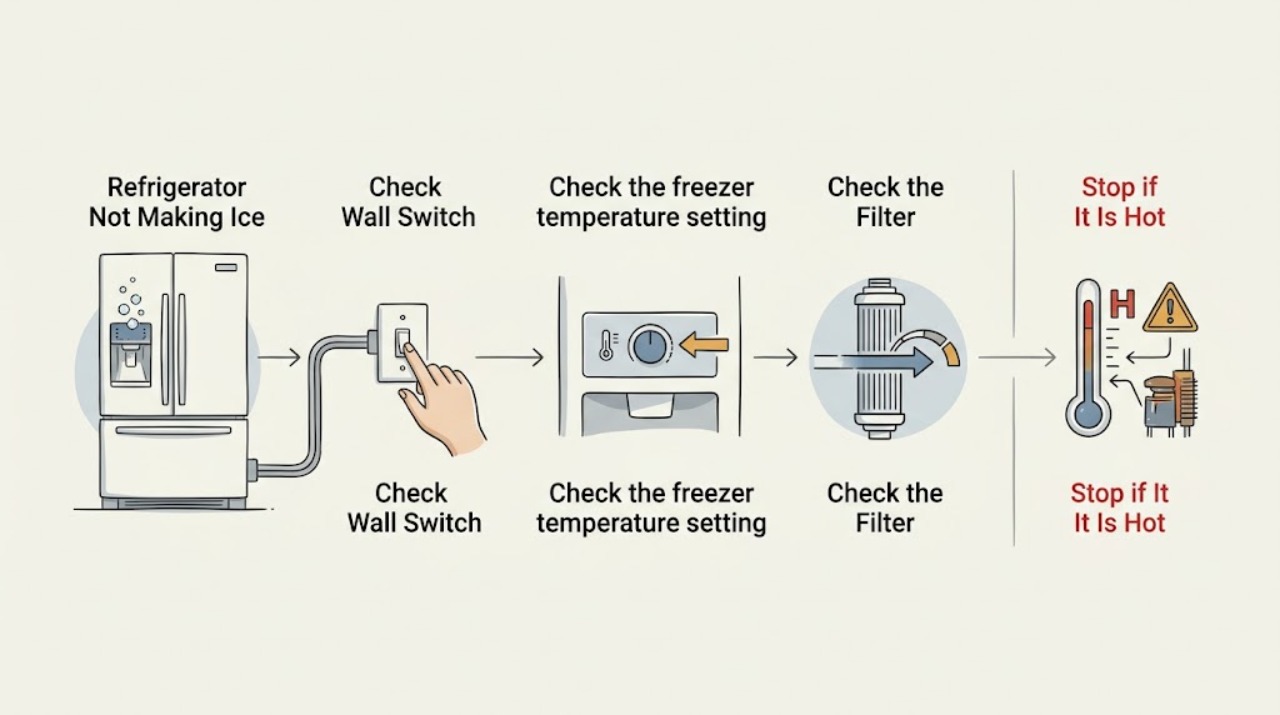
Work through in order
Diagnostic checks
Use only checks that match the exact appliance or system and its official guide.
-
Check 1
Check that the ice maker is switched on and that its feeler arm or paddle is not blocked or held in the full position, using only the model instructions.
Expected result: The ice maker was off or obstructed, or it is enabled and clear.
Next step: Enable it or clear only a visible obstruction, then continue if ice production does not begin.
Why this matters
Why: An off control or blocked level sensor can stop a normal ice cycle; a clear, enabled unit needs water and temperature checks.
-
Check 2
Check the freezer temperature setting and whether the refrigerator has had time to stabilize after installation or a prolonged power interruption.
Expected result: The freezer is warmer than the manual's setting or the appliance is newly installed, or temperature is stable.
Next step: Use model-specific controls and allow stabilization; do not guess at a service temperature or dismantle the unit.
Why this matters
Why: An incorrect temperature or recent installation can delay ice production; a stable temperature shifts attention to water flow or the ice-maker mechanism.
-
Check 3
Check that the water supply is on, the line is not visibly kinked, and the filter is seated and within its service interval; do not disconnect a pressurized line.
Expected result: Water supply or filter flow is restricted, or supply and filter appear normal.
Next step: Restore only an accessible supply condition or fit a model-approved filter, then monitor one cycle.
Why this matters
Why: No water means the ice maker cannot fill; a clear supply makes a mold-release or ice-maker control problem more likely.
-
Check 4
Look at the ice mold and bucket for a visible jam or frozen clump, without prying the mold, twisting the mechanism, or pouring hot water into controls.
Expected result: A removable clump blocks the bucket, the mold remains full but does not release, or no ice forms.
Next step: Remove only loose, accessible ice as the manual permits; arrange service for a stuck mold or repeated failure.
Why this matters
Why: A bucket jam can stop dispensing while the ice maker works; a full mold that does not release suggests a mechanism fault; no ice formation returns attention to temperature or water.
Use your observations
Decision map
Find the observation that best matches what you see, then follow the next safe action.
-
PATH 01Next step
What you see
The ice maker was off, its sensor was blocked, or the unit had just been installed and begins cycling after correction.
Do this next
Keep the sensor clear and allow the model's normal fill time.
Why this path and its safety boundary
Why it matters: The lack of ice was an operating-state or stabilization issue.
-
PATH 02Next step
What you see
The freezer is cold enough and the ice maker is enabled, but the mold is dry and water flow is absent.
Do this next
Check only the external supply and model-approved filter path; arrange service if water does not return.
Why this path and its safety boundary
Why it matters: A supply, filter, inlet, or frozen water-path issue is more likely than a release problem.
-
PATH 03Next step
What you see
The mold contains ice but does not release, or a jam returns after accessible clearing.
Do this next
Do not force the mold; arrange appliance service.
Why this path and its safety boundary
Why it matters: The ice-maker mechanism or control may be failing.
Helpful context
Understand the symptom
Separate no-water from no-release
A dry mold, a full mold that does not eject, and a bucket that stays empty after installation point to different checks. Observe the ice-maker area without inserting tools into the mechanism.
Only after diagnosis
Potential parts
- refrigerator water filter
Only relevant when restricted flow and the model's filter system support a filter diagnosis.
Confirm the exact refrigerator model and approved filter before ordering.
When checks do not resolve it
Need a professional?
Arrange service for a stuck mold, repeated jams, no water after supply and filter checks, or an ice maker that remains enabled and inactive.
Safety scope: Do not pry the mold, access live controls, use sharp tools or concentrated heat, or disconnect pressurized tubing.
Have this ready
- Provide the model, freezer temperature setting, ice-maker state, mold/bucket observation, water/filter status, and installation or power-interruption timing.
Common questions
FAQ
Why is a new Profile refrigerator not making ice yet?
GE Appliances lists a newly installed refrigerator needing time to fill the ice bucket as a normal possibility; check temperature, water, and the ice-maker state while it stabilizes.
What should I check when the ice maker has no water?
Check that the supply is on and not kinked, the filter is not clogged, and the ice-maker sensor is clear; arrange service if flow remains absent.
Read the exact guide
Official sources
- Refrigerator and Freezer Troubleshooting and SupportGE Appliances (GE Profile) · GE Profile refrigerator ice-maker temperature, filter, water-supply, sensor, and installation guidance
Community feedback
Share a repair observation
Share a plain-text repair observation. Accepted observations are published automatically; this page may take a moment to update.