
On this page
Start here
Quick answer
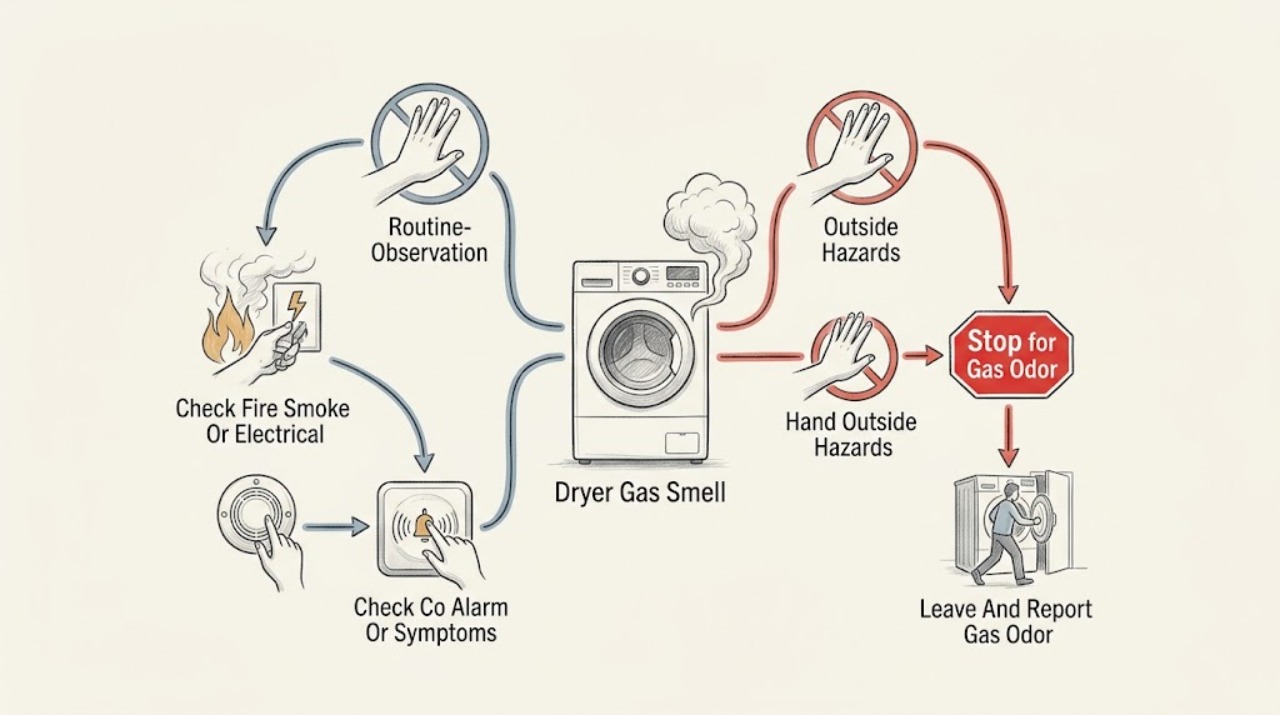
If you smell gas near a Samsung gas dryer, do not press buttons, operate electrical switches, use a phone inside, light a flame, or restart the dryer. Leave the building and contact emergency or gas-leak help from a safe location. Do not re-enter until the responsible professionals say it is safe. After the area and appliance have been professionally cleared, confirm the exact model and fuel type and limit troubleshooting to visible, external observations such as the lint screen, exhaust termination, and room ventilation. A smell that returns during heating, delayed ignition, smoke, a burning or electrical odor, a carbon-monoxide alarm, or symptoms such as headache, dizziness, nausea, or shortness of breath is a stop-and-service condition, not a reason to run another test cycle.
Before you begin
Safety first
- This article supports evacuation, safe reporting, model and symptom documentation after clearance, and limited external observation only. Do not operate a hazardous dryer, work on gas or live electrical parts, move the appliance, open its cabinet, or bypass any safety device.
Work through in order
Diagnostic checks
Use only checks that match the exact appliance or system and its official guide.
-
Check 1
If gas odor is present or its source is uncertain, stop where you are, avoid the dryer and all switches or flames, leave the building, and contact emergency or gas-leak help from a safe location.
Expected result: From outside, record only whether the odor was noticed near the dryer, elsewhere in the building, or outdoors, without re-entering to locate it or test the appliance.
Next step: Keep everyone out and do not return, operate the dryer, or reset power until qualified responders declare the area safe.
Stop if: Do not use a phone inside, operate a light or appliance switch, start a vehicle near the suspected leak, light a match, or restart the dryer.
Why this matters
Why: A current or unexplained gas odor is a potential leak or unsafe combustion event, not a routine dryer symptom.
-
Check 2
After leaving, tell responders whether there was smoke, flame, a bang, soot, a burning or electrical odor, a hot plug or outlet, or visible damage; do not approach the dryer to inspect these signs.
Expected result: Classify the event from what was safely seen or smelled before evacuation: gas odor only, gas odor with delayed ignition or bang, smoke or flame, or burning/electrical evidence.
Next step: Follow emergency instructions for active smoke or fire; otherwise keep the appliance isolated and arrange qualified gas-appliance and electrical service as indicated.
Stop if: Do not open panels, touch a hot connection, repeatedly reset a breaker, relight a burner, or attempt to reproduce a delayed ignition.
Why this matters
Why: Smoke, flame, a bang, soot, or an electrical/burning smell raises fire and combustion risk and rules out a homeowner test cycle even if the gas odor is gone.
-
Check 3
If a carbon-monoxide alarm sounds or anyone develops headache, fatigue, nausea, dizziness, shortness of breath, confusion, or weakness, move everyone to fresh air immediately and seek emergency help from outside.
Expected result: Record whether an alarm sounded, which people had symptoms, and when the symptoms began, without trying to find the source indoors.
Next step: Do not re-enter until emergency responders permit it, and do not operate the dryer or any suspected fuel-burning appliance until trained personnel inspect it.
Stop if: Never silence an alarm by removing its batteries, ventilate by re-entering, or run the dryer to see whether the alarm repeats.
Why this matters
Why: Carbon monoxide is odorless and cannot be cleared by deciding that the gas smell has stopped; an alarm or compatible symptoms require an emergency response.
-
Check 4
Only after qualified responders clear the area, photograph or write down the Samsung model and fuel type and document when the smell occurred, what cycle was selected, and whether the dryer displayed a code.
Expected result: Record an exact model and exact display text or code, plus whether the odor appeared before starting, during an ignition attempt, during a heat cycle, after stopping, or near the exhaust.
Next step: Give these details to a qualified appliance technician; do not start the dryer to fill in a missing part of the history.
Stop if: Do not treat a code from a different Samsung model as applicable, bypass an error, or remove panels to read a hidden label or component.
Why this matters
Why: Timing separates a possible supply or connection concern from a dryer ignition, combustion, or exhaust concern, while the exact model prevents applying the wrong error-code instructions.
-
Check 5
After the space and appliance are professionally cleared and the dryer remains off, inspect only the lint screen and the visible outside vent termination; look from a safe position for lint, a closed flap, a crushed or separated visible duct, or an obstruction.
Expected result: Classify the accessible path as clear and intact, visibly blocked or crushed, disconnected, or unsafe/inaccessible to reach without moving the dryer.
Next step: Keep the dryer off and arrange qualified vent or appliance service for any restriction, damage, inaccessible connection, or recurrence of odor.
Stop if: Do not move a gas dryer, disconnect its gas line, reach into the cabinet, remove panels, or run it to test the vent flap.
Why this matters
Why: A restricted exhaust can contribute to heat and combustion problems, but a clear screen or vent does not prove that the gas train, burner, ignition, or internal vent is safe.
-
Check 6
If the smell was noticed at a start command, after a pause before flame, or with a pop, bang, or repeated ignition attempt, leave the dryer off and provide that sequence and any exact error code to a qualified gas-appliance technician.
Expected result: Record whether the odor preceded ignition, returned on each heat attempt, was accompanied by a bang or soot, or was associated with a model-specific gas ignition error.
Next step: Arrange model-specific professional diagnosis and do not attempt to adjust gas pressure, clean an igniter in place, relight anything, or substitute a part from another model.
Stop if: Any renewed gas smell, delayed ignition, bang, yellow or unstable flame observed by a professional, smoke, soot, or carbon-monoxide concern keeps the dryer out of service.
Why this matters
Why: Fuel accumulating before ignition or recurring odor during burner operation may indicate an ignition, burner, valve, venting, or combustion fault that cannot be safely diagnosed by repeated cycling.
-
Check 7
After a qualified technician completes the repair and explicitly clears the appliance, follow the exact Samsung manual and observe only the first approved cycle from a safe position; do not leave it unattended.
Expected result: Stop and note any returning gas, burning, electrical, or exhaust odor, unusual noise or ignition delay, smoke, error display, alarm, or abnormal heat without approaching the appliance.
Next step: Stop using the dryer and call the servicing professional back if any warning returns; preserve the exact time, cycle, and display information.
Stop if: Do not continue cycles, reset an alarm, bypass a safety control, or accept a temporary disappearance of odor as a repair confirmation.
Why this matters
Why: A recurrence means the original hazard remains unresolved or another fuel-burning or venting issue is present; a single quiet cycle is not permission to bypass future warnings.
Use your observations
Decision map
Find the observation that best matches what you see, then follow the next safe action.
-
PATH 01Safety boundary
What you see
Gas odor is present now or its source cannot be identified safely.
Do this next
Leave immediately, avoid switches, flames, appliances, and phones inside, and contact emergency or gas-leak help from a safe location.
Why this path and its safety boundary
Why it matters: Treat it as a possible gas leak or unsafe combustion event.
Safety stop: Do not re-enter, restart the dryer, or return to inspect the connection until qualified responders clear the area.
-
PATH 02Safety boundary
What you see
There is smoke, flame, soot, a bang, visible heat damage, or a burning or electrical odor.
Do this next
Stay out of danger, follow emergency instructions for fire or smoke, and leave the dryer isolated for qualified service.
Why this path and its safety boundary
Why it matters: The event may involve fire, delayed ignition, combustion, or electrical failure.
Safety stop: Do not operate controls, reset power repeatedly, relight anything, or open the cabinet.
-
PATH 03Safety boundary
What you see
A carbon-monoxide alarm sounds or someone has compatible symptoms such as headache, dizziness, nausea, shortness of breath, confusion, or weakness.
Do this next
Move outside, seek emergency help, and do not re-enter or operate any suspected fuel-burning appliance until responders and trained personnel approve it.
Why this path and its safety boundary
Why it matters: Carbon monoxide is odorless and potentially fatal; the dryer smell is not a reliable safety test.
Safety stop: Do not silence the alarm, search indoors for the source, or run the dryer to investigate.
-
PATH 04Safety boundary
What you see
Professionals have cleared the area and the dryer is cool and off; the accessible lint screen or outside vent can be viewed without moving the gas appliance.
Do this next
Document the observation and arrange qualified vent or appliance service; follow Samsung's exact model instructions for any permitted cleaning.
Why this path and its safety boundary
Why it matters: A visible airflow restriction may be a maintenance or installation issue, but it does not rule out an internal gas or combustion fault.
Safety stop: Stop if access requires moving the dryer, touching a gas connection, opening panels, or operating the appliance.
-
PATH 05Safety boundary
What you see
The smell occurred during an ignition attempt, after a pause before flame, with a pop or bang, or returns whenever the dryer heats.
Do this next
Keep the dryer off and give the technician the exact model, timing, and display code; request model-specific gas-appliance diagnosis.
Why this path and its safety boundary
Why it matters: A gas ignition, burner, valve, combustion-air, or exhaust problem remains possible.
Safety stop: Do not make another test cycle, adjust gas controls, relight a burner, or replace an ignition or valve part without professional diagnosis.
-
PATH 06Safety boundary
What you see
After professional clearance, the reported smell is determined not to be gas and is instead a laundry, mildew, or non-combustion odor.
Do this next
Follow the relevant appliance's model instructions for cleaning and arrange service if the odor returns, changes to burning or gas, or cannot be confidently identified.
Why this path and its safety boundary
Why it matters: Samsung notes that some sour or mildew smells can originate in laundry, the washer, or retained water, but that conclusion must not be used to dismiss an uncertain gas odor.
Safety stop: If gas odor, smoke, burning smell, an alarm, or symptoms return, stop and use the emergency branch immediately.
Helpful context
Understand the symptom
Treat a gas smell as an emergency first
A gas smell around a gas dryer can come from the appliance, its connection, another fuel-burning appliance, or the building supply. The first decision is not which dryer part to replace. Do not touch the dryer controls, lights, plugs, breakers, or other electrical switches inside the building, and do not use a flame to locate the leak. Leave immediately and contact emergency or gas-leak help from outside or another safe location. Keep everyone away and wait for qualified responders to declare the area safe.
A cleared appliance still needs a model-specific diagnosis
Once professionals have cleared the area, do not assume the dryer is safe merely because the smell has faded. Record the exact model, whether it is a gas model, when the odor occurred, and whether it coincided with a start command, burner heat, an ignition attempt, an error display, or the exhaust. A repeated odor, delayed ignition, smoke, soot, or a burning or electrical smell requires the dryer to remain off while a qualified gas-appliance technician investigates. Samsung's error guide is model-dependent, so preserve the exact code instead of applying a code from another dryer.
Only inspect accessible venting after the safety clearance
After a qualified person confirms that the space and appliance may be approached, ordinary troubleshooting can be limited to the lint screen, the visible outside vent termination, and an externally visible crushed or separated duct. Do not move a gas dryer, disconnect a gas connection, open the cabinet, or operate it just to see whether the vent flap opens. Vent or combustion work that requires disassembly belongs to qualified service. Carbon monoxide cannot be detected by smell, so a gas odor that disappears is not proof that combustion or venting is safe.
Safety boundary
Stop conditions
- For any current or uncertain gas smell, leave the building and contact emergency or gas-leak help from a safe location; do not operate switches, appliances, phones, or flames inside.
- Do not restart the Samsung dryer for smoke, flame, a bang, delayed ignition, soot, a returning gas odor, burning or electrical smell, visible damage, or a hot plug or outlet.
- If a carbon-monoxide alarm sounds or anyone has compatible symptoms, move outside and do not re-enter or operate fuel-burning appliances until emergency responders permit it and trained personnel inspect them.
- Do not move the gas dryer, disconnect or adjust its gas line, open the cabinet, remove panels, probe live electrical parts, bypass safety controls, or relight anything.
- Do not treat a clear lint screen, a faded odor, or a code from another Samsung model as proof that the dryer is safe; use qualified model-specific service for persistent or recurring symptoms.
Only after diagnosis
Potential parts
- dryer ignition or burner assembly
Consider this category only if a qualified diagnosis finds delayed ignition, repeated ignition failure, or a burner-related fault after gas supply and venting are assessed.
Confirm the exact Samsung model and professional diagnosis; do not relight, adjust, or replace gas or ignition components as a homeowner test. - dryer gas valve or valve coil assembly
Consider this category only when a qualified technician identifies a gas-control or valve fault consistent with the observed odor or ignition sequence.
Gas components require exact model fitment and qualified installation; never substitute a valve or adjust gas pressure by symptom alone. - dryer exhaust duct or vent component
Consider this category only when a safe external or professional vent assessment confirms a crushed, disconnected, blocked, or otherwise unsuitable exhaust path.
Confirm the exact dryer model, fuel type, route, material, and local installation requirements; gas-appliance and inaccessible vent work require qualified service.
When checks do not resolve it
Need a professional?
Use emergency or gas-leak help immediately for a current or uncertain gas odor, smoke, fire, a bang, or a carbon-monoxide alarm or symptoms. After the area is safe, arrange qualified gas-appliance service for any odor linked to ignition or heating, delayed ignition, a model-specific gas error, soot, recurrence, or any need to inspect the burner, gas valve, combustion air, internal vent, or control. Use qualified electrical service for a hot or damaged cord, plug, outlet, breaker, arcing, or electrical smell.
Safety scope: This article supports evacuation, safe reporting, model and symptom documentation after clearance, and limited external observation only. Do not operate a hazardous dryer, work on gas or live electrical parts, move the appliance, open its cabinet, or bypass any safety device.
Common questions
FAQ
Can I run the Samsung dryer once the gas smell disappears?
No. A faded odor is not proof that a leak or combustion fault is resolved. Keep the dryer off until qualified responders clear the area and a qualified technician confirms the appliance is safe.
What if the dryer displayed a gas ignition error?
Record the exact code and model, but do not assume the same code applies to another Samsung dryer. Keep the dryer off and have a qualified gas-appliance technician diagnose the ignition and combustion system.
Can a Samsung gas dryer smell cause carbon-monoxide exposure?
A gas smell and carbon monoxide are different warning signs, and carbon monoxide has no smell. If an alarm sounds or anyone has compatible symptoms, move outside and do not re-enter or operate fuel-burning appliances until emergency responders permit it and trained personnel inspect them.
Read the exact guide
Official sources
- Recognizing and Responding to Pipeline EmergenciesU.S. Department of Transportation, Pipeline and Hazardous Materials Safety Administration · U.S. government emergency guidance for suspected natural-gas or pipeline leaks; local emergency instructions also apply.
- Samsung dryer smells or smokesSamsung Electronics · Official Samsung US troubleshooting guidance for dryer smells and smoke; exact model instructions still control.
- Carbon Monoxide Fact SheetU.S. Consumer Product Safety Commission · U.S. government consumer-safety guidance for carbon monoxide from fuel-burning products, including clothes dryers.
- Samsung dryer displays an error codeSamsung Electronics · Official Samsung US error-code guide; displayed codes and corrective steps vary by dryer model.
Community feedback
Share a repair observation
Share a plain-text repair observation. Accepted observations are published automatically; this page may take a moment to update.