
On this page
Start here
Quick answer
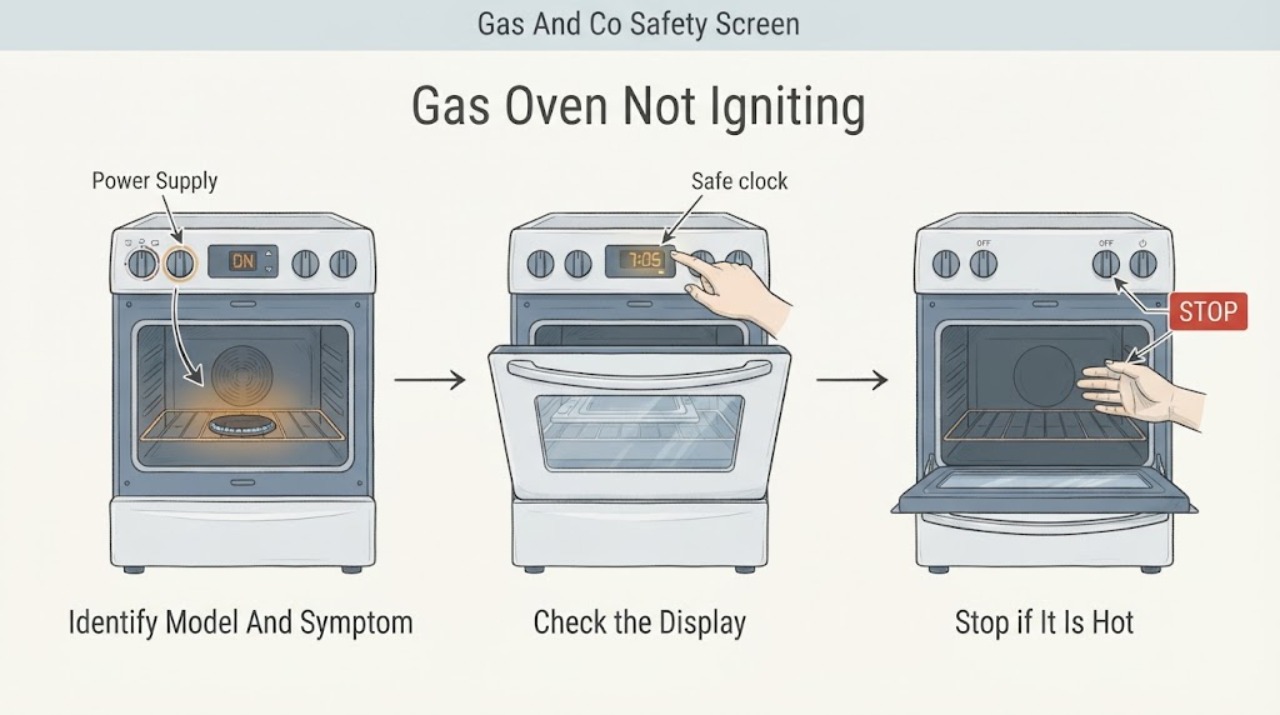
First confirm that this is a Samsung gas oven and distinguish a normal ignition sequence from a failed one. With the room free of a gas smell, smoke, or unusual heat, record whether the display works, whether Bake or Broil is accepted, and whether the surface burners ignite. Do not keep trying to light the oven if you smell gas, hear uncontrolled gas flow, see delayed ignition or a burst of flame, find smoke or soot, hear popping, see an arc, or the circuit trips. Samsung's oven guidance says a gas range may ignite and cycle during normal cooking; if the oven does not ignite at all, the cooktop burner and gas-supply behavior can help separate a supply-pressure problem from an oven-side fault. Check the model manual for the exact mode, lock, error, and reset procedure. After safe external checks and one model-authorized power cycle, a Samsung oven that still will not ignite needs qualified appliance service rather than a guessed igniter, valve, or control replacement.
Work through in order
Diagnostic checks
Use only checks that match the exact appliance or system and its official guide.
-
Check 1
Before touching a control, stand in a safe, ventilated position and note the room and range condition; do not operate a switch, flame, or oven control if gas is suspected.
Expected result: Record whether there is a gas smell, hissing, smoke, soot, a CO alarm, headache or other possible exposure symptom, a burst or delayed flame, loud popping, visible arc, melted wiring, abnormal heat, or a breaker trip.
Next step: If any hazard is present, leave the area or home as appropriate, avoid ignition sources and electrical switching, and contact emergency or gas-safety help from a safe location. Do not return to test the oven until cleared and serviced.
Stop if: Stop immediately for gas odor, hissing, smoke, soot, delayed ignition, a flash or burst, CO alarm or symptoms, arc, hot connection, or repeated electrical trip.
Why this matters
Why: These are safety events, not evidence for an ordinary igniter adjustment. A CO alarm or suspected gas release requires an emergency response and the appliance must remain off. A clean, cool, odor-free exterior allows only the low-risk external checks below.
-
Check 2
Read the complete Samsung model number from the appliance label or existing manual and write down whether the unit is a gas range, a gas wall oven, or a dual-fuel configuration; do not remove panels to find it.
Expected result: Record natural-gas or propane identity if stated, whether the control panel is blank or lit, the selected Bake or Broil mode, the set temperature, the time since Start, and whether the cooktop burners ignite normally.
Next step: Use the matching Samsung manual and support page for the exact model and preserve this baseline for service; do not apply an error code or ignition sequence from another model.
Stop if: Do not open the control area, remove the oven floor, or infer an igniter or gas-valve failure from the absence of a sound alone.
Why this matters
Why: A blank panel points first toward power or controls. A lit panel with a rejected mode points toward settings, lock, door, or control logic. A working cooktop with a non-igniting oven narrows the question to the oven ignition, gas-pressure, burner, valve, or sensor path but does not identify a component.
-
Check 3
From a dry, safe position, verify that the range or oven is connected to its intended power supply and that the display responds; check the household breaker once without opening the electrical panel or touching wiring.
Expected result: Record whether the display is normal, the panel is blank or incomplete, a breaker appears open, the breaker trips again, or the panel returns but Bake or Broil still will not start.
Next step: If the breaker or supply is abnormal, stop and arrange qualified electrical service. If the display remains faulty with a safe supply, leave the range off and arrange Samsung or qualified appliance service.
Stop if: Do not repeatedly reset a breaker, use an extension cord, remove an electrical cover, test live voltage, or continue if there is a hot plug, smell, smoke, or arc.
Why this matters
Why: The ignition system needs the appliance's control and electrical path. A blank or repeatedly tripping supply needs electrical or appliance service before a gas diagnosis. A normal display shifts the check toward mode, door, gas, and ignition behavior.
-
Check 4
With no gas or electrical hazard and the display responsive, cancel an unintended timer or lock, select Bake or Broil exactly as the model manual shows, set a normal target, and press Start once; do not repeatedly reissue the command.
Expected result: Record whether the mode and temperature remain displayed, a lock or demo indicator appears, the oven begins its normal preheat sequence, the display returns to idle, or an exact code appears.
Next step: Use only the exact model manual to clear a lock or Demo mode. If Start is accepted but the oven never ignites, continue to the external gas and burner observation without opening the oven.
Stop if: Do not enter an unverified service mode, defeat a door or control lock, repeatedly start Bake, or test ignition with a lighter or match.
Why this matters
Why: Samsung says Demo mode can leave the oven and cooktop unable to heat while a gas cooktop can still ignite. A lock, invalid mode, or demo indication is a control-state issue; a valid accepted mode with no ignition points toward the gas or oven ignition branch.
-
Check 5
Only when there is no gas odor, smoke, abnormal flame, or other hazard, observe whether an existing Samsung gas cooktop burner can be lit using its normal control; do not use the burner as a repeated oven test or adjust a regulator.
Expected result: Record whether no cooktop burner ignites, burners ignite normally while the oven does not, the oven ignites only while a cooktop burner is lit, or the burner flame is weak, unstable, yellow, or unusually noisy.
Next step: If all burners fail, stop using the gas appliance and have the gas supply and electrical path assessed. If the oven depends on a lit burner or flames are abnormal, stop and contact the gas provider or qualified installer from a safe condition; otherwise arrange appliance service for an oven-only failure.
Stop if: Do not ignite a burner if gas is suspected, use a flame to inspect for leaks, adjust a regulator, remove burner parts while connected, or continue with a yellow/unstable flame, pop, or odor.
Why this matters
Why: Samsung's guidance uses this distinction for gas-pressure and supply diagnosis: burners that will not light can indicate gas supply or power issues, while an oven that works only with a cooktop burner can indicate excessive gas pressure. A normal cooktop with a failed oven does not prove the oven igniter is bad.
-
Check 6
From outside the appliance, inspect only the accessible shutoff position, visible gas connection, and range clearance for an obvious closed valve, displaced connector, kink, or installation disturbance; do not loosen or test a gas fitting.
Expected result: Record whether the shutoff appears in its normal documented position, a connector or line is visibly damaged or displaced, the appliance was recently installed or converted, or no external issue is visible.
Next step: If an external connection is damaged, displaced, or uncertain, stop and have a qualified gas professional inspect it. Do not reposition a fitting or resume ignition tests. If it is intact, continue only with display and error documentation.
Stop if: Do not tighten, loosen, disconnect, soap-test, relight, convert, or modify a gas connection, and stop for any odor, hiss, soot, or damaged line.
Why this matters
Why: A recently installed or converted range can have model, fuel, pressure, or connection issues that require a licensed installer or gas professional. A normal-looking valve and connection do not rule out an internal valve, igniter, burner, or sensor fault.
-
Check 7
With the oven door closed or in the normal safe viewing position for the model, make one ordinary Bake or Broil start only if the previous checks were clean; observe from outside and do not remove the oven floor, burner cover, racks, or panels.
Expected result: Record whether the oven preheats, a normal ignition sound occurs and heat begins, there is no sound or heat, there is repeated clicking, gas odor without flame, delayed ignition, a loud pop, smoke, soot, or abnormal flame.
Next step: If it does not establish normal heat after this single safe observation, stop and arrange qualified appliance service with the exact sequence. If a hazard occurs, leave the appliance off and follow the safety branch immediately.
Stop if: Do not repeat the ignition attempt after gas odor, delayed ignition, a burst, pop, smoke, soot, abnormal flame, arc, or a hot electrical connection.
Why this matters
Why: No response with a valid mode points toward controls or power. A normal command with no heat can involve the oven ignition chain. Gas odor without flame, delayed ignition, popping, soot, or abnormal flame is unsafe and does not support another test.
-
Check 8
If the display shows letters, numbers, an icon, a door warning, or a Demo indication, photograph or transcribe it exactly along with the door state, selected mode, and whether the cooktop is on; do not clear it repeatedly.
Expected result: Record whether the code is a door or partition condition, Demo indication, power-line message, communication code, temperature-related code, or an unknown model-specific message, and whether it returns after one documented correction.
Next step: Apply only an exact manual instruction that is safe and external, then stop if the message returns or the model meaning is uncertain. Include the photo and sequence in the service handoff.
Stop if: Do not guess a code, access service mode, bypass a door switch, remove a partition while hot, or continue cooking with a persistent fault or abnormal heat.
Why this matters
Why: Samsung's error guide gives different paths for door, Demo, power connection, and other codes. A recurring or unknown code needs model-specific service; it is not a universal label for an igniter, valve, or control board.
-
Check 9
Only when there is no gas odor, smoke, heat, wet connection, or other hazard, perform one power reset using the model's safe method; Samsung's general guidance describes switching the range or oven off at the circuit breaker for about 30–60 seconds, while the exact manual controls the procedure.
Expected result: Record whether the display returns normally, the code clears, Bake is accepted, the oven ignites normally, or the same no-ignition symptom or code returns.
Next step: If the oven returns to normal with no hazard, use it only under ordinary observation. If ignition remains absent or the fault returns, leave it off and arrange qualified appliance service.
Stop if: Do not reset after a gas event, CO alarm, smoke, arc, overheating, or repeated breaker trip, and do not keep cycling power to suppress a code.
Why this matters
Why: A reset can clear a temporary control state but cannot establish that a gas valve, igniter, flame sensor, wiring, or pressure problem is repaired. A returning fault is evidence for service.
-
Check 10
After the safe external checks, classify the fault as power/control, gas supply or pressure, oven ignition, or an immediate safety event and prepare the appropriate professional handoff.
Expected result: Choose the strongest observed branch: blank or tripping power; valid controls but no oven heat; no cooktop gas; oven works only with a cooktop burner; repeated code; delayed ignition or abnormal flame; or a clean single attempt with no ignition.
Next step: Give the provider the model, fuel, display, mode, cooktop result, external connection observation, exact code, ignition sound/odor/flame result, and any outage, installation, pop, smoke, soot, or CO event. Keep the appliance off when any hazard occurred.
Stop if: Do not remove panels, probe the igniter or valve, test gas pressure, jumper a safety switch, or continue operating a range with unsafe combustion signs.
Why this matters
Why: The classification tells the provider whether to begin with the household circuit, gas supply/installation, or model-specific oven diagnosis. It does not justify opening the gas train or replacing a part at home.
Use your observations
Decision map
Find the observation that best matches what you see, then follow the next safe action.
-
PATH 01Safety boundary
What you see
Gas is smelled or heard, a CO alarm sounds, someone has possible exposure symptoms, or there is smoke, soot, delayed ignition, a burst of flame, loud popping, or an abnormal flame.
Do this next
Do not operate controls or create an ignition source; leave for fresh air and contact emergency or gas-safety help from outside or another safe location. Do not re-enter or operate the appliance until cleared and serviced by trained personnel.
Why this path and its safety boundary
Why it matters: This is a gas or combustion safety event, not a normal ignition diagnosis.
Safety stop: Do not test another burner, relight the oven, reset power, ventilate by switching electrical equipment, or inspect the burner while gas may be present.
-
PATH 02Safety boundary
What you see
The panel is blank or faulty, the breaker or supply is abnormal, or Bake/Broil is not accepted even though the gas appliance is otherwise safe.
Do this next
Stop resetting and arrange qualified electrical or appliance service based on whether the household supply or the range itself fails; preserve any panel code.
Why this path and its safety boundary
Why it matters: The control or electrical path must be established before diagnosing gas ignition.
Safety stop: Do not open the electrical panel, test live voltage, remove the console, or operate with a hot or damaged cord.
-
PATH 03Safety boundary
What you see
The display shows Demo/tESt, a control or child lock, a door/partition warning, or a mode-selection condition that prevents heating.
Do this next
Follow only the matching Samsung manual's safe external procedure once, then retry a normal mode only if no hazard exists. Arrange service if the state returns.
Why this path and its safety boundary
Why it matters: A control state or model-specific mechanical condition may prevent a normal ignition request; this does not identify a gas component.
Safety stop: Do not bypass a door or partition switch, use an unverified key sequence, or continue when the oven is hot or the door is damaged.
-
PATH 04Safety boundary
What you see
No Samsung gas cooktop burner ignites during an otherwise safe, ordinary observation.
Do this next
Stop using the gas appliance and arrange gas-supply/installation and electrical assessment as appropriate; do not keep trying burners or the oven.
Why this path and its safety boundary
Why it matters: The common gas supply, pressure, or appliance power path needs attention before an oven-only diagnosis.
Safety stop: Do not adjust a regulator, open a fitting, use a match, or continue if there is gas odor, hissing, abnormal flame, or smoke.
-
PATH 05Safety boundary
What you see
The display and cooktop burners are normal, but a valid oven mode is accepted and the oven does not establish heat on one safe observation.
Do this next
Leave the oven off and arrange model-specific qualified appliance service with the exact sound, display, and timing observations.
Why this path and its safety boundary
Why it matters: An oven-side ignition, burner, valve, sensor, wiring, or control fault is plausible, but the visible symptom cannot identify the failed part.
Safety stop: Do not remove the bottom panel, watch the igniter, measure a valve, or substitute a part without qualified diagnosis.
-
PATH 06Safety boundary
What you see
The oven ignites only while a cooktop burner is lit, the range was recently installed or converted, or burners are weak, unstable, or otherwise abnormal.
Do this next
Stop using the range and have a qualified gas provider, installer, or appliance professional assess the supply, pressure, fuel configuration, and installation.
Why this path and its safety boundary
Why it matters: Samsung identifies a gas-pressure or supply/installation distinction in this symptom pattern; repeated ignition is unsafe.
Safety stop: Do not compensate by leaving a burner lit, adjust the regulator, alter orifices, or repeat oven starts.
-
PATH 07Safety boundary
What you see
An exact error, door warning, power-line message, or communication message returns after the model-authorized external correction or one safe reset.
Do this next
Leave the evidence intact and provide the model, code, mode, fuel, door state, and reset result to Samsung or qualified appliance service.
Why this path and its safety boundary
Why it matters: The appliance needs model-specific diagnosis; the code is not a universal part number.
Safety stop: Do not repeatedly clear the message, enter service mode, or continue cooking with a persistent fault.
-
PATH 08Safety boundary
What you see
The appliance is dry and hazard-free, the mode is accepted, and one model-authorized power reset does not restore normal ignition.
Do this next
Keep the gas oven off and arrange qualified appliance service with the complete observation record.
Why this path and its safety boundary
Why it matters: A temporary control glitch is less likely; continued testing will not identify or repair a gas ignition component safely.
Safety stop: Do not repeat power cycles or perform internal gas or electrical tests.
Helpful context
Understand the symptom
Normal cycling is not the same as failure to ignite
A Samsung gas oven can ignite, shut off, and reignite while maintaining the selected temperature. A short pause before a visible flame is therefore not enough to diagnose a failed part. The useful distinction is whether the oven ever establishes normal heat, whether the display accepts the mode and temperature, and whether the cooktop burners behave normally. If there is a gas smell, delayed ignition, a loud pop, a burst of flame, smoke, soot, or an abnormal flame, stop rather than extending the observation.
Use Samsung's exact model and fuel configuration
Samsung ranges differ in controls, error displays, dual-oven or partition features, ignition design, and installation. Record the complete model number and whether the unit is natural gas or propane as identified by its documentation. A gas cooktop burner check can show whether the appliance has power and whether gas is available, but it does not authorize opening a gas line or diagnosing an oven valve. Keep any error text exactly as shown and use the matching manual before interpreting it.
Do not turn an ignition problem into a gas or carbon-monoxide exposure
Never use a lighter or match to test an oven burner, repeatedly start Bake to clear accumulated gas, or remove the oven bottom to watch an igniter. If a carbon-monoxide alarm sounds, leave immediately for fresh air and do not re-enter until emergency responders allow it; a malfunctioning fuel-burning appliance must remain off until trained personnel inspect it. A person cannot reliably detect carbon monoxide by smell, so a quiet appliance is not proof that combustion is safe.
The service handoff should describe the ignition sequence
Give the technician the model number, fuel type, whether the display is lit, the selected mode, whether the cooktop burners ignite, what happens after Start, any exact code, the presence or absence of clicking or gas odor, and whether the oven has ever heated normally. Also report a recent installation, conversion, outage, breaker trip, cleaning event, spill, unusual pop, soot, or CO alarm. These observations separate supply, control, igniter, burner, valve, and safety-sensor paths without requiring a homeowner to access them.
Safety boundary
Stop conditions
- Stop immediately for gas odor or hissing, a CO alarm or possible exposure symptoms, smoke, soot, delayed ignition, a burst of flame, loud popping, or an abnormal yellow or unstable flame.
- Stop for a visible electrical arc, burning or melting odor, hot or damaged cord or receptacle, wet electrical connection, or a breaker that trips again.
- Do not use a match or lighter to test ignition, repeatedly start the oven to clear gas, or leave a cooktop burner lit to make the oven work.
- Do not remove the oven floor, burner cover, racks, control panel, wiring, igniter, valve, or safety sensor; do not test live gas pressure or bypass a door or safety interlock.
- Do not continue cooking after an abnormal ignition event, recurring error, uncontrolled heat, or a CO alarm; leave the appliance off until qualified personnel assess it.
Only after diagnosis
Potential parts
- oven igniter or ignition electrode
Consider only after qualified model-specific diagnosis shows the oven ignition component is not producing the required ignition behavior; no-click or no-heat symptoms alone are insufficient.
Confirm the complete Samsung model and exact fuel configuration before selecting any part; do not expose or test the igniter as a homeowner procedure. - oven gas valve
Consider only when model-specific professional testing identifies the valve or pressure-control path after supply and ignition conditions are established.
Gas-valve fit and fuel configuration are model-specific; installation and testing require qualified gas-appliance service. - oven temperature or flame sensor
Consider only if qualified diagnosis links the recurring no-ignite, shutoff, or error symptom to the applicable sensor on the exact model.
Verify the model manual and professional diagnosis; do not assume a sensor part from another Samsung range fits. - range control or relay assembly
Consider only when the panel, mode request, or both oven functions indicate a diagnosed control or relay fault rather than a gas-supply or ignition fault.
Confirm exact model, revision, and diagnosis before ordering; a control board should not be substituted based on a no-ignition symptom alone.
When checks do not resolve it
Need a professional?
Arrange qualified appliance service when a Samsung gas oven accepts Bake or Broil but does not establish heat, the cooktop works while the oven does not, a lock or error returns, or one safe model-authorized reset does not restore ignition. Arrange gas-supply or professional installation assessment when no cooktop burner lights, the oven works only with a cooktop burner, the range was recently installed or converted, or flames are weak or unstable. Treat any gas odor, hissing, delayed ignition, burst, pop, smoke, soot, abnormal flame, CO alarm, electrical arc, hot connection, or repeated trip as an immediate stop.
Common questions
FAQ
Why does my Samsung gas oven click or try to start but not ignite?
Record whether the cooktop burners work, whether the display accepts Bake, and whether there is any gas odor, delay, pop, or abnormal flame. If the controls and cooktop are normal but the oven does not establish heat, leave it off and arrange model-specific appliance service rather than opening the burner area.
Why does my Samsung oven ignite only when a cooktop burner is on?
Samsung identifies this pattern as a possible gas-pressure issue. Do not leave a burner lit as a workaround or repeat oven starts; stop using the range and have a qualified gas professional or installer assess supply, pressure, and installation.
Can Demo mode make a Samsung gas oven seem like it will not ignite?
Yes. Samsung says Demo mode can prevent the oven and cooktop from heating while a gas cooktop can still ignite. If the display shows tESt, tE5t, or a Demo indicator, follow the exact model manual's procedure and do not assume an igniter has failed.
Should I use a lighter to test my Samsung gas oven igniter?
No. Do not add a flame, remove the oven floor, or repeatedly start the oven to investigate gas ignition. Gas odor, delayed ignition, a burst, pop, smoke, soot, or abnormal flame is an immediate stop and service boundary.
What should I do if a Samsung oven CO alarm sounds?
Move outside to fresh air and follow emergency instructions; do not re-enter until responders permit it. Do not operate the gas oven again until trained personnel inspect and service the malfunctioning appliance.
Read the exact guide
Official sources
- Samsung range or wall oven panel is blank, blinking, or incorrectSamsung · Samsung gas ranges when the panel is blank, incomplete, or unresponsive before an ignition diagnosis
- Samsung range or wall oven error codesSamsung · Samsung gas ovens when an exact display code or door/mode condition appears; use the exact model manual for final interpretation
- Carbon Monoxide Fact SheetU.S. Consumer Product Safety Commission · Any home gas oven when a CO alarm or possible combustion exposure occurs
- Samsung SupportSamsung · Samsung gas ovens when the exact model manual or service route is needed
- What can you do when the burner of your Samsung gas cooktop does not ignite or has other ignition issuesSamsung Canada · Samsung gas range external burner and pressure observations that can inform an oven ignition branch; page is for Canada cooktops and does not replace the oven model manual
- Samsung oven temperature issuesSamsung · Samsung gas ovens when the display accepts a mode but the oven does not establish heat; confirm the exact model
Community feedback
Share a repair observation
Share a plain-text repair observation. Accepted observations are published automatically; this page may take a moment to update.