
On this page
Start here
Quick answer
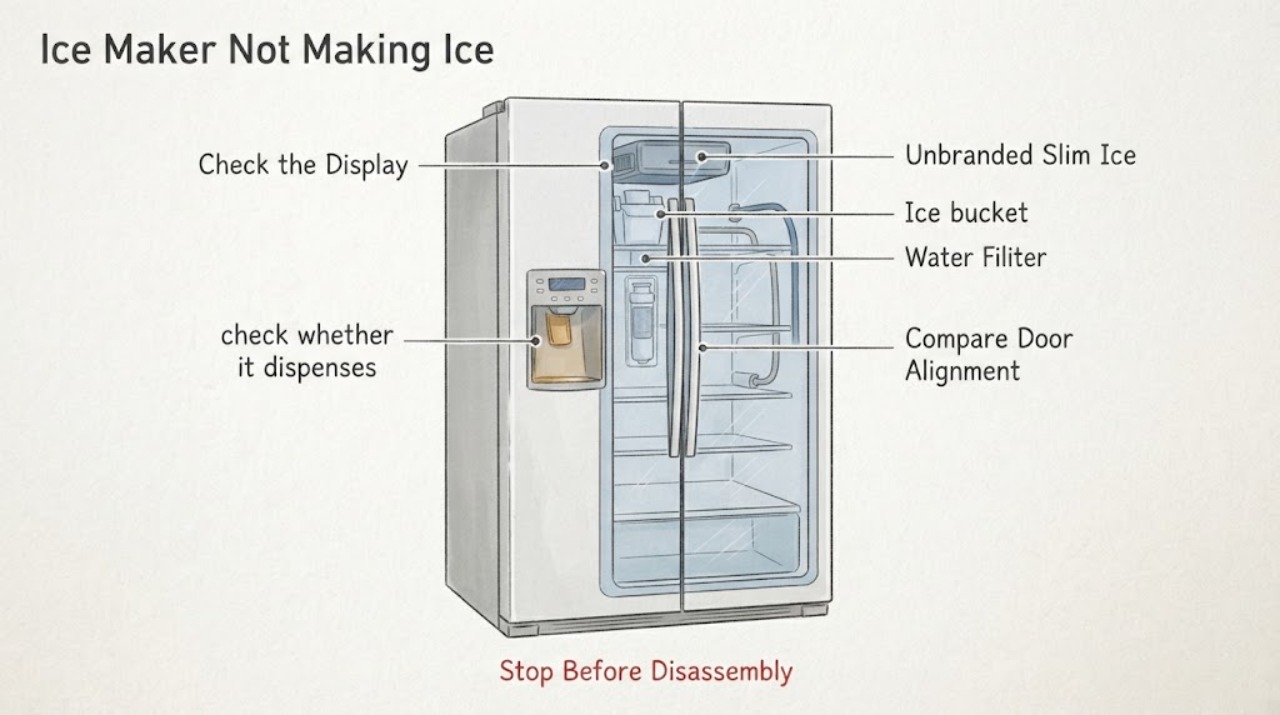
For a Samsung RF263BEAESG/AA ice maker that is not producing ice, first check whether the ice maker is turned on and whether the bucket is actually empty or simply not dispensing. This model is listed with a Slim Ice Master and an Ice & Water dispenser. Confirm the control is not showing Ice Off, make sure the bucket is seated and not frozen into a block, and check that the dispenser can deliver water. If the model's water dispenser fails the Samsung pressure check, or water flow improves only with the filter removed, resolve the supply or filter issue before testing the ice maker. Samsung says an ice-maker reset is a last resort: use the exact model instructions, run the test only once, and allow up to 8 hours for production to begin and up to 24 hours to return to normal. If there is still no ice, a code returns, water leaks, or the bucket cannot be removed safely, stop using the ice function and arrange qualified service.
Work through in order
Diagnostic checks
Use only checks that match the exact appliance or system and its official guide.
-
Check 1
Copy the full model number, check the display for an Ice Off state, and determine whether the ice bucket is empty or contains ice that will not dispense. Check that the bucket is seated and that the ice is not frozen into one solid block; do not force it.
Expected result: Ice Off is lit, the bucket contains ice but will not dispense, the bucket is empty, the bucket is stuck, or ice is piled against one side.
Next step: If ice is present but will not dispense, use Samsung's dispenser guidance. If Ice Off is lit, enable the ice maker using the exact model control sequence. If the bucket is empty, continue to the water-flow check. If it is stuck or frozen solid, stop and do not pry it loose.
Stop if: Do not chip at the bucket, insert a sharp tool, or continue if water is leaking toward electrical parts or the bucket cannot be removed with gentle model-authorized movement.
Why this matters
Why: Samsung treats an ice-dispenser failure, a disabled ice maker, a frozen or mis-seated bucket, and a true no-production complaint as different paths. A full bucket does not prove that the ice maker has stopped producing.
-
Check 2
With a glass or measuring cup under the RF263BEAESG/AA water dispenser, check whether it dispenses at least 6 ounces, or three-quarters of a cup, in less than 10 seconds. Keep the refrigerator and floor dry while observing.
Expected result: No water dispenses, the measured flow is below Samsung's check, or the dispenser passes the check.
Next step: If there is no flow, verify the accessible household water valve is open and the line is connected without moving the refrigerator. If flow is low, address the supply or filter path before testing the ice maker. If flow passes, continue to the filter comparison and control check.
Stop if: Do not disconnect a pressurized line, pull the refrigerator out, or work near a wet outlet or cord.
Why this matters
Why: A closed or poorly connected supply, low household pressure, or a restricted filter can prevent the ice maker from filling even though the refrigerator has power. Passing the dispenser check makes a general supply restriction less likely but does not prove the ice-maker valve or fill tube works.
-
Check 3
If the water dispenser uses a filter, repeat Samsung's water-flow check only as the model guide permits with the filter removed, then inspect the filter seating and housing for an obvious misalignment or leak. Do not use a filter type that the model documentation does not specify.
Expected result: Flow improves only with the filter removed, flow remains poor with the filter removed, or the housing is dry and flow is normal.
Next step: Install only the model-authorized filter and correct its seating if the guide permits. Resolve low supply pressure at the source before further ice-maker testing. If flow and filter condition are normal, proceed to a single power cycle and model-authorized test.
Stop if: Stop for a cracked housing, persistent leak, water near electrical components, or any need to open a sealed panel.
Why this matters
Why: Samsung says a dispenser that passes only without the filter points to a filter restriction; if flow remains poor, the household pressure or supply path remains unresolved. A normal test shifts attention toward the ice setting, bucket, test cycle, or an internal ice-maker fault.
-
Check 4
After the refrigerator is dry and free of hazards, turn it off or unplug it for two minutes, restore power, and follow the RF263BEAESG/AA manual to locate the ice-maker test control. Run the test once only and observe whether it completes, fills, or reports an error.
Expected result: The test completes and the valve fills the ice maker, the test does not start or complete, an error appears, or water overflows or jams.
Next step: If the test completes normally, leave the ice maker enabled and allow the documented recovery period. If it fails, repeats a code, or causes a jam or overflow, stop using the ice function and arrange qualified service.
Stop if: Do not press the test button repeatedly, disconnect wiring, remove panels, or reach into moving or energized mechanisms.
Why this matters
Why: Samsung describes the test as a functional check, not a confirmed part diagnosis. A completed test followed by no ice shifts attention to recovery time or a model-specific production condition; an incomplete test, code, overflow, or jam needs service diagnosis.
-
Check 5
After one successful test, check for the first new ice after about 8 hours and normal recovery by 24 hours. Dispense ice occasionally so it does not pile up at one end of the bucket; record the model, water-flow result, test result, elapsed time, and any display code.
Expected result: Ice begins forming within the window, production remains absent after 8 hours, normal quantity has not returned after 24 hours, or the issue is accompanied by a leak, code, unusual noise, or electrical symptom.
Next step: Contact Samsung or qualified refrigerator service with the exact model, test result, water-flow result, and timing. Keep the ice function off when the problem includes a leak or unsafe electrical symptom.
Stop if: Do not continue repeated resets or order an ice-maker part from the symptom alone.
Why this matters
Why: Samsung distinguishes initial recovery from normal production. No ice after the stated window, or any hazard or recurring code, means that the user-level sequence has not restored operation; it does not identify a compatible valve, motor, board, or ice-maker assembly.
Use your observations
Decision map
Find the observation that best matches what you see, then follow the next safe action.
-
PATH 01Next step
What you see
The bucket is empty, Ice Off is not displayed, and the dispenser fails Samsung's water-flow check or improves only when the filter is removed.
Do this next
Resolve the accessible valve, model-authorized filter, or household pressure issue first. Do not order an ice-maker part until the water path is normal.
Why this path and its safety boundary
Why it matters: A supply, filter, or water-pressure restriction is more likely than a confirmed failed ice-maker assembly.
-
PATH 02Next step
What you see
The bucket is seated, the ice maker is enabled, water flow is normal, and the single model-authorized test completes without an error.
Do this next
Leave the ice maker enabled and allow up to 8 hours for new ice and up to 24 hours for normal recovery. Dispense occasionally and monitor without repeated resets.
Why this path and its safety boundary
Why it matters: The basic control, water-flow, and test sequence has completed, but the test does not prove that every production component is healthy.
-
PATH 03Next step
What you see
The test will not start or complete, an error code returns, water overflows, the bucket remains frozen or stuck, or no ice appears after the documented recovery period.
Do this next
Stop using the ice function and arrange qualified Samsung or appliance service with the model number, display photo, water-flow result, and test behavior.
Why this path and its safety boundary
Why it matters: A model-specific ice-maker, valve, sensor, control, fill, or mechanical fault remains possible, but the user-level checks cannot select the failed part.
-
PATH 04Next step
What you see
Water leaks, approaches the cord or outlet, the refrigerator shows smoke, burning odor, sparking, a hot plug, or another electrical hazard.
Do this next
Stop using the affected water and ice functions. From a dry, safe position close the accessible water valve and isolate power only when safe, then obtain qualified service. Do not pull the refrigerator out or open panels.
Why this path and its safety boundary
Why it matters: The immediate water or electrical risk overrides ice-maker diagnosis.
Helpful context
Understand the symptom
Confirm what is failing before calling for service
Samsung lists the RF263BEAESG/AA as a French-door refrigerator with a Slim Ice Master and an Ice & Water dispenser. Separate an empty ice bucket from a dispenser problem: if ice is present but will not come out, use the ice-dispenser path; if the bucket is empty, continue with ice-production checks. Record the full model suffix, the control display, whether water dispenses, and whether the ice maker has stopped completely or is only making less ice.
Check the ice setting and bucket first
On Samsung refrigerators, an Ice Off indicator means the ice maker is disabled; the exact button or touch sequence depends on the control panel, so use the RF263BEAESG/AA manual or its model support page. Check that the bucket is fully seated and that ice is not piled against one side or frozen into a solid block. Do not force a stuck bucket or chip at frozen parts with a sharp tool.
Use water flow to separate a supply problem from an ice-maker problem
Because this model is listed with an Ice & Water dispenser, make the Samsung water-flow check with a measuring cup. Samsung's guide says the line should deliver 6 ounces, or three-quarters of a cup, in less than 10 seconds. If no water comes out, verify the line is connected and the household valve is open. If flow is poor with the filter installed but passes with the filter removed, the filter or its seating is restricting flow; use the model documentation for the correct replacement. Do not assume that a working dispenser proves the ice-maker fill path is healthy.
Power cycle, then use the ice-maker test once
After the setting, bucket, and water checks, Samsung's guide permits a two-minute refrigerator power cycle before the ice-maker test. A test button may be behind the bucket or on the ice maker, and the exact access procedure belongs to the model manual. Hold the test control only as directed and do not repeat it: Samsung says the test can take about six minutes, during which the valve may fill the ice maker. If the test produces an error, does not complete, or causes overflow or a jam, stop rather than opening panels or testing live wiring.
Allow the documented recovery time before judging the result
Samsung says ice should begin appearing within about 8 hours after the troubleshooting sequence, while normal production can take up to 24 hours. Dispense ice occasionally during that period so it does not pile up at one end of the bucket and falsely signal that the bucket is full. This waiting period does not apply when there is a leak, an error code, an abnormal electrical symptom, or a bucket that cannot be handled safely.
When checks do not resolve it
Need a professional?
Arrange qualified Samsung refrigerator service when the ice maker still produces no ice after the enabled-setting, bucket, water-flow, filter, single-test, and recovery checks; when a test fails or an error returns; or when diagnosis would require a valve, fill path, sensor, control, wiring, or ice-maker assembly test. Provide RF263BEAESG/AA, the display state, bucket condition, water-flow result, filter comparison, test result, and time since reset. Do not choose a replacement part from the symptom alone.
Common questions
FAQ
Is the Samsung RF263BEAESG/AA ice maker turned off?
Check the control panel for an Ice Off indicator and use the exact RF263BEAESG/AA manual for the button sequence. Samsung says the ice maker must be enabled before production can resume. Also confirm that the bucket is seated and not frozen into a block.
Should I reset this Samsung ice maker?
Samsung describes reset or test as a last resort after the setting, bucket, water-flow, and filter checks. Run the exact model test once only; do not repeat it because water can overflow or ice can jam. Allow about 8 hours for initial ice and up to 24 hours for normal recovery.
Is it worth calling for service if the ice maker still makes no ice?
Samsung's guidance directs you to contact support when no ice remains after the documented checks and recovery period. The checks do not establish whether a valve, fill path, sensor, control, or ice-maker assembly is at fault, so service value, repair cost, and part selection cannot be determined from this symptom alone.
Read the exact guide
Official sources
- RF263BEAESG French Door with Twin Cooling Plus, 24.6 cu.ft | RF263BEAESG/AASamsung · The opened Samsung product page identifies this exact suffix as a French-door refrigerator with Slim Ice Master and an Ice & Water dispenser.
- Steps to get your Samsung ice maker working againSamsung · Samsung notes that the provided information refers to refrigerators sold in Canada; use the RF263BEAESG/AA manual for regional control labels and model-specific access. The guide supports the general setting, water-flow, filter, power-cycle, test, recovery, and service sequence.
- Refrigerator Ice Maker ServiceSamsung · Samsung's service page provides symptom selection and directs unresolved ice-maker problems to Samsung Care Pro or arranged service.
- Test or reset your Samsung ice makerSamsung · The opened Samsung US guide states that reset is generally a last resort and that the test button location and procedure vary by model; the RF263BEAESG/AA manual controls the exact access sequence.
- RF263BEAESG | Samsung Support CASamsung · The opened Samsung support page identifies RF263BEAESG and links its model support area to ice-maker guidance and manuals; regional suffix and control options must be checked against the owner's exact unit.
Community feedback
Share a repair observation
Share a plain-text repair observation. Accepted observations are published automatically; this page may take a moment to update.