
On this page
Start here
Quick answer
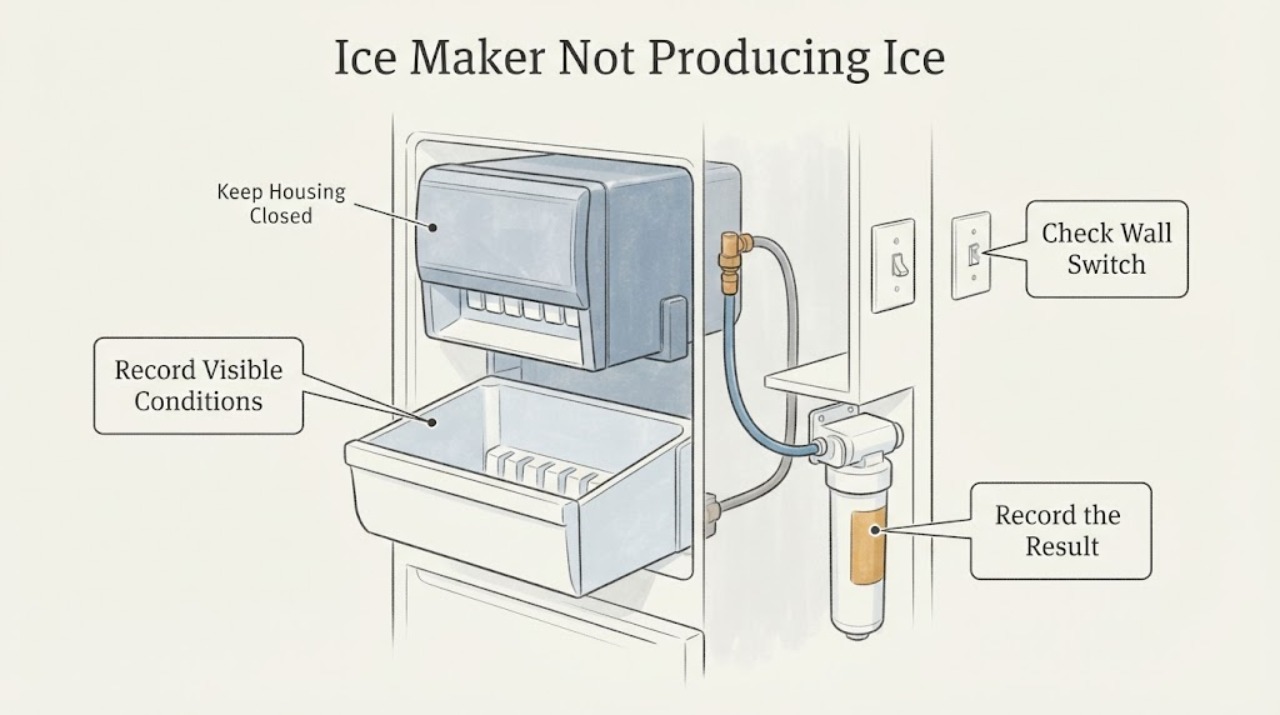
First confirm that this is a Bosch refrigerator’s built-in ice maker and identify the exact E-Nr/model; a standalone ice maker needs its own manual. On dispenser-equipped Bosch refrigerator families, official manuals list the user-level checks as ice production being enabled, the ice bin fully inserted and unobstructed, the freezer having reached its operating temperature, water being supplied through an open valve and unkinked hose, and adequate pressure with a serviceable filter. A recently connected appliance or a large harvest can also need hours before ice is available. Do not reach into the ice maker, force an auger or sensor, guess a valve or heater, or transfer a reset sequence from another model. If the model-matched checks fail or water leaks, arrange Bosch or qualified service.
Work through in order
Diagnostic checks
Use only checks that match the exact appliance or system and its official guide.
-
Check 1
Confirm that the ice maker is built into a Bosch refrigerator, then record the complete E-Nr/model, FD number and region from the rating label or paperwork. Open the matching Bosch manual and identify the ice-maker control, ice-bin layout and water-filter arrangement; do not use a standalone ice-maker procedure on a refrigerator or vice versa.
Expected result: The appliance is a refrigerator with a documented built-in ice maker and matching manual, or the device/model remains uncertain.
Next step: If the model or device class is uncertain, provide the rating-label information and photos to Bosch support before ordering a part or using a reset. If it is a built-in refrigerator ice maker, continue with the documented external checks.
Why this matters
Why: Bosch ice-maker controls and service procedures vary by product family. Missing identity prevents a safe choice of reset, filter, bin or component procedure but does not prove the appliance has no repair path.
-
Check 2
Using only the exact manual, check whether ice production is switched on and whether the ice bin is fully inserted and aligned. With the appliance off or the bin removed only as the manual permits, clear loose food, bottles or an ice scoop that could obstruct the fill-level sensor; never reach into or under the ice maker.
Expected result: Ice production is off, the bin is misaligned/not fully inserted, or objects obstruct the bin/sensor area; or these conditions are absent.
Next step: Correct only the documented setting/bin condition and close the appliance. Do not force the bin, ejector or sensor. If the condition is already correct, move to freezer readiness and the water path.
Why this matters
Why: A disabled maker, an unseated bin or a blocked fill-level sensor can stop production without identifying a failed valve or ice-maker assembly.
-
Check 3
Check whether the refrigerator was recently installed or switched on, whether the freezer has reached the exact manual’s operating condition, and whether doors were opened frequently or a large amount of ice was recently removed. Wait the model-specific production interval instead of judging the maker immediately after startup or a large harvest.
Expected result: The appliance is newly connected, the freezer is not yet at its documented condition, doors have been open frequently, or a large harvest recently occurred; or the timing and freezer condition are normal.
Next step: Allow the exact manual’s stated recovery period with the doors closed as much as practical. If production remains absent after that period and the water path is normal, continue to service triage rather than repeatedly cycling the maker.
Why this matters
Why: Bosch manuals describe delayed first batches and recovery time after startup, warm conditions or high demand. A delay does not prove an internal fault.
-
Check 4
Make a safe external check that the refrigerator is connected to water, the accessible shutoff valve is open, the hose is not kinked or visibly damaged, and the model-approved filter is installed and not reported blocked. Turn off the water supply before straightening a kink or addressing a visible leak; do not disconnect a pressurized hose.
Expected result: No water supply/closed valve, a kink or damaged hose, low pressure, a blocked/overdue filter or a leak is present; or the visible water path appears normal.
Next step: Correct only the documented external condition, using the exact filter manual. Keep water off and arrange an installer or service professional for a leak, inaccessible connection or damaged hose. If the water path is normal, use the service branch.
Why this matters
Why: Bosch lists these water-path conditions among causes of no or low ice production. They can explain the symptom without proving a failed inlet valve, pump or ice-maker component.
-
Check 5
If the model-matched setting, bin, freezer timing and water-path checks are correct but no ice is produced, record whether the maker is silent, shows a fault, leaks, or produces deformed/insufficient cubes. Keep the identifiers and the last successful production date for Bosch service; do not open the freezer liner or test an internal valve, motor or heater.
Expected result: No ice persists after the documented external checks, or a leak/display fault is present.
Next step: Contact Bosch or an authorized/qualified appliance professional with the E-Nr/FD, region, water/filter history and observed behavior. Keep the water supply off for a leak.
Why this matters
Why: The remaining cause is outside the supported user checks and a component diagnosis would be speculative without the model and professional assessment.
Use your observations
Decision map
Find the observation that best matches what you see, then follow the next safe action.
-
PATH 01Next step
What you see
The device is a standalone ice maker, has no documented built-in ice maker, or the Bosch E-Nr/model and region cannot be confirmed.
Do this next
Identify the exact appliance and use its Bosch manual/support path; do not order a refrigerator ice-maker part or apply a refrigerator reset sequence.
Why this path and its safety boundary
Why it matters: Refrigerator ice-bin, water-filter and control steps cannot be safely transferred to a different product class or unknown Bosch family.
-
PATH 02Next step
What you see
The exact manual shows ice production switched off, an unseated bin, or food/objects blocking the fill-level sensor.
Do this next
Enable production or reseat/clear the bin only as the manual permits, then allow the documented production interval. Never reach into or force the maker.
Why this path and its safety boundary
Why it matters: The maker may be disabled or unable to recognize its fill state; this does not establish a failed component.
-
PATH 03Next step
What you see
The refrigerator was recently connected, the freezer has not reached its documented condition, doors were open frequently, or substantial ice was recently removed.
Do this next
Keep the freezer closed as practical and wait the exact manual’s stated interval before judging production.
Why this path and its safety boundary
Why it matters: The ice maker may be waiting for temperature or recovery time rather than malfunctioning.
-
PATH 04Next step
What you see
The supply is off, pressure is low, the hose is kinked/damaged, the filter is blocked/not seated, or water is leaking.
Do this next
Correct only the documented external condition, shut off water for a leak or hose work, and use an installer/professional when the connection is inaccessible.
Why this path and its safety boundary
Why it matters: The external water path can account for no ice; no valve or heater diagnosis follows from that observation.
-
PATH 05Next step
What you see
The model-matched setting, bin, freezer timing and water path are correct but no ice is produced, or a fault persists after the exact manual’s permitted reset.
Do this next
Keep the water supply off for a leak and contact Bosch or qualified service with E-Nr/FD, region and the production history.
Why this path and its safety boundary
Why it matters: The symptom is outside the supported external checks and needs model-specific service; it does not identify a valve, motor, heater or control board.
Helpful context
Understand the symptom
Confirm the appliance and the ice-maker identity first
This topic has no E-Nr/model or region. Bosch refrigerators can have different ice-maker controls, bin layouts and water-filter arrangements; a standalone Bosch ice maker is a different product class. Record the complete model and check the matching Bosch manual before using a control sequence or ordering a component. The checks below are for a built-in refrigerator ice maker and are narrowed where the opened manual is family-specific.
An enabled ice maker still needs time and a clear bin
The opened Bosch B24...80 manual says ice production starts after the appliance is on and the freezer reaches its set temperature, with the first batch taking about four hours for that family. Bosch’s refrigerator FAQ says the ice bin must be inserted and aligned correctly. Bosch manuals also warn that food, bottles or an ice scoop can block the fill-level sensor or make the maker think the bin is full. These are checks, not proof of a failed ice-maker module.
Check the water path without opening the appliance
Bosch troubleshooting lists no water supply, a closed shutoff, a kinked hose, low pressure and a blocked filter as causes associated with ice production problems. Inspect only accessible connections, filter status and hose routing. Turn off the water supply before correcting a kink or dealing with a leak, and do not disconnect a pressurized line or diagnose an inlet valve from no ice alone.
Persistent no ice is a service decision, not a component guess
If the exact manual’s setting, bin, freezer, water and filter checks are correct and the maker still produces no ice, the remaining cause is not established by user checks. Bosch manuals route a persistent ice-maker fault to customer service, and Bosch support directs owners to authorized service providers. Do not reach into rotating parts, force a mold/ejector, bypass a sensor or open the freezer liner.
When checks do not resolve it
Need a professional?
Contact an installer or qualified appliance professional for a closed/inaccessible water connection, damaged hose or leak., Contact Bosch or authorized service when the model-matched setting, bin, temperature/recovery, water and filter checks do not restore ice production., Do not reach into or under the ice maker, force an ejector or sensor, open the freezer liner, or test an internal valve or heater.
Have this ready
- complete Bosch E-Nr/model and FD number
- country/region
- whether the ice maker is built into a refrigerator
- last date ice was produced and whether the appliance was recently installed
- ice-production setting, bin/filter status, water-supply observations and any display message
Common questions
FAQ
Why is my Bosch ice maker not making any ice after installation?
Bosch manuals say ice production begins after the refrigerator is on and the freezer reaches its set condition; the first batch can take hours for the documented family. Confirm the water connection, production setting and bin position before deciding there is a fault.
Can an incorrectly seated ice bin stop a Bosch ice maker?
Yes. Bosch’s refrigerator FAQ says the ice bin must be inserted and aligned correctly, and manuals warn that objects in the bin can block the fill-level sensor. Reseat or clear it only as the exact manual permits, without reaching into the maker.
Should I replace the water inlet valve when the Bosch ice maker is empty?
No. First check the model-specific setting, freezer readiness, supply valve, hose, pressure and approved filter. If those checks are correct and ice still does not form, arrange model-specific service rather than guessing a valve or other part.
What should I do if the ice maker is leaking?
Stop the water supply if the shutoff is safely accessible, do not disconnect a pressurized hose, and arrange an installer or qualified appliance professional. Do not keep cycling the ice maker to locate the leak.
Read the exact guide
Official sources
- Use and Care Manual B24...80Bosch Home Appliances · Opened the official Bosch manual PDF and verified the B24...80 family heading. It is used as conditional family evidence for a built-in refrigerator ice maker, not as a universal procedure for every Bosch model.
- Bosch refrigerator use and care manualBosch Home Appliances · Opened the official Bosch manual PDF and used its explicit troubleshooting table as a second family reference. Because the task has no model, only common external checks are carried over; model-specific controls and timings remain conditional.
- How to Replace Your Refrigerator Water Filter: Step-by-Step GuideBosch Home Appliances · Opened official Bosch filter guide. It supports checking model-approved filter compatibility and the housing/seating/leak boundary; it is not used to diagnose an ice-maker valve.
- Get Support - Refrigeration | Bosch Home AppliancesBosch Home Appliances · Opened official Bosch US refrigeration support page. It provides model/manual lookup, Service Assistant and authorized service routing; it does not establish a universal ice-maker part or reset.
- Getting Started with your Bosch Refrigerator | Refrigerator FAQsBosch Home Appliances · Opened official Bosch refrigerator FAQ. It is used for the general point that an equipped refrigerator must have its ice bin inserted/aligned and that model-specific manual/support remains controlling.
Community feedback
Share a repair observation
Share a plain-text repair observation. Accepted observations are published automatically; this page may take a moment to update.