
On this page
Start here
Quick answer
For a Samsung refrigerator ice-maker leak, first identify whether water is coming from the ice chute/dispenser, filter or water connection, or the ice-maker compartment. A few drops immediately after dispensing can be normal, but water that returns, leaks while making ice, or appears near electrical parts needs service. Keep the floor dry, avoid using the affected dispenser, and do not remove sealed panels.
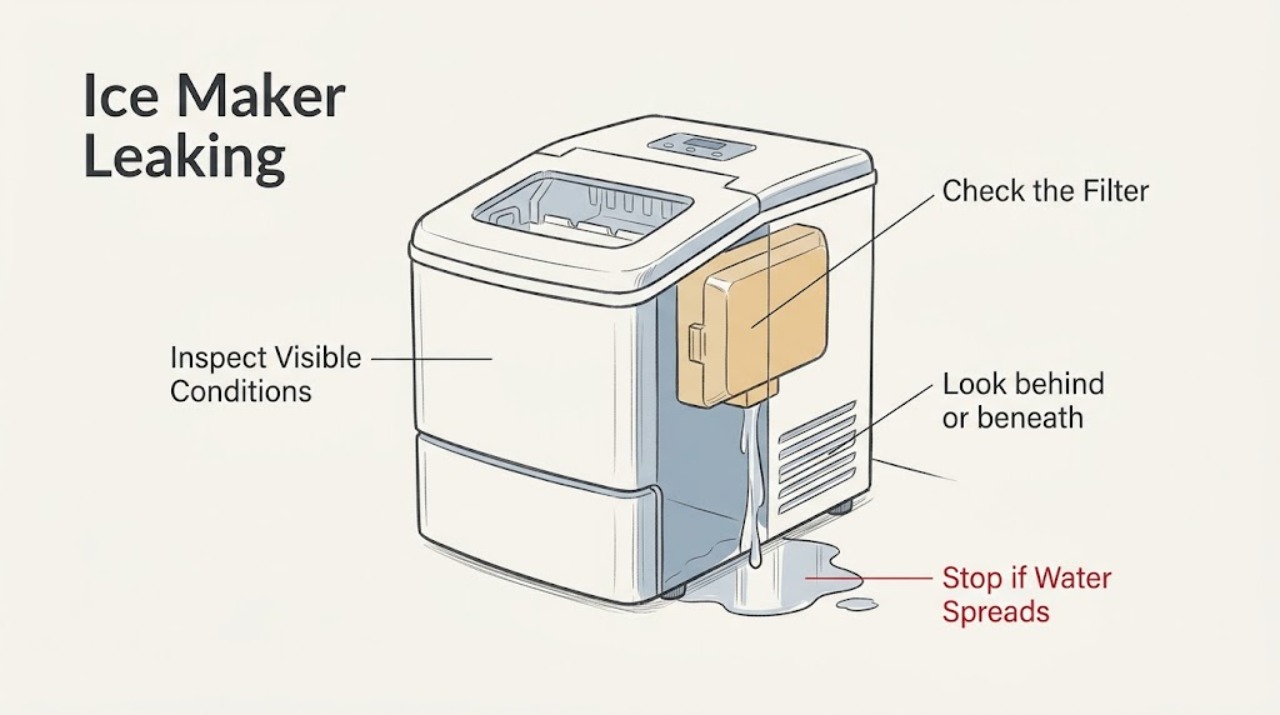
Work through in order
Diagnostic checks
Use only checks that match the exact appliance or system and its official guide.
-
Check 1
Dry the dispenser area and observe a single water or ice dispense with a glass in place; watch the tray, chute, and nearby door seam for the first wet point.
Expected result: Only a few drops appear immediately after dispensing, or water continues after dispensing stops.
Next step: Leave the glass under the nozzle briefly for normal residual drops; stop using the dispenser if dripping continues.
Why this matters
Why: A short post-dispense drip can be normal, while a continuing drip suggests a dispenser, filter, line, or valve issue.
-
Check 2
If the model has a removable water filter, inspect the filter seating and surrounding housing for moisture without forcing the cartridge.
Expected result: Moisture is concentrated around a crooked/loose filter, or the filter housing is dry while leaking continues.
Next step: Reseat only according to the model manual; arrange service if the seal/housing is damaged or wetness remains.
Why this matters
Why: A filter seal or installation can leak; a dry, correctly seated filter shifts suspicion to another line or internal component.
-
Check 3
Look behind or beneath the refrigerator for an accessible water-line connection, keeping hands away from plugs and wiring; check whether the leak occurs only during ice making or dispensing.
Expected result: An accessible connection is wet, or the exterior connections are dry while water appears inside/under the unit.
Next step: Close the water supply if safely accessible and arrange qualified service for a wet connection or internal source.
Why this matters
Why: A rear connection can be the source; a dry exterior with recurring internal water suggests an internal hose, valve, or ice-maker path.
-
Check 4
Check the ice bucket, chute flap, and ice-maker area for an obvious spill, slushy ice, or a bucket that is not fully seated; do not pry frozen parts.
Expected result: Water is confined to a spill or mis-seated bucket, or it returns with no visible spill.
Next step: Clean and reseat accessible parts; request service if water returns or the bucket is stuck.
Why this matters
Why: A spill or bucket/flap seal can imitate a plumbing leak; recurrence without an accessible cause needs diagnosis.
Use your observations
Decision map
Find the observation that best matches what you see, then follow the next safe action.
-
PATH 01Next step
What you see
Only a few drops occur immediately after dispensing and stop when the tray/nozzle is dried.
Do this next
Leave a glass under the nozzle briefly after dispensing and monitor for recurrence.
Why this path and its safety boundary
Why it matters: Residual dispenser drips are more likely than an active leak.
-
PATH 02Next step
What you see
Water starts around the filter, rear connection, or only during dispensing/ice making.
Do this next
Stop the affected function, close the accessible supply if safe, and arrange service for persistent moisture.
Why this path and its safety boundary
Why it matters: A filter seal, water-line connection, valve, or ice-maker feed path is more likely.
-
PATH 03Next step
What you see
Water returns without dispensing, reaches the floor/electrical area, or comes from inside the cabinet.
Do this next
Stop using the refrigerator water/ice functions, protect the floor, and obtain qualified service promptly.
Why this path and its safety boundary
Why it matters: An internal or significant leak is possible and is not a safe user repair.
Helpful context
Understand the symptom
Trace the first wet point
Water can travel from a dispenser or filter area before it reaches the floor. Samsung's support guidance distinguishes brief dispenser drips, filter and line connections, cross-connected lines on certain models, and recurring leaks that require service.
Only after diagnosis
Potential parts
- water filter seal, inlet line, or ice-maker water valve
Consider a part only after the wet point and exact model diagnosis identify a failed seal, line, or valve.
Confirm the complete refrigerator model and Samsung fit information before ordering; a leak location alone does not prove compatibility.
When checks do not resolve it
Need a professional?
Stop using the ice maker and water dispenser and request qualified service if a leak returns, water comes from inside the cabinet, a line or filter housing is damaged, the bucket is frozen/stuck, or water approaches an outlet or cord. Shut off the water supply if safely accessible and never open sealed panels.
Common questions
FAQ
Is a few drops from a Samsung dispenser always a leak?
Samsung says a dispenser can drip for a few seconds after dispensing. If dripping continues, returns without use, or wets the floor, stop the function and trace the source.
Should I keep making ice while the ice maker leaks?
No. Stop the affected water/ice function and close the accessible water supply if safe. Persistent or internal leaks need qualified service.
Read the exact guide
Official sources
- Samsung ice maker is not workingSamsung Electronics America · Samsung ice-bucket stuck/frozen safety and service
- Samsung refrigerator water dispenser issuesSamsung Electronics America · Samsung refrigerator dispenser residual drips, ice/water line behavior, and leak escalation
- Frost forms in the Samsung freezer, refrigerator, or ice bucketSamsung Electronics America · Samsung ice-bucket seal, flap, alignment, and moisture paths
- Water leaks in a Samsung refrigeratorSamsung Electronics America · Samsung refrigerator water leaks from filters, lines, dispenser/ice connections, and service
Community feedback
Share a repair observation
Share a plain-text repair observation. Accepted observations are published automatically; this page may take a moment to update.