
On this page
Start here
Quick answer
For a GE refrigerator ice maker that produces no ice, first confirm that the ice maker is turned on in the refrigerator's control panel or on the ice-maker assembly, then check freezer temperature, water supply, filter flow and a blocked feeler arm or ice mold. GE says the ice maker needs the freezer near 0°F and the mold near 16°F before a cycle can begin; a clogged filter, closed/kinked supply or stuck ice can stop filling or ejection. Because this is described as an in-door GE Profile ice maker without a complete model, use the exact owner's manual for its controls and do not remove the door module or test internal valves. If the external checks do not restore a cycle, arrange GE or qualified appliance service.
Before you begin
Safety first
- Do not remove the in-door ice-maker assembly, expose wiring, test a valve, force the feeler arm, bypass a sensor or use a generic reset sequence. Keep hands out of moving mechanisms and follow the exact manual for any bin or filter removal.
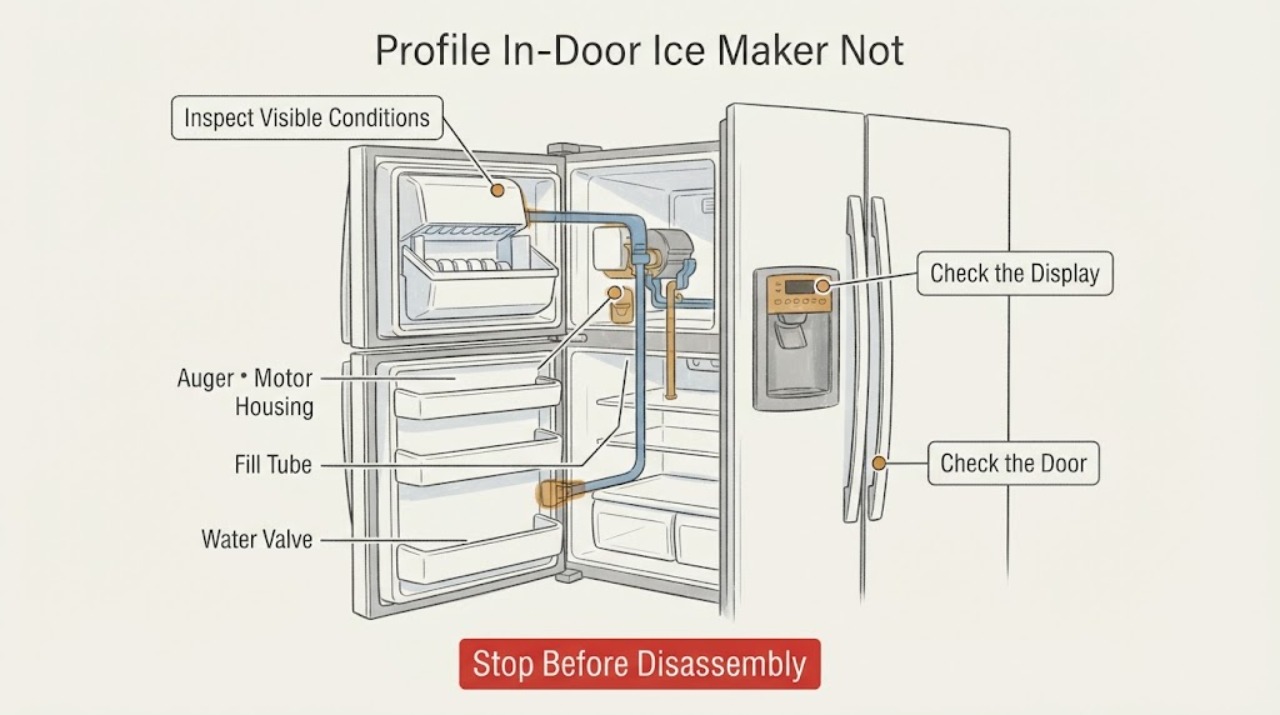
Work through in order
Diagnostic checks
Use only checks that match the exact appliance or system and its official guide.
-
Check 1
Check the complete model label or QR code, then confirm that the ice maker is enabled using the exact GE manual. For an in-door design, look for the ice-maker setting on the refrigerator control panel; do not assume a visible switch on the door module.
Expected result: The control shows the ice maker on, shows it off, or the setting cannot be identified because the model is unknown.
Next step: Turn it on only through the model-specific user control. If the model cannot be identified, record the label and use GE model support rather than removing the in-door assembly or guessing a reset sequence.
Why this matters
Why: GE says the on/off location varies by model and that in-door ice makers may be controlled from the refrigerator panel. An off setting explains no production; an unknown setting leaves the cause unresolved.
-
Check 2
Check the refrigerator and freezer temperature displays and allow a newly installed refrigerator or ice maker the time specified by its manual. Compare the freezer setting with GE's general 0°F recommendation and confirm the refrigerator is not unusually warm.
Expected result: The freezer is near the recommended range and the unit has had time to cool, or it is warmer/was recently installed and has not completed its initial cooling period.
Next step: Correct only the user temperature setting permitted by the manual and wait for the specified stabilization period. If the freezer cannot hold temperature, address refrigerator cooling service before blaming the ice maker.
Why this matters
Why: GE says the ice maker must become cold enough to begin a cycle and that a warm freezer delays or prevents ice production. A new installation may need roughly 24–48 hours, depending on the model and conditions.
-
Check 3
With the door and bin safely positioned, inspect the accessible ice bin, feeler arm or paddle, and mold opening for a clump or cube blocking movement. Do not force a frozen in-door assembly or reach behind a cover.
Expected result: Ice or a full bin holds the feeler arm/paddle out of position, the ejector/rake is visibly blocked, or the arm and mold area are clear.
Next step: Remove only loose, accessible ice as the exact manual permits and keep hands clear of moving parts. If a blockage is frozen into the in-door module or cannot be removed without disassembly, stop and request service.
Why this matters
Why: GE says a blocked feeler arm/paddle pauses production and a stuck ejector/rake prevents the cycle from completing. A clear accessible area means the no-ice cause is not established by this check.
-
Check 4
Check the refrigerator's external water shutoff and visible supply tubing for an off valve or kink, then assess the dispenser flow if the model has one. If the filter is due or flow is restricted, use only the exact model's filter/bypass instructions.
Expected result: The supply valve is off/kinked, dispenser flow improves after the model-approved filter check, or water flow is normal but the ice mold remains empty.
Next step: Restore the external supply or replace the filter with the exact model-approved procedure. Do not remove an in-door water valve or test it with exposed wiring; persistent no-fill needs service.
Why this matters
Why: GE identifies a closed supply, restricted filter and slow water flow as causes of an empty or underfilled mold. Normal dispenser flow does not rule out every ice-maker fault, while a restricted filter gives a supported next branch.
-
Check 5
If the mold is empty and the exact GE manual explicitly permits a user fill check, follow that manual only; otherwise do not pour water into or disassemble the in-door module. Record whether the unit later freezes/ejects or remains inactive and give those observations to service.
Expected result: The model-specific manual supports the check and the batch freezes/ejects, or no user-approved check is available or the ice maker remains inactive.
Next step: Use the result only to describe the symptom: if the unit can freeze/eject but does not fill, request water-path service; if it cannot cycle or the check is not authorized, arrange GE/qualified service without opening the assembly.
Why this matters
Why: GE's general water-fill article uses a small manual-fill observation to distinguish a working eject cycle from a water-distribution problem, but an in-door design may require different access. A failed or unavailable user check does not identify a particular internal part.
Use your observations
Decision map
Find the observation that best matches what you see, then follow the next safe action.
-
PATH 01Next step
What you see
The ice maker is off, the freezer is too warm or the refrigerator is newly installed and has not reached the required temperature.
Do this next
Enable the ice maker using the exact model control, correct only permitted temperature settings and allow the documented stabilization period before reassessing production.
Why this path and its safety boundary
Why it matters: GE identifies these conditions as sufficient to delay or stop a cycle without proving that the ice-maker hardware has failed.
-
PATH 02Next step
What you see
The ice maker is on and cold enough, but the feeler arm/ejector is blocked or the filter, supply valve or tubing restricts water flow.
Do this next
Clear only loose accessible ice, restore the external supply or replace the filter using the exact GE instructions. Escalate if the blockage is frozen into the in-door module or flow remains abnormal.
Why this path and its safety boundary
Why it matters: The supported cause is a blocked cycle or restricted external water path, rather than a confirmed failed valve or motor.
-
PATH 03Next step
What you see
The settings, temperature, accessible blockage and external water checks are normal, or the fill tube/module requires removal to inspect.
Do this next
Keep the refrigerator assembled, provide the complete model/serial information and the observed fill/eject behavior to GE or a qualified appliance technician, and do not bypass or probe the in-door assembly.
Why this path and its safety boundary
Why it matters: GE recommends service when those checks do not restore production and specifically reserves frozen-fill-tube verification for a technician; the exact in-door component failure is not established.
Helpful context
Understand the symptom
Start with the ice-maker state and temperature
GE says refrigerator ice makers can be turned off from the control panel or at the ice-maker assembly, depending on the model. GE also says the refrigerator should be around 37°F in the fresh-food section and 0°F in the freezer, with the ice-maker mold reaching about 16°F before a cycle begins. A newly installed refrigerator or ice maker may need a day or two to cool before it fills, so do not interpret the first waiting period as proof of a failed module.
Separate water-fill from ice-ejection symptoms
If the mold stays empty, inspect the refrigerator's water supply, filter and fill path from the outside. GE says a restricted filter can reduce flow and a frozen fill tube can stop water from reaching the mold; checking a frozen fill tube requires the ice maker to be removed and should be done by a service technician. If the mold contains ice but nothing is released, GE points to a stuck ejector/rake or an obstruction in the mold. Do not force an in-door assembly or reach into a moving mechanism.
Keep the in-door model boundary explicit
The task does not include a complete GE model number. GE's support site directs owners to model-specific support using the model/serial label or its QR code, and its control instructions differ by refrigerator design. Use the exact manual for an in-door Profile unit before touching a control, removing a bin or interpreting a service indication. The safe general checks below do not establish a failed valve, motor, sensor or control board.
When checks do not resolve it
Need a professional?
Contact GE or a qualified appliance technician when external supply and filter checks are normal but there is no fill/eject cycle, when a fill tube appears frozen, when the in-door assembly must be removed, or when the complete model cannot be identified.
Safety scope: Do not remove the in-door ice-maker assembly, expose wiring, test a valve, force the feeler arm, bypass a sensor or use a generic reset sequence. Keep hands out of moving mechanisms and follow the exact manual for any bin or filter removal.
Have this ready
- Provide the complete GE model and serial label, installation type, freezer temperature, whether the dispenser has normal flow, filter history, whether the mold is empty or contains stuck ice, and which user controls were verified.
Common questions
FAQ
Why can a GE ice maker stop making ice even when the refrigerator is running?
GE identifies several separate conditions: the ice maker may be off, the freezer may be too warm, the filter may restrict water flow, or ice may block the feeler arm or ejector. A running refrigerator does not prove that the ice maker is enabled or cold enough to cycle.
How do I check an in-door GE Profile ice maker without a model number?
Use the model/serial label or QR code to find the exact manual first. GE says some in-door ice makers are controlled from the refrigerator panel, so do not assume the assembly has a universal switch or reset sequence. You can still check external temperature, water supply, filter and accessible ice blockage.
Should I remove the GE in-door ice maker to check the fill tube?
No. GE says a frozen fill tube requires removing the ice maker and should be checked by a service technician. Keep the module assembled and report whether the dispenser works, whether the mold is empty and whether the external supply/filter checks were normal.
When is a GE ice-maker service call justified?
Use service when the ice maker is enabled and cold enough, the accessible arm/mold is clear, external supply and filter checks are normal, but no fill or eject cycle occurs. Service is also appropriate when a fill tube or in-door assembly must be removed or the exact model cannot be identified.
Read the exact guide
Official sources
- Refrigerator - Icemaker Doesn't Fill With WaterGE Appliances Product Support · Opened GE's official water-fill article. It supports supply, feeler-arm, filter and technician-only frozen-fill-tube distinctions, plus a conditional general fill/eject observation.
- Refrigerator - Icemaker Not Producing IceGE Appliances Product Support · Opened a second official GE refrigerator support article with the same user symptom. It reinforces temperature, filter and stuck-mold checks and recommends service when they do not resolve the issue.
- Refrigerator - Icemaker Not Producing IceGE Appliances Product Support · Opened GE's official general refrigerator ice-maker article. It supports on/off, temperature, filter and stuck-ejector checks for refrigerator ice makers, with exact controls remaining model-specific.
- Refrigerators, Freezers and Icemakers - Troubleshooting and SupportGE Appliances · Opened GE's official support hub. It directs owners to model/serial or QR-code specific support and summarizes temperature, filter, ice-mold and water-supply checks.
- Refrigerator - Icemaker Does Not Fill With WaterGE Appliances Product Support · Opened GE's official water-fill article. It explicitly notes that in-door ice makers may be turned off from the control panel and describes external supply/filter checks; it does not establish an exact Profile model procedure.
Community feedback
Share a repair observation
Share a plain-text repair observation. Accepted observations are published automatically; this page may take a moment to update.