
On this page
Start here
Quick answer
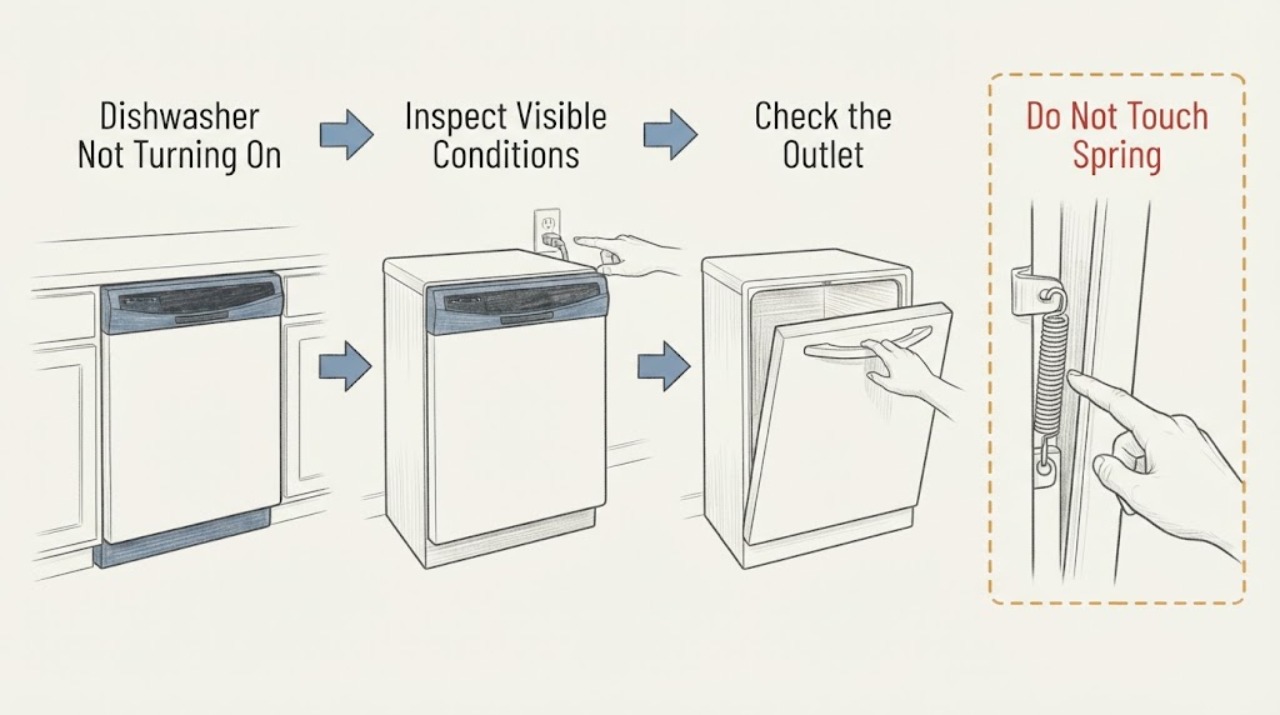
When a Siemens dishwasher will not turn on or start, first determine whether any display or indicator lights are visible. If there are no lights, check the accessible power connection, test the outlet with a small appliance, and check the household residual-current device or fuse without opening the dishwasher. If the display is on, close the door firmly and check that the water tap is open and the inlet hose is not visibly kinked. Siemens says an open door prevents the dishwasher from starting and that a water-inlet problem can also block a start. If the outlet is good but the dishwasher stays dark, the door will not latch, water cannot enter, an error remains, or the unit still will not start after these checks, stop and arrange Siemens service; do not remove panels or work on live wiring.
Before you begin
Safety first
- Stop using the dishwasher for water around the appliance, a damaged or wet plug or cable, burning odor, smoke, repeated electrical trips, or a door that will not close or latch. Do not pull out a built-in unit to expose wiring, remove electrical covers, bypass the door safety, disconnect the inlet hose as a guess, or replace an internal component from the no-start symptom alone.
Work through in order
Diagnostic checks
Use only checks that match the exact appliance or system and its official guide.
-
Check 1
Look at the dishwasher before moving it or changing a setting. Record whether the display or any indicator lights are completely dark, whether the display is lit but Start does nothing, and whether a symbol or error is shown. Note the exact E-Nr. or model from the rating label if it is visible without dismantling the appliance.
Expected result: No indicator lights are visible; lights are on but the cycle will not start; or a specific error or lock symbol is present.
Next step: Follow the matching power, door, and water-inlet checks below, and keep the model information for Siemens support if the symptom persists.
Why this matters
Why: A completely dark panel makes the supply connection and household circuit the first decision. A lit panel shifts attention to the door, water inlet, selected program, or a model-specific control state. An unrecognized symbol cannot be interpreted reliably without the exact model manual.
-
Check 2
If no lights are visible, check the accessible mains connection and confirm the plug is fully seated in its outlet. Test that outlet with a small appliance such as a lamp, then check whether the household residual-current device or fuse for that circuit has tripped. Do not pull out a built-in dishwasher or handle a wet or damaged plug to reach a connection.
Expected result: The outlet is dead, the residual-current device or fuse has tripped, the outlet works but the dishwasher remains dark, or the dishwasher display returns after the supply is restored.
Next step: If the household protection trips again, the plug or cable is damaged, or the display stays dark with a working outlet, stop and contact a qualified electrician or Siemens service. If power returns normally, continue to the door and water-inlet checks.
Why this matters
Why: A dead outlet or tripped protection device can explain a dark dishwasher without proving an appliance failure. If the outlet works and the dishwasher remains dark, an internal power or control fault is possible and cannot be safely diagnosed from outside.
-
Check 3
If the display is lit, close the dishwasher door firmly using normal pressure and check the visible latch area for an obstruction that prevents closure. Do not force a crooked door, bend the latch, or bypass the door safety. Start the selected program only after the door is fully closed.
Expected result: The cycle starts after the door is closed, the door will not latch, the door is visibly misaligned or damaged, or the display remains lit with no start.
Next step: Remove only an accessible obstruction and try one normal start. If the door will not latch, shows damage, or the dishwasher still refuses to start with a correctly closed door, arrange Siemens service and do not defeat the latch.
Why this matters
Why: Siemens states that an open door prevents the dishwasher from starting. A door that will not latch or is damaged leaves a latch, hinge, or safety-switch fault possible; the observation does not justify replacing an internal part.
-
Check 4
Inspect the dishwasher's external water supply without disconnecting the hose. Confirm the shutoff tap is open and look for a visible kink, crush point, leak, or damage in the inlet hose. If the appliance has been pushed back recently, correct only a visible bend while keeping the hose and connections dry.
Expected result: The tap is closed, the inlet hose is kinked or crushed, a leak is visible, or the tap and hose appear normal.
Next step: Open the tap or straighten only a visible kink, then try one normal cycle while watching for leaks. Do not disconnect the hose or clean an inlet filter unless the exact model instructions support it; arrange Siemens or plumbing service for a leak, damaged hose, or persistent no-start.
Why this matters
Why: Siemens identifies a water-inlet problem as another reason a dishwasher may not start. A closed tap or visible kink can restrict filling; a leak or damaged hose creates a water-safety boundary. A normal-looking hose does not rule out an inlet valve, filter, sensor, or control fault.
-
Check 5
After the external power, door, and water checks pass, make one supervised start using the normal program and record the result. Do not repeatedly cycle the power or select a random reset sequence, because Siemens controls and error meanings vary by model.
Expected result: The dishwasher begins filling, the same no-start symptom remains, an error returns, the household protection trips, or water appears around the appliance.
Next step: Stop after the controlled attempt. Contact Siemens service with the exact model, display state, error symbol, power result, door result, water-inlet result, and any leak or breaker behavior.
Why this matters
Why: A normal start after correcting a connection, door, or inlet issue supports that condition as the immediate block. A persistent no-start or recurring error after those checks leaves a model-specific control, latch, inlet, or electrical fault possible.
Use your observations
Decision map
Find the observation that best matches what you see, then follow the next safe action.
-
PATH 01Next step
What you see
No dishwasher lights are visible and the test appliance also fails in the same outlet, or the residual-current device or fuse has tripped.
Do this next
Remove other loads from the circuit and contact a qualified electrician if the outlet or protection device does not restore safely. Do not repeatedly reset a device that trips again.
Why this path and its safety boundary
Why it matters: The household supply or circuit protection is more likely than a confirmed dishwasher control failure.
-
PATH 02Next step
What you see
The outlet works and its protection device is stable, but the dishwasher display remains completely dark after the accessible connection check.
Do this next
Leave the dishwasher switched off and arrange Siemens service. Do not pull out a built-in unit to probe wiring or remove covers.
Why this path and its safety boundary
Why it matters: An internal appliance power or control fault remains possible; the external checks cannot identify a safe replacement part.
-
PATH 03Next step
What you see
The display is lit, but the dishwasher will not start until the door is closed firmly, or the door remains unable to latch.
Do this next
Remove only an accessible obstruction and try one normal start. If the latch or door remains abnormal, stop and arrange Siemens service.
Why this path and its safety boundary
Why it matters: Door closure or the door safety circuit is more likely than a proven water-inlet failure. A damaged or misaligned door needs service rather than force.
-
PATH 04Next step
What you see
The display is lit and the door closes, but the inlet tap is closed, the hose is visibly kinked, or water leaks when a cycle is attempted.
Do this next
Open the tap or straighten only a visible kink if dry and accessible. Stop immediately for a leak and arrange Siemens or plumbing service; do not disconnect the hose as a guess.
Why this path and its safety boundary
Why it matters: A water-supply restriction or hose problem can prevent the dishwasher from starting or filling; a leak adds a water-safety risk.
-
PATH 05Next step
What you see
Power is stable, the door latches, the external water supply looks normal, and the dishwasher still will not start or repeatedly shows an unexplained error.
Do this next
Stop repeated start attempts and contact Siemens service with the model and recorded observations. Follow only the exact model manual for any error-code interpretation.
Why this path and its safety boundary
Why it matters: A model-specific control, latch, inlet, sensor, or electrical fault remains possible, but the symptom does not identify a replacement part.
Helpful context
Understand the symptom
“Not turning on” can describe two different states: the dishwasher has no visible power, or its display is lit but a cycle will not start. Siemens' support guidance treats those states separately. Start with the visible display and power path, then check the door and water inlet. Use the manual for the exact E-Nr. or model if an indicator or control sequence is different in your region.
Keep checks external. Do not pull out a built-in dishwasher to expose wiring, touch a wet plug, bypass the door latch, or remove electrical covers. If there is water around the appliance, a damaged cable, burning odor, smoke, or a breaker that trips again, leave it out of service and use qualified electrical or Siemens service.
When checks do not resolve it
Need a professional?
Arrange Siemens service when the outlet and household protection are normal but the display remains dark, the door will not latch, the external water supply is normal but the dishwasher will not start, an error remains unexplained by the exact model manual, or the same failure returns after one controlled start.
Safety scope: Stop using the dishwasher for water around the appliance, a damaged or wet plug or cable, burning odor, smoke, repeated electrical trips, or a door that will not close or latch. Do not pull out a built-in unit to expose wiring, remove electrical covers, bypass the door safety, disconnect the inlet hose as a guess, or replace an internal component from the no-start symptom alone.
Have this ready
- Provide the exact E-Nr. or model, region, installation type, whether any lights are visible, the outlet and household-protection result, whether the door latches, the inlet tap and hose condition, any error or lock symbol, and whether there was a leak, odor, smoke, or repeated trip.
Common questions
FAQ
Why is my Siemens dishwasher completely dark?
Check the accessible mains connection, test the outlet with a small appliance, and check the household residual-current device or fuse. If the outlet works but no dishwasher lights return, the external checks cannot identify the internal fault; leave the dishwasher off and arrange Siemens service.
Why does my Siemens dishwasher have lights but not start?
Close the door firmly and check for an accessible obstruction at the latch area. Siemens states that an open door prevents the dishwasher from starting. If the door will not latch or the display remains lit with a correctly closed door, use the exact model manual and arrange service.
Can a water supply problem stop a Siemens dishwasher from starting?
Yes. Siemens lists a water-inlet problem as another reason a dishwasher may not start. Confirm the external tap is open and look for a visible kink or damage in the inlet hose, but stop for a leak and do not disconnect the hose as a guess.
Should I replace a Siemens dishwasher part when it will not turn on?
No. A no-start symptom can involve the household supply, appliance power path, door safety, water inlet, controls, or sensors. Siemens' user guidance ends with professional service when the external checks do not solve the problem, so identify the exact model and have the failed assembly confirmed before ordering a part.
Read the exact guide
Official sources
- Zmywarka nie pobiera wody | Siemens HomeSiemens Home Appliances / BSH · Siemens dishwasher water-inlet, tap, hose-kink, leak, and inlet-filter guidance
- Zmywarka nie włącza się | Siemens HomeSiemens Home Appliances / BSH · Siemens dishwasher not turning on or starting, power, door, water-inlet, and service checks
Community feedback
Share a repair observation
Share a plain-text repair observation. Accepted observations are published automatically; this page may take a moment to update.