
On this page
Start here
Quick answer
First confirm that the Siemens appliance is a gas oven or gas-combination cooker; an electric or induction oven has no gas burner to ignite. Record the full model identifier, fuel type, selected function, and whether you hear a click, see a spark, smell gas, or get no ignition response. Check the clock, control lock, selected mode, door, and accessible power or gas supply only as the exact manual permits. Never keep trying ignition when there is a gas odor, delayed ignition, a whoosh or bang, abnormal flame, smoke, carbon-monoxide concern, arcing, or overheating. Stop, leave the area if needed, and obtain qualified gas or appliance help from a safe location.
Before you begin
Safety first
- Do not open panels, loosen gas fittings, test for leaks with a flame, bypass a safety control, or repeatedly ignite the oven. Gas odor, delayed ignition, smoke, abnormal flame, carbon-monoxide concern, or immediate danger requires evacuation and appropriate emergency help first.
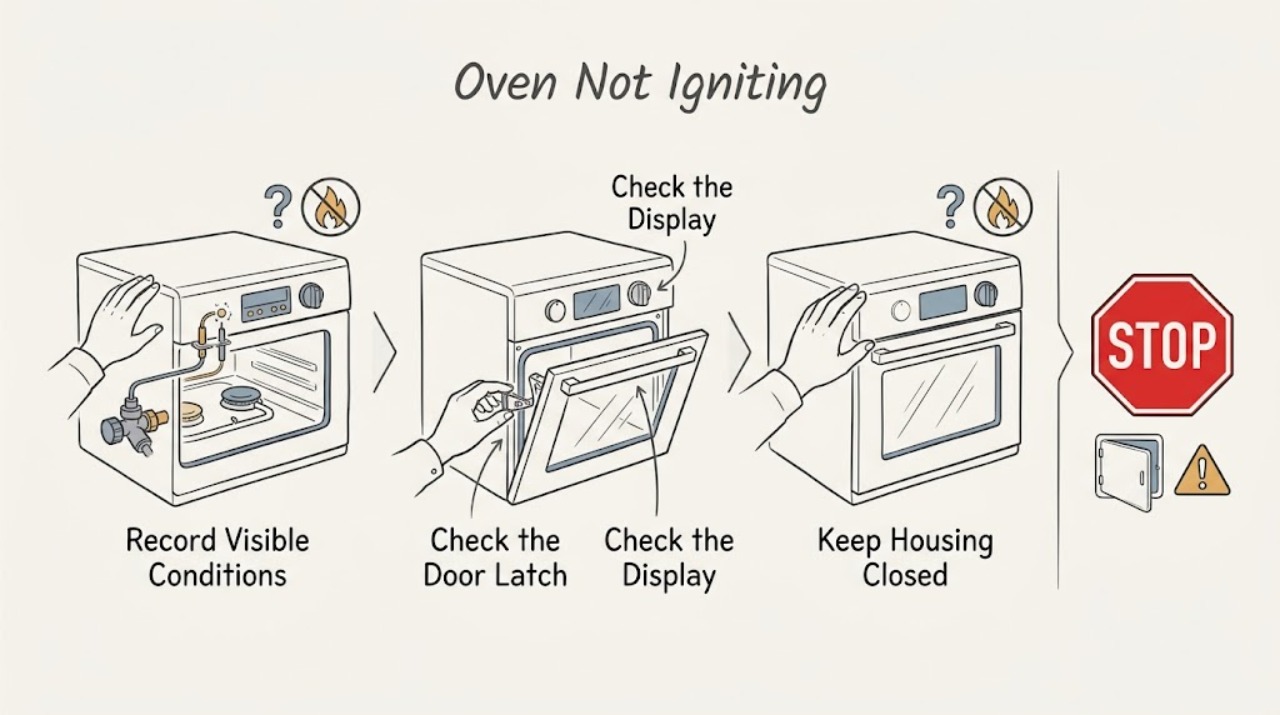
Work through in order
Diagnostic checks
Use only checks that match the exact appliance or system and its official guide.
-
Check 1
Read the rating plate or exact manual and record the Siemens model, fuel type, selected oven function, and whether the oven is a wall oven or part of a gas-combination cooker; do not assume a gas system from the word oven alone.
Expected result: The appliance is confirmed gas or dual-fuel, it is electric or induction, or the fuel type and model cannot be confirmed.
Next step: Use the exact Siemens manual and support category for the confirmed model. If fuel type cannot be verified, stop at identification and request model-specific help rather than attempting ignition tests.
Why this matters
Why: Only a gas-capable model has an oven burner and ignition path. A missing model or uncertain fuel type makes component advice unsafe and can send the diagnosis to the wrong system.
-
Check 2
With no gas odor or other hazard present, confirm the clock, selected heating function, temperature setting, control or child lock, and fully closed door match the exact model instructions; do not force a latch or defeat a safety lock.
Expected result: The controls show a lock, unset clock, delayed or non-heating mode, open door, or normal settings with no ignition response.
Next step: Correct only a plainly incorrect setting using the manual, then make one normal start attempt. If the door will not close or the oven still does not respond, stop and request service.
Why this matters
Why: A control state or door interlock can prevent a heating command from being issued. Siemens support treats controls, door function, and failure to operate as model-specific categories.
-
Check 3
From a dry, safe location, confirm that the appliance has its normal electrical supply and that the accessible gas isolation control is in its normal operating position only if the manual and local installation permit that check; do not touch fittings or test for a leak.
Expected result: The display is dark, the circuit has tripped, the gas supply is unavailable, or supply appears normal while the oven still will not ignite.
Next step: Do not reset repeatedly or open the appliance. If the supply is plainly unavailable, use the appropriate qualified electrical or gas provider; if supply appears normal but ignition fails, request Siemens appliance service.
Why this matters
Why: Ignition controls and safety valves need both the correct appliance state and their required supplies. A tripped circuit, damaged connection, or uncertain gas supply needs qualified assessment rather than repeated starts.
-
Check 4
If the model is gas-capable and there is no gas odor, follow the normal ignition instruction once from a safe position and note whether there is a brief click or spark, a flame that establishes, no spark, or delayed ignition; do not hold the control longer than the manual states.
Expected result: A flame establishes promptly, clicking occurs without flame, there is no ignition response, or ignition is delayed and followed by a whoosh, bang, or abnormal flame.
Next step: For prompt normal ignition, use the oven within the model instructions. For no flame, continuing clicks, delayed ignition, a whoosh or bang, or abnormal flame, stop immediately and obtain qualified gas-appliance service; do not repeat the test.
Why this matters
Why: The pattern distinguishes a normal ignition event from a possible igniter, burner, supply, valve, or control fault, but observation alone cannot prove which component is defective. Delayed ignition can allow unburned gas to accumulate.
-
Check 5
If the oven clicks or sparks but does not light, leave the control off and use the exact manual to identify whether the model permits any external cleaning of a visible burner area; do not remove gas parts, poke an orifice, or reach into a hot cavity.
Expected result: The manual documents a cool, external cleaning step, the burner area is obstructed or wet, or the manual does not authorize user access.
Next step: Perform only the model-documented cool external care step, then stop. Do not disassemble or retry a delayed or abnormal ignition; request qualified service.
Why this matters
Why: Moisture or residue can affect ignition on some gas appliances, but a gas oven's burner and safety system are model-specific. An inaccessible or recurring failure requires professional diagnosis.
-
Check 6
Record any exact display code, symbol, or sequence of lights and compare it with the same model's Siemens manual; do not map a code from a different oven, hob, or region onto this appliance.
Expected result: The code has a matching model-specific instruction, the code is absent or not listed, or the display is accompanied by gas odor, smoke, abnormal flame, or electrical symptoms.
Next step: Follow only the matching low-risk manual step. If the code is unlisted or any hazard is present, leave the oven off and provide the complete display to qualified service.
Why this matters
Why: Siemens support structures troubleshooting by product and model, and ignition categories can differ across appliance families. A code cannot safely replace fuel and model identification.
-
Check 7
Only when there is no gas odor, smoke, heat damage, or electrical danger and the exact manual permits it, perform one normal power reset using the appliance's safe isolation method; then do not repeat ignition if the fault returns.
Expected result: The oven starts normally, the same no-ignition symptom returns, the display remains faulty, or a gas, flame, smoke, carbon-monoxide, or electrical warning appears.
Next step: Stop and request model-specific service for a recurring fault. For gas odor, abnormal flame, smoke, carbon-monoxide concern, arcing, or immediate danger, leave the area and obtain appropriate emergency help first.
Why this matters
Why: A reset may clear a temporary control state but cannot repair a failed igniter, valve, burner, sensor, wiring, or safety control. A returning symptom is an unresolved fault.
Use your observations
Decision map
Find the observation that best matches what you see, then follow the next safe action.
-
PATH 01Next step
What you see
The appliance is electric or induction, not gas-capable.
Do this next
Arrange qualified service and follow the exact model guidance.
Why this path and its safety boundary
Why it matters: Do not troubleshoot gas ignition. Use the exact electric-oven power, mode, door, and heating guidance for the model.
-
PATH 02Next step
What you see
The model or fuel type cannot be confirmed.
Do this next
Arrange qualified service and follow the exact model guidance.
Why this path and its safety boundary
Why it matters: Stop at identification and obtain the Siemens manual or model-specific support. Do not attempt ignition or component work by assumption.
-
PATH 03Next step
What you see
The display is dark, the clock or control lock is active, or the door is not detected closed.
Do this next
Arrange qualified service and follow the exact model guidance.
Why this path and its safety boundary
Why it matters: Correct only the model-documented setting or visible closure issue, then make one normal start attempt. A recurring lock or control problem needs service.
-
PATH 04Next step
What you see
A gas model has a brief ignition click and prompt normal flame.
Do this next
Arrange qualified service and follow the exact model guidance.
Why this path and its safety boundary
Why it matters: This may be normal operation. Continue only within the manual and monitor for delayed ignition or abnormal flame.
-
PATH 05Next step
What you see
A gas model clicks without flame, produces no spark, or fails repeatedly.
Do this next
Arrange qualified service and follow the exact model guidance.
Why this path and its safety boundary
Why it matters: Stop ignition attempts. Keep the control off and request qualified gas-appliance service rather than removing gas parts or testing repeatedly.
-
PATH 06Next step
What you see
Ignition is delayed or followed by a whoosh, bang, abnormal flame, or gas odor.
Do this next
Arrange qualified service and follow the exact model guidance.
Why this path and its safety boundary
Why it matters: Stop immediately, avoid switches and flames, leave the area if needed, and obtain appropriate gas-safety or emergency help from a safe location.
-
PATH 07Next step
What you see
An exact model error code has a matching Siemens low-risk instruction.
Do this next
Arrange qualified service and follow the exact model guidance.
Why this path and its safety boundary
Why it matters: Follow only that instruction. Do not use a code meaning from another model or appliance family.
-
PATH 08Next step
What you see
The symptom remains after one permitted normal reset or the oven shows smoke, carbon-monoxide concern, arcing, or overheating.
Do this next
Arrange qualified service and follow the exact model guidance.
Why this path and its safety boundary
Why it matters: Leave the oven off and arrange qualified service. Do not resume ignition testing to gather more evidence.
Helpful context
Understand the symptom
Confirm the appliance can use gas
Siemens sells electric, gas, and combination cooking appliances. Confirm fuel type from the rating plate, installation information, or manual before interpreting a no-ignition symptom. If the appliance is electric, troubleshoot power, mode, door, and heating controls instead; do not look for a gas igniter that the appliance does not have.
No spark and no flame are different clues
A gas oven may click or spark but fail to establish a flame, or it may produce no ignition response at all. Those observations can point to different control, ignition, fuel, or safety-interlock paths, but they do not identify a replaceable part by themselves. Keep the oven off if ignition is delayed or the flame behavior is abnormal.
Gas safety overrides diagnosis
Do not test for a leak with a flame, repeatedly turn an ignition control, remove burner or gas fittings, or open panels. A gas odor, explosion-like sound, abnormal flame, smoke, or a carbon-monoxide concern requires safe evacuation and appropriate emergency or gas-safety assistance before appliance troubleshooting.
Safety boundary
Stop conditions
- Stop immediately for gas odor, delayed ignition, a whoosh or bang, abnormal flame, smoke, carbon-monoxide concern, or any sign of fire.
- Stop for arcing, burning odor, a hot or damaged electrical connection, repeated breaker trips, or uncontrolled heating.
- Never test for a gas leak with a flame, remove gas fittings, poke burner orifices, open panels, or bypass a door or safety interlock.
- Do not repeat ignition attempts when the burner does not light or the exact model and fuel type are uncertain.
Only after diagnosis
Potential parts
- gas oven igniter
Consider only after qualified diagnosis confirms a gas model and links no spark or no ignition to the exact model's igniter circuit.
Confirm the full Siemens model, fuel configuration, and manufacturer fit information before selecting any part. - gas valve or flame-safety component
Consider only after qualified testing shows that the gas valve or flame-safety system is responsible for a confirmed ignition failure.
Gas components require model-specific service procedures and must not be selected from a symptom or code alone. - oven control or temperature-sensing component
Consider only when the exact model diagnosis links a control, sensor, or interlock fault to the no-ignition command.
Confirm appliance type, model, fuel configuration, and approved service procedure before any replacement.
When checks do not resolve it
Need a professional?
Use qualified service for any recurring no-ignition condition, suspected gas or ignition component, abnormal flame, safety interlock problem, or model-uncertain fault.
Safety scope: Do not open panels, loosen gas fittings, test for leaks with a flame, bypass a safety control, or repeatedly ignite the oven. Gas odor, delayed ignition, smoke, abnormal flame, carbon-monoxide concern, or immediate danger requires evacuation and appropriate emergency help first.
Common questions
FAQ
How do I know whether my Siemens oven uses gas?
Check the rating plate, installation information, or exact manual. Siemens makes several oven and combination-appliance types, so do not assume an oven has a gas burner or igniter.
What if my Siemens gas oven clicks but does not light?
Keep the control off and do not repeat ignition attempts. If there is no gas odor or abnormal flame, use only the exact model's low-risk guidance; a recurring no-flame condition needs qualified gas-appliance service.
Can I keep trying if I smell gas?
No. Stop, avoid flames and electrical switches, leave the area if needed, and obtain appropriate gas-safety or emergency help from a safe location. Do not search for a leak or restart the oven.
Is a failed igniter the only reason a Siemens gas oven will not ignite?
No. Fuel supply, controls, door or safety interlocks, burner condition, valve, sensor, wiring, and the exact model configuration can change the diagnosis. A sound or code alone does not select a part.
Read the exact guide
Official sources
- Model HG73G6257M/01: User manuals, spare parts, accessories | Siemens HomeSiemens Home Appliances · Siemens gas range model support structure, ignition-fault category, manuals, and installation documents
- Product group Ovens | Siemens HomeSiemens Home Appliances · Siemens oven model-specific troubleshooting categories, manuals, ignition-related support, and safety guidance
- Customer support for your home appliance | Siemens Home AppliancesSiemens Home Appliances · Siemens appliance support, troubleshooting, manuals, and repair routing across oven and gas-appliance categories
Community feedback
Share a repair observation
Share a plain-text repair observation. Accepted observations are published automatically; this page may take a moment to update.