
On this page
Start here
Quick answer
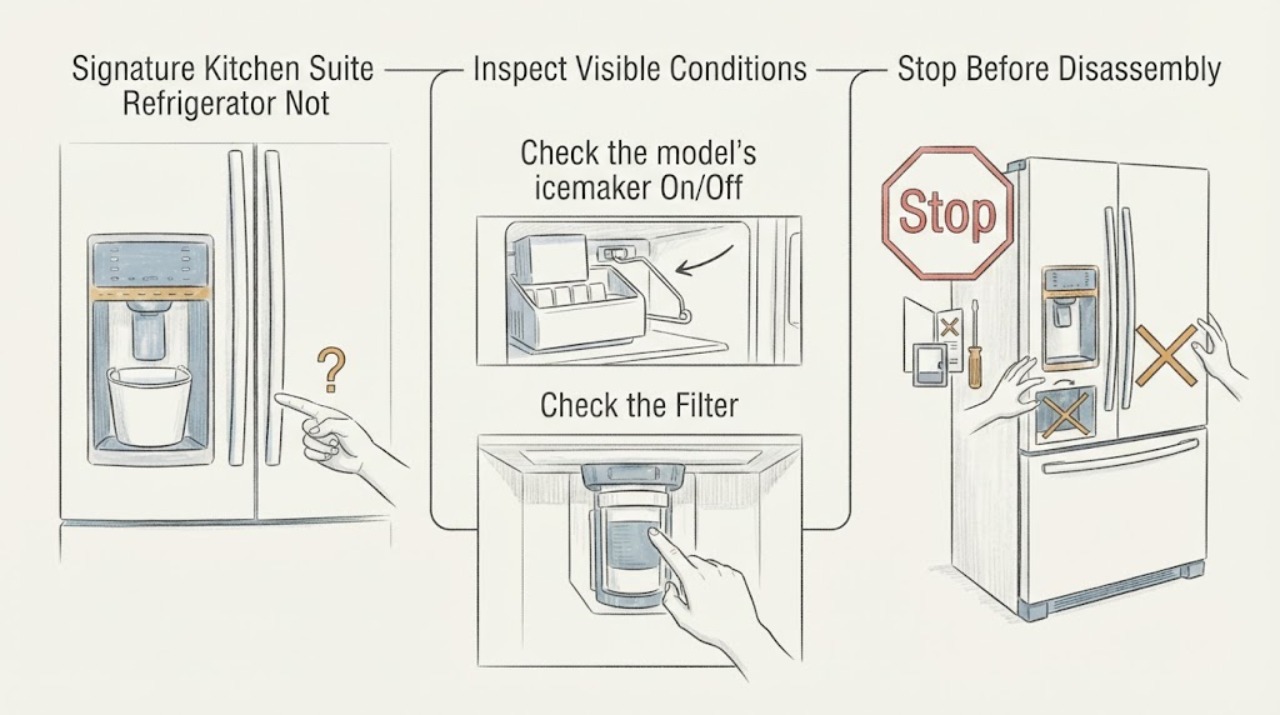
Start by identifying the exact Signature Kitchen Suite refrigerator model and whether the affected maker produces cubed ice, Craft Ice, or another model-specific option. Confirm the icemaker is turned on, the ice-detecting sensor or shutoff arm has a clear path, the freezer is cold, the doors close fully, and the water supply valve is open with no visible kink in the supply line. A recently installed refrigerator or newly connected icemaker may need the model's documented startup period. If the refrigerator is cold and supplied with water but still makes no ice after those checks, arrange service rather than replacing a valve or icemaker from the symptom alone.
Work through in order
Diagnostic checks
Use only checks that match the exact appliance or system and its official guide.
-
Check 1
Record the exact refrigerator model and identify the affected ice maker. Observe whether the refrigerator and freezer are cooling normally, whether the icemaker has an On/Off control, whether the ice bin is full, and whether the problem began after installation, a water-filter change, a power outage, or cleaning.
Expected result: The model has a cubed-ice maker, a Craft Ice maker, or another documented option; the unit is recently installed or reconnected; the maker is disabled; the bin is full; or the model and ice-maker type are unclear.
Next step: Use the exact model manual and wait only the startup period it documents when the refrigerator was recently installed or connected. Continue with the external checks below when the appliance is established and the bin is not full; do not force a harvest cycle or open the ice maker.
Why this matters
Why: Signature Kitchen Suite manuals do not use one production schedule or control layout for every refrigerator. The cited manuals describe a startup delay after installation or connection and different ice-maker features, so the model and timing change the correct next check.
-
Check 2
Check the model's icemaker On/Off setting and inspect the user-accessible ice bin area. Make sure a feeler arm moves freely when the model uses one, or that no ice, frost, or foreign material blocks the electronic ice-detecting sensors. Do not chip at a frozen mechanism or reach into moving parts.
Expected result: The icemaker is off, the bin is full, an arm or sensor path is blocked, frost is present around a sensor, or the control and sensor area are clear.
Next step: Enable the icemaker or remove only a loose, visible obstruction, then monitor one normal cycle using the model guide. If the arm will not move, frost returns, or a clear sensor path still produces no ice, stop before disassembly and arrange service.
Why this matters
Why: The owner manuals state that an off icemaker cannot produce ice and that an obstructed arm or sensor can interrupt or fail to stop production. A clear bin area does not prove that the internal icemaker motor or control is working.
-
Check 3
Check the external water supply: confirm the refrigerator's cold-water shutoff valve is fully open, inspect the visible tubing for a kink or damage, and verify the water dispenser's flow if the model has one. If the model manual calls for inlet-filter work, turn off the water supply before disconnecting any hose and check every reconnected joint for leaks.
Expected result: The valve is closed, the tubing is kinked or damaged, dispenser flow is reduced, a filter indicator is active, the supply uses reverse osmosis, or the external water path appears normal.
Next step: Open a clearly closed valve or correct a visible kink only when the line remains intact and dry. Follow the exact model's filter instructions for any replacement, and use a plumber when house pressure or the water installation is the issue. Persistent no ice with a normal external supply needs appliance service.
Why this matters
Why: Signature Kitchen Suite manuals link no ice or reduced production to a disconnected or restricted supply, an exhausted filter, low house pressure, a kinked line, or reverse-osmosis pressure. A normal dispenser does not conclusively prove that the icemaker inlet valve or internal fill path works.
-
Check 4
Check the freezer conditions without disassembling the refrigerator. Confirm the freezer temperature is at the model's recommended setting, air vents are not packed against food, and both refrigerator doors close completely with the ice bin, shelves, and door bins seated correctly.
Expected result: The freezer is warmer than the model setting, vents are blocked, a door or ice bin is out of position, doors are opened frequently, or temperature and closure appear normal.
Next step: Restore airflow and door or bin seating, reduce unnecessary door openings, and allow the compartment to stabilize before one supervised ice check. Do not use a hair dryer or other improvised heat to clear frost; request service if abnormal frost or temperature persists.
Why this matters
Why: The manuals state that a warm freezer, warm air entering through frequent or incomplete door closure, and restricted airflow can reduce or delay ice production. A cold freezer with correctly closed doors makes those operating conditions less likely but does not identify an internal fault.
-
Check 5
After the external checks, record whether the icemaker makes a fill sound, produces partial or malformed ice, shows a water-filter or temperature indication, or remains completely silent. Compare the observation with the exact model manual instead of repeatedly cycling power or forcing the feeler arm.
Expected result: Ice production returns, only small or partial ice appears, the icemaker remains silent with normal temperature and water, or the refrigerator shows a persistent fault or leak.
Next step: Monitor one normal cycle after a safe correction. If no ice returns, provide the exact model, ice-maker type, time since installation or last batch, water and temperature observations, and any display indication to qualified service; do not select a replacement part from the symptom alone.
Why this matters
Why: Returning production after a documented supply, setting, or temperature correction favors an operating condition. Partial ice, silence with normal external conditions, and persistent faults leave an internal fill, control, icemaker, or cooling issue unresolved.
Use your observations
Decision map
Find the observation that best matches what you see, then follow the next safe action.
-
PATH 01Next step
What you see
The refrigerator or icemaker was recently installed, reconnected, or restored after an outage, and the freezer is still reaching its model-specific operating temperature.
Do this next
Keep the refrigerator powered and supplied as the model manual directs, then wait only the stated startup period before judging production. Request service if the documented period passes with normal temperature and no ice.
Why this path and its safety boundary
Why it matters: The documented startup or temperature-stabilization period is a more likely explanation than an established failed icemaker.
-
PATH 02Next step
What you see
The icemaker is switched off, the storage bin is full, or a feeler arm or electronic ice sensor is visibly obstructed.
Do this next
Enable the maker or clear only a loose, accessible obstruction, then observe one normal cycle. If the arm or sensor remains stuck or production does not return, arrange model-specific service.
Why this path and its safety boundary
Why it matters: A documented enablement or ice-level condition can stop production without proving a failed valve, motor, or control.
-
PATH 03Next step
What you see
The water shutoff is closed, the supply tubing is kinked, dispenser flow is reduced, or a filter or reverse-osmosis setup is affecting water flow.
Do this next
Correct the safe external supply condition and check for leaks. Follow the exact model filter instructions or contact a plumber for pressure or installation issues; use appliance service if water delivery appears normal but no ice returns.
Why this path and its safety boundary
Why it matters: The no-ice condition is consistent with restricted or insufficient water delivery, while the icemaker itself remains unproven.
-
PATH 04Next step
What you see
The freezer is warmer than the model setting, vents or doors are obstructed, or the ice bin is not seated correctly.
Do this next
Restore clear airflow and complete door and bin closure, allow the freezer to stabilize, and monitor one cycle. Persistent warm conditions or abnormal frost require qualified service.
Why this path and its safety boundary
Why it matters: Temperature, airflow, or door-sealing conditions can reduce ice production and should be corrected before an internal diagnosis.
-
PATH 05Next step
What you see
The refrigerator is cold, the icemaker is enabled, the bin and sensor path are clear, water is available, and the model's documented startup period has passed, but no ice is produced.
Do this next
Stop owner troubleshooting and arrange qualified Signature Kitchen Suite service with the model, icemaker type, timing, water and temperature observations, and any sound, frost, leak, or display details. Do not remove panels or force a harvest cycle.
Why this path and its safety boundary
Why it matters: The remaining possibilities include an internal icemaker, fill, control, or cooling fault that cannot be identified safely from the symptom alone.
Helpful context
Understand the symptom
A Signature Kitchen Suite refrigerator can have a full-size freezer icemaker, a Craft Ice maker, or another model-specific configuration. No ice does not identify one failed part. The useful distinction is whether the maker is disabled or sensing a full bin, whether water can reach it, whether the freezer is cold enough, and whether the refrigerator was recently installed or reconnected. Use the model number on the rating plate to select the matching manual before changing a setting or removing a bin.
When checks do not resolve it
Need a professional?
Arrange qualified Signature Kitchen Suite service when no ice persists after the exact model's external setting, sensor, water-supply, door, airflow, and temperature checks; when an arm or sensor will not move; when the refrigerator remains warm or abnormally frosted; or when diagnosis would require removing panels, testing internal wiring, accessing the icemaker motor or inlet valve, or working on the sealed cooling system. Provide the exact model, ice-maker type, time since installation or last batch, icemaker setting, bin and sensor condition, water and filter observations, freezer temperature, and any noise, leak, or display indication. Use Signature Kitchen Suite support and the model manual for approved service and part identification.
Common questions
FAQ
Why is my Signature Kitchen Suite refrigerator not making ice after installation?
The owner manual for the exact model controls the waiting period. Some Signature Kitchen Suite manuals state that a new refrigerator or newly connected icemaker needs time for the compartment to reach temperature before production begins. Confirm the icemaker is on, water is connected, the freezer reaches its setting, and the bin or sensor is not obstructed before requesting service.
Can a blocked sensor or feeler arm stop a Signature Kitchen Suite icemaker?
Yes. The manuals say frost, foreign material, or an obstructed feeler arm or electronic sensor path can interrupt ice production or the full-bin stop. Clear only a loose, visible obstruction and do not force the mechanism. If the sensor remains blocked or the maker stays idle, arrange service.
Could the water filter or supply cause no ice?
Yes. Signature Kitchen Suite identifies a closed or clogged supply, kinked tubing, reduced water pressure, an exhausted filter, and reverse-osmosis pressure as possible ice-production problems. Check the external valve and tubing, follow the exact model's filter instructions, and use a plumber for water-installation or pressure problems.
Should I replace the Signature Kitchen Suite icemaker or water valve?
Not from the no-ice symptom alone. First record the model, icemaker type, setting, sensor or bin condition, water flow, freezer temperature, and startup timing. If the external checks do not restore production, qualified service should confirm the failed component and the compatible repair for that model.
Read the exact guide
Official sources
- OWNER'S MANUALSignature Kitchen Suite · Signature Kitchen Suite built-in refrigerator models SKSFD4826P and SKSFD4826SP, including cubed and Craft Ice operation and no-ice troubleshooting.
- Service CentresSignature Kitchen Suite · Signature Kitchen Suite customer-care and authorized service-centre routing.
- OWNER'S MANUALSignature Kitchen Suite · Signature Kitchen Suite French Door refrigerator family SKSFD3623, including automatic and Craft Ice maker operation and troubleshooting.
Community feedback
Share a repair observation
Share a plain-text repair observation. Accepted observations are published automatically; this page may take a moment to update.