
On this page
Start here
Quick answer
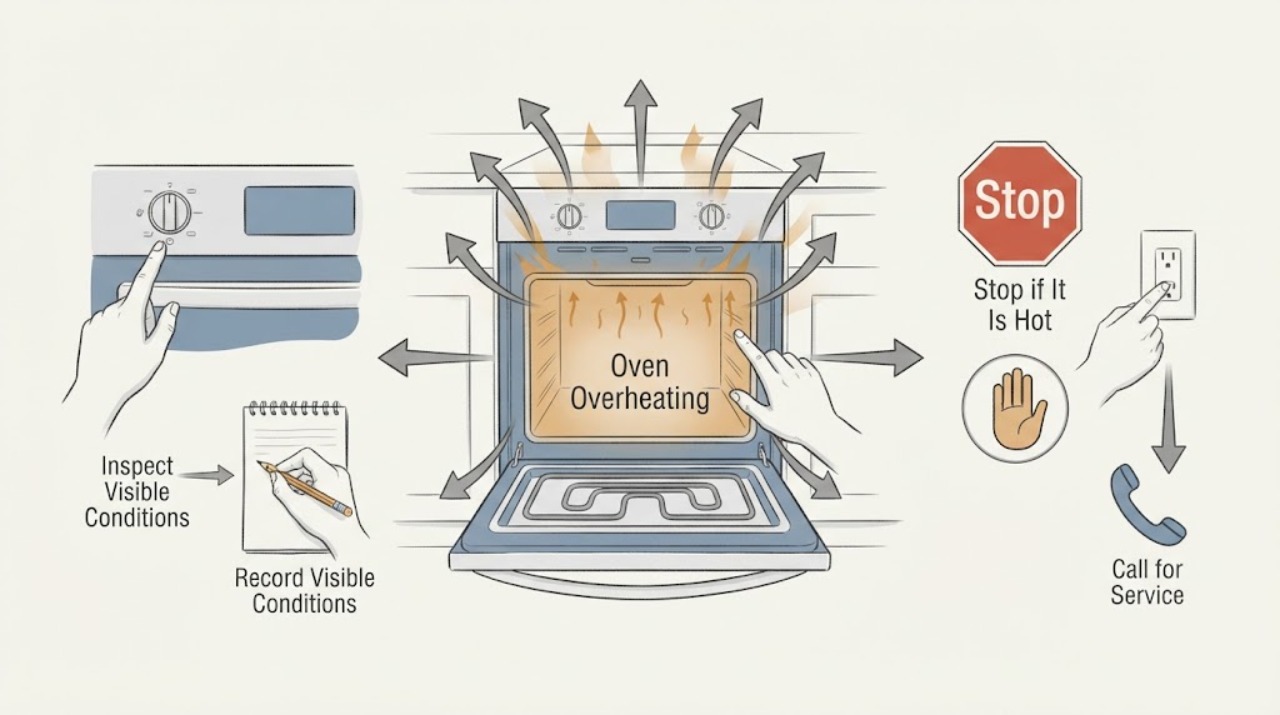
First distinguish normal heat: a hot door, warm vent air, and a cooling fan that runs during or after cooking can occur on Smeg ovens. Overheating is more concerning when the oven keeps heating after being turned off, the temperature rises far beyond the selected setting, food or nearby surfaces scorch, smoke appears, a gas flame is abnormal, or an electrical protection device trips. Let the appliance cool, record the exact model, mode, temperature, display, and timing, and make only the safe external checks in the model manual. Stop immediately for smoke, fire, a carbon-monoxide alarm or symptoms, gas odor, delayed ignition or an abnormal flame, arcing, burning odor, a hot connection, or repeated breaker trips; do not open the oven or bypass a safety device.
Work through in order
Diagnostic checks
Use only checks that match the exact appliance or system and its official guide.
-
Check 1
If the oven is hot, switch it off using the normal control only if there is no smoke, fire, gas odor, arcing, or other immediate hazard, then keep people away until the surfaces cool. Look for smoke, flames, a carbon-monoxide alarm or symptoms, an abnormal gas flame, an ignition bang, burning odor, sparks, or a hot/damaged plug or outlet.
Expected result: Any emergency warning is present, or the oven cannot be stopped normally.
Next step: Stop using the appliance. For suspected gas, do not operate switches or create a flame; leave from a safe route and contact the gas supplier or emergency services from a safe location. For smoke, fire, or electrical danger, leave and contact emergency services. Do not return or reuse until the area and appliance are declared safe.
Stop if: Smoke, fire, CO alarm or symptoms, gas odor, delayed ignition/bang, abnormal flame, arcing, burning odor, hot damaged connection, or failure to turn off means stop immediately; do not reset or re-run the oven.
Why this matters
Why: This is a fire, carbon-monoxide, gas, burn, or electrical emergency rather than a calibration or cooking-setting issue.
-
Check 2
After the appliance is cool and safe, record the model and serial, heating type, selected mode, target temperature, timer or delayed-start state, exact display message, and when the overheating occurs: during preheat, after reaching temperature, when the door is opened, or after the controls are turned off.
Expected result: The model, mode, setting, display, and timing are clear; the symptom may be a warm vent/fan after cooking or a continued heat rise after an off command.
Next step: Use the exact model manual for the recorded mode and display. Keep the oven off if it heats with no active request or if the display fault returns.
Stop if: Stop if recording requires moving the range, touching hot parts, removing a cover, or continuing while a safety warning is present.
Why this matters
Why: The timing separates expected cooling behavior from a temperature-control or shutdown fault and avoids applying another Smeg model's limits or code explanation.
-
Check 3
Compare the observed heat with the selected mode and the exact manual: confirm that a high-heat, grill, self-clean, rapid-preheat, or other intentionally hot mode is not selected, and check that a timer, delayed start, demonstration state, or control lock is not causing unexpected operation.
Expected result: The mode or setting explains the heat and the oven returns to normal cooling, or the oven continues heating despite an appropriate lower setting or an off command.
Next step: Correct only the documented setting and observe one normal cycle. If the oven ignores the off command or repeats the overshoot, leave it off and arrange service.
Stop if: Do not keep cycling controls to force a shutdown, bypass a lockout, or continue if smoke, gas odor, abnormal flame, or electrical warning appears.
Why this matters
Why: A wrong mode can look like overheating; continued heating after an off command points toward a control, relay, sensor, burner, or safety-system fault instead.
-
Check 4
With the oven cool, inspect only visible user-accessible airflow and door conditions: check that the vent and air intake are not covered by foil or objects, that the door closes normally, and that the visible gasket is not damaged or displaced.
Expected result: A vent is blocked, foil covers an opening, the door does not close, or the gasket is damaged; alternatively, the visible airflow and door are normal.
Next step: Remove only a loose, cool, user-removable obstruction when the exact manual permits it. Leave the appliance off and arrange service for a damaged gasket, door, inaccessible blockage, or any continued overheating.
Stop if: Do not remove the gasket, dismantle the door, reach into hot areas, cover openings, or disassemble an airflow path.
Why this matters
Why: Blocked cooling airflow or a damaged door system can raise temperatures or make the oven appear hotter, but a visual check cannot prove an internal temperature-control fault.
-
Check 5
For a gas Smeg model only, and only with no gas odor or other hazard, observe one normal heating cycle from outside: note whether the burner lights promptly, cycles off near the selected setting, and remains a stable normal flame rather than yellow, sooty, noisy, delayed, or outside the intended burner area.
Expected result: The gas flame is abnormal, remains on continuously, lights with a delay or bang, goes out and relights repeatedly, or the oven overheats while the setting is unchanged.
Next step: Stop the cycle and arrange qualified gas-appliance service. Do not adjust an orifice, regulator, valve, burner, or flame-safety device, and do not run the oven again until cleared.
Stop if: Any gas odor, delayed ignition/bang, burn-back, abnormal flame, smoke, soot, or inability to stop normally requires immediate shutdown and qualified gas help.
Why this matters
Why: The pattern can indicate a gas, burner, flame-sensing, safety-valve, temperature-control, or combustion problem; it is not safe to identify the component by repeated relighting.
-
Check 6
For an electric or mixed-fuel Smeg model, observe only the external control and power symptoms after cooling: note whether the display or fan remains active after an off command, whether a breaker trips, or whether the plug, receptacle, or surrounding trim is hot, discolored, wet, or damaged.
Expected result: The oven remains powered or heating after shutdown, trips protection, or shows a hot/damaged electrical connection; or it cools normally with no electrical warning.
Next step: Leave the oven off and use qualified appliance or electrical service for any persistent operation, trip, heat, damage, or odor. Never probe energized wiring or repeatedly reset a breaker.
Stop if: Stop for arcing, burning smell, smoke, hot/discolored outlet, wet electrical parts, or any need to open a panel or perform live measurements.
Why this matters
Why: Continued operation or electrical warning can indicate a control/relay, wiring, supply, or appliance fault and presents a fire or shock risk; a normal cool-down makes a runaway fault less likely but does not prove calibration.
-
Check 7
Use only the single reset or cancel-and-retry procedure explicitly authorized by the exact Smeg manual for the recorded display or control condition, and do it only after the oven is cool and no stop condition exists.
Expected result: The oven returns to normal cycling and stops heating at the selected setting, or it overheats again, ignores the off command, or shows the same fault.
Next step: Stop user diagnosis and give qualified service the model/serial, mode and temperature, display, timing, fan/vent behavior, gas flame observations if applicable, and all safety symptoms.
Stop if: Do not repeat resets, bypass a safety lockout, operate an oven that continues heating after shutdown, or remove panels for gas or electrical diagnosis.
Why this matters
Why: A one-time recovery may clear a transient control state; a returning symptom points to a persistent sensor, control, relay, burner, safety, or airflow problem.
Use your observations
Decision map
Find the observation that best matches what you see, then follow the next safe action.
-
PATH 01Next step
What you see
The oven is warm at the vent or door and the cooling fan runs during or after a cycle, but it respects the selected mode and off command
Do this next
Allow the model-specific cool-down to finish and keep vents clear; arrange service if the temperature becomes unsafe or behavior changes.
Why this path and its safety boundary
Why it matters: Normal heat removal is more likely than temperature runaway
-
PATH 02Next step
What you see
The oven continues heating after an off command, repeatedly overshoots, or cannot be controlled
Do this next
Stop using the oven and arrange qualified appliance service; do not keep cycling the controls or open the appliance.
Why this path and its safety boundary
Why it matters: A control, relay, sensor, burner, or safety-system fault is more likely
-
PATH 03Next step
What you see
A high-heat or grill-like mode, delayed start, timer, or other documented setting explains the temperature
Do this next
Correct the setting according to the exact model manual and observe one normal cycle; escalate if heat remains uncontrolled.
Why this path and its safety boundary
Why it matters: A control-state or expected high-temperature condition is possible
-
PATH 04Next step
What you see
A vent is blocked, foil covers an opening, or the door/gasket is visibly abnormal while cool
Do this next
Remove only a clearly loose, cool obstruction permitted by the manual; service any damaged seal, door, or inaccessible vent.
Why this path and its safety boundary
Why it matters: Airflow or heat retention may contribute, but the door and combustion path must remain intact
-
PATH 05Next step
What you see
A gas model shows delayed ignition, abnormal flame, soot, burn-back, or flame that will not cycle normally
Do this next
Stop, avoid relighting, isolate gas only if safely accessible, and contact qualified gas-appliance service; do not reuse until cleared.
Why this path and its safety boundary
Why it matters: Unsafe combustion or gas-control behavior
-
PATH 06Next step
What you see
Smoke, fire, CO alarm or symptoms, gas odor, arcing, burning odor, hot connection, wet electrical parts, or repeated trips occur
Do this next
Leave or isolate the hazard as appropriate, contact emergency/gas/electrical professionals from a safe location, and do not return or reuse until cleared.
Why this path and its safety boundary
Why it matters: Emergency or high-risk condition
Helpful context
Understand the symptom
Normal heat versus a real overheating fault
A Smeg oven can feel hot around the door and can discharge warm air through its cooling path. On a representative Smeg full-gas range, the product information identifies an oven cooling system and a gas oven with a defined temperature range; other Smeg models may use different heating systems and controls. The exact model manual therefore determines which fan sounds, vent locations, temperature limits, and heating modes are expected.
Why the symptom matters
If the oven is merely warm around the vent or fan after a cycle, it may be shedding stored heat. If heat continues after an off command or the oven repeatedly overshoots, the cause may be a control setting, door or airflow problem, temperature-sensing fault, relay or control fault, or—on a gas model—a burner, flame-safety, or gas-control problem. Those internal causes are model-specific and should be diagnosed by qualified service.
Keep the checks external and cool
Do not touch the cavity, racks, door glass, or trim until cool. Do not cover vents or openings with foil, use the oven as a room heater, remove the door gasket, or probe live wiring. Smeg's safety guidance places gas installation and service with qualified personnel and warns against operating switches or trying to light an appliance when gas is suspected.
Only after diagnosis
Potential parts
- oven temperature sensor or thermostat
Consider only if qualified diagnosis shows the sensor or thermostat is reporting or controlling temperature incorrectly on the exact model.
Confirm the complete Smeg model and the manufacturer's fit information before selecting any temperature-control part. - control board or heating relay
Consider only when the oven continues heating after an off command and a qualified technician confirms a control or relay fault.
Do not infer a board or relay failure from overheating alone; model and revision must be verified by qualified service. - gas oven burner or flame-safety component
Consider only for a gas model after qualified service confirms abnormal combustion, flame sensing, burner, or gas-control behavior.
Gas components are model- and region-dependent; do not substitute by appearance or attempt adjustment yourself.
Common questions
FAQ
Is a hot Smeg oven door or warm vent always overheating?
No. Warm surfaces, vent air, and a cooling fan during or after cooking can be normal, depending on the exact model. It is concerning when the oven ignores the off command, repeatedly overshoots, smokes, or produces an abnormal flame or electrical warning.
What should I do if the Smeg oven keeps heating after I turn it off?
Stop using it and do not keep cycling the controls. Once safe, provide the technician the model, mode, temperature, display, and timing; a persistent shutdown failure needs qualified appliance diagnosis.
Can foil over the oven vent cause overheating?
It can obstruct required airflow and create a safety risk. With the oven cool, remove only a loose, user-accessible obstruction when the exact manual permits it; do not cover vents or openings with foil and do not dismantle the appliance.
When is overheating on a Smeg gas oven an emergency?
Treat gas odor, delayed ignition or a bang, yellow or sooty flame, burn-back, smoke, fire, a carbon-monoxide alarm or symptoms, or inability to shut down normally as an emergency or high-risk condition. Stop, avoid switches and flames, leave if needed, and call qualified or emergency help from a safe location.
Should I replace the temperature sensor when a Smeg oven runs hot?
Not from the symptom alone. A hot oven can involve settings, airflow, sensing, controls, relays, or gas combustion depending on the model. Have the exact model and observed behavior diagnosed before selecting a part.
Read the exact guide
Official sources
- Gas Appliance Safety & WarrantySmeg · Smeg gas-appliance safety guidance for a regional market; local code and exact model instructions control.
- Guide to Home Wiring HazardsU.S. Consumer Product Safety Commission · General household electrical safety guidance, not a Smeg repair manual.
- Guidelines for Cleaning Safely After a DisasterCenters for Disease Control and Prevention · General emergency guidance; follow local emergency and gas-supplier instructions.
- 02 477 B359 EN.fmSmeg · Official Smeg user manual for a specific gas-range family; the exact model manual takes precedence.
- SPR30UGGX 30" Full Gas RangeSmeg · A representative Smeg full-gas range page; exact model documentation controls for other Smeg ovens.
Community feedback
Share a repair observation
Share a plain-text repair observation. Accepted observations are published automatically; this page may take a moment to update.