
On this page
Start here
Quick answer
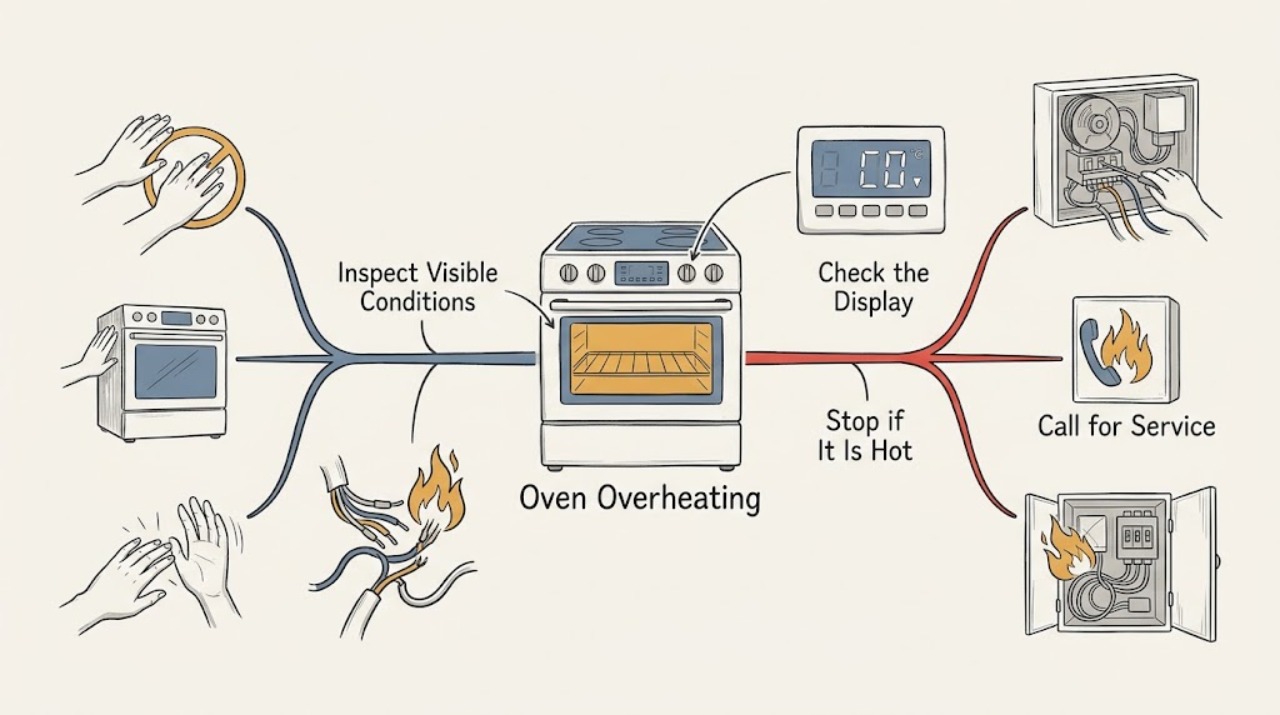
If a GE oven is actually continuing to heat, shut it off and stop using it. If it ignores Cancel or Off, disconnect power only when this can be done safely; for a gas model, turn the oven control off and do not touch electrical switches if you smell gas. A cooling fan that continues after cooking, or heating elements that cycle on and off, can be normal. Food browning too quickly or a measured temperature that is consistently high is a different problem that may be addressed by model-specific temperature calibration. Smoke, flame, burning odor, visible arcing, gas odor, a failed control, a hot door or cabinet, or a repeated breaker trip requires immediate shutdown and qualified service, not internal disassembly.
Work through in order
Diagnostic checks
Use only checks that match the exact appliance or system and its official guide.
-
Check 1
Press Cancel, Off, or Power once and observe from a safe distance whether the heating elements or gas flame stop. Do not open the door repeatedly or reach inside to test the temperature.
Expected result: Heating stops and only a cooling fan continues, or the elements or flame continue after the stop command.
Next step: If heat continues, leave the oven off and disconnect power only if safe; arrange qualified service instead of repeating the test.
Why this matters
Why: A post-cook cooling fan can be normal, but continued heat generation after cancellation suggests a control, sensor, relay, or fuel-system fault.
-
Check 2
Check the panel and oven behavior without opening the appliance: note whether the display responds, whether an error appears, whether the door or cabinet is unusually hot, and whether the fan alone is running after cooking.
Expected result: The display is normal and only the fan runs, or the controls are frozen, an error is present, or heat remains uncontrolled.
Next step: Follow the model manual only for a documented control response. Keep the oven off and call service for a frozen control, error, or uncontrolled heat.
Why this matters
Why: Fan-only cooldown can be normal; unresponsive controls, error states, or uncontrolled heat are not evidence that a temperature calibration will solve the problem.
-
Check 3
Decide whether the concern is cooking too hot rather than uncontrolled heating. Compare the selected mode and temperature with the recipe, rack position, cookware placement, and whether Convection Conversion or another mode-specific setting is active.
Expected result: The oven turns off and on normally but food consistently browns or cooks too quickly, or the apparent high temperature occurs only in one mode.
Next step: Use GE's model-specific temperature guidance and consider one documented calibration adjustment only after confirming the oven cycles normally; do not calibrate a dangerous or uncontrolled oven.
Why this matters
Why: A normal temperature swing, rack or pan placement, convection conversion, or a user-adjustable thermostat offset can feel like overheating without a stuck heater.
-
Check 4
If the oven is cool enough and no warning sign is present, inspect only the visible door seal, rack placement, and air circulation. Keep pans clear of the walls and do not cover the entire rack with foil.
Expected result: The gasket is torn, racks or pans block the door or circulation, or foil covers the rack; or the visible setup is correct but the oven still overheats.
Next step: Correct only the external rack, pan, or foil placement. Do not use a damaged gasket or continue using an oven that remains abnormally hot; arrange service.
Why this matters
Why: Poor sealing or blocked circulation can change cooking results, but an intact setup with persistent uncontrolled heat points toward a service fault.
-
Check 5
For a gas oven, stop immediately if you smell unburned gas, hear a boom, see the door move, or see an abnormal flame. For an electric oven, stop for smoke, a spark, visible arcing, a burning odor, damaged wiring, or a breaker that trips again.
Expected result: A gas or electrical danger sign is present.
Next step: For gas odor, avoid electrical switches and flames, leave the area, and contact the gas supplier or emergency services from outside. For smoke or electrical fire signs, shut off power only if safe and use emergency services; otherwise call qualified service.
Why this matters
Why: These are fuel, fire, or shock hazards, not temperature-calibration symptoms.
-
Check 6
If the oven is powered down and safe, record the model number, fuel type, mode, set temperature, display message, fan behavior, whether heating stops at Cancel, and the exact cooking or heat symptom. Use the model manual before considering calibration or service.
Expected result: The manual documents a calibration path for a stable temperature offset, or it does not explain the persistent overheating or uncontrolled heat.
Next step: Make at most one model-documented calibration adjustment for a stable offset. For uncontrolled heat, warning signs, or a recurring fault, leave the oven off and arrange professional diagnosis.
Why this matters
Why: Calibration can address a consistent set-temperature preference on supported modes; it cannot establish that a control, sensor, element, ignition, or gas valve is safe.
-
Check 7
After any safe external check, do not perform live measurements, remove a control panel, access a burner or element connection, bypass a thermostat or door switch, or open a gas path.
Expected result: An internal component would need to be inspected to explain the fault.
Next step: Keep the oven de-energized or the gas appliance unused and schedule qualified appliance service; provide the recorded observations.
Why this matters
Why: The problem has reached the appliance service boundary and requires qualified equipment and model-specific procedures.
Use your observations
Decision map
Find the observation that best matches what you see, then follow the next safe action.
-
PATH 01Next step
What you see
The oven turns off normally and only a cooling fan continues after cooking.
Do this next
Allow the oven to cool and check the model manual; call service if the fan is accompanied by continued heating, smoke, odor, or abnormal noise.
Why this path and its safety boundary
Why it matters: The observed fan run time may be normal cooldown behavior.
-
PATH 02Next step
What you see
The oven cycles normally but food consistently cooks too quickly or the temperature is consistently offset.
Do this next
Confirm settings and circulation, then use only the model-specific calibration instructions; do not calibrate an oven with uncontrolled heat.
Why this path and its safety boundary
Why it matters: A mode, rack, cookware, or thermostat-calibration issue is possible.
-
PATH 03Next step
What you see
Heating continues after Cancel or Off, or the control is frozen or fails to respond.
Do this next
Disconnect power or stop fuel use only if safe, keep the oven out of service, and arrange qualified repair.
Why this path and its safety boundary
Why it matters: A control, sensor, relay, heating, or fuel-system fault is possible.
-
PATH 04Next step
What you see
Smoke, flame outside the normal burner area, burning odor, visible arcing, a hot or damaged cord, or a breaker trip occurs.
Do this next
Stop use, shut off power only if safe, and use emergency services for smoke or fire; otherwise call qualified appliance or electrical service.
Why this path and its safety boundary
Why it matters: A fire or electrical hazard takes priority over temperature diagnosis.
-
PATH 05Next step
What you see
Unburned gas odor, delayed ignition, a boom, or oven-door movement occurs on a gas model.
Do this next
Do not touch electrical switches or use flames; leave the area and contact the gas supplier or emergency services from outside.
Why this path and its safety boundary
Why it matters: Possible unburned gas or delayed ignition is present.
Helpful context
Understand the symptom
“Overheating” can describe three different observations: the oven temperature is consistently too high, the elements cycle more visibly than expected, or the oven continues heating after the control is cancelled. GE says cycling is part of normal temperature regulation and a cooling fan may run after cooking, so identify which behavior is happening before changing a thermostat setting. An oven that cannot be stopped, produces smoke, or shows a gas or electrical warning is a safety event.
Keep every check external and use the model manual for controls, calibration, and fuel type. Calibration changes the target temperature for supported modes; it cannot repair a stuck relay, failed sensor, gas ignition problem, damaged element, failed door or control, or restricted airflow. Never remove panels or test energized wiring to chase an overheating complaint.
When checks do not resolve it
Need a professional?
Call qualified appliance service when the oven remains uncontrolled, ignores Cancel or Off, repeatedly overheats, returns an error, or remains abnormally hot after the safe checks. Stop immediately for smoke, flame, arcing, burning odor, gas odor, delayed ignition, door movement, a hot or damaged cord, or a repeated breaker trip.
Common questions
FAQ
Is it normal for a GE oven to stay hot or run its fan after it is turned off?
A cooling fan may continue while the oven and controls cool, and the heating elements normally cycle during baking. Heat that continues after Cancel, smoke, an odor, or a control that does not respond is not normal cooldown; leave the oven off and arrange service.
Can I calibrate a GE oven that is cooking too hot?
Only if the oven cycles normally and the problem is a stable temperature offset. Use the model-specific calibration instructions; do not use calibration to address uncontrolled heating, smoke, a failed control, gas odor, arcing, or a repeated breaker trip.
What should I do if my GE gas oven overheats and smells like gas?
Stop immediately. Do not touch electrical switches or use a flame; leave the area and contact the gas supplier or emergency services from outside. Do not repeat ignition or open the gas system.
Read the exact guide
Official sources
- Range & Wall Oven - Oven Temperature Is Not CorrectGE Appliances · GE oven temperature cycling and apparent temperature problems
- Range & Wall Oven - Oven Will Not Come OnGE Appliances · GE range and wall-oven power and safety checks
- Range & Wall Oven - Oven Fan Run TimeGE Appliances · GE oven cooling-fan behavior
- Range & Wall Oven - Calibrating Oven Using Settings and Options on ControlGE Appliances · GE model-dependent oven temperature calibration
- Gas Range - What is Normal Operation vs What Requires ServiceGE Appliances · GE gas range operation and delayed-ignition warnings
- Gas Range - Gas OdorsGE Appliances · GE gas-odor safety guidance
Community feedback
Share a repair observation
Share a plain-text repair observation. Accepted observations are published automatically; this page may take a moment to update.