
On this page
Start here
Quick answer
A bad smell from a steam oven is often caused by food or grease residue, standing water or scale in the water path, cleaner residue, or a mild first-use odor from protective materials. Steam can make an otherwise small residue smell stronger. Let the oven cool, stop using it if the odor is burning, electrical, fuel-like, or accompanied by smoke, and use only the cavity, door seal, drain, and water-container cleaning steps allowed by the exact model manual. Empty and rinse the water container when the manual calls for it, wipe residue from a cool cavity, and allow the appliance to dry. If there is smoke, flame, arcing, a damaged or hot cord or plug, a carbon-monoxide alarm, a fuel-like odor, or a persistent smell after safe cleaning, stop and arrange qualified appliance service; do not open the casing or repeatedly heat the oven to mask the smell.
Work through in order
Diagnostic checks
Use only checks that match the exact appliance or system and its official guide.
-
Check 1
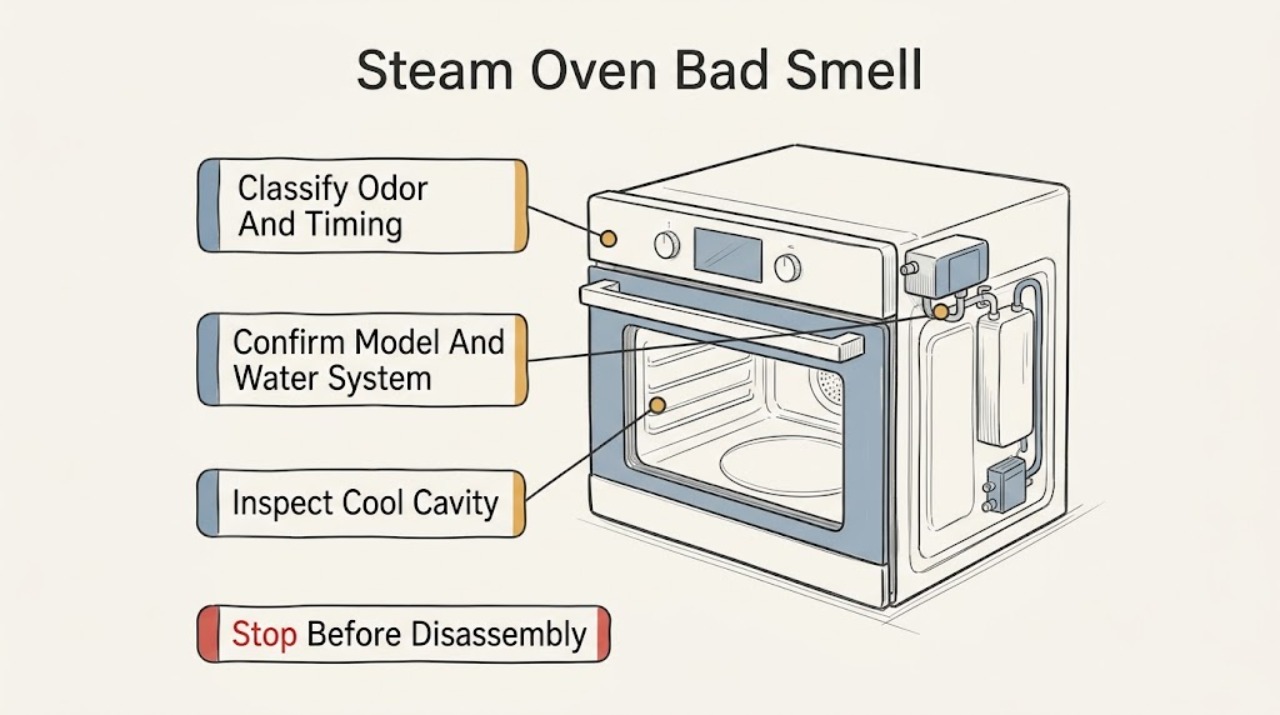
From a safe position, record whether the odor is musty or sour, food or grease-like, chemical, a light first-use smell, burning plastic or electrical, or fuel-like; note whether it begins during preheat, steam injection, draining, cooling, or after the cycle ends.
Expected result: A mild odor tied to the first uses or to a damp cavity differs from an odor with smoke, flame, crackling, a hot plug, or a fuel-like smell.
Next step: For smoke, flame, arcing, a hot or damaged cord, a fuel-like odor, or a carbon-monoxide alarm or symptoms, stop and follow the matching stop branch. Otherwise continue only after the oven is off and cool.
Why this matters
Why: Timing and odor character separate a likely residue or water-path issue from a heat, electrical, or combustion hazard.
-
Check 2
Read the rating label or manual from outside the appliance and identify the model, whether it uses a removable reservoir or a plumbed water supply, and whether the smell followed first use, storage, descaling, cleaning, or a recent installation.
Expected result: A new or recently transported appliance may have residual test water; a reservoir, drain filter, descaling program, or plumbed system may have model-specific care instructions.
Next step: Use the exact manual's care section for that model. If the label or water-system arrangement cannot be identified, stop at external observation and request manufacturer-qualified appliance service.
Why this matters
Why: The water system and model determine which parts may be emptied or cleaned and which steps must be left to service; a generic procedure could send water into an electrical area or damage a finish.
-
Check 3
When the oven is fully cool, use ordinary access to look for spilled food, grease, dampness, scale, cleaner film, residue on racks, a dirty door seal, or material near the cavity drain; do not remove the outer casing or reach behind panels.
Expected result: A localized residue or standing water that matches the smell gives a specific cleaning target; a clean cavity with odor around the controls, plug, or cabinet does not.
Next step: Remove only loose, cool residue and clean the permitted surfaces with the exact manual's method. If moisture is near electrical parts or the smell is not localized to a safe surface, stop and arrange service.
Why this matters
Why: A visible cavity or water-container source can be handled only by the model's cleaning directions, while an external electrical or concealed source needs professional assessment.
-
Check 4
Following the exact model instructions, empty and rinse a removable water container, clean an accessible drain or filter only where the manual explicitly permits it, and wipe the cool cavity and seal; never mix products or pour cleaner into a water path unless the manual specifies that product and location.
Expected result: If the odor decreases after a permitted clean-and-dry cycle, residue or stagnant water was plausible; if it returns immediately or the water path cannot be safely accessed, the source remains unresolved.
Next step: Let the oven dry as directed and observe one normal, model-approved cycle only if there were no stop symptoms. Persistent or worsening odor goes to service.
Why this matters
Why: Improvement supports a surface or water-path cause, but recurrence can indicate trapped residue, scale, a drain issue, or a component that needs service rather than stronger chemicals.
-
Check 5
After cleaning and cooling, note whether the smell is confined to steam, the cavity, the drain, the control area, the plug, or the surrounding cabinet without placing hands near hot, wet, or energized parts.
Expected result: A smell only during steam or draining suggests the water path or residue; a smell at the plug, controls, cabinet, or wiring area suggests an electrical or installation issue.
Next step: Do not remove panels, test live wiring, bypass a door or thermal interlock, or run repeated cycles. Provide the observed location and timing to a qualified technician.
Why this matters
Why: The location changes the handoff: a safe surface-cleaning result may be monitored, while an external electrical smell or heat requires the appliance to remain out of service.
-
Check 6
Before calling service, record the model, fuel type if applicable, cycle and temperature, whether the reservoir or drain was involved, the smell description, visible smoke or moisture, any displayed message, and whether the odor changed after the permitted cleaning.
Expected result: A repeatable cycle-specific odor with no smoke is useful diagnostic context; any recurrence of burning, fuel-like odor, smoke, arcing, abnormal heating, or an alarm is a safety event.
Next step: Keep the appliance out of service when a stop condition occurred and arrange qualified appliance service; use emergency services for fire, suspected gas release, or carbon-monoxide symptoms.
Why this matters
Why: Clear context helps the technician distinguish cavity residue from a water-system, heating, control, wiring, or combustion concern without unsafe user testing.
Use your observations
Decision map
Find the observation that best matches what you see, then follow the next safe action.
-
PATH 01Next step
What you see
There is smoke, flame, arcing, a burning-plastic smell, a hot or damaged plug or cord, or the appliance is heating when it should not.
Do this next
Stop the cycle and keep people away. Disconnect power or close fuel only if it is safe to reach without smoke, heat, water, or the suspected fault; do not open panels or resume testing. Use emergency services for fire or immediate danger, then use qualified appliance service.
-
PATH 02Next step
What you see
The steam oven is gas or dual-fuel and the smell is fuel-like, there is delayed ignition or abnormal flame, a carbon-monoxide alarm sounds, or anyone has headache, dizziness, nausea, or unusual weakness.
Do this next
Do not operate switches, create a flame, search for a leak, or relight the appliance. Leave the area and contact the local gas emergency provider or emergency services from a safe location; do not use the appliance until qualified professionals say it is safe.
-
PATH 03Next step
What you see
The odor is musty, sour, food-like, or chemical and a cool, accessible surface or removable reservoir has visible residue with no smoke or electrical symptoms.
Do this next
Follow the exact model's cavity, seal, reservoir, drain, and cleaning-product instructions. Rinse or wipe only the permitted surfaces, let them dry, and stop if moisture reaches electrical areas or the smell becomes burning or sharp.
-
PATH 04Next step
What you see
The smell is mild, occurs during the first uses or after installation, and there is no smoke, alarm, abnormal flame, or electrical heat.
Do this next
Check the manual's first-use preparation, remove packaging only from safe accessible areas, clean the cavity and water container as directed, and ventilate the room. A smell that is strong, worsening, or still present after the approved preparation needs service.
-
PATH 05Next step
What you see
The cavity is clean and dry but the odor returns, comes from the controls or cabinet, follows draining or heating, or cannot be safely localized.
Do this next
Keep the oven out of service and give a qualified technician the model, cycle, odor location, and timing. Do not use repeated heat cycles, a steam cleaner, unapproved descaler, or internal disassembly as a diagnostic test.
Helpful context
Understand the symptom
Classify the smell before cleaning
A damp, sour, or food-like odor after steaming points toward residue, standing water, a drain path, or a water container. A light manufacturing smell on the first few uses can be different from a sharp burning-plastic or electrical smell. A fuel-like odor is an emergency branch for a gas or dual-fuel appliance, not a normal steam-oven cleaning issue. Note when the smell starts, whether it is inside the cavity or around the controls and plug, and whether there is visible smoke or an alarm before touching the appliance.
Clean only the surfaces and water parts allowed by the model
After the oven is off and cool, check the cavity, racks, door seal, drain area, and water container for food, grease, scale, or cleaner residue. Miele's support guidance says new steam ovens can retain water from factory testing and describes cleaning the water container and cavity before first use. Other models may have a plumbed supply, reservoir, drain filter, or a self-clean or steam-clean program with different limits, so use the exact manual rather than assuming that every water path can be removed or descaled. Never mix cleaning chemicals or use a product that the manual does not allow.
Treat heat, steam, smoke, and electricity as separate risks
The cavity, door, racks, and residual water can remain hot after a cycle. A short burst of steam or a small amount of condensation is not by itself evidence of a fault, but water near controls, the plug, or wiring changes the decision. Miele's operating instructions warn that steam can damage electrical components and that service work belongs to an authorized technician. If smoke or a burning odor persists, do not open the door until it is safe to do so and do not continue testing.
Safety boundary
Stop conditions
- Stop immediately for smoke, flame, arcing, a burning-plastic or electrical odor, visible damage, a hot or damaged plug or cord, uncontrolled heating, or repeated breaker trips.
- For a fuel-like odor, delayed ignition, abnormal flame, carbon-monoxide alarm, or symptoms, leave the area and contact gas emergency or emergency services from a safe location; do not operate switches or relight the appliance.
- Stop if water reaches controls, the plug, wiring, or another electrical area, or if there is active leakage or standing water near electricity.
- Do not open the casing, remove gas or electrical parts, bypass an interlock, or use live electrical tests; these require qualified service.
When checks do not resolve it
Need a professional?
Call qualified appliance service when the smell is persistent after the exact manual's safe cleaning steps, returns during heating or draining, comes from the controls or cabinet, or is accompanied by abnormal heating, moisture near electrical parts, a fault message, or repeated trips. Treat smoke, fire, suspected fuel release, carbon-monoxide alarms, or symptoms as an emergency rather than a routine repair visit.
Common questions
FAQ
Why does my steam oven smell musty after use?
Residual water, food or grease, scale, or a damp cavity can produce a musty or sour odor. Once cool, follow the exact manual for emptying or rinsing a removable reservoir and cleaning and drying permitted surfaces.
Is a smell during the first use normal?
A mild first-use smell can come from manufacturing residue or retained test moisture, but smoke, flame, a sharp burning odor, fuel-like smell, or abnormal heating is not a normal cleaning issue. Follow the model's first-use instructions and stop for those warning signs.
Can I run a steam-clean cycle to remove the smell?
Only if the exact model supports that cycle and its instructions permit it. Steam-clean cycles leave hot water and heat behind, and using repeated cycles to mask a burning or electrical odor is unsafe.
When should a bad smell from a steam oven be serviced?
Arrange qualified service when the smell persists after permitted cleaning, returns during heating or draining, comes from the controls or cabinet, or accompanies moisture near electricity, abnormal heat, a fault message, or breaker trips. Treat smoke, fire, fuel-like odor, or a carbon-monoxide alarm as an emergency.
Read the exact guide
Official sources
- Operating and Installation InstructionsMiele USA · Miele DGC 6705/6805 combi-steam oven operation, steam and heat safety, cleaning, and service boundaries
- Moisture inside oven compartment of new appliancesMiele USA · Miele steam ovens and combi-steam ovens; first-use moisture and cavity preparation
- How to clean your Samsung ovenSamsung Electronics · Samsung ovens with self-clean or steam-clean features; model-dependent cleaning and cooling cautions
- Carbon Monoxide Fact SheetU.S. Consumer Product Safety Commission · Carbon-monoxide safety around fuel-burning appliances and alarms
Community feedback
Share a repair observation
Share a plain-text repair observation. Accepted observations are published automatically; this page may take a moment to update.