
On this page
Start here
Quick answer
A brief hum from the water pump, a quiet fan that runs during or after a cycle, and occasional clicks as controls or hot metal change temperature can be normal on a steam oven when they match the operating stage in the model manual. A grinding or rubbing sound, a loud hum that persists, repeated banging, continuous hissing from the door or an unintended opening, smoke, an electrical crackle, a burning smell, or a gas odor is not a normal noise pattern: stop using the oven, let it cool without opening a hot door, and arrange qualified service. Do not remove covers, reach through vents, probe the pump, or repeat a hazardous test.
Before you begin
Safety first
- The owner scope ends at cool, external, user-accessible observations and the exact manual's permitted cleaning or descaling steps. Do not open the housing or service the pump, fan, heater, valve, seal, wiring, or fuel system.
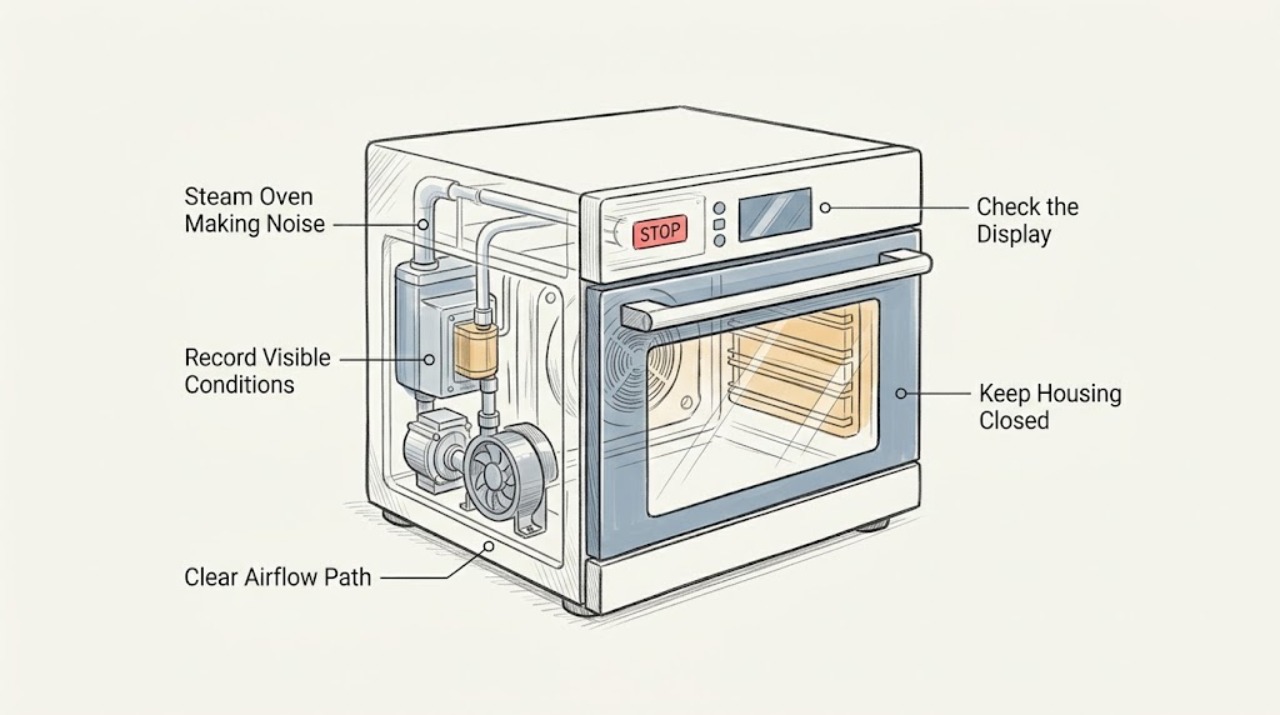
Work through in order
Diagnostic checks
Use only checks that match the exact appliance or system and its official guide.
-
Check 1
Write down the exact model, the selected mode, and the point in the cycle when the noise starts: filling, steam injection, cooking, draining, drying, or cooldown.
Expected result: A short hum or click appears only at a documented stage, or the noise is present in every mode and continues after the oven is cool.
Next step: Compare the timing with the exact model manual. If the manual does not describe the sound, do not keep running cycles to reproduce it; record the pattern for service.
Why this matters
Why: Stage-linked sound is more consistent with a pump, fan, relay, or thermal expansion; a new sound independent of the mode is more consistent with a fault that needs model-specific diagnosis.
-
Check 2
From a safe position outside the hot cavity, identify the apparent location and character of the sound without touching vents or moving the appliance: low hum near the water system, airflow at a vent, click or pop from controls or hot metal, or grinding, scraping, knocking, or electrical crackling.
Expected result: The sound is a quiet hum or airflow that changes with the cycle, versus metal-on-metal rubbing, repeated impact, a harsh squeal, or a crackle with an odor or visible flash.
Next step: Stop at the first abnormal mechanical or electrical sign. If it is only a quiet stage-linked sound, continue with the passive checks below and the model manual.
Why this matters
Why: Changing hum or airflow can be a normal pump or fan behavior; rubbing, impact, or electrical noise can indicate a mechanical or electrical fault and should not be diagnosed by opening the cabinet.
-
Check 3
After the oven is switched off and has cooled, inspect only the user-accessible water tank, its seating, and the visible tank area as described by the manual; do not reach behind the control panel or remove a cover that the manual does not identify as user removable.
Expected result: The tank is empty, not seated, visibly damaged, or repeatedly causes the pump to hum without a normal water movement; or it is correctly filled and seated with no visible issue.
Next step: Correct only the fill or seating issue permitted by the manual, then stop if the unusual noise returns. Do not run the pump dry, force a control panel, or dismantle the water system.
Why this matters
Why: A tank condition can make a pump cycle or cause a water warning on some models, while persistent noise with a correctly seated tank points beyond a simple refill or seating check.
-
Check 4
When cool, look at the visible drain or condensate outlet, drip area, and accessible tray for standing water, overflow, or a blocked-looking path; do not insert a tool or pour an unapproved chemical into it.
Expected result: Water remains where the manual expects it to drain, an error or drain warning appears, or there is no visible water problem.
Next step: Use only the cleaning or descaling procedure and product named for the exact model. If water backs up, leaks toward electrical parts, or the noise remains after an authorized procedure, stop and call appliance service.
Why this matters
Why: A pump that is working against a restricted drain can sound different and may leave water behind; a clear, dry visible path makes an internal pump or valve fault more likely if the noise persists.
-
Check 5
Observe the fan only from outside the appliance during and after a cycle, noting whether it is a smooth airflow sound that fades during cooldown or a new squeal, scrape, or grinding sound.
Expected result: The fan runs briefly after shutoff and fades, or it is loud, rough, intermittent with scraping, or continues abnormally long while the cavity is cool.
Next step: Keep the vents clear of external objects only. If the fan noise is rough, worsening, or accompanied by heat, odor, smoke, or a fault display, stop use and arrange service.
Why this matters
Why: A cooling fan that runs after a cycle can be normal on a steam oven; a rough or persistent fan sound may indicate an obstructed or failing fan and is not a reason to reach through the grille.
-
Check 6
From a safe distance, check whether steam is leaving only from the outlet described by the manual and whether the door remains closed and aligned; never open a hot door into escaping steam or put a hand near a jet.
Expected result: There is a brief, expected release at the designed outlet, or there is continuous hissing and steam from the door edge, control area, a damaged seal, or another unexpected location.
Next step: Stop the cycle using the normal control if it is safe, keep people away, and let the oven cool. Do not force the door or reseat a hot seal; arrange qualified appliance service for unexpected steam escape.
Why this matters
Why: The first pattern may be normal steam management; the second can indicate a seal, door, drain, or pressure-path problem and creates a scalding risk.
-
Check 7
If this is a fuel-burning combination model, note any gas odor, boom, delayed ignition, or abnormal flame only from a safe distance; for any model, stop immediately for smoke, burning odor, visible arcing, a hot plug or outlet, or a tripped breaker.
Expected result: There is no hazard sign and the sound is limited to a documented operating hum, fan, or click, or there is any gas, smoke, arc, burning, overheating, or repeated trip sign.
Next step: For smoke, fire, arcing, or burning, leave the area if needed and use the electrical isolation point only when it can be reached without contact with heat or water. For gas odor or a carbon-monoxide alarm, leave without operating switches or searching for the leak and contact local emergency or gas-safety services from a safe location. Do not restart the oven.
Why this matters
Why: The first pattern can remain within normal operation if the model manual confirms it. The second pattern is a safety event, not a noise-adjustment problem; fuel-burning equipment can also create carbon monoxide risk.
-
Check 8
Prepare a service note with the model and serial information, mode, sound description, location, start and stop timing, water or drain observations, displayed message, and any photo taken only after the appliance is cool and safe.
Expected result: The pattern can be reproduced only in one mode, is associated with a warning, or is present even when the oven is idle and cool.
Next step: Give the note and the exact manual or fault message to qualified appliance service. Do not open the housing or attempt an internal pump, fan, heater, valve, or wiring repair.
Why this matters
Why: These details help a technician distinguish a normal pump or fan event from a pump, fan, seal, valve, control, or electrical fault without unsafe exploratory testing.
Use your observations
Decision map
Find the observation that best matches what you see, then follow the next safe action.
-
PATH 01Next step
What you see
The sound is a brief pump hum, quiet fan, or occasional control/thermal click that matches the mode and the exact manual.
Do this next
Keep the water and ventilation areas clear and monitor for a change in sound, water handling, or fault display; no repair is indicated unless the pattern changes.
Why this path and its safety boundary
Why it matters: This is consistent with an expected operating sound.
-
PATH 02Next step
What you see
The pump hum repeats with no expected water movement, a drain warning, standing water, or a water leak.
Do this next
Stop the cycle when safe, use only the model-authorized cleaning or descaling procedure, and call appliance service if the fault or noise persists.
Why this path and its safety boundary
Why it matters: A restricted drain, scale-related fault, tank condition, or pump problem is possible.
-
PATH 03Next step
What you see
The sound is grinding, scraping, repeated hard knocking, or a harsh squeal from the fan or another moving area.
Do this next
Do not reach through vents or keep running cycles to test it. Stop using the oven and arrange qualified appliance service.
Why this path and its safety boundary
Why it matters: A mechanical obstruction, fan, pump, or mounting fault may be present.
-
PATH 04Next step
What you see
Steam hisses continuously from the door edge, control area, or another unintended location, or the door does not remain safely closed.
Do this next
Stop the cycle if safe, stay clear of the vapor, let the oven cool, and call appliance service. Do not force the door or attempt a hot seal repair.
Why this path and its safety boundary
Why it matters: The seal, door alignment, drain, or steam path may not be containing hot vapor.
-
PATH 05Next step
What you see
There is smoke, a burning smell, visible arcing, a hot electrical connection, repeated breaker operation, gas odor, a boom, or a carbon-monoxide alarm.
Do this next
Stop use and leave the area as appropriate; do not operate switches, search for a gas leak, reset repeatedly, or restart the oven. Contact emergency, gas-safety, electrician, or appliance professionals from a safe location.
Why this path and its safety boundary
Why it matters: This is an immediate electrical, fire, fuel, or carbon-monoxide safety concern.
Helpful context
Understand the symptom
Why a steam oven can sound active
A steam cycle moves water through a tank, pump, generator, drain path, or condensate system, so the sound may start before cooking, pulse while moisture is injected, or continue while water is returned or drained. A ventilation or cooling fan can also run while the cavity dries and the controls cool. Bosch documentation describes a pump hum during and after operation as a normal pump-function test, while Miele identifies its operating hum as water being pumped through the system. These examples are not a substitute for the exact manual for your model.
Use the sound pattern, not volume alone
Note when the sound begins, where it seems to come from, and whether it follows steam generation, draining, convection, or cooldown. A brief hum or click tied to one stage is different from a new grinding sound that follows the drum, fan, or pump speed. Steam escaping from the intended outlet can be part of operation; steam from the door edge, control area, or another unexpected location is a reason to stop and have the seal or steam path assessed.
Safety boundary
Stop conditions
- Stop and move away from the appliance for smoke, fire, visible arcing, a burning or melting smell, a hot plug or outlet, or repeated breaker operation.
- If a fuel-burning combination model has a gas odor, boom, abnormal flame, or a carbon-monoxide alarm, do not ignite, switch, search, or retest; leave and contact the relevant emergency or gas-safety service from a safe location.
- Keep clear of hot steam and do not force a hot door. Unexpected steam from the seal, controls, or another unintended opening requires cooling and qualified appliance service.
- Do not remove the housing, probe a pump or heater, touch wiring, open a vent, or run repeated cycles to reproduce an abnormal sound. Water near electrical parts is also a stop condition.
When checks do not resolve it
Need a professional?
Arrange service for an abnormal sound that persists, changes with no mode change, is associated with a water or steam fault, or returns after the model-authorized user check.
Safety scope: The owner scope ends at cool, external, user-accessible observations and the exact manual's permitted cleaning or descaling steps. Do not open the housing or service the pump, fan, heater, valve, seal, wiring, or fuel system.
Common questions
FAQ
Is a humming sound normal on a steam oven?
Often, yes, if it is a quiet hum that occurs during water movement or shortly after shutoff and the exact model manual describes it. A new grinding, scraping, or persistent loud hum needs service.
Why does a steam oven fan keep running after I turn it off?
A cooling or moisture-removal fan may continue while the oven cools and dries. It should fade as expected for the model; a rough, worsening, or unusually persistent sound should be assessed by service.
What should I do if the noise is accompanied by steam at the door?
Stay clear of hot vapor, stop the cycle only if it is safe, and let the oven cool. Do not force the door or repair a hot seal. Steam from an unintended location should be checked by qualified appliance service.
Can I open the steam oven to inspect the pump or fan?
No. Limit owner checks to cool, external, user-accessible areas and the exact manual's permitted procedures. Internal pump, fan, heater, valve, wiring, and fuel work belongs to qualified service.
Read the exact guide
Official sources
- Samsung Wall Oven FAQsSamsung US · Samsung wall oven support and sound guidance
- Operating and Installation InstructionsMiele USA · Miele combination convection-steam oven operating and installation instructions
- Steam oven operating instructionsBosch Home Appliances · Bosch steam-assisted oven operating instructions
- Fault F11Miele USA · Miele steam oven support
- Carbon Monoxide Fact SheetU.S. Consumer Product Safety Commission · Carbon-monoxide and fuel-burning appliance safety
- Humming soundMiele USA · Miele steam oven support
Community feedback
Share a repair observation
Share a plain-text repair observation. Accepted observations are published automatically; this page may take a moment to update.