
On this page
Start here
Quick answer
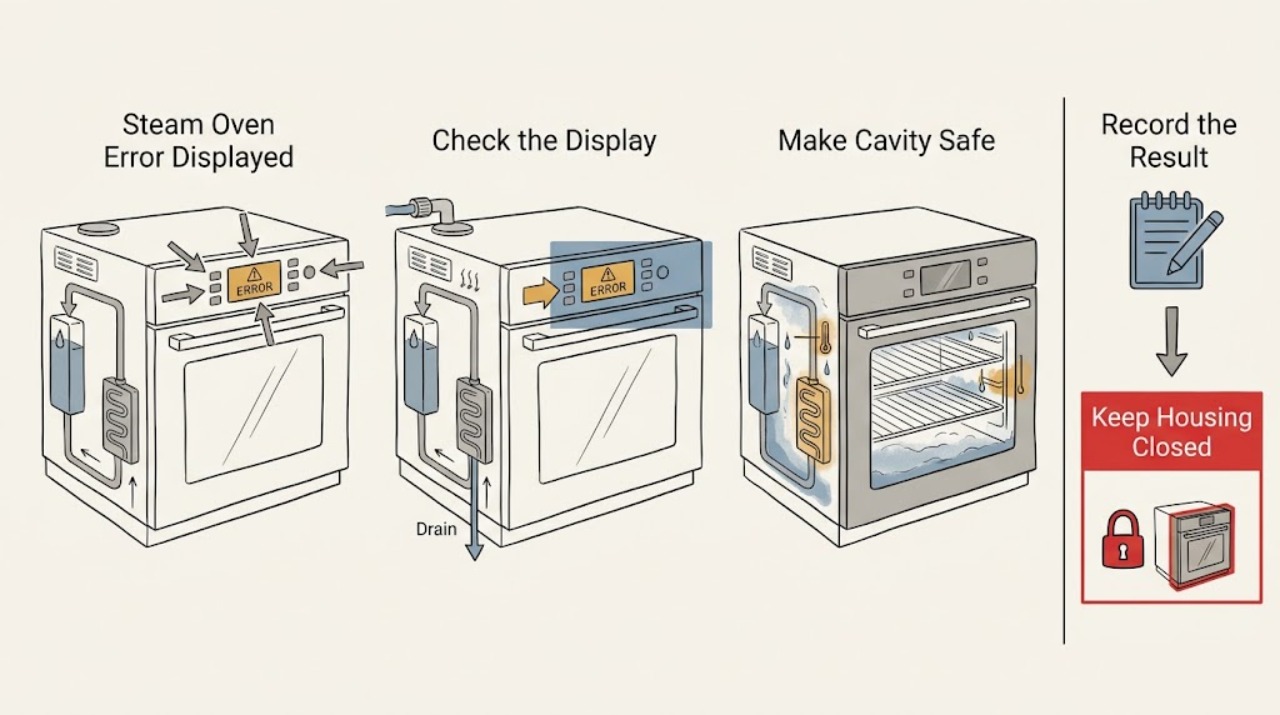
A steam oven error message must be interpreted against the exact model, full code, region, and point in the program; do not borrow a meaning from another brand or model. Photograph or transcribe the complete display, note whether the oven is a steam or combi-steam model, and record whether the fault appeared during filling, heating, draining, or after standby. If the cavity is hot or pressurized with steam, stop and allow the model's safe cooling procedure before opening or removing anything. Only after the oven is cool and the manual permits it should you check visible water-tank seating, an accessible water or drain hose, or a user-cleanable filter. Some Miele examples show that F12 can relate to water intake while F196 can relate to drainage, but these are model-family-specific examples, not universal code definitions. Use one manual-authorized reset only when there is no leak, electrical, steam, or other hazard; a returning code, water fault, damaged door, smoke, burning odor, or electrical problem needs qualified service.
Before you begin
Safety first
- This article supports exact code recording, model-scope matching, safe cooling, and only the visible water or filter checks expressly authorized for the exact model. It does not authorize hot-cavity access, door bypass, pump or hose dismantling, chemical drain treatment, panel removal, live electrical work, or repeated resets.
Work through in order
Diagnostic checks
Use only checks that match the exact appliance or system and its official guide.
-
Check 1
From a safe position, photograph or transcribe the complete error, symbol, and display text. Record the model, region, steam or combi-steam type, selected mode, and program stage when the message appeared; do not clear the message before recording it.
Expected result: The code is complete and repeatable, only a symbol or plain-language message is shown, the model is unknown, or the display changes between messages.
Next step: Use the exact manual or official support page for that model and code; if the model or code cannot be identified, keep the oven off and arrange service rather than guessing.
Stop if: Stop for hot steam, a stuck or damaged door, water near electrical controls, smoke, burning odor, sparking, shock, or a carbon-monoxide or fire alarm.
Why this matters
Why: A complete model-specific record is needed before interpreting the error. A changing or incomplete message cannot safely be mapped to a part or water path.
-
Check 2
Determine whether the error appeared with a hot cavity, visible steam, hot water, or a running pump. Follow the model's normal stop and cooling sequence and wait until the appliance is safe to approach; do not force the door or remove a water container while hot steam may escape.
Expected result: The cavity is cool and accessible, the door remains locked, water or steam remains, or the error is present with smoke, odor, leak, or electrical symptoms.
Next step: Leave the appliance off and arrange service for a locked or damaged door, residual hot water or steam that will not clear, a leak, or any safety symptom. Continue only with external model-authorized checks when cool.
Stop if: Do not force a door, reach into a hot cavity, handle hot water, touch wet controls, or operate the appliance with smoke, burning odor, sparking, or a damaged seal or glass.
Why this matters
Why: Heat, pressure, and water can cause burns or shock, and a locked door may be an intentional safety state. An unsafe symptom overrides any code-clearing step.
-
Check 3
Compare the complete code and model only with the exact manufacturer's support result or owner's manual. Check whether the page applies to a steam oven or combi-steam oven and to the same model family; do not substitute a similar-looking code from another appliance.
Expected result: The official result matches the code and model, matches only a different family, or no authoritative match can be found.
Next step: Follow only the matching model instruction. If no exact match exists, preserve the display record and contact the manufacturer or qualified appliance service.
Stop if: Do not apply another brand's code table, change hidden settings, bypass a safety message, or continue operation when the error is unresolved and the oven behaves abnormally.
Why this matters
Why: A matching official scope can identify a conditional visible check, while a different-family or missing match means the code meaning is unresolved.
-
Check 4
Only for an exact model instruction that identifies a water-intake fault, and only when the appliance is cool and dry, check the visible water-supply state, tank seating, and accessible intake hose or filter without opening the cabinet. Do not dismantle the inlet or continue if a hose is damaged.
Expected result: The water supply is closed, the tank is not seated, an accessible filter is blocked, the hose is visibly faulty, or the external water path appears normal.
Next step: Follow the exact manual for a normal visible correction. If the fault returns, the hose is damaged, or the code is not an exact match, turn the steam oven off and arrange service.
Stop if: Stop for leaking water, wet electrical equipment, a damaged hose or fitting, hot water, an unidentifiable code, or any need to open the appliance.
Why this matters
Why: On the Miele models covered by its F12 page, water-intake conditions can interrupt the program; a faulty hose is a service boundary. These checks do not define an unassigned code on another model.
-
Check 5
Only for an exact model instruction that identifies a drainage fault, and only after the oven is cool, check the visible floor filter or drain-hose arrangement named by the manual. Do not reach into residual water, remove a hidden pump, or straighten a hose inside the appliance.
Expected result: A specified filter is visibly dirty or misplaced, a specified drain hose is kinked or looped, water remains in the cavity, or the model does not match the instruction.
Next step: Perform only the exact cool-appliance cleaning or placement step named for the model. If water remains or F196 returns, leave the oven off and contact qualified service.
Stop if: Do not handle hot water, remove a pump, open panels, pour chemicals into the drain, or continue with a leak, wet electrical area, smoke, odor, or damaged hose.
Why this matters
Why: On specified Miele combi-steam families, F196 can indicate that water did not pump away and the official page gives model-specific filter and hose checks. A mismatch or persistent water fault needs service.
-
Check 6
If the exact manual authorizes a power cycle or restart for the recorded code, the oven is cool and dry, and no safety symptom exists, perform no more than that single documented reset. Do not use repeated resets to hide a returning error.
Expected result: The display clears and the appliance remains normal, the same code returns, a new code appears, or the reset causes a breaker event or abnormal behavior.
Next step: Leave the steam oven unused and give the exact code, model, stage, and reset result to qualified appliance service when the error returns or behavior remains abnormal.
Stop if: Do not reset repeatedly, restore a breaker that trips, run a hot steam cycle to test it, or continue after smoke, gas odor, sparking, water, or uncontrolled heat.
Why this matters
Why: A cleared message is not proof that the underlying cause is repaired. A returning or changing code is evidence for model-specific service, and a breaker or abnormal event is a safety stop.
-
Check 7
Prepare the service handoff with model and serial information, full error text, code, region, steam or combi-steam type, program stage, cavity and water state, visible hose or filter observations, reset result, and any door, leak, heat, smoke, odor, or electrical symptom. Do not perform another test once a service trigger exists.
Expected result: The record distinguishes an exact water-inlet or drain match, a control or display message, an unknown code, a returning fault, or a safety event.
Next step: Keep the appliance out of service until the manufacturer or qualified technician advises otherwise; use emergency response for fire, smoke, carbon-monoxide danger, or immediate electrical hazard.
Stop if: Do not open panels, bypass door or safety controls, move a built-in appliance, access the pump or wiring, or use the oven with an unresolved safety symptom.
Why this matters
Why: A precise record lets the technician select a safe model-specific path without guessing across code families or asking the user to reproduce hot steam or water conditions.
Use your observations
Decision map
Find the observation that best matches what you see, then follow the next safe action.
-
PATH 01Safety boundary
What you see
The complete code and model match an official water-intake fault instruction, and the appliance is cool and dry.
Do this next
Follow only the matching manual. On the Miele F12 page, a closed intake valve or blocked intake filter is listed, while a faulty hose is a service condition; arrange service if the fault persists.
Why this path and its safety boundary
Why it matters: A model-specific visible intake, tank, hose, or filter check may be appropriate; the code must not be generalized.
Safety stop: Stop for leaking water, damaged hose or fitting, wet controls, hot water, an unmatching model, or any need to dismantle the inlet.
-
PATH 02Safety boundary
What you see
The complete code and model match an official drainage fault instruction, and the appliance is cool.
Do this next
On the specified Miele families covered by F196, follow the cool filter and visible hose instructions. If the code or water fault persists, contact qualified service.
Why this path and its safety boundary
Why it matters: A model-specific floor filter or drain-hose check may be appropriate; residual water and pump access remain safety and service boundaries.
Safety stop: Do not handle hot water, remove a pump, open panels, pour drain chemicals, or continue with a leak or wet electrical area.
-
PATH 03Safety boundary
What you see
The code is incomplete, the model differs from the official result, the display is only a symbol, or no exact authoritative match exists.
Do this next
Keep the display record, leave the appliance off if it behaves abnormally, and contact the manufacturer or qualified appliance service with model, region, code, and stage.
Why this path and its safety boundary
Why it matters: The error cannot be safely decoded from a generic steam-oven list.
Safety stop: Do not borrow another model's code meaning, change hidden settings, repeatedly reset, or run a steam cycle to test an unknown fault.
-
PATH 04Safety boundary
What you see
The error appears with a locked or damaged door, visible steam or hot water, a leak, or water near the controls.
Do this next
Stop the appliance according to the safe model procedure, stay clear until cool, and arrange qualified service for a persistent lock, leak, damaged door, or residual water problem.
Why this path and its safety boundary
Why it matters: Heat, pressure, burn, and electrical risks take priority over code interpretation.
Safety stop: Do not force the door, reach into hot steam, touch wet controls, move the appliance, or continue operation.
-
PATH 05Safety boundary
What you see
The message accompanies smoke, fire, burning odor, sparking, shock, uncontrolled heating, a hot panel, or a breaker that trips again.
Do this next
Leave the appliance off, stay clear, and contact emergency, electrical, or appliance service from a safe location.
Why this path and its safety boundary
Why it matters: This is an immediate safety boundary, not a display-reset branch.
Safety stop: Do not touch hot or wet equipment, reset a tripped breaker, open panels, or continue troubleshooting near smoke or fire.
Helpful context
Understand the symptom
Record the complete message and the steam-oven identity
A code such as F12 or F196 is not a universal language. Record every character, symbol, flashing indicator, model number, region, and whether the appliance is a steam oven or combi-steam oven. Also note the selected mode, whether the fault appeared while taking in water or draining it, and whether the cavity was hot. Miele's support index separates many codes and operating messages by appliance family, so the model guide takes priority over a generic code list.
Steam and hot water change the safe sequence
Do not open a hot steam cavity quickly or remove a tank, tray, or filter while hot steam can escape. Let the exact manual's cooling process finish and use appropriate protection for hot surfaces. Panasonic's manual says to stop using an abnormal appliance and not to disassemble or repair it yourself. A leak, wet control, damaged door, smoke, burning odor, or electrical fault ends the ordinary troubleshooting path.
Treat code examples as conditional, not as a universal decoder
On the specific Miele families covered by its support pages, F12 points to water not entering and can involve a closed intake valve, a blocked intake filter, or a faulty intake hose. On specified Miele combi-steam families, F196 points to water not pumping away and can involve a floor filter or a kinked drain hose. These examples show why the exact model and code are essential; they do not authorize applying F12 or F196 instructions to another steam oven.
Safety boundary
Stop conditions
- Stop and stay clear for hot steam, hot water, a forced or damaged door, active leakage, water near controls, smoke, fire, burning odor, sparking, shock, uncontrolled heat, or a breaker that trips again.
- Do not force the door, reach into a hot cavity, move a built-in appliance, open panels, access wiring or pumps, or use a steam cycle to test an unresolved code.
- Do not apply another brand's or model family's code meaning, change hidden settings, repeatedly reset power, pour chemicals into a drain, or dismantle a water inlet.
- Keep the steam oven out of service for an unknown or returning error, a faulty hose or drain path, a persistent water fault, a damaged door, or any abnormal behavior; arrange qualified service.
- Use the exact manufacturer's manual for code scope, safe cooling, water handling, cleaning, and reset behavior; an official example such as F12 or F196 is not a universal decoder.
When checks do not resolve it
Need a professional?
Arrange qualified appliance service when the exact code cannot be matched to the model, a code returns after one authorized reset, water does not enter or drain, a hose or door is damaged, the display remains abnormal, or the steam oven behaves unexpectedly. Stop immediately for hot-steam or hot-water danger, leaks near electrical controls, smoke, fire, burning odor, sparking, shock, uncontrolled heating, or a breaker that trips again; use emergency or electrical response from a safe location.
Safety scope: This article supports exact code recording, model-scope matching, safe cooling, and only the visible water or filter checks expressly authorized for the exact model. It does not authorize hot-cavity access, door bypass, pump or hose dismantling, chemical drain treatment, panel removal, live electrical work, or repeated resets.
Common questions
FAQ
Can I use a generic steam-oven error-code list?
No. Record the complete code, model, region, appliance type, and program stage, then use the exact manufacturer's manual or support result. Even Miele's F12 and F196 articles apply to different water paths and specified model families; they are examples, not universal definitions.
What should I do if a steam-oven error appears while the cavity is hot?
Stop normal troubleshooting and follow the model's safe cooling procedure. Do not force the door or remove a tank, tray, or filter while hot steam or water may escape. Arrange service for a persistent lock, leak, damaged door, or an error that remains after cooling.
What do Miele F12 and F196 mean?
On the specific Miele support pages, F12 concerns water not entering the steam oven, while F196 on specified combi-steam families concerns water not being pumped away. The model scope matters; do not apply either meaning or filter instruction to another appliance.
When should a steam-oven error be treated as urgent?
Stop for hot steam or water danger, a leak near controls, a forced or damaged door, smoke, fire, burning odor, sparking, shock, uncontrolled heating, or a breaker that trips again. Keep the appliance off and use emergency, electrical, plumbing, or qualified appliance service as appropriate.
Read the exact guide
Official sources
- Miele Steam Oven | Fault F196 (DGC 6xx5, DGC 7xxx)Miele USA · Miele official F196 guidance only for the specified DGC model families; do not generalize the code or filter orientation.
- Owner’s Manual Convection Steam OvenPanasonic Appliances Microwave Oven (Shanghai) Co., Ltd. · Official Panasonic NU-SC180B convection steam-oven manual; exact model and region control operating details.
- Miele Steam Oven | Fault F12Miele USA · Miele official F12 guidance for applicable steam and combi-steam ovens; it must not be generalized to other models or codes.
- Troubleshooting for Display messages & light indicators problem with Miele Steam OvenMiele USA · Miele official steam-oven support index; exact model and linked fault article control code interpretation.
Community feedback
Share a repair observation
Share a plain-text repair observation. Accepted observations are published automatically; this page may take a moment to update.