
On this page
Start here
Quick answer
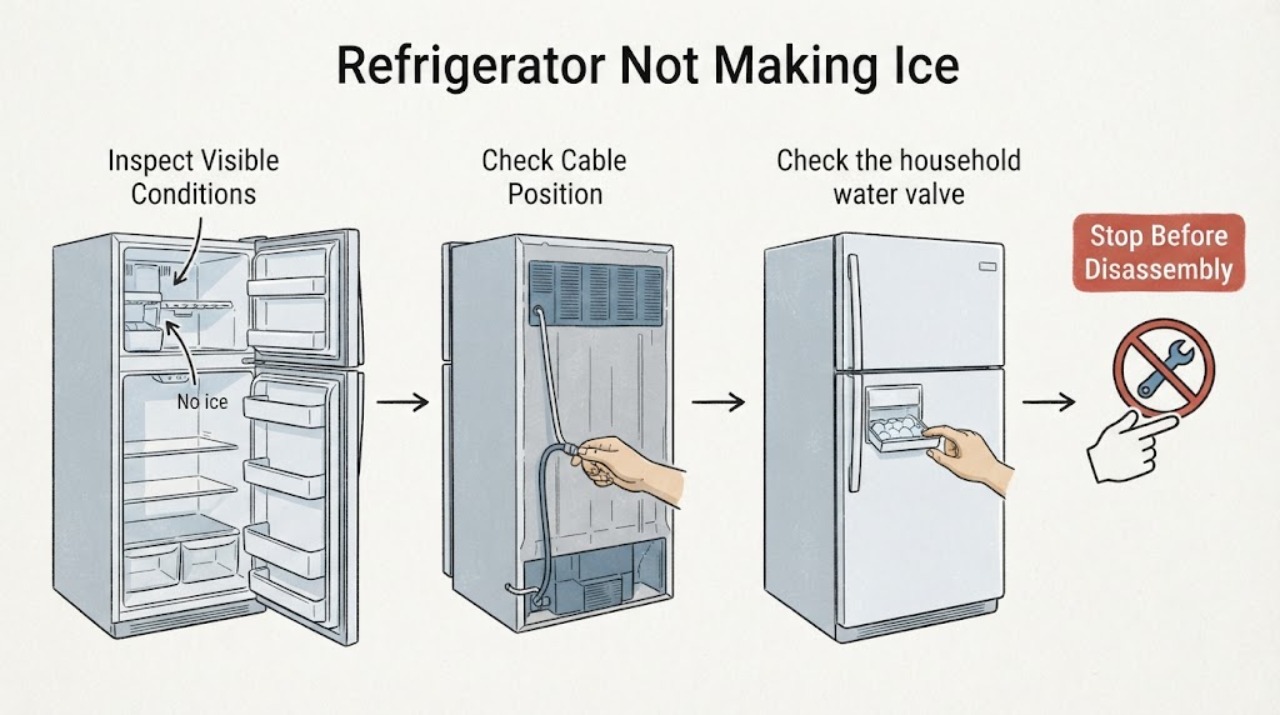
For a Tappan refrigerator that is not making ice, first separate “no ice is produced” from “ice exists but will not dispense.” Confirm the ice maker is enabled, the refrigerator has cooled, the water supply is connected, and the bin is seated. A newly installed system may produce empty cycles while air leaves the lines; persistent no-fill, leaks, or electrical symptoms require model-specific service.
Work through in order
Diagnostic checks
Use only checks that match the exact appliance or system and its official guide.
-
Check 1
Observe whether the bin is empty, the ice maker is disabled, the dispenser is jammed, or water is present in the dispenser.
Expected result: An empty bin can mean no production, while a full bin with no dispensing is a separate auger/chute problem; no water points to supply/prime/filter paths.
Next step: Keep the refrigerator closed as much as possible and continue with the matching visible check.
Why this matters
Why: This observation narrows the likely cause but does not identify an internal part by itself.
-
Check 2
Confirm the ice maker’s visible On/Off setting and that the bin is fully seated; do not force a wire arm or removable tray.
Expected result: A disabled control or mis-seated bin can inhibit production or signal full; a correct state keeps water, temperature, or service causes in scope.
Next step: Use the exact Tappan manual for the control position and bin design.
Why this matters
Why: This observation narrows the likely cause but does not identify an internal part by itself.
-
Check 3
Check the household water valve, exposed tubing, and dispenser flow for a connected, leak-free supply.
Expected result: No dispenser flow or a leak makes water supply/filter/valve issues more likely; normal flow does not prove the ice inlet works.
Next step: Repair leaks and use model-approved filter/prime instructions; call service for inaccessible connections.
Why this matters
Why: This observation narrows the likely cause but does not identify an internal part by itself.
-
Check 4
If newly installed or recently filtered, prime/flush the water system and allow the refrigerator to cool for the model’s documented period before judging production.
Expected result: Air in new lines can cause several empty cycles; a mature, cold unit with no fill needs further diagnosis.
Next step: Do not repeatedly cycle the maker or run it without water.
Why this matters
Why: This observation narrows the likely cause but does not identify an internal part by itself.
-
Check 5
Record model/serial, ice-maker setting, bin position, dispenser flow, filter age, installation date, freezer temperature indication, and any fill-valve sound.
Expected result: These observations distinguish setup, supply, jam, temperature, and internal valve/control possibilities without claiming a part.
Next step: Arrange Tappan service for persistent no production, leaks, abnormal noise, or a fault display.
Why this matters
Why: This observation narrows the likely cause but does not identify an internal part by itself.
Use your observations
Decision map
Find the observation that best matches what you see, then follow the next safe action.
-
PATH 01Next step
What you see
Maker is off or bin is mis-seated, with normal water flow and no leak.
Do this next
Correct the setting/bin position using the exact manual and monitor one production period.
Why this path and its safety boundary
Why it matters: A setup state is more likely than a failed ice-maker component.
-
PATH 02Next step
What you see
New installation has normal water flow but several initial empty cycles.
Do this next
Prime the system and allow the documented cooling period before service.
Why this path and its safety boundary
Why it matters: Air in the water lines and initial cooling time are plausible.
-
PATH 03Next step
What you see
Dispenser has no water, tubing leaks, or the maker makes repeated fill noise without water.
Do this next
Turn the maker off if water is unavailable, correct only accessible supply issues, and arrange service for recurrence.
Why this path and its safety boundary
Why it matters: The water path is more likely and can damage a valve if operated dry.
-
PATH 04Next step
What you see
The unit is cold and enabled but never fills after setup checks.
Do this next
Arrange qualified Tappan service with the recorded observations.
Why this path and its safety boundary
Why it matters: A model-specific valve, control, sensor, or ice-maker fault remains; no single part is proven.
Helpful context
Understand the symptom
Official refrigerator guidance identifies ice-maker On/Off state, water-line priming, cooling time, and bin position as first checks. It does not establish Tappan-specific controls without a model.
Do not force an ejector, probe a valve, or infer a filter/valve part from no ice alone. Use the exact Tappan manual for controls and water-filter details.
When checks do not resolve it
Need a professional?
Call qualified Tappan service for persistent no ice after correct setup/prime, no-fill with normal supply, leaks, damaged tubing, abnormal noise, or electrical symptoms.
Common questions
FAQ
Should a new Tappan refrigerator make ice immediately?
Not necessarily. Initial air in the plumbing and cooling time can produce empty cycles; use the exact manual and allow its documented period.
Why is the dispenser working but there is no ice?
Dispenser operation does not prove the ice maker is filling. Check the maker setting, bin, water supply, and filter/prime state.
Can I force the ice-maker ejector?
Do not force or probe moving parts. Use the model manual or qualified service.
Read the exact guide
Official sources
- My refrigerator was just installed and the ice maker is not working, how do I fix it?Frigidaire · General refrigerator ice-maker checks used for a Tappan refrigerator symptom; exact Tappan model controls and water system remain authoritative.
Community feedback
Share a repair observation
Share a plain-text repair observation. Accepted observations are published automatically; this page may take a moment to update.