
On this page
Start here
Quick answer
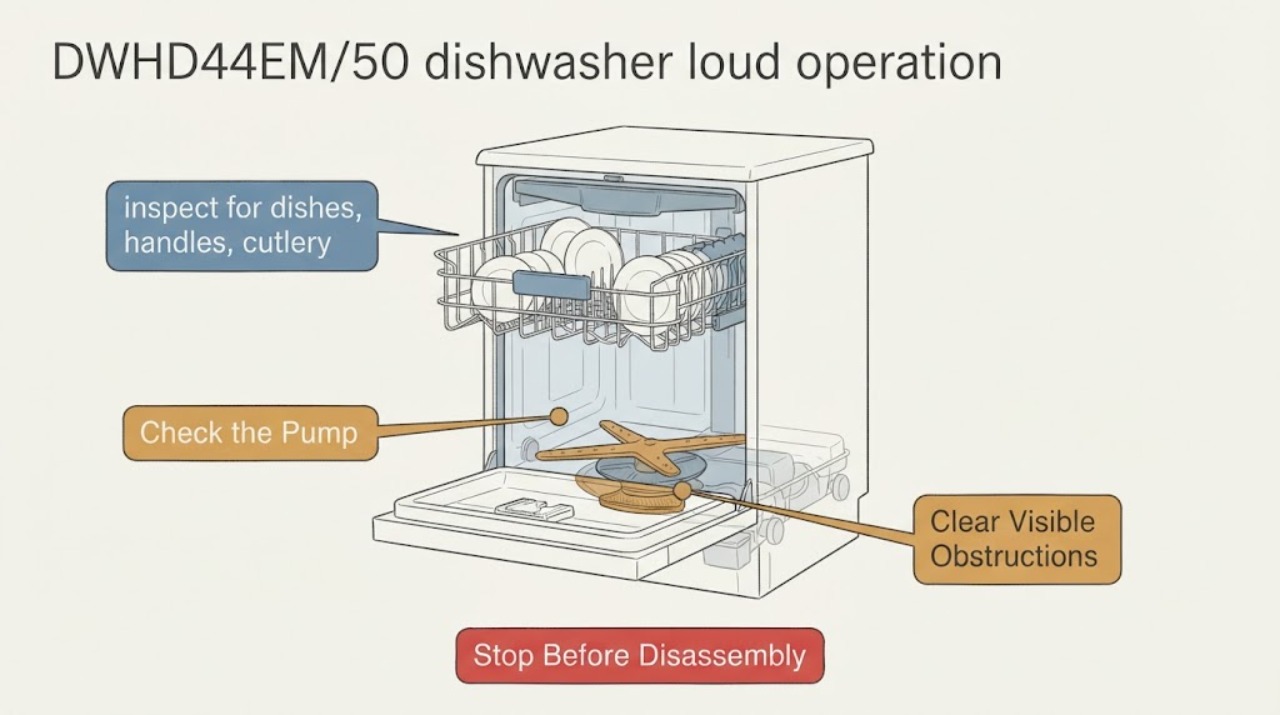
A Thermador DWHD44EM/50 that still cleans and drains can sound loud for different reasons, and the sound alone does not identify a failed pump. The opened Thermador use-and-care manual covers the DWHD44E family and starts with loading clearances, spray-arm access, and the filter system: items must not touch or protrude into the spray-arm path, spray nozzles should be unobstructed, and the accessible filter system should be checked for foreign objects. Compare the noise with the racks empty and note whether it occurs during filling, washing, or draining. If the noise remains with an empty load after the visible spray-arm and filter checks, or is accompanied by leaking, smoke, a burning smell, poor cleaning, or failure to drain, stop the cycle and use qualified Thermador service rather than naming a pump from the sound alone.
Work through in order
Diagnostic checks
Use only checks that match the exact appliance or system and its official guide.
-
Check 1
Run a short observation with no dishes or loose utensils in the racks only if there is no leak, smoke, burning smell, or electrical hazard. Note when the sound starts: during filling, while the wash spray is running, or during draining. Do not use the sound to identify a pump yet.
Expected result: The sound disappears with an empty tub, remains only during one phase, or remains through the wash and drain phases.
Next step: Use the matching branch below. Stop the observation if water, smoke, burning odor, or abnormal vibration appears; do not continue repeated cycles to force a diagnosis.
Why this matters
Why: A load-dependent sound points first to contact or clearance; a phase-specific or persistent sound narrows the service description but does not prove which motor or pump has failed.
-
Check 2
With the dishwasher off and the racks pulled out, inspect for dishes, handles, cutlery, or rack hardware touching one another or protruding through the rack. Reposition only dishwasher-safe items so they do not contact neighboring items or block either spray-arm path.
Expected result: The sound changes or stops after the load is rearranged, or it remains with the racks empty and the spray paths clear.
Next step: If the sound stops, use the corrected loading pattern and monitor. If it persists, continue with the spray-arm and filter checks rather than ordering a part.
Why this matters
Why: A change after rearranging supports a loading/contact source. Persistence with an empty load means the noise is not explained by the observed dish contact, but it still does not identify a pump or motor.
-
Check 3
Inspect the upper and lower spray arms from inside the tub. Remove only the empty rack or spray arm as described for the DWHD44E family, look for blocked nozzle openings, flush visible obstruction under running water, and reinstall the arm so it is seated correctly. Do not reach into the large-object trap with your fingers.
Expected result: A nozzle is visibly blocked, a spray arm was not seated, or both spray arms are clear and move without contact.
Next step: Correct the visible obstruction or seating issue and monitor one normal cycle. If the noise remains with clear, correctly seated arms, record the cycle phase and escalate without opening the pump area.
Why this matters
Why: A visible nozzle or seating problem can disturb the spray path and create abnormal water noise. Clear arms do not prove the circulation system is healthy; they only remove this accessible cause from the check.
-
Check 4
Remove the bottom rack and inspect the accessible filter system for glass, food, or other foreign objects. Follow the manual's external filter removal and rinsing steps; lift the filter assembly out, clean visible debris, reinstall it fully, and verify that it is locked. Keep hands out of the large-object trap and treat sharp debris as a stop condition.
Expected result: Foreign material is present in the filter or trap, the filter was not seated or locked, or the filter area is clear and correctly reinstalled.
Next step: After cleaning and locking the filter, monitor whether the sound changes. If grinding, scraping, or a persistent loud hum remains, stop parts swapping and arrange qualified service.
Why this matters
Why: The manual says the filter system protects the main and drain pumps from foreign material, so debris is a concrete accessible finding. A clear filter does not establish that a pump is defective.
-
Check 5
Photograph the complete model and serial label at the dishwasher door edge before requesting parts or service. Keep the slash suffix and revision exactly as printed; do not treat the family label DWHD44E as proof that every DWHD44 variant has identical components.
Expected result: The full label confirms DWHD44EM/50 or another variant, or the label cannot be read.
Next step: Give the complete label and the recorded noise phase to Thermador service. If the label cannot be confirmed, do not order a sound-related replacement part.
Why this matters
Why: The opened manual covers the DWHD44E family but exact fitment and service records depend on the complete model identifier. A model mismatch can send a technician or parts search to the wrong pump, spray arm, or filter assembly.
Use your observations
Decision map
Find the observation that best matches what you see, then follow the next safe action.
-
PATH 01Next step
What you see
The noise disappears or changes substantially after the racks are emptied and dishes or utensils are repositioned away from the spray-arm paths.
Do this next
Keep items separated and below the rack boundaries described in the manual. If the sound returns with a corrected load, continue with spray-arm and filter checks.
Why this path and its safety boundary
Why it matters: The result supports a loading or contact source rather than proving a pump failure.
-
PATH 02Next step
What you see
The sound occurs during washing with empty racks, or it remains after clear spray arms and a clean, locked filter have been verified.
Do this next
Stop disassembly and provide qualified service with the exact model, the phase when the sound occurs, and whether cleaning performance and draining remain normal. Do not choose a pump from the sound alone.
Why this path and its safety boundary
Why it matters: The accessible loading and obstruction causes are less likely, but the symptom does not distinguish a wash motor, drain motor, bearing, foreign object beyond the filter, or cabinet vibration.
-
PATH 03Next step
What you see
The loud operation is accompanied by leaking, smoke, a burning smell, electrical symptoms, severe vibration, sharp debris, poor draining, or the need to remove a cover or pull the unit from the cabinet.
Do this next
Stop the cycle, isolate water and power only when safe, leave the enclosure and interlocks intact, and contact a qualified Thermador service technician using the full model label.
Why this path and its safety boundary
Why it matters: The symptom has crossed the safe external-check boundary and may expose water, electrical, or sharp-edge hazards.
Helpful context
Understand the symptom
The opened Thermador manual identifies this older dishwasher family as DWHD44E and describes a noise-reduction system using a two-pump motor system, a suspension motor, and triple insulation. That description explains why a new or worsening loud sound deserves comparison with the normal operating pattern, but it does not prove which pump or motor is responsible. The full model suffix on the door-edge label still controls parts and service information.
Begin inside the tub. Thermador says to avoid contact points between dishes, keep items from protruding through the rack, and check that the spray arms can operate. It also gives an external-access maintenance path for spray-arm nozzles and the filter system. These checks can separate a load or obstruction noise from a persistent wash-system symptom without opening the cabinet.
Keep the service boundary strict. Thermador's safety instructions say repairs must be performed by a qualified technician using original factory parts, and its customer-service section warns that removing covers or pulling the dishwasher from the cabinet can expose hot water, electrical power, and sharp edges. A loud dishwasher that remains noisy after the accessible checks needs a professional diagnosis, not a pump or motor replacement chosen from an audio description.
When checks do not resolve it
Need a professional?
When noise persists with empty racks after visible spray-arm and filter checks., When the sound is accompanied by leaking, smoke, burning odor, severe vibration, poor cleaning, or failure to drain., Before removing covers, pulling the dishwasher from the cabinet, or entering the pump or electrical area., Before ordering a pump, motor, spray arm, or other part without the complete model suffix.
Common questions
FAQ
Does a loud Thermador dishwasher automatically need a new pump?
No. A sound can change with dish contact, a blocked or incorrectly seated spray arm, filter debris, cabinet vibration, or a wash or drain phase. Thermador's manual supports accessible loading, spray-arm, and filter checks but does not identify a pump from sound alone.
What should I check before calling service?
Record when the sound occurs, run the safe comparison with empty racks if there is no hazard, check for dish or utensil contact, inspect spray-arm nozzles, and clean and relock the accessible filter as the manual describes. Keep the full model label available.
Can I remove the dishwasher to reach the pump?
Do not do that as a homeowner noise test. Thermador warns that pulling the dishwasher from the cabinet or removing covers can expose hot water connections, electrical power, and sharp edges, and it directs repairs to qualified service technicians.
Does the DWHD44E manual exactly prove every DWHD44EM/50 part is interchangeable?
No. The opened manual identifies the DWHD44E family and supports the external checks in this article. Confirm the complete DWHD44EM/50 label before parts, fitment, or service decisions.
Read the exact guide
Official sources
- Dishwasher Use and Care ManualThermador / BSH Home Appliances · Opened the official BSH-hosted Thermador manual. Its cover lists DWHD44E among the supported model families; the task's DWHD44EM/50 identifier shares that family prefix. The article uses only family-level external checks and explicitly requires the complete suffix for parts or service decisions.
Community feedback
Share a repair observation
Share a plain-text repair observation. Accepted observations are published automatically; this page may take a moment to update.