
On this page
Start here
Quick answer
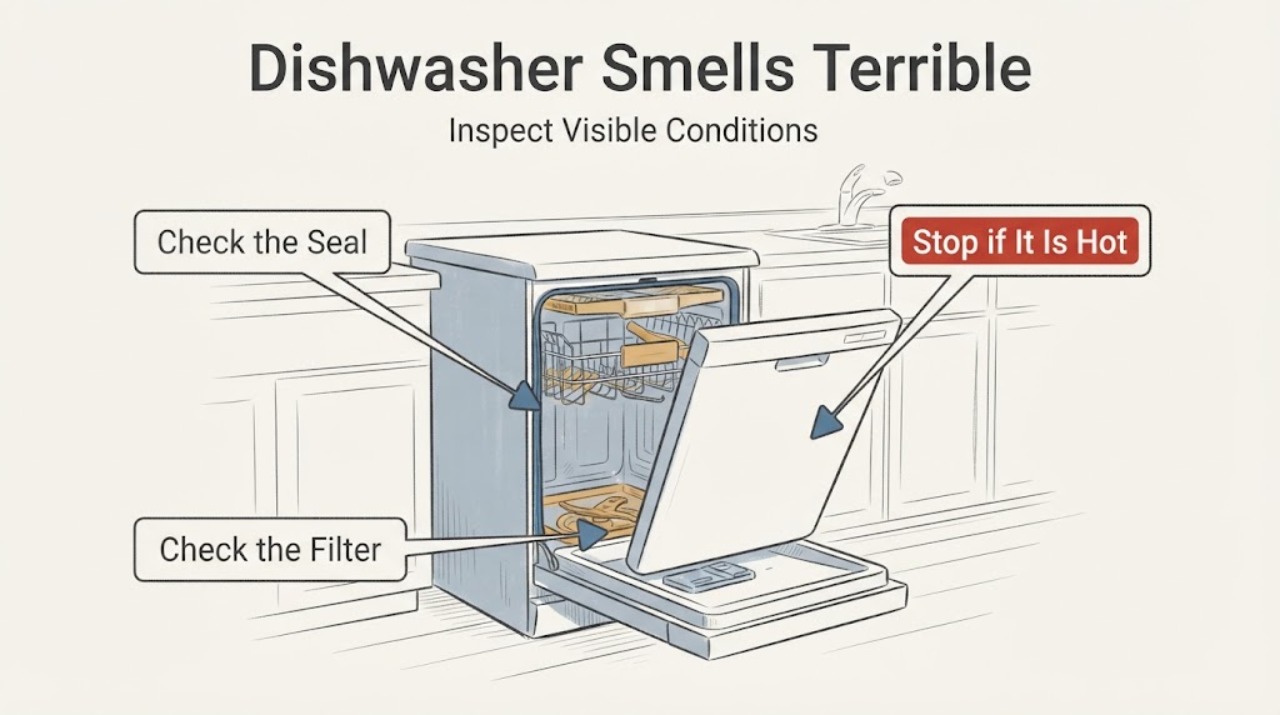
A terrible smell from a Thermador dishwasher is not automatically a failed pump or heater. Thermador lists infrequent use, food debris in the filter or at the door seal, residual water, and an obstructed drain hose as odor causes. With the dishwasher stopped and cool, remove only the user-accessible filter if the exact manual permits it, rinse it with a soft brush, wipe food particles from the door seal, and confirm the last cycle drained. Use a Thermador dishwasher cleaner or descaler only as directed by the exact manual and product label; never mix cleaners, add household dish soap, or use a steam cleaner. If the smell is burning, electrical, solvent-like, or returns after safe cleaning, stop using the dishwasher and arrange authorized Thermador service.
Work through in order
Diagnostic checks
Use only checks that match the exact appliance or system and its official guide.
-
Check 1
Stop the dishwasher and identify the odor from a safe position without running another cycle. If it smells like burning plastic, hot wiring, solvent, smoke or an electrical fault, switch the appliance off and isolate power only from a safe, dry location.
Expected result: The smell is food-like, sour or stale, or it is burnt/electrical/chemical and may be accompanied by smoke, heat, sparking or a tripped breaker.
Next step: For a burnt/electrical/chemical odor or any smoke, heat, spark or trip, leave the dishwasher powered off and arrange authorized Thermador service or an electrician as appropriate. Do not run a test cycle.
Stop if: Do not touch hot, wet or damaged wiring, open panels, add a chemical to mask the smell, or restore power after a safety event.
Why this matters
Why: Food/drain odor fits Thermador's documented cleaning and drainage causes; burning, smoke, heat or electrical signs are outside routine cleaning and may indicate a hazardous fault.
-
Check 2
After the dishwasher is cool and stopped, inspect the bottom for food debris and check the door-seal groove for particles. Remove only visible loose debris and wipe the seal with a damp cloth, then dry it; do not pry the seal out.
Expected result: Food residue is on the tub bottom or near the seal, or those accessible areas are clean.
Next step: Clean the accessible surfaces and continue to the filter check. If the smell persists without visible residue, use the exact manual and service path rather than opening the tub or pump area.
Why this matters
Why: Thermador lists food debris at the filter/bottom and particles near the door seal as odor sources. A clean visible seal does not rule out a drain or internal issue.
-
Check 3
Using the exact Thermador owner's manual, remove the bottom filter only if the model's instructions identify it as user-serviceable. Rinse the filter and its parts under running water, use a soft brush for debris, and lock it back into place before any future use.
Expected result: The filter is blocked with food/starch, is clean, or cannot be removed and reinstalled exactly as the manual specifies.
Next step: Clean and securely reinstall only a matching user-accessible filter. If it is damaged, missing, or cannot lock, leave the dishwasher off and arrange service; do not run it with an unsecured filter.
Why this matters
Why: Thermador says filter debris can contribute to odor and recommends regular cleaning, but a filter that cannot be secured or a model-specific design that differs from the generic page needs the exact manual/service path.
-
Check 4
Check whether water remains at the bottom after the last completed cycle and whether the odor is strongest at the drain area. From outside the appliance, inspect only the accessible air gap or disposal connection for an obvious blockage; do not disconnect the drain hose.
Expected result: Standing water remains, the unit did not complete draining, the drain area smells strongly, or there is no standing water and the drain path appears normal.
Next step: Use the exact owner's manual for a cancel/drain operation and accessible air-gap/disposal check. If water remains, the hose is obstructed, or the drain cannot be checked safely, leave the dishwasher off and request authorized service.
Why this matters
Why: Thermador identifies residual water and an obstructed drain hose as odor causes, and says the hose high loop and drain configuration matter. A drain symptom does not prove a failed pump.
-
Check 5
If the odor is stale or food-like and the filter/seal are clean, identify the exact model and follow Thermador's manual for a dishwasher-cleaner or descaler cycle. Use only one product at a time, follow its label, and never use household dish soap, mixed chemicals or a steam cleaner.
Expected result: The manual and product label match a cleaner for grease/food residue or a descaler for visible limescale, or the smell persists after one correctly completed maintenance cycle.
Next step: Ventilate the dishwasher and observe whether the odor returns. If it returns, if cleaning cannot be matched to the model, or if any abnormal noise/leak appears, stop use and arrange Thermador service.
Why this matters
Why: Thermador separates organic residue cleaning from limescale descaling; recurring odor after the appropriate maintenance path is not evidence that more or stronger chemicals are needed.
Use your observations
Decision map
Find the observation that best matches what you see, then follow the next safe action.
-
PATH 01Next step
What you see
The odor is burnt, electrical, solvent-like or smoky, or the dishwasher is hot in an abnormal area, sparks, leaks near electrical parts or trips the breaker.
Do this next
Keep the dishwasher off, isolate power only from a safe dry location, and arrange authorized Thermador service or qualified electrical help. Do not run a cleaner cycle or open panels.
Why this path and its safety boundary
Why it matters: This is not a routine food/filter odor. Thermador warns that internal components can cause shock or other hazards and discourages unqualified repair.
-
PATH 02Next step
What you see
The odor is sour, stale or food-like and visible food debris is present at the filter/bottom or door seal.
Do this next
Clean only the accessible seal and exact-manual filter path, reinstall the filter securely, and use a matching dishwasher-cleaner cycle if the manual permits it.
Why this path and its safety boundary
Why it matters: Thermador identifies food debris and particles near the seal as documented odor sources.
-
PATH 03Next step
What you see
The dishwasher has standing water after a completed cycle or the smell is strongest at the drain area.
Do this next
Follow the exact manual for cancel/drain and inspect only an accessible air gap or disposal connection. If water remains or the hose/pump area needs access, leave the unit off and request authorized service.
Why this path and its safety boundary
Why it matters: Residual water or a blocked drain path is more likely than a simple stale interior; Thermador identifies drain-hose obstruction as a service issue.
-
PATH 04Next step
What you see
The filter, seal and drain result are normal, but the odor returns after one model-appropriate cleaner or descaler cycle.
Do this next
Stop adding products, keep the dishwasher available for inspection, and provide the exact model, odor description, standing-water observation and maintenance history to Thermador service.
Why this path and its safety boundary
Why it matters: The routine residue path has not resolved the problem; repeated chemical use cannot identify or fix an internal source.
Helpful context
Understand the symptom
Identify the type of smell before cleaning
A sour, stale or food-like smell after a cycle points toward residue, infrequent use, standing water or the drain path. A sharp burnt-plastic, electrical, solvent or smoke smell is a stop condition. Thermador's odor guidance does not support identifying a heater, pump or wiring fault from smell alone, and its safety notice warns that internal components can be sharp or hazardous.
Use one model-appropriate cleaner at a time
Thermador distinguishes dishwasher cleaner for grease, starch and protein residue from descaler for limescale. The exact model determines which programs, softener system and manual steps apply. Follow one product's label and the owner's manual, never combine cleaners or add household dish soap, and do not use steam cleaning inside the dishwasher.
When checks do not resolve it
Need a professional?
Provide the complete Thermador model, odor description and timing, whether water remains after a cycle, filter/seal findings, drain/air-gap observations, products used, and any smoke, heat, leak, spark or breaker event.
Common questions
FAQ
Why does my Thermador dishwasher smell like food or sewage?
Thermador lists infrequent use, food debris in the filter or near the door seal, residual water and an obstructed drain hose as odor causes. Check only the accessible filter/seal and the exact manual's drain path; standing water or a blocked hose needs service if it cannot be cleared safely.
Can I pour bleach and vinegar into the dishwasher together?
No. Do not mix cleaners or add unapproved chemicals. Use one Thermador or model-approved dishwasher cleaner or descaler at a time and follow its label and the owner's manual; never use a steam cleaner.
Is a little water near the Thermador dishwasher filter normal?
Thermador says a small amount of water around the filter can be normal. Water that remains with a strong drain odor or after an incomplete cycle is different; use the exact manual's drain guidance and request service if it persists.
Should I remove the pump cover to fix the smell?
Do not remove it based only on an odor. Thermador directs model-specific drain-pump access through the owner's manual and warns against unqualified repair. If standing water or a blockage persists, arrange authorized service.
Read the exact guide
Official sources
- How to Clean Your DishwasherThermador · Thermador family cleaning guidance; exact filter access and locking arrangement remain model/manual dependent.
- Appliance Features - Dishwashers SupportThermador · Thermador dishwasher family guidance for a no-model odor task; used for external cleaning and service branches, not a model-specific pump or heater diagnosis.
- Troubleshooting - Dishwashers SupportThermador · Thermador family troubleshooting page used to keep drain and pump access manual-specific; no universal reset or internal procedure is given.
- Cleaning & Care - Dishwashers SupportThermador · Thermador dishwasher family cleaning guidance; product and cycle selection must follow the exact owner's manual and cleaner label.
- Thermador Repair Terms and Safety ConcernsThermador · Thermador appliance safety notice used for internal service escalation; it does not define a particular dishwasher failure.
Community feedback
Share a repair observation
Share a plain-text repair observation. Accepted observations are published automatically; this page may take a moment to update.