
On this page
Start here
Quick answer
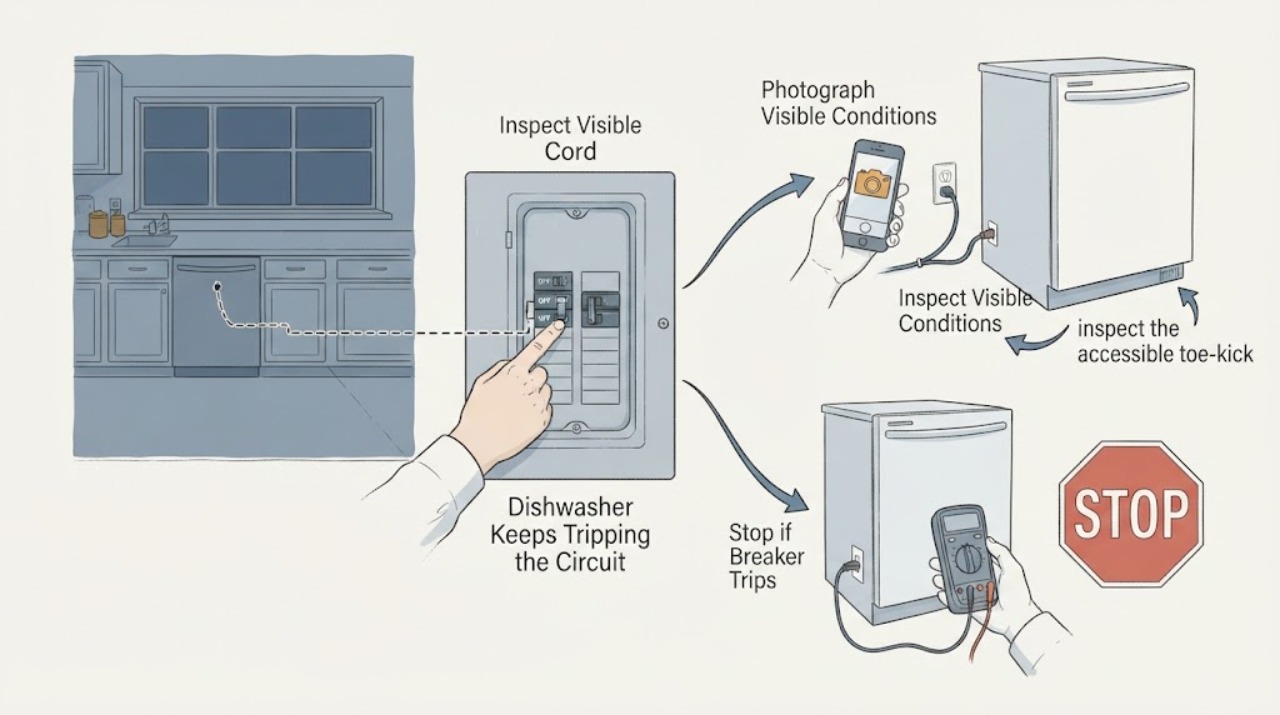
Stop using the Thermador dishwasher after a repeated breaker trip and do not keep resetting it to finish a cycle. The matching report says the unit is on a dedicated circuit, still trips at varying points in the cycle, and can trip overnight; that pattern does not prove a weak breaker, heater fault, pump fault, or house-wiring problem. From outside the appliance, record the full model/rating information, which protective device operated, when the trip occurred in the last observed cycle, and whether there is visible moisture, scorching, odor, or cord damage. Do not open the breaker panel, remove the dishwasher, disconnect hardwired conductors, bypass protection, or take live measurements. Thermador directs owners to model-specific manuals and support, while its service safety terms reserve internal repair and parts work for trained service; arrange qualified appliance service and use a qualified electrician when the circuit itself or its protective device needs evaluation.
Work through in order
Diagnostic checks
Use only checks that match the exact appliance or system and its official guide.
-
Check 1
Leave the dishwasher stopped after the recurrent trip and do not reset the breaker again to complete the wash. From a safe position, record whether the operated device is a breaker, GFCI, AFCI, or combination protective device and photograph only the closed panel label if it can be done safely.
Expected result: The same protective device has tripped more than once, or the device shows a fault indicator; alternatively, the event was a single unexplained trip with no repeat.
Next step: Keep the dishwasher out of service and arrange qualified evaluation. Do not open the panel, replace the breaker, bypass protection, or move the appliance to another circuit as a test.
Why this matters
Why: A repeated or indicated protection event is a stop condition and cannot be treated as a harmless nuisance trip. A single event is still unresolved and should be documented rather than retested by repeated resets.
-
Check 2
Write down the last observed cycle stage and timing without running another cycle: start, fill, wash, heating or drying phase if known, end of cycle, or hours after completion. Note whether the trip happened only on one program or also on other historical runs.
Expected result: The available history shows a consistent phase, different phases, only heavy-cycle history, or no reliable pattern.
Next step: Give the timing history to service and do not reproduce the event. Do not use a diagnostic cycle or a different cycle as a user test unless a qualified technician directs and monitors it.
Why this matters
Why: Timing is useful information for a technician but does not prove a heater, pump, motor, control, or breaker fault; varying timing can involve more than one possible load or protection response.
-
Check 3
With the appliance stopped and without removing panels or touching conductors, inspect the accessible toe-kick and under-sink area for visible water, a wet or scorched cord, melted plastic, smoke residue, or an electrical odor.
Expected result: There is visible water or damage/odor, or the accessible area is dry and visually intact.
Next step: If water, scorching, smoke, or odor is present, keep the water supply and appliance power isolated through safe accessible controls and arrange service. If no external sign is present, still do not re-energize the dishwasher; provide the observation to the technician.
Why this matters
Why: Water or heat damage raises an immediate electrical and leakage concern but does not identify the failed component. A dry exterior does not rule out an internal fault or a circuit/protective-device problem.
-
Check 4
Collect the complete Thermador model and rating-plate information, installation date or recent work, breaker/protection label, cycle history, visible observations, and whether the dishwasher is cord-connected or hardwired without disconnecting it.
Expected result: The model and electrical arrangement are clear, or the label/connection type cannot be read without moving the appliance or opening an enclosure.
Next step: Send the information and photos to a qualified Thermador appliance technician. If the protective device trips with the appliance safely isolated, or the circuit/device itself is suspect, have a qualified electrician evaluate the house wiring and protection.
Why this matters
Why: Model-specific manuals and support determine what Thermador documentation applies. An unreadable or inaccessible identity is a reason for service identification, not a reason to borrow another model's test procedure.
Use your observations
Decision map
Find the observation that best matches what you see, then follow the next safe action.
-
PATH 01Next step
What you see
The dishwasher has tripped the same breaker or protective device repeatedly, including after the appliance has been idle or during the reported night-time run.
Do this next
Keep the dishwasher out of service and arrange qualified appliance evaluation, with an electrician involved when the circuit or protective device also needs assessment. Do not re-energize it to finish a cycle.
Why this path and its safety boundary
Why it matters: This is a recurrent protection event, not evidence that a reset is a repair; the cause may be in the appliance, circuit, or protective device and cannot be separated safely by consumer trial and error.
-
PATH 02Next step
What you see
Visible water, scorching, melted insulation, smoke, or an electrical odor is present near the dishwasher or accessible connection area.
Do this next
Do not touch the damaged area or restore power. Shut off the water supply and isolate power only through safe accessible controls, then arrange qualified service; use emergency procedures for active smoke or fire.
Why this path and its safety boundary
Why it matters: The observation creates an immediate water or electrical safety boundary, but it does not prove whether the cause is a heater, cord, leak, terminal, or house wiring.
-
PATH 03Next step
What you see
The exterior is dry and intact, but the trip recurs at different points in the cycle or the model/circuit identity is incomplete.
Do this next
Stop user testing, provide the full rating and event history to a qualified appliance technician, and have a qualified electrician assess the circuit when indicated. Do not use a different cycle, outlet, extension cord, or altered breaker as a diagnostic workaround.
Why this path and its safety boundary
Why it matters: A clean exterior does not rule out an internal dishwasher fault or an electrical supply/protection issue, and the timing is not enough to name a component.
-
PATH 04Next step
What you see
A qualified technician determines that the appliance is safely isolated and the circuit/protective device trips without the dishwasher load.
Do this next
Follow the electrician's evaluation of the circuit, protection, and supply. Keep the dishwasher disconnected or isolated until both professionals confirm a safe repair path.
Why this path and its safety boundary
Why it matters: That result points the next investigation toward the house circuit or protective device, but the reader should not create this condition by disconnecting hardwired conductors or opening the panel.
Helpful context
Understand the symptom
A dedicated circuit does not identify the cause
The original report says the Thermador dishwasher has its own dedicated circuit, yet the breaker trips at different points in a cycle or sometimes not at all, including overnight. That rules out the reporter's concern about another appliance running at the same time, but it does not distinguish an appliance fault from a protective-device, supply, or wiring issue. The community suggestions about a heater or breaker are hypotheses, not a Thermador diagnosis.
Use the official support path without repeating the trip
Thermador's dishwasher support page points owners to the owner's manual, model-specific troubleshooting, error-code information, and service paths. Its public guidance covers ordinary operating and water-related checks, but it does not turn a repeated breaker trip into permission to open the electrical enclosure or run the appliance again for diagnosis. A single historical trip may be documented; a recurrent trip should be treated as a stop condition.
Separate visible water or damage from an unknown internal fault
Thermador's error-code guidance describes water in the base as a leakage-protection condition and directs the owner to turn off the water supply. Outside the appliance, look for visible water at the toe-kick or under-sink area, a wet or damaged cord, scorching, smoke, or an electrical odor without touching wiring. These observations do not prove a leak source or failed part; they determine whether the appliance must remain isolated while service is arranged.
Keep panel, breaker, and live-test work professional
Thermador/BSH states that repair, technical work, and parts replacement should not be performed by untrained users because internal components may cause shock or other harm. Do not open the breaker panel, change the breaker rating, bypass GFCI/AFCI or other protection, pull a hardwired dishwasher out, or measure energized conductors. A qualified appliance technician can assess the dishwasher, and a qualified electrician can assess the circuit or protective device when the appliance is safely isolated.
Common questions
FAQ
Does a dedicated circuit prove that the Thermador dishwasher itself is faulty?
No. It only addresses the possibility of another appliance sharing the circuit. The exact report still has varying trip times and no confirmed component diagnosis. A qualified appliance technician and, when indicated, a qualified electrician must separate appliance, protective-device, and house-circuit causes.
Can I reset the breaker and run another cycle to see when it trips?
Do not repeatedly re-energize a dishwasher after a recurrent trip. Record the timing already observed and leave the appliance out of service until it is evaluated. Repeated resets can turn an unresolved electrical or water fault into a greater hazard.
Should I replace the breaker or change it to a larger rating?
Do not replace, resize, bypass, or alter the breaker as a consumer test. The protection device and circuit require qualified electrical evaluation, while the dishwasher requires model-specific appliance service.
What should I do if I see water or scorching under the dishwasher?
Do not touch the damaged area or restore power. Shut off the water supply and isolate power only through safe accessible controls, then arrange qualified service. Do not pull out a hardwired unit or open its electrical enclosure.
Read the exact guide
Official sources
- Dishwashers - TroubleshootingThermador · Supports the official model-specific support path and the need to use the owner's manual/installation guide. It does not diagnose the assigned no-model breaker trip or authorize electrical-panel work.
- BSH Terms and Conditions (Service Visit)Thermador / BSH Home Appliances Corporation · Supports the professional boundary for repair, parts replacement, and internal work. It does not diagnose the cause of the breaker trip.
- Dishwasher keeps tripping the circuit breakerReddit r/Appliances · Supports only the Thermador brand, dedicated-circuit/night-time context, inconsistent cycle timing, and reported reset behavior. It does not verify a heater, breaker, pump, wiring, control, or other failed component.
- Dishwashers - Error CodesThermador · Supports only the bounded safety examples that water in the base can activate leakage protection and that low supply voltage requires professional electrical evaluation. Error-code meanings remain model-dependent and are not assigned to this no-model report.
Community feedback
Share a repair observation
Share a plain-text repair observation. Accepted observations are published automatically; this page may take a moment to update.