
On this page
Start here
Quick answer
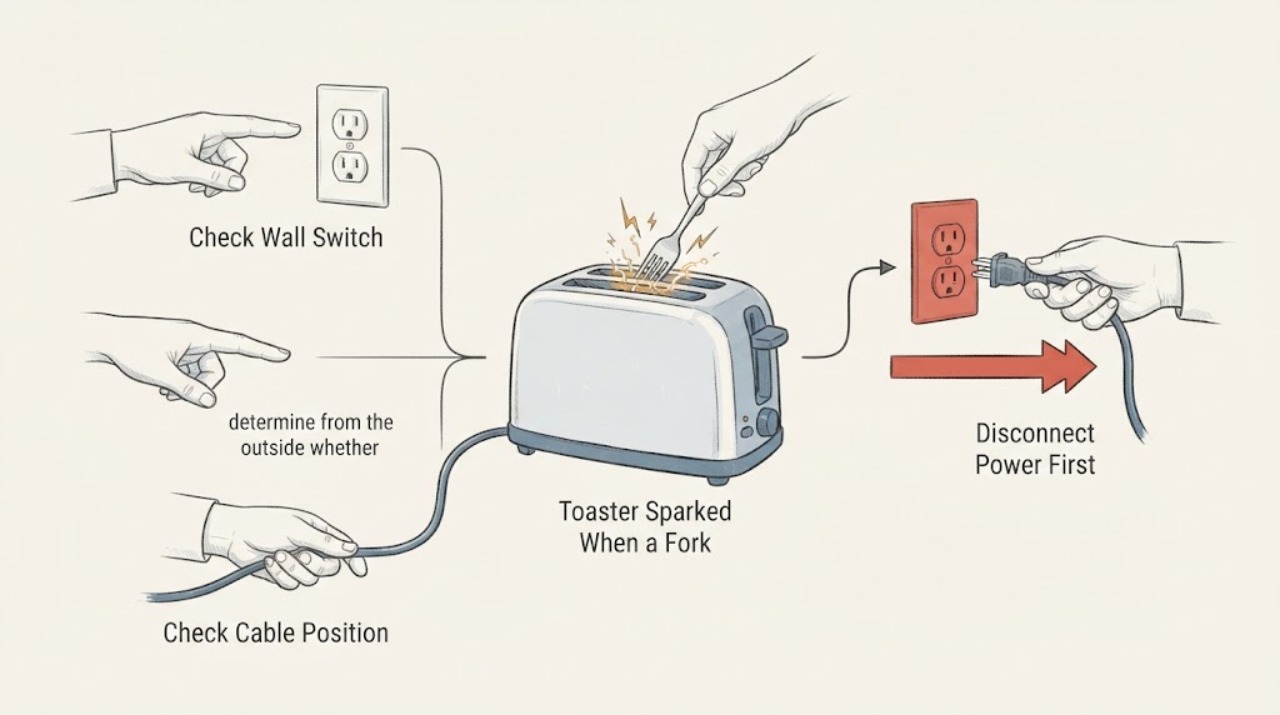
A fork in a powered toaster can contact live heating or electrical parts and create an electric-shock or fire hazard. Stop the cycle, disconnect power by the plug only if it is safe to reach without touching the fork or a damaged plug, and keep hands and metal objects out of the slots. Do not power the toaster again to see whether it still works. After it is disconnected and fully cool, inspect only the outside for scorch marks, melted plastic, a damaged cord or plug, smoke residue, or a hot or damaged outlet; any such sign, or a fork that remains stuck, requires the manufacturer or a qualified repair professional to assess the appliance. A toaster that sparked while in use should remain out of service even if no external damage is visible.
Work through in order
Diagnostic checks
Use only checks that match the exact appliance or system and its official guide.
-
Check 1
Stop the toaster and isolate it from power. If the plug and outlet are intact and you can reach the plug without touching the fork, hot surfaces, smoke, or a damaged cord, switch the control off and unplug by grasping the plug. If that is not safe, move away and have power disconnected from a safe location by a qualified person or emergency responder.
Expected result: Power is disconnected without contact with the fork, or the appliance is still energized because the plug or access is unsafe.
Next step: Do not touch or remove the fork while the toaster is energized. Once disconnected, let the appliance cool completely before any external observation; if power cannot be isolated safely, stop and call for qualified help.
Why this matters
Why: The fork was inserted while energized, so further contact with the slot or a repeat start could expose a person to shock, burns, or another arc. The safe state is de-energized and hands-off.
-
Check 2
After the toaster is disconnected and fully cool, determine from the outside whether the fork is still lodged in a slot. Do not pull it, reach into the slot, use another utensil, remove the cover, or turn the toaster over after a sparking event.
Expected result: The fork remains stuck or its removal would require contact with internal parts, or it is no longer present without any further handling.
Next step: Keep the toaster unplugged and arrange manufacturer or qualified service assessment. Do not use the absence of a visible fork as permission to run a test cycle.
Why this matters
Why: A stuck metal object leaves an unresolved contact and injury hazard. The Hamilton Beach manual permits no utensil insertion and directs repair information to the manufacturer or its service agent when the appliance malfunctions or is damaged; it does not authorize improvised removal after an arc.
-
Check 3
With power still disconnected and the toaster cool, inspect only the exterior cord, plug, casing, slot rim, and nearby outlet for scorch marks, melted or cracked plastic, exposed wire, smoke residue, a loose fit, or unusual heat.
Expected result: Any cord, plug, casing, or outlet damage or heat is visible, or the exterior appears normal.
Next step: For any damage, heat, odor, or loose outlet, leave the toaster disconnected and have the appliance and outlet assessed; do not replace a plug, outlet, fuse, or cord as a DIY experiment. If no damage is visible, still keep the toaster out of service because the powered metal contact was abnormal.
Why this matters
Why: CPSC says damaged cords can expose live wires and create shock or fire hazards, and an unusually warm outlet can indicate an unsafe wiring condition. A normal-looking exterior cannot rule out internal damage caused by the spark.
-
Check 4
Assess whether there was smoke, flame, a popping or continuing arcing sound, a burning odor, or a tripped breaker during the event. Do this from a safe distance without reconnecting the toaster or opening it.
Expected result: Smoke or flame is present, the event continues, or the appliance or circuit has tripped; alternatively, the spark stopped immediately with no visible fire.
Next step: For fire or continuing smoke, leave the area and call emergency services from a safe location. For a trip, odor, or arc, keep the appliance and affected outlet off and obtain qualified electrical/appliance service. Do not reset and retry the toaster.
Why this matters
Why: Active smoke or flame is a fire emergency, while a tripped protective device or burning odor indicates an electrical fault that should not be recreated. A stopped spark is not evidence that the toaster is safe to reuse.
-
Check 5
Record the toaster brand, model, and the sequence of events from the exterior label or purchase record only: whether the fork remains, where the spark appeared, whether the breaker tripped, and any visible damage. Do not energize the toaster to gather more information.
Expected result: The model and event details are available for service, or the model cannot be identified.
Next step: Give the record to the manufacturer, an authorized service agent, or a qualified repair professional. If the appliance cannot be safely identified or assessed, replace it through an appropriate disposal route rather than returning it to use.
Why this matters
Why: The manufacturer needs the exact appliance identity to determine inspection, warranty, recall, or replacement handling. Missing model information does not make a sparking toaster safe for a generic reset or test.
Use your observations
Decision map
Find the observation that best matches what you see, then follow the next safe action.
-
PATH 01Next step
What you see
The fork is still in the slot or cannot be removed without touching the interior.
Do this next
Keep the toaster unplugged and cool; contact the manufacturer or qualified service. Do not use another utensil, open the case, or try a second run.
Why this path and its safety boundary
Why it matters: The conductive object and any unseen arc damage remain unresolved, and improvised removal would add shock and burn risk.
-
PATH 02Next step
What you see
There is smoke, flame, continuing crackling, or a burning odor after the spark.
Do this next
Leave the area and call emergency services from a safe location for smoke or flame. Do not pour water onto an energized appliance or re-enter to retrieve the toaster.
Why this path and its safety boundary
Why it matters: The event may involve an active appliance or electrical fire hazard rather than a harmless momentary spark.
-
PATH 03Next step
What you see
The plug, cord, casing, or outlet is scorched, melted, cracked, loose, or unusually warm.
Do this next
Leave the toaster disconnected and have the appliance and outlet checked by qualified professionals. Do not replace the outlet, cord, or protective device as a test.
Why this path and its safety boundary
Why it matters: CPSC identifies damaged cords and warm or improperly operating outlets as shock or fire hazards; the spark may have damaged the appliance or the circuit.
-
PATH 04Next step
What you see
The spark stopped and no external damage is visible.
Do this next
Keep the toaster out of service and obtain manufacturer or qualified service guidance; do not reconnect it just to see whether it still toasts.
Why this path and its safety boundary
Why it matters: An external inspection cannot verify the condition of internal live parts or insulation after metal contacted a powered toaster.
Helpful context
Understand the symptom
Treat the spark as an electrical safety event
The fork was an unintended conductive object inside a live heating appliance. The immediate question is not whether the toaster can still brown bread; it is whether it can be made safe without touching the metal or exposing yourself to heat, shock, or a damaged cord. The opened Hamilton Beach toaster manual warns against inserting metal utensils, says to unplug before clearing a lodged item, and says not to operate an appliance after it malfunctions or is damaged. Its exact model is 22614-CL, so model-specific service instructions must come from the toaster's own manual.
Keep the inspection external
After power is isolated and the toaster is completely cool, look only at the cord, plug, outlet, casing, and slot opening from the outside. Do not reach into a slot, pull on a stuck fork, remove the cover, bend heating elements, or perform a test run. A spark can leave damage that is not visible without disassembly, and an apparently normal second run would not prove the appliance is safe.
Use service or replacement as the endpoint
If the fork is stuck, the toaster smoked, a breaker tripped, the cord or plug is marked, or the outlet is warm or scorched, keep the appliance disconnected and contact the manufacturer or a qualified repair professional. If there was a flame or continuing smoke, move away and use local emergency fire guidance. Do not use water on an energized toaster.
When checks do not resolve it
Need a professional?
Call the manufacturer or a qualified appliance/electrical professional when the fork remains stuck, the toaster sparked, smoked, smelled burnt, tripped protection, or has any cord, plug, casing, or outlet damage. Treat smoke or flame as an emergency and do not reuse the toaster while waiting.
Have this ready
- Provide the brand/model from the exterior label if safely readable, whether the fork remains, where the arc appeared, whether the breaker tripped, and any visible or odor-based damage. Do not perform another power-on test for the report.
Common questions
FAQ
Can I plug the toaster back in if it still looks normal?
No. A spark while a fork was inside is an abnormal electrical event. Keep it unplugged and have the manufacturer or a qualified professional assess it; a normal exterior does not prove that internal insulation or live parts are safe.
How do I get a fork out of a toaster?
Do not reach in, use another utensil, or handle the fork while the toaster is powered or hot. Disconnect power only if that can be done safely without touching the hazard, let the unit cool, and contact the manufacturer or qualified service if the fork remains lodged.
What should I do if the outlet or plug is scorched?
Leave the toaster disconnected and stop using the affected outlet. CPSC identifies damaged cords and unusually warm or improperly operating outlets as shock or fire hazards; have the appliance and outlet checked by qualified professionals.
Read the exact guide
Official sources
- Cooking Fire SafetyU.S. Fire Administration · Government guidance for responding to smoke or fire during cooking and keeping fire hazards controlled.
- Hamilton Beach Toaster (22614-CL) - Use & CareHamilton Beach · The opened manual is for model 22614-CL. Its explicit metal-utensil prohibition, unplug/cool requirement, and damaged-appliance service boundary are used as manufacturer safety evidence; model-specific repair instructions are not generalized.
- Appliance and Electrical Fire SafetyU.S. Fire Administration · Government fire-safety guidance for small-appliance disconnection, damaged cords, and electrical fire prevention.
- HOME ELECTRICAL Safety ChecklistU.S. Consumer Product Safety Commission · CPSC staff checklist for identifying damaged electrical cords and unsafe or unusually warm outlets; it does not diagnose toaster internals.
Community feedback
Share a repair observation
Share a plain-text repair observation. Accepted observations are published automatically; this page may take a moment to update.