
On this page
Start here
Quick answer
No. A toaster plug or cord that has melted, softened, discolored, or become hot is damaged electrical equipment. Stop toasting and keep the toaster out of service. If it is safe to approach, switch the toaster off and disconnect it by the plug; if the plug is hot, stuck, sparking, smoking, or surrounded by flame, do not touch it and use emergency help as appropriate. Let everything cool without cleaning or reusing it. Retire the toaster or have the manufacturer or a similarly qualified service provider assess it, and have an electrician inspect a discolored, loose, hot, or damaged receptacle before another appliance is connected. Do not trim the plug, tape the cord, replace the plug yourself, or test the toaster again.
Before you begin
Safety first
- Do not clean and retry the toaster, touch a hot or stuck plug, cut or splice the cord, install a replacement plug, remove the outlet cover, probe the receptacle, open the toaster, or bypass any electrical protection. Keep the appliance disconnected until qualified service or replacement is arranged.
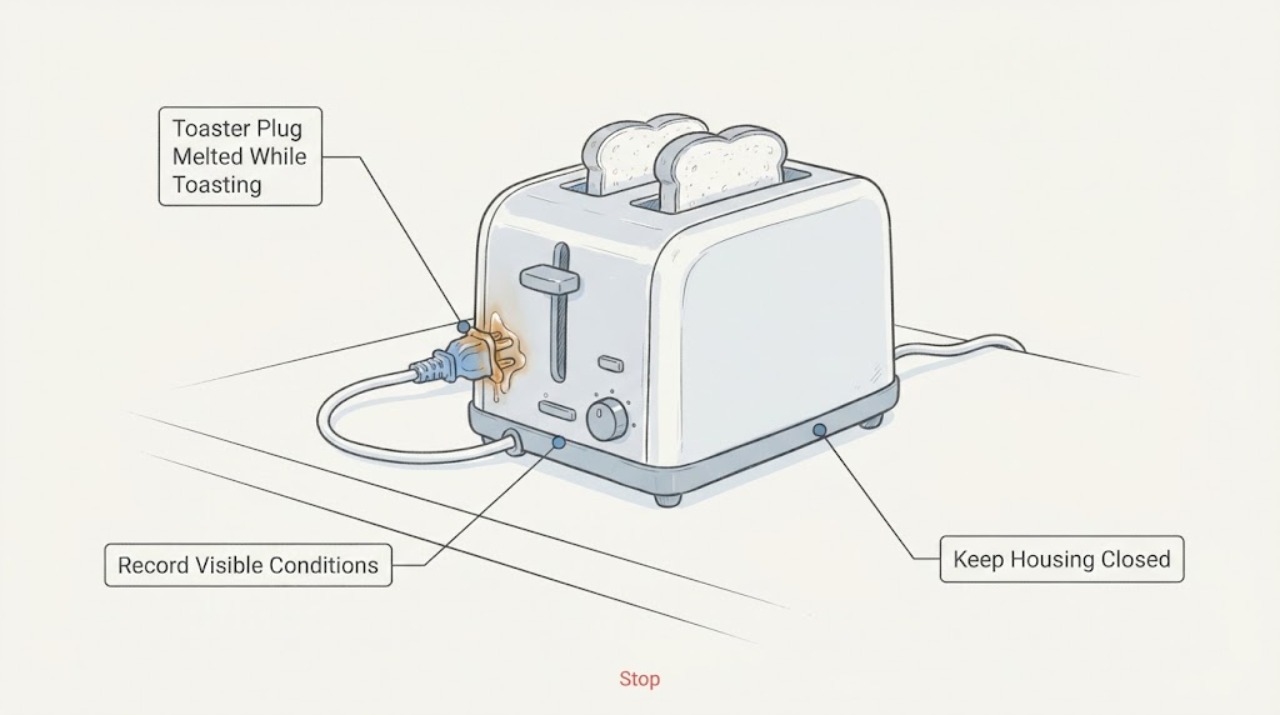
Work through in order
Diagnostic checks
Use only checks that match the exact appliance or system and its official guide.
-
Check 1
Stop the toast cycle. If the plug and receptacle are cool and reachable, switch the toaster off and pull the plug by its insulated body; if the plug is hot, stuck, sparking, smoking, or near flame, do not touch it.
Expected result: Power is disconnected safely, or there is active smoke, flame, sparking, or heat that makes approaching the toaster unsafe.
Next step: Keep people away and use emergency help as appropriate for smoke or fire. Otherwise leave the toaster disconnected and untouched until it is completely cool.
Why this matters
Why: A melted plug is a damaged electrical connection. Active smoke or flame is an emergency condition, not a troubleshooting test.
-
Check 2
When the toaster, plug, and receptacle are completely cool and de-energized, make a visual record from the outside: note melted or exposed cord insulation, distorted plug blades, brown or black marks, a loose-fitting receptacle, or damage to an extension cord or adapter.
Expected result: The damage is limited to the plug or cord, the wall receptacle also shows heat or looseness, an extension device was involved, or the affected area cannot be identified safely.
Next step: Do not touch, scrape, straighten, tape, or open the damaged parts. Keep the toaster out of service; arrange qualified appliance service for the toaster and electrician evaluation for any outlet, circuit, or extension-device damage.
Why this matters
Why: The observation narrows which professional needs to assess the next step, but it does not prove which part caused the heating. A loose or damaged receptacle can remain a hazard even after the toaster is removed.
-
Check 3
Compare the condition with the toaster's rating label and use history without reconnecting it: record the exact model if readable, whether an extension cord, adapter, or power strip was used, whether the plug had felt loose or hot, and whether a breaker tripped.
Expected result: The model and event details are available, or the model is missing and the cause remains uncertain.
Next step: Give the model, photos of the cool exterior, and event history to the manufacturer or a qualified service provider. If the model cannot be identified, replace the toaster rather than selecting a cord or plug by appearance.
Why this matters
Why: The details help the manufacturer or service provider distinguish a damaged appliance from a receptacle or installation concern; they are not permission to substitute a cord or test the toaster.
-
Check 4
Before another appliance is connected to the same receptacle, check only whether the outlet face is visibly burned, cracked, loose, or unable to hold a plug snugly, with the circuit left off when that can be done safely.
Expected result: The receptacle is discolored, warm, damaged, loose, or a plug does not fit snugly; or it looks normal from the outside.
Next step: Do not use the damaged outlet or remove its cover. Have a qualified electrician inspect it before reuse; keep the toaster retired or professionally assessed even if the outlet appears normal.
Why this matters
Why: Visible outlet damage or poor plug retention is a reason for electrician inspection. A normal-looking face does not clear the receptacle or branch wiring after a melted plug event.
Use your observations
Decision map
Find the observation that best matches what you see, then follow the next safe action.
-
PATH 01Next step
What you see
There is active smoke, flame, sparking, a hot or stuck plug, or a burning smell that continues after the toaster is stopped.
Do this next
Keep clear, leave the area if needed, and contact emergency services or the local fire service as appropriate. Do not re-energize the toaster to see whether the symptom repeats.
Why this path and its safety boundary
Why it matters: The event may still be an electrical or fire emergency, and touching the plug or adding water can worsen the hazard.
-
PATH 02Next step
What you see
The toaster plug or cord is melted or visibly damaged, but the outlet is cool and has no obvious mark.
Do this next
Keep the toaster unplugged and retire it or send it to the manufacturer or a similarly qualified service provider. Do not splice, tape, trim, or replace the plug as a user repair.
Why this path and its safety boundary
Why it matters: The toaster is still not safe to operate; a normal-looking outlet does not prove that the toaster cord was the only problem.
-
PATH 03Next step
What you see
The receptacle is discolored, loose, warm, cracked, or no longer holds a plug snugly.
Do this next
Do not use that receptacle and do not remove its cover. Arrange a qualified electrician inspection before connecting another appliance there.
Why this path and its safety boundary
Why it matters: The outlet or connected wiring needs an electrical safety assessment; changing only the toaster would leave a possible installation hazard unaddressed.
-
PATH 04Next step
What you see
The plug has cooled and looks normal, but the toaster or outlet previously became hot or the plug was loose during toasting.
Do this next
Do not resume use. Preserve the model and event details for the manufacturer and have the receptacle checked by a qualified electrician if any looseness, heat, or discoloration was observed.
Why this path and its safety boundary
Why it matters: A transient heating event is still unexplained; visual recovery does not establish that the appliance or receptacle is safe.
Helpful context
Understand the symptom
Treat a melted plug as electrical damage
Melted plastic, a hot plug, discoloration, or a soft cord is enough to stop using this toaster. The opened Proctor Silex toaster manual says not to operate an appliance with a damaged supply cord or plug and directs cord replacement or repair to the manufacturer, service agent, or a similarly qualified person. That instruction is a safe boundary for an unbranded toaster as well: do not restore operation by cleaning away the mark or fitting a replacement plug from a hardware shelf.
A plug mark does not identify the failed part
A melted plug can leave several possibilities: damage at the toaster cord or plug, a poor connection at the receptacle, an extension cord or adapter, overload, or another wiring fault. A photograph or a single event cannot distinguish those causes. The useful decision is whether the toaster and receptacle are safe to leave disconnected, not whether a user can prove which component heated first.
Keep the next check external
After power is disconnected and the parts are fully cool, record only what can be seen without opening anything: whether the plug blades or cord insulation are melted, whether the receptacle face is brown or deformed, whether the plug was loose, and whether there was smoke, sparking, or a breaker trip. Do not remove the receptacle cover, probe the outlet, cut away the damaged plug, or open the toaster.
When checks do not resolve it
Need a professional?
Contact the toaster manufacturer or a similarly qualified appliance service provider for any melted, softened, scorched, or damaged plug or cord. Contact a qualified electrician before reuse when the receptacle is loose, discolored, hot, cracked, or otherwise damaged, or when the cause of the heating is uncertain.
Safety scope: Do not clean and retry the toaster, touch a hot or stuck plug, cut or splice the cord, install a replacement plug, remove the outlet cover, probe the receptacle, open the toaster, or bypass any electrical protection. Keep the appliance disconnected until qualified service or replacement is arranged.
Have this ready
- Provide the exact model and serial information if readable, photos taken only after cooling and disconnecting, the location of the melting, whether an extension device was involved, whether the plug felt loose or hot, and any smoke, sparking, odor, or breaker event.
Common questions
FAQ
Can I keep using the toaster if the plug only melted a little?
No. A melted or softened plug is damaged electrical equipment. Keep the toaster disconnected and retire it or have the manufacturer or qualified service provider assess it.
Can I cut off the damaged plug and fit a new one?
Do not make that a user repair. The opened toaster manual sends damaged cord or plug replacement to the manufacturer, service agent, or similarly qualified person, and USFA says not to try to repair damaged appliance cords.
Should I replace only the toaster or also the outlet?
The toaster must stay out of service. If the outlet is loose, discolored, hot, cracked, or was involved in the melting, have a qualified electrician inspect it before another appliance is connected. A normal-looking outlet still does not identify the cause, so do not use the toaster to test it.
Read the exact guide
Official sources
- Electrical Fire SafetyU.S. Fire Administration · Opened the USFA electrical fire safety handout. It says to replace damaged appliance cords, not try to repair them, and have home electrical work done by a qualified electrician; it is used for the safety boundary rather than a toaster-specific failure diagnosis.
- Appliance and Electrical Fire SafetyU.S. Fire Administration · Opened USFA consumer fire-safety page. It supports replacing appliances with damaged cords, replacing outlets that do not hold plugs snugly, unplugging small appliances when not in use, and replacing damaged extension cords; it does not diagnose this toaster's cause.
- Proctor Silex Toaster (22302) - Use and CareHamilton Beach Brands / Proctor Silex · Opened the manufacturer-hosted toaster manual. It is used for the model-specific example that a toaster with a damaged supply cord or plug must not be operated and that cord replacement/repairs require the manufacturer, service agent or similarly qualified persons; the assigned topic has no confirmed brand or model, so no Proctor Silex part fit is inferred.
- CPSC Warns Consumers About Faulty Extension Cords, Power Strips and Surge ProtectorsU.S. Consumer Product Safety Commission · Opened CPSC safety release. It supports stopping use of a hot cord, discarding damaged cords, and recognizing loose connections/overload as possible hazards for cords and plug-in equipment; it is not used to assign a cause to this toaster event.
Community feedback
Share a repair observation
Share a plain-text repair observation. Accepted observations are published automatically; this page may take a moment to update.