
On this page
Start here
Quick answer
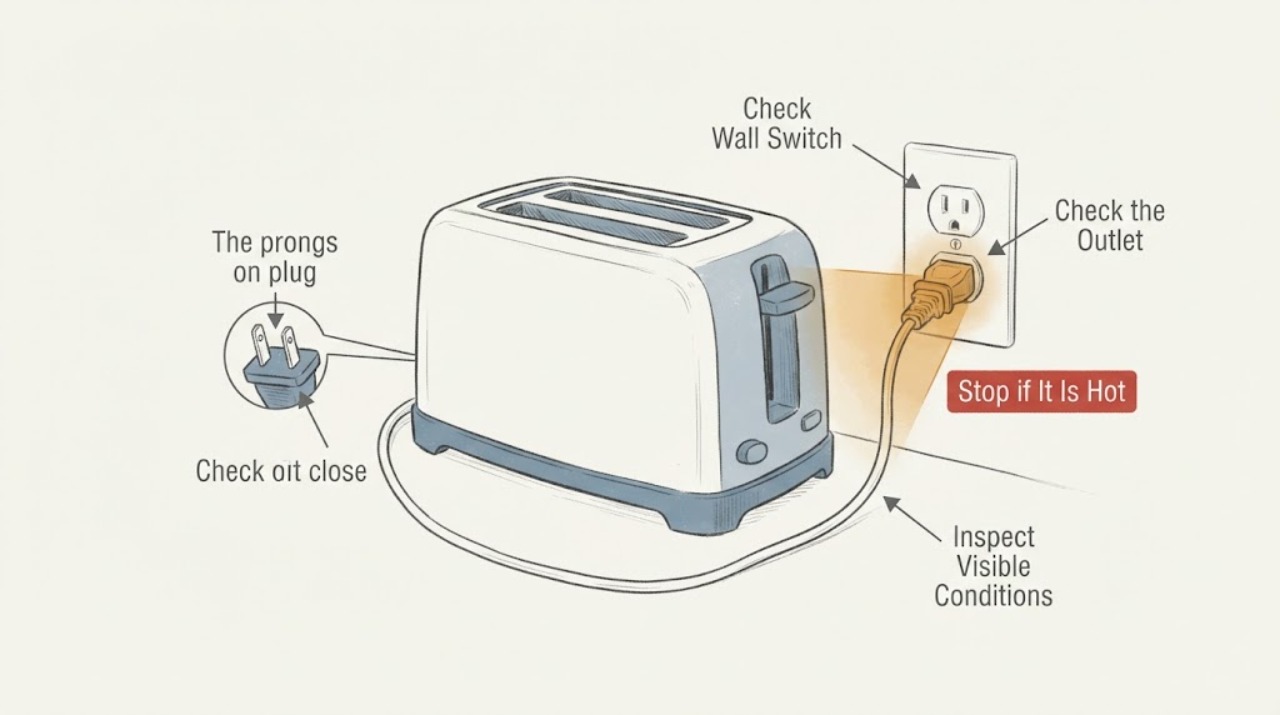
Yes. A hot toaster plug, prong, or cord is a stop-using warning, especially if the plug, outlet, or insulation is discolored, melted, loose, buzzing, or smells like hot plastic. Stop the toaster and unplug it only if the plug can be touched and removed safely; if it is too hot, damaged, smoking, sparking, or stuck, keep clear and switch off the circuit breaker if you can do so safely. Do not plug it back in to see whether it heats again, tape or splice the cord, or use an extension cord. A damaged toaster should be replaced, and a hot or loose receptacle should be inspected by a qualified electrician.
Work through in order
Diagnostic checks
Use only checks that match the exact appliance or system and its official guide.
-
Check 1
Turn the toaster off and stop using it. If there is no smoke, flame, exposed conductor, melted plug, or dangerous heat and the plug can be handled safely, unplug by gripping the plug body rather than pulling the cord. If the plug is too hot, stuck, smoking, sparking, or damaged, do not touch it; keep clear and switch off the circuit breaker only if that can be done safely.
Expected result: The plug disconnects normally; the plug or outlet is too hot or damaged to touch; or smoke, flame, arcing, or a burning smell is present.
Next step: Leave the toaster unplugged and do not retry it. For smoke or fire, leave the area and call emergency services; for a de-energized but hot or damaged connection, arrange qualified electrician inspection.
Why this matters
Why: Hot plug/socket conditions can indicate a deteriorated connection or overload. Smoke, flame, arcing, or severe heat is an immediate fire/electrical hazard, not a toaster performance issue.
-
Check 2
After the appliance and receptacle are fully cool and power is off, visually identify whether the heat or damage is on the prongs/plug face, the first section of cord, the receptacle, or multiple points. Look for darkening, melted plastic, softened insulation, cracking, exposed wire, a loose fit, buzzing, or a hot-plastic smell. Do not scrape, bend, tighten, or open anything.
Expected result: Only the toaster plug/cord is marked; the wall receptacle is discolored or loose; both show heat damage; or no visible damage remains.
Next step: If the toaster cord or plug is damaged, discard/replace the toaster rather than repairing it. If the receptacle is hot, loose, discolored, or damaged, leave it unused and call a qualified electrician. Do not use the toaster because a visual check looks normal after cooling.
Why this matters
Why: CPSC says overheating can occur at the plug, socket, or cord and that hot plugs/sockets are often caused by deteriorated wire connections. ESFI treats warm outlets, discoloration, buzzing, and burning odor as wiring-problem warning signs.
-
Check 3
Check how the toaster was powered without plugging it back in: identify any extension cord, power strip, multi-outlet adapter, loose receptacle, or other heat-producing appliance sharing the receptacle. Do not rearrange a hot or damaged setup while energized.
Expected result: The toaster was on an extension cord/power strip, shared with another heat-producing appliance, or plugged into a receptacle that does not hold the plug snugly; or it was directly in a sound wall outlet.
Next step: Do not transfer the toaster to another outlet as a test. Retire a damaged toaster and have a suspect outlet/circuit evaluated; after an electrician clears the receptacle, follow the replacement appliance instructions and use a direct wall outlet.
Why this matters
Why: USFA and ESFI recommend direct wall connection for appliances and warn against overloads, damaged cords, and loose receptacles. A direct connection does not make an already hot plug safe to reuse.
-
Check 4
Photograph the cooled plug, prongs, cord entry, and receptacle from a safe distance, and note whether the heat began at the toaster end or wall end, how long the toaster had been running, and whether a breaker tripped. Do not cut the cord, tape the damage, or disassemble the toaster or outlet.
Expected result: The damage is localized to the toaster, localized to the receptacle, present at both ends, or there is no visible damage but the heat recurs in use.
Next step: Provide the photos and observations to the qualified electrician or appliance replacement/service provider. Keep the toaster out of service until the responsible side is cleared or replaced.
Why this matters
Why: The location of heat helps an electrician or appliance service provider distinguish an appliance-side cord/plug problem from a receptacle or circuit problem, but it does not prove a specific failed component.
Use your observations
Decision map
Find the observation that best matches what you see, then follow the next safe action.
-
PATH 01Next step
What you see
The toaster plug, prongs, or cord are hot, discolored, melted, cracked, or smell of hot plastic, while the outlet is not visibly damaged.
Do this next
Keep the toaster unplugged and replace the toaster or have its cord/plug assessed by qualified service. Do not tape, splice, bend, or retest it.
Why this path and its safety boundary
Why it matters: The appliance-side cord/plug or its connection is unsafe to reuse; CPSC warns that hot plugs and deteriorated wire connections can overheat.
-
PATH 02Next step
What you see
The wall receptacle is hot, loose, discolored, buzzing, or has a burning odor, whether or not the toaster plug also shows damage.
Do this next
Leave the receptacle unused and call a qualified electrician. Do not test it with another appliance and do not reset a tripped breaker repeatedly.
Why this path and its safety boundary
Why it matters: ESFI treats these as warning signs of an overload or wiring problem, and a loose receptacle can create a deteriorated connection at the plug.
-
PATH 03Next step
What you see
The toaster was powered through an extension cord, power strip, or shared outlet with another heat-producing appliance.
Do this next
Do not move the toaster and try again. Retire the damaged toaster and have the receptacle/circuit cleared before using a replacement directly at the wall.
Why this path and its safety boundary
Why it matters: The supply arrangement can add overload or connection risk; direct wall connection is the safe baseline for cooking appliances.
-
PATH 04Next step
What you see
There is smoke, flame, sparking/arcing, a plug that cannot be safely touched, or an exposed conductor.
Do this next
Keep away, cut power only if safe, leave the area, and call emergency services for fire or active smoke; arrange qualified electrical service after the hazard is controlled.
Why this path and its safety boundary
Why it matters: This is an active fire or shock hazard, not a troubleshooting opportunity.
Helpful context
Understand the symptom
Treat heat at a toaster plug or cord as a stop-use condition
A toaster is a heat-producing appliance, so warmth from the appliance itself does not make a hot plug or cord normal. The important distinction is where the heat appears and whether there is any looseness, discoloration, odor, noise, or damage. This guide limits you to de-energized visual checks and electrical-safety decisions; it does not authorize opening the toaster or receptacle.
Do not perform a repeat test
Once a plug, prong, cord, or outlet has become hot, repeated plugging can recreate an overheating connection. Remove the toaster from service, preserve the visible condition for service or replacement, and have an electrician inspect a suspect receptacle before it is used again.
When checks do not resolve it
Need a professional?
Replace the toaster or obtain qualified appliance service for a hot/damaged plug or cord, and call a qualified electrician for a hot, loose, discolored, buzzing, or damaged receptacle or circuit. Call emergency services for smoke, flame, or active arcing.
Common questions
FAQ
Is it bad if the toaster plug prongs and wire get hot?
Yes. A hot plug, prong, or cord is a stop-use warning, especially with discoloration, odor, looseness, buzzing, or melted insulation. Unplug only if it is safe to touch; otherwise cut power safely and arrange service.
Can I try the toaster in another outlet?
No. Repeated plugging can recreate an overheating connection, and moving the toaster does not clear an appliance-side cord fault. Keep it out of service; have the toaster replaced/assessed and have a suspect receptacle inspected.
Is a warm wall outlet safe if the toaster still works?
Do not assume so. ESFI lists warm outlets, discoloration, buzzing, and burning odor as electrical warning signs. Leave that receptacle unused and call a qualified electrician.
Can I repair the hot toaster wire with tape?
No. CPSC warns against inadequate repairs and cord alteration. Replace the toaster or use qualified service; do not tape, splice, trim, or alter the plug blades.
Should a toaster use an extension cord or power strip?
No. USFA and ESFI recommend plugging cooking appliances directly into a wall outlet and avoiding extension cords or overloaded power strips.
Read the exact guide
Official sources
- Household Extension Cords Can Cause FiresU.S. Consumer Product Safety Commission · The opened CPSC safety alert addresses extension cords, but its hot plug/socket and deteriorated wire-connection warnings are used only for electrical hazard recognition and no-DIY boundaries, not for toaster-specific component diagnosis.
- Pictograph: Never Use Extension Cords for Cooking AppliancesU.S. Fire Administration · General cooking-appliance guidance directly relevant to a toaster; it does not diagnose an individual toaster component.
- Electrical Safety DosElectrical Safety Foundation International · General electrical safety guidance applicable to a hot toaster plug, cord, or receptacle; it does not identify an internal appliance part.
- Appliance and Electrical Fire SafetyU.S. Fire Administration · General small-appliance, cord, plug, outlet, extension-cord, and service safety; used for toaster stop-use and direct-wall guidance.
Community feedback
Share a repair observation
Share a plain-text repair observation. Accepted observations are published automatically; this page may take a moment to update.