
On this page
Start here
Quick answer
A toaster that becomes unusually hot and then shuts off cannot be cleared as normal from the symptom alone. Treat unexpected extreme heat, a burning smell, smoke, sparks, a hot plug or outlet, uneven heating, repeated short cycles or a tripped breaker as unsafe operation: stop using it and unplug it only when that can be done without touching a hot or damaged cord. Let it cool away from anything combustible. Do not run repeated tests, insert tools, shake it, open the housing or replace an internal part. After it is cool, make only an external check for crumbs and cord or plug damage; if the behavior remains unexplained, have it assessed by a qualified small-appliance professional or replace it after checking the exact model for safety notices.
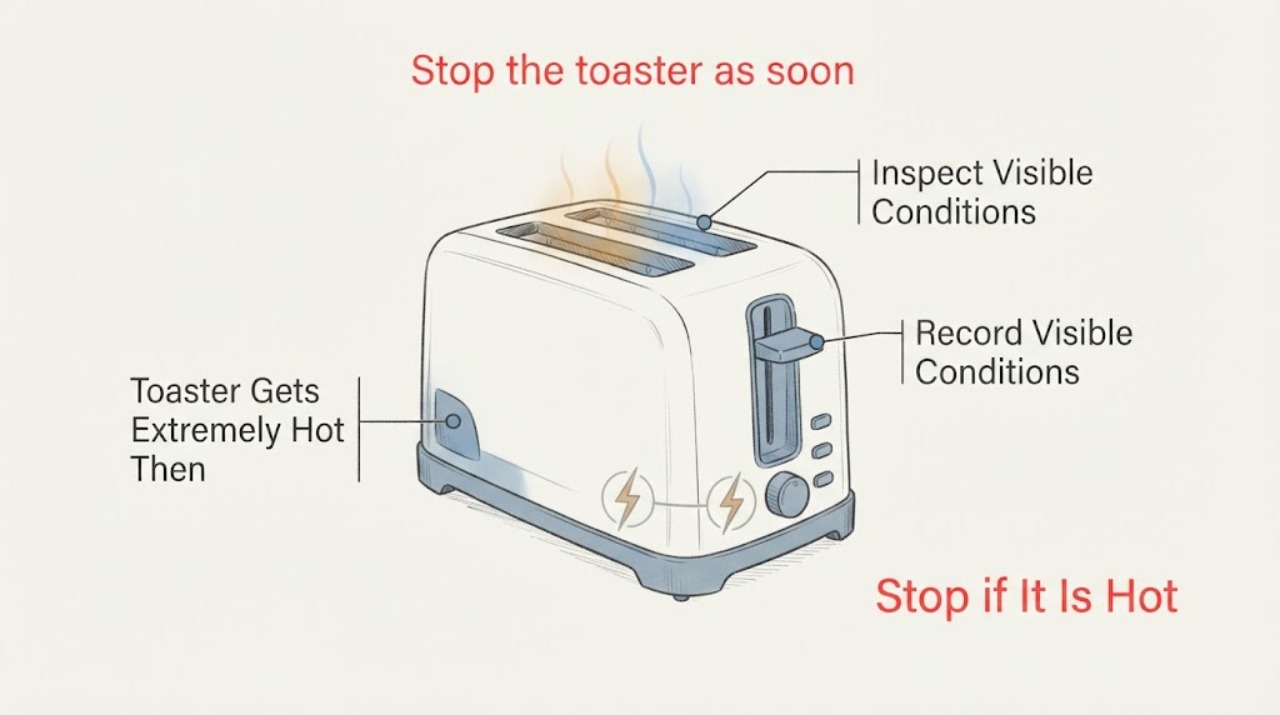
Work through in order
Diagnostic checks
Use only checks that match the exact appliance or system and its official guide.
-
Check 1
Stop the toaster as soon as it becomes unusually hot or shuts off unexpectedly. If there is no active flame and the cord and plug can be reached without touching hot or damaged material, unplug it; otherwise step away, keep combustibles clear if safe, and use emergency help for smoke or fire.
Expected result: There is smoke, flame, sparking, a burning-electrical odor, a glowing area outside the intended slots, or the plug/outlet is hot or damaged.
Next step: Keep away from the appliance, leave the area for spreading smoke or fire, and call emergency services as appropriate. Do not pour water on an energized appliance or handle a damaged cord.
Stop if: Stop all handling immediately for flame, smoke, sparks, exposed wiring or heat at the plug/outlet.
Why this matters
Why: This is a potential fire or shock hazard rather than a normal toast-cycle question.
-
Check 2
After the toaster is fully cool and disconnected, inspect only from outside: look for accumulated crumbs, a scorched exterior, melted plastic, a cracked or frayed cord, damaged plug, loose outlet fit or a tripped protective device. Do not insert a knife, fork, brush or other tool into the slots.
Expected result: Crumbs, charring, melted material, cord/plug damage, outlet heat or an electrical trip is present.
Next step: Keep the toaster out of service. Have the damaged supply checked by a qualified electrician or appliance professional and repair or replace the toaster according to the exact model's safety information.
Why this matters
Why: The appliance or its supply path has a visible electrical or fire-safety concern; the cause cannot be safely isolated by cleaning or another test cycle.
-
Check 3
Write down what happened without repeating the test: how many seconds it ran, whether both sides or only one side became hot, whether food was present, whether the lever stayed down, whether the cycle ended by itself, and whether odor, smoke, noise or a breaker trip occurred.
Expected result: The event is repeatable, has worsening heat or odor, leaves food partly heated, or is accompanied by power interruption or abnormal sound.
Next step: Give the written sequence and any model/serial label to a qualified professional; do not run another cycle to obtain more data.
Why this matters
Why: The pattern confirms abnormal operation but does not identify a safe-to-replace component or prove that a thermal cutoff is functioning correctly.
-
Check 4
Read the brand, model and serial label from a safe, cool toaster without opening it. Check the manufacturer's safety notice or recall route for that exact identifier before deciding whether to repair or replace it.
Expected result: The identifier is readable, or it is missing or inaccessible without disassembly.
Next step: Use the exact identifier with the manufacturer or a qualified service provider. If it cannot be confirmed, keep the toaster out of service rather than guessing a mechanism or replacement part.
Why this matters
Why: Safety notices and parts information are model-specific; an unknown toaster cannot be matched to a recall or internal repair procedure.
Use your observations
Decision map
Find the observation that best matches what you see, then follow the next safe action.
-
PATH 01Next step
What you see
Smoke, flame, sparking, exposed wiring, a hot/damaged plug or outlet, or a burning odor is present.
Do this next
Stop handling it, leave the area if the hazard is spreading, and use appropriate emergency or electrical-professional help. Do not test it again.
Why this path and its safety boundary
Why it matters: The toaster may present an immediate fire or shock hazard.
-
PATH 02Next step
What you see
The toaster is cool and there are only loose crumbs with no cord, plug, outlet or housing damage.
Do this next
Keep it disconnected and follow the exact manufacturer's cleaning and service guidance; do not insert tools or perform a test cycle if the original overheating remains unexplained.
Why this path and its safety boundary
Why it matters: Crumbs can contribute to a toaster fire, but removing a visible loose crumb does not prove the heating and control system is safe after abnormal overheating.
-
PATH 03Next step
What you see
The toaster shuts off after a short period but has no known model, no visible damage and no confirmed normal behavior for comparison.
Do this next
Do not repeat the cycle. Obtain the model/serial and ask a qualified professional to assess it, or replace it after checking the applicable safety information.
Why this path and its safety boundary
Why it matters: The short cycle is an unresolved symptom, not proof of a working thermal protector or a particular failed part.
-
PATH 04Next step
What you see
The exact model is identified and a manufacturer notice or professional assessment gives a documented remedy.
Do this next
Follow the documented remedy and keep the toaster out of service until that remedy is complete; if no safe remedy is established, replace it.
Why this path and its safety boundary
Why it matters: A repair or replacement decision can now follow model-specific safety information instead of a guessed mechanism.
Helpful context
Understand the symptom
The shutoff may be a designed response or a fault, but the symptom does not tell you which. Unusually high heat is the decision point: protect people and the surrounding counter first, then document what happened without putting the toaster through another cycle.
Because the brand and model are not supplied, this page does not assign a thermostat, heating element, timer or other part, and it does not give an internal repair procedure. Exact recall or service information requires the appliance's identification label.
When checks do not resolve it
Need a professional?
Use emergency services for an active or spreading fire. Have an electrician check a hot, loose or damaged outlet or plug. Arrange qualified small-appliance service before reuse when the toaster overheats, shuts off abnormally or shows smoke, odor, sparks or damage.
Common questions
FAQ
Could the toaster simply be using a normal heat cutoff?
Possibly, but the short hot cycle alone does not prove that. Without the brand, model and documented normal behavior, treat unexpected extreme heat as unresolved abnormal operation and do not test it repeatedly.
Can I clean the crumbs and try it again?
Only an unplugged, cool toaster should receive an external crumb check, and cleaning does not clear an unexplained overheating or shutoff. Do not put it back into service without applicable manufacturer or professional guidance.
What if it shuts off before there is smoke?
No smoke does not identify the cause or prove the safety control worked. Record the sequence, keep it disconnected, identify the model, and obtain qualified advice before reuse.
Should I replace it instead of repairing it?
Do not decide from the symptom alone. First check the exact model for safety information and obtain a professional assessment; if a safe, model-matched remedy cannot be established, replacement is the safer path.
Read the exact guide
Official sources
- Fire SafetyU.S. Consumer Product Safety Commission · General household fire response and escape planning; it does not determine whether a particular toaster is repairable.
- HOME ELECTRICAL Safety ChecklistU.S. Consumer Product Safety Commission staff publication · General electrical safety guidance for an unidentified toaster; it does not diagnose the cause of the short hot cycle.
- Pictographs: CookingU.S. Fire Administration · General toaster and cooking-appliance safety; it does not diagnose a particular toaster or confirm a heat-control mechanism.
Community feedback
Share a repair observation
Share a plain-text repair observation. Accepted observations are published automatically; this page may take a moment to update.