
On this page
Start here
Quick answer
Treat a toaster that leaves bread down or keeps heating as a fire and burn hazard: stop using it, unplug it by the plug when that is safe, and do not force the lever, reach into the slots, or plug it back in to repeat the test. A toast carriage that fails to release at the end of a cycle is a different symptom from a lever that will not latch at the start; official manufacturer guidance links the latter to power or crumbs on some models, while the former requires a cool, unplugged check and service if it persists. Hamilton Beach documents automatic popping at the end of a cycle and a STOP control, and its manual warns against unattended use and lists fire hazards; Oster likewise documents anti-jam shutoff and warns that crumbs can catch fire.
Work through in order
Diagnostic checks
Use only checks that match the exact appliance or system and its official guide.
-
Check 1
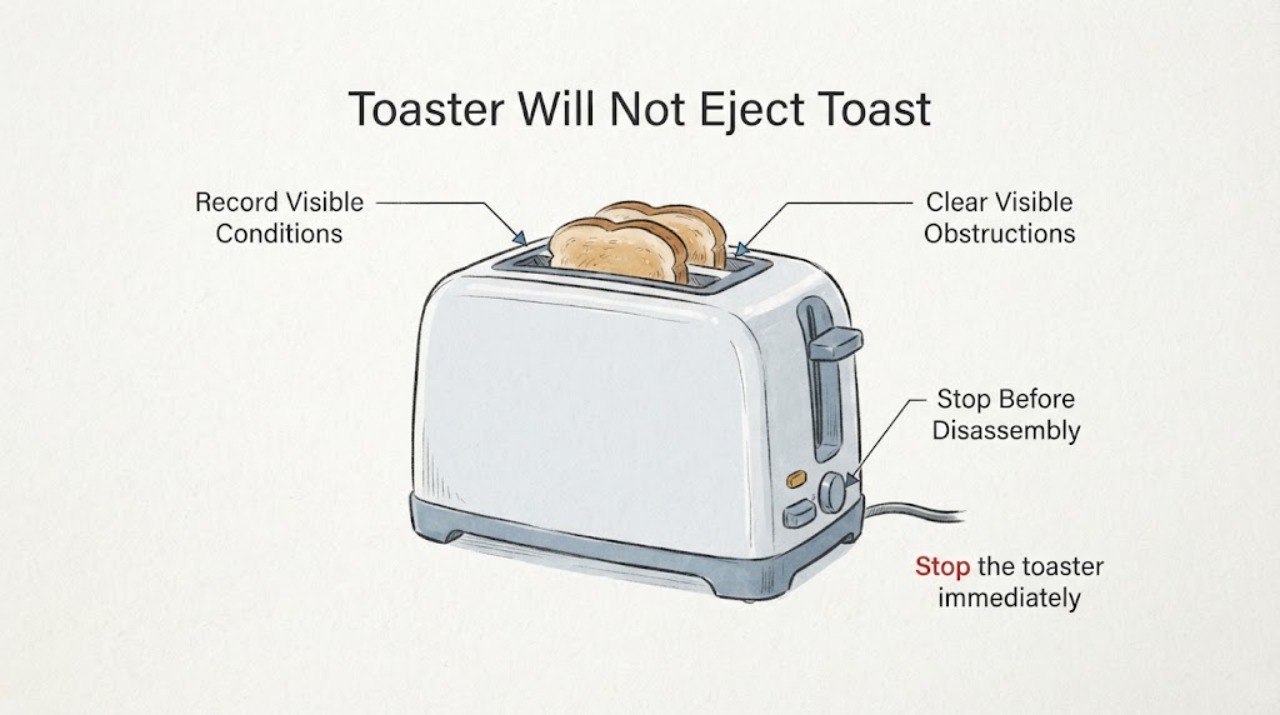
Stop the toaster immediately. If the plug and cord can be reached without touching a hot surface, smoke or a damaged conductor, unplug it by the plug; otherwise leave the area and use the safest available power isolation or emergency response. Do not press the lever, reach into a slot, or reconnect the toaster.
Expected result: The heater stops and the toaster begins to cool, or heating, smoke, a burning smell, scorching or another unsafe condition continues.
Next step: Keep the toaster out of service. For smoke, flames, sparking or a strong burning odor, move away and contact local emergency or electrical assistance when safe; do not attempt a second toast cycle.
Why this matters
Why: A toaster that will not end its cycle has crossed the normal-use boundary. Continued heat or visible fire risk is not a crumb-check condition and cannot be diagnosed safely while energized.
-
Check 2
Once the toaster is unplugged and completely cool, record whether the bread is physically wedged in the slot, whether the carriage is still down, or whether the bread is free but the control did not end the cycle. Do not pull hard on the bread or force the carriage.
Expected result: The slice is lodged, the carriage is mechanically held down, or no bread is trapped but the appliance previously stayed energized.
Next step: Wait for full cooling before any hand removal. If the toaster remained energized or the shutoff behavior was abnormal, stop at the external check and arrange manufacturer or qualified service rather than testing again.
Why this matters
Why: A lodged slice can explain a carriage that cannot rise, but it does not prove that the automatic shutoff or latch is sound. Bread-free continued heating is a separate control/safety failure pattern.
-
Check 3
With the plug removed and the toaster cool, remove only a slice that is loose enough to lift by hand. If crumbs are the only visible obstruction, empty the removable crumb tray and use the exact manual's permitted gentle tap or upside-down shake; never insert a fork, knife, metal tool or other sharp object into a slot.
Expected result: The bread or crumbs come out without force, or the slice remains stuck / the carriage still does not move freely.
Next step: If anything resists, stop and send the toaster for service or replace it according to the manufacturer's support path. Do not open the case, bend contacts, bypass a latch or try to free the bread while the toaster is hot or connected.
Why this matters
Why: A loose obstruction may account for a carriage problem, while resistance or a remaining stuck carriage leaves an internal mechanical or electrical condition unresolved. Oster warns that sharp objects can damage the toaster and that crumbs can catch fire; Hamilton Beach gives its unplugged, cool, upside-down shake procedure for lodged food.
-
Check 4
Classify the original event before deciding whether it is safe to retain the toaster: did the lever fail to latch before a cycle, or did a completed cycle fail to release the toast and stop heating? Preserve the model and serial information if visible, without opening the appliance.
Expected result: Only the starting lever failed to latch, or the toaster actually stayed on / failed to eject toast at the end of toasting.
Next step: For a persistent starting-latch issue, use the exact model's manual and service route rather than borrowing another brand's reset. For any end-of-cycle non-ejection or failure to shut off, keep the toaster unplugged and obtain professional evaluation or replace it; do not reconnect for a confirmation test.
Why this matters
Why: De'Longhi and Tefal describe the starting-latch symptom as potentially related to absent mains power or debris on their product families. That is not equivalent to a toaster that keeps heating after its cycle; the latter is the assigned safety fault.
Use your observations
Decision map
Find the observation that best matches what you see, then follow the next safe action.
-
PATH 01Next step
What you see
The toaster is still heating, producing smoke or a burning smell, sparking, scorching the bread, or has a damaged cord or plug.
Do this next
Do not touch the slots or try another cycle. Disconnect from a safe point only if possible, leave it out of service, and obtain emergency, electrical or qualified appliance assistance as appropriate.
Why this path and its safety boundary
Why it matters: The appliance presents an active fire or electrical hazard, so the problem is not a routine crumb obstruction.
-
PATH 02Next step
What you see
The appliance is unplugged and cool, and the slice lifts out by hand without force after the carriage has released.
Do this next
Do not reconnect a toaster that previously failed to shut off. Record the model and use the manufacturer service or replacement path before further use.
Why this path and its safety boundary
Why it matters: The immediate burn and entrapment risk has been reduced, but this does not prove the automatic shutoff fault is repaired.
-
PATH 03Next step
What you see
The bread remains wedged, the carriage will not rise without force, or an unplugged gentle crumb check does not restore free movement.
Do this next
Leave the toaster unplugged and send it to the manufacturer's approved service route or replace it. Do not use utensils, open the case or bend the mechanism.
Why this path and its safety boundary
Why it matters: The obstruction or carriage mechanism remains unresolved; a hidden heater, latch or control fault cannot be identified from the symptom alone.
-
PATH 04Next step
What you see
The lever never stayed down at the beginning of a cycle, but there was no end-of-cycle heating or trapped-toast event.
Do this next
Do not force or repeatedly reconnect the appliance. Confirm the exact model and follow only its manual; if the latch remains unreliable, use service rather than bypassing it.
Why this path and its safety boundary
Why it matters: This is a different starting-latch symptom. The cited brand pages associate it with live-power/outlet conditions or crumbs on their own families, not with a universal toaster fault code.
Helpful context
Understand the symptom
Do not treat a failed pop-up as a normal long cycle
The exact model is not supplied, so the article does not assign a component or universal reset sequence. A normal toaster cycle is designed to end and release the carriage, but the control layout and protection behavior vary. If the heater remains on, the bread is trapped, or there is smoke, a burning smell, scorching or a damaged cord, stop using the appliance and keep it disconnected. Do not leave it plugged in while you look for crumbs or wait for it to finish.
Separate the two common lever symptoms
A lever that will not stay down before a cycle is not proof that a completed cycle failed to eject toast. De'Longhi, Tefal and KitchenAid each describe live-power or outlet conditions for the starting latch on their own product families, while De'Longhi and Tefal also mention crumbs as a possible obstruction. Those family-specific pages do not establish that every unbranded toaster has the same latch design. If the appliance has already shown a failure to shut off, do not reconnect it merely to test the distinction.
When checks do not resolve it
Need a professional?
Arrange qualified service or replacement if the toaster stayed on, failed to release toast, repeatedly jams, has smoke, a burning smell, scorching, sparking or a damaged cord/plug. Do not resume use merely because the bread was eventually removed.
Common questions
FAQ
Are a toaster that will not eject toast and a lever that will not stay down the same fault?
No. The first describes an end-of-cycle release or shutoff failure and should be treated as a safety issue. The second happens before a cycle on some designs and can be related to power or crumbs, but the cited manufacturer pages are family-specific. Do not reconnect a toaster that has already failed to shut off just to compare the symptoms.
How do I get bread out of a toaster that will not pop it up?
Stop the appliance, unplug it by the plug when safe, and wait until it is completely cool. Remove only a slice that is loose enough to lift by hand. Do not use a fork, knife or other tool, and do not force the lever; if the slice remains stuck, use service or replacement.
Can crumbs cause a toaster to stay on or fail to pop?
Crumbs can obstruct a carriage or latch on some manufacturer families, and accumulated crumbs are a fire concern. They do not prove that the automatic shutoff is safe. Only after unplugging and cooling may you follow the exact manual's gentle tray/tap/shake cleaning instruction; a persistent end-of-cycle failure requires service.
Read the exact guide
Official sources
- toasters-faqOster Canada / Sunbeam Products · Opened the official Oster Canada toaster FAQ. Its anti-jam and latch statements are scoped to Oster toasters and are used as clearly labelled manufacturer-family evidence, not as a universal design claim.
- Lift Lever Will not Stay Down - Toaster - Product HelpKitchenAid Product Help · Opened the official KitchenAid product-help page. It confirms that the starting-latch symptom is treated separately from end-of-cycle non-ejection and directs persistent problems to service; its outlet test is not prescribed here for a toaster that already failed to shut off.
- User manual and frequently asked questions TOAS 2S TT520Tefal · Opened the official Tefal product page for TT520D10. It is used for the family-specific stuck-bread, unplugged cooling, gentle crumb and approved-service instructions; no TT520 procedure is presented as a universal model instruction.
- Toaster Use and Care Manual 840231800Hamilton Beach · Opened the official Hamilton Beach PDF. It is used as a manufacturer-family example for automatic toast release, STOP/unplug operation, fire warnings and cool unplugged removal of lodged food; no model-specific compatibility is inferred for this unbranded task.
- Why does the lever not lock down into position on my toaster? FAQDe'Longhi GB · Opened the official De'Longhi GB FAQ. It is used only to distinguish a starting-latch symptom and its family-specific power/debris explanation; no De'Longhi model or repair part is assigned to this task.
Community feedback
Share a repair observation
Share a plain-text repair observation. Accepted observations are published automatically; this page may take a moment to update.