
On this page
Start here
Quick answer
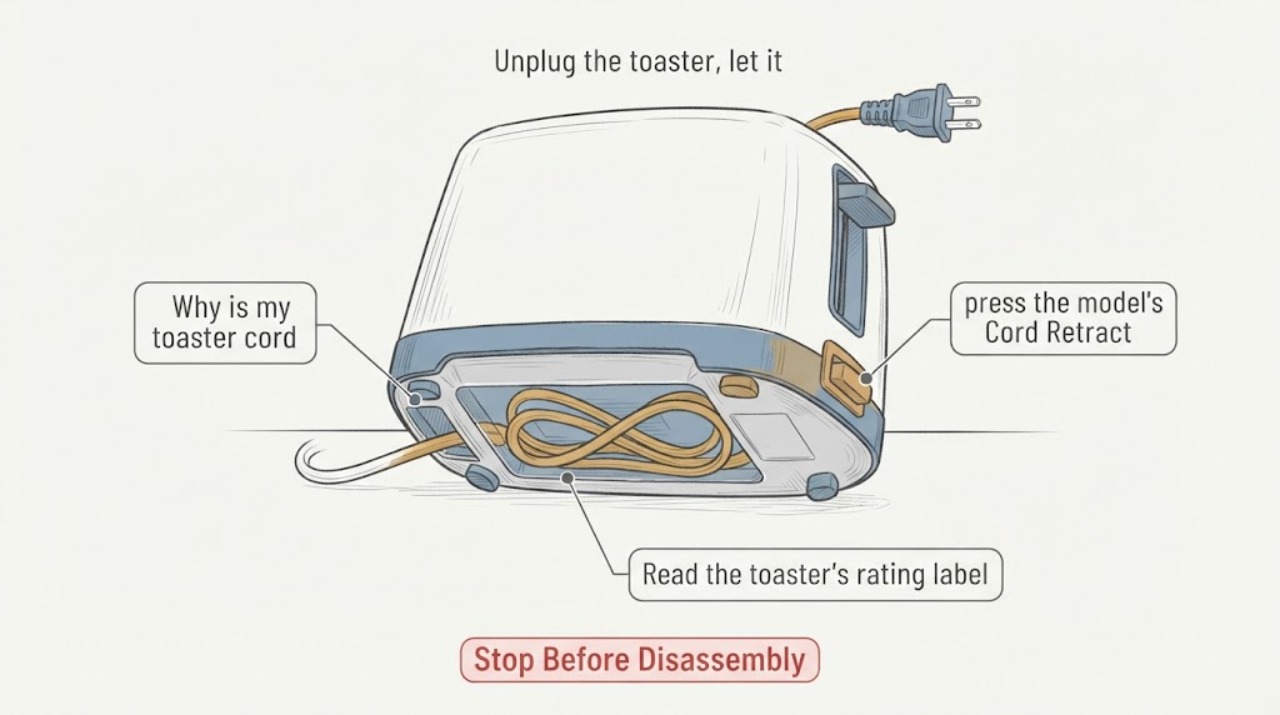
First confirm that this toaster actually has a retractable-cord button. Some toaster models use a retractable cord, while others only have a cord wrap or fixed under-base storage. For a model with a cord-retract button, unplug the toaster, let it cool, hold the plug in one hand, and press the retract button with the other while guiding the cord. Do not force the cord or use the toaster if the cord, plug, or toaster is damaged. If the model has the button but the cord still will not retract, stop using it and arrange model-specific service.
Work through in order
Diagnostic checks
Use only checks that match the exact appliance or system and its official guide.
-
Check 1
Read the toaster's rating label and inspect the base and manual for a labeled Cord Retract Button or retractable-cord feature.
Expected result: The exact model documents a retractable cord and shows a retract button, or the toaster only has a cord wrap/fixed storage channel and no retract control.
Next step: If there is no retract button or retractable-cord feature, do not pull the cord expecting it to rewind; use the documented wrap/storage method. If the exact model does have the feature, continue with the unplugged check.
Why this matters
Why: A retractable mechanism is model-specific. Hamilton Beach model 22810 documents a retractable cord, while Hamilton Beach model 22217 and Cuisinart CPT-1800 describe cord wrap or built-in storage instead.
-
Check 2
Unplug the toaster, let it cool completely, and inspect the exposed cord, plug, and the area where the cord enters the base without removing the housing.
Expected result: The cord and plug are intact and the toaster has no burn mark, melted area, exposed conductor, or other visible damage, or any damage/malfunction is present.
Next step: If any damage, scorching, looseness, or abnormal heat is present, leave the toaster unplugged and arrange examination or repair. If the outside is intact and the model is confirmed retractable, continue to the button procedure.
Why this matters
Why: The Hamilton Beach guide says not to operate a toaster with a damaged cord or plug or after it malfunctions, and to unplug before cleaning or moving it. Visible damage changes this from a storage inconvenience to an electrical safety issue.
-
Check 3
With the toaster unplugged and the plug held securely in one hand, press the model's Cord Retract Button with the other hand and guide the cord in rather than letting the plug snap back.
Expected result: The cord retracts smoothly, retracts only partway, does not move, or the plug/cord catches and requires force.
Next step: If it retracts smoothly and the cord remains undamaged, use the toaster only as the model manual directs. If it stops, binds, will not retract, or the button does not operate, keep the toaster unplugged and request model-specific service; do not pull harder or open the base.
Why this matters
Why: The matching Hamilton Beach guide gives this controlled hand position for retracting the cord and warns of an eye hazard. A cord that still stalls or needs force after the documented procedure has not been shown to be user-retractable.
-
Check 4
Check whether the cord retracts only when the toaster is twisted, pressed down, or the plug is pulled sharply.
Expected result: Retraction works only with force or an unusual angle, or it remains inconsistent even when the plug is held and the button is pressed normally.
Next step: Stop using the retract feature and provide the exact model/type/series information to the manufacturer's service channel for examination or adjustment. Keep the appliance unplugged until the cord and mechanism are judged safe.
Why this matters
Why: The official procedure does not call for forcing, twisting, or disassembling the appliance. An inconsistent mechanism is a malfunction or an unverified model/feature match, not a reason to improvise an internal repair.
Use your observations
Decision map
Find the observation that best matches what you see, then follow the next safe action.
-
PATH 01Next step
What you see
The exact toaster has no Cord Retract Button and its official page or manual describes a cord wrap or fixed cord storage.
Do this next
Store the cord using the documented wrap or under-base channel. Do not install an aftermarket reel or modify the cord.
Why this path and its safety boundary
Why it matters: The cord is not expected to rewind automatically on that model; the reported behavior is a storage-design mismatch rather than proof of a failed reel.
-
PATH 02Next step
What you see
The exact model has a retractable cord and button, but the cord remains extended or catches after the plug is held and the button is pressed with the toaster unplugged.
Do this next
Leave the toaster unplugged and arrange manufacturer or qualified appliance service. Do not force the cord or remove the toaster housing.
Why this path and its safety boundary
Why it matters: The official user procedure did not restore retraction, so a model-specific mechanism fault or another service issue remains possible; the opened guide does not support a user diagnosis of the internal part.
-
PATH 03Next step
What you see
The cord or plug is cut, frayed, melted, loose, unusually hot, or the toaster has malfunctioned in another way.
Do this next
Stop using the toaster, unplug it if this can be done safely, and contact the manufacturer or a qualified service provider.
Why this path and its safety boundary
Why it matters: The Hamilton Beach safety instructions treat a damaged cord/plug or malfunction as a no-use condition requiring examination, repair, or adjustment.
-
PATH 04Next step
What you see
The exact model has a retract button and the cord retracts smoothly when the documented unplugged procedure is followed, with no cord damage.
Do this next
Use the toaster according to its manual and monitor it. If retraction becomes intermittent or the cord shows damage, stop and return to the service branch.
Why this path and its safety boundary
Why it matters: The symptom is not reproduced under the manufacturer's stated procedure.
Helpful context
Understand the symptom
Confirm the storage design before treating it as a fault
The symptom is meaningful only if the toaster was designed to retract its cord. Hamilton Beach identifies a retractable cord on its Warm Mode 2-Slice Toaster model 22810 and lists a Cord Retract Button in the matching use-and-care guide. Other official toaster pages describe a cord wrap or built-in cord storage instead. Read the model and type from the rating label and compare the exact manual or product page before trying to retract anything.
Keep the check external and unplugged
A toaster cord is part of the electrical safety system. The opened Hamilton Beach guide says to unplug before cleaning and not to operate a toaster with a damaged cord or plug or after a malfunction; it directs questions about examination, repair, or adjustment to customer service. Do not open the toaster or attempt to repair a spring, reel, switch, or wiring yourself.
When checks do not resolve it
Need a professional?
Arrange manufacturer or qualified appliance service when a confirmed retractable-cord toaster still will not retract after the unplugged button procedure, when the cord binds or needs force, or when the cord, plug, or toaster is damaged. Give the service provider the rating-label model/type/series information and describe whether the cord is fully extended, partially stuck, or visibly damaged.
Common questions
FAQ
Does every toaster have a retractable cord?
No. The official examples show different designs: Hamilton Beach model 22810 has a retractable cord and Cord Retract Button, while Hamilton Beach model 22217 and Cuisinart CPT-1800 describe cord wrap or built-in cord storage. Check the exact model before diagnosing a failed retraction mechanism.
How should I use a toaster's retract button?
For the Hamilton Beach guide reviewed here, unplug the toaster, hold the plug with one hand, and press the Cord Retract Button with the other hand to retract the cord. The guide warns about eye injury, so guide the plug rather than letting it snap back. Exact instructions can vary by model.
Can I keep using the toaster if the cord will not retract?
Do not keep testing it if the cord binds, the button fails, force is needed, or the cord or plug is damaged. The official guide says not to operate a toaster with a damaged cord or plug or after a malfunction and directs examination, repair, or adjustment to customer service.
Can I open the toaster to repair the retracting spring?
No. The opened guidance supports an external, unplugged procedure and service for examination or repair; it does not support opening the housing or replacing an internal reel or spring on an unknown model.
Read the exact guide
Official sources
- Warm Mode 2-Slice Toaster - 22810 | HamiltonBeach.comHamilton Beach · Opened the exact Hamilton Beach product page; used as a model-specific example, not as proof that every toaster retracts.
- 4-Slice XL-Slot Stainless Steel Toaster - CuisinartCuisinart · Opened the official product page as an additional manufacturer example that built-in cord storage is not automatically a retractable reel.
- Print SpecsHamilton Beach · Opened the official Hamilton Beach PDF and used only its visible toaster instructions; the guide says the Cord Retract Button is on select models, so the exact model must be verified.
- the Eye Q® Auto range toasters with Browning Sensors - Breville (US)Breville · Opened the official Breville toaster page only for the design distinction between cord storage and a retractable cord.
- Hamilton Beach 2 Slice Toaster with Extra-Wide Slots - 22217Hamilton Beach · Opened the exact official product page to distinguish a cord-wrap toaster from a retractable-cord model.
Community feedback
Share a repair observation
Share a plain-text repair observation. Accepted observations are published automatically; this page may take a moment to update.