
On this page
Start here
Quick answer
Uneven toast is often a loading or bread-variable problem before it is a failed toaster. Manufacturer guidance says a single slice in a two-slot toaster can brown unevenly, and that slice size, thickness, freshness, moisture and surface change the required setting. Compare equal slices in the intended slots, use the same browning setting, and wait at least 30 seconds between cycles on models whose guidance calls for the control to reset. With the toaster unplugged and cool, empty the crumb tray and gently remove loose crumbs; never insert metal into a slot or touch a heating element. If the same side remains pale with matched bread and settings, or there is smoke, a damaged cord or a stuck carriage, stop using it and use approved service.
Before you begin
Safety first
- Do not insert knives, forks or other metal objects, touch heating elements, operate with crumbs accumulated or a missing crumb tray, bypass a carriage safety mechanism, or open the toaster to inspect wiring. Unplug and cool it before any allowed cleaning.
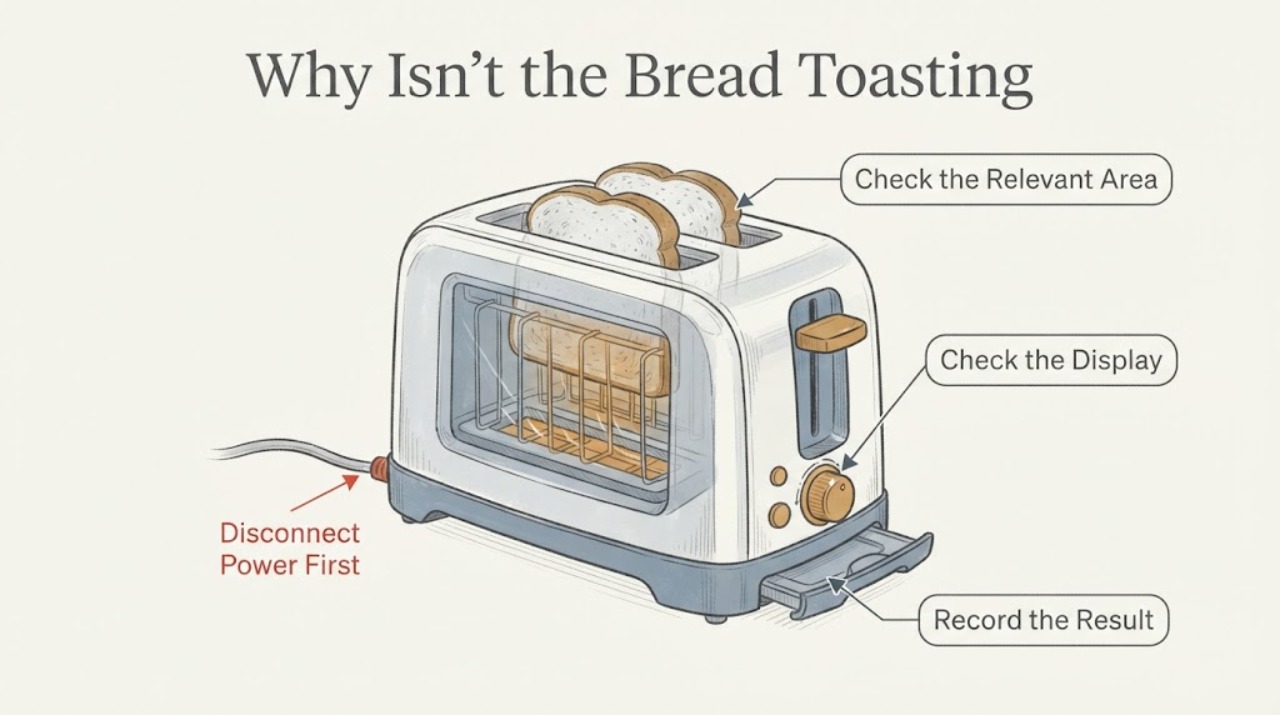
Work through in order
Diagnostic checks
Use only checks that match the exact appliance or system and its official guide.
-
Check 1
Run a controlled comparison with two slices that match in size, thickness, shape and freshness, placed in the intended slots. Use the same browning setting for both and do not compare a single slice in a two-slot toaster with a full two-slice load.
Expected result: The matched slices brown similarly, or one slot/side remains much lighter or darker.
Next step: If the matched test is even, adjust bread selection and setting rather than replacing a part. If one slot remains abnormal, stop repeated high-setting tests and arrange approved service for the exact toaster model.
Why this matters
Why: Tefal says a single slice can heat unevenly, and Kenwood links uniform browning to matching slice size, thickness and freshness. A persistent slot difference with matched slices is more relevant than a difference caused by the bread.
-
Check 2
Keep the bread type and moisture consistent, then adjust only the browning control in small steps. Treat dry/stale, fresh, wheat, frozen, thick or irregularly shaped bread as different loads and use the model manual’s dedicated frozen or reheat function when available.
Expected result: The result changes predictably when the bread type or setting changes, or the same side remains uneven across matched loads.
Next step: Use the setting that matches the controlled bread and follow the exact manual. If the same slot/side remains abnormal, use service rather than opening the toaster.
Why this matters
Why: Bread moisture and thickness change toasting time; the control setting is not a universal temperature or time. Unchanged unevenness with controlled bread makes a loading-variable explanation less likely.
-
Check 3
If the toaster has been run repeatedly, allow the control to reset between cycles; for the Kenwood guidance used here, wait at least 30 seconds. Compare the first cycle with a later cycle at the same setting without changing bread or slot placement.
Expected result: The later cycle changes after the pause, or the uneven result is unchanged after a proper interval.
Next step: Follow the exact manual’s interval. If a controlled interval does not correct a persistent slot difference, stop testing and request service.
Why this matters
Why: Kenwood links a minimum interval with automatic control reset and uniform browning. This timing is not asserted for every model, so a different manual may specify a different interval.
-
Check 4
Unplug the toaster, let it cool completely, remove and empty the crumb tray if fitted, and gently remove loose crumbs using only the manufacturer-permitted method. Do not insert metal tools or touch the heating elements.
Expected result: The tray is full or crumbs are visible, or the toaster is clean but still browns unevenly.
Next step: Reinstall the tray before use and test only with matched bread if the cord and housing are undamaged. If crumbs are lodged near elements, smoke appears or the result persists, leave it unplugged and arrange service.
Why this matters
Why: Accumulated crumbs can affect safe operation, but cleaning does not prove that a heating element or control is defective. A clean toaster with a repeatable slot difference needs model-specific service assessment.
-
Check 5
Inspect only the external cord, plug, housing, lever and slots after the toaster is cool. Do not operate it unattended, and stop immediately if there is smoke, a burning smell beyond an initial documented first-use odor, sparking, a damaged cord or bread that will not release.
Expected result: The toaster is externally intact and the carriage releases normally, or there is a hazard or mechanical fault.
Next step: If a hazard or stuck bread is present, unplug it, let it cool and use approved service; never reach into the slots while connected or use a metal object.
Why this matters
Why: A browning complaint becomes a safety/service issue when electrical damage, smoke, trapped bread or a failed carriage is present. Those conditions are not solved by increasing the browning setting.
Use your observations
Decision map
Find the observation that best matches what you see, then follow the next safe action.
-
PATH 01Next step
What you see
Unevenness occurs only with one slice in a two-slot toaster or with slices of different thickness, size or freshness.
Do this next
Use matched slices in the intended slots and choose a setting appropriate to the bread type.
Why this path and its safety boundary
Why it matters: The result matches documented bread/loading differences and does not establish a failed heating element.
-
PATH 02Next step
What you see
Matched slices, the same setting and the model’s recommended interval still leave one slot or one side consistently pale or dark.
Do this next
Stop repeated high-setting experiments and arrange approved service with the exact model and the controlled-test result. Do not open the toaster.
Why this path and its safety boundary
Why it matters: A repeatable appliance-side difference is more concerning than a bread-variable difference, but the model is unknown and the public guidance does not identify which internal component failed.
-
PATH 03Next step
What you see
The result improves after emptying crumbs and restoring the crumb tray, with no smoke, cord damage or contact with the heating elements.
Do this next
Use the toaster only with the tray installed and continue using matched bread. If unevenness returns, request model-specific service.
Why this path and its safety boundary
Why it matters: The maintenance condition may have affected operation, but cleaning does not prove a component repair.
-
PATH 04Next step
What you see
There is smoke, sparking, a damaged cord, a burning smell, a stuck slice or a lever that will not operate normally.
Do this next
Switch off and unplug if safe, let the toaster cool, keep metal objects out of the slots and use an approved repair centre or replace the appliance according to its manufacturer guidance.
Why this path and its safety boundary
Why it matters: This is an electrical, burn or fire-safety boundary rather than a browning adjustment.
-
PATH 05Next step
What you see
The toaster browns evenly after a proper bread/setting comparison but the user expected identical results from different bread types.
Do this next
Follow the model’s bread, frozen and reheat guidance and adjust the browning control for the specific bread rather than treating the variation as a fault.
Why this path and its safety boundary
Why it matters: Different moisture, thickness and surface shape require different toasting times and settings.
Helpful context
Understand the symptom
Match the bread before judging the toaster
Tefal identifies a single slice in a two-slot toaster as a cause of uneven heating. Kenwood also says even thickness, freshness and size produce more uniform browning, while dry or stale bread toasts faster than fresh bread and thick bread takes longer. Use matched slices before treating one pale side or one slot as a hardware fault.
Reset the comparison between cycles
Kenwood recommends waiting at least 30 seconds between toasting cycles so the control can reset, and says a lower setting may be appropriate for additional toasting. This is a model-specific manufacturer example, not a universal timing for every toaster; follow the exact manual when available.
Clean only when the toaster is safe to handle
Before cleaning, unplug the toaster and let it cool. Use the removable crumb tray if fitted and gently clear loose crumbs as the manual allows. Do not insert knives, forks or other metal objects, scrape heating elements or keep using a toaster that smokes or has a damaged cord.
When checks do not resolve it
Need a professional?
Use approved manufacturer service when a matched-bread test shows a repeatable slot/side difference after the model’s control-reset interval, or immediately for smoke, sparking, a damaged cord, stuck bread or a failed carriage. Provide the exact model and the controlled test details.
Safety scope: Do not insert knives, forks or other metal objects, touch heating elements, operate with crumbs accumulated or a missing crumb tray, bypass a carriage safety mechanism, or open the toaster to inspect wiring. Unplug and cool it before any allowed cleaning.
Common questions
FAQ
Why does one slice toast unevenly in a two-slot toaster?
Tefal states that one slice in a two-slot toaster can cause uneven heating. Compare two matched slices in the intended slots before concluding that the toaster has a fault.
Does bread freshness affect browning?
Yes. Kenwood says dry or stale bread toasts faster than fresh bread, and thick or irregular bread takes longer. Match the bread before changing the toaster setting.
How should I clean a toaster that browns unevenly?
Unplug it and let it cool, then use the crumb tray if fitted and follow the exact manual for loose crumbs. Do not insert metal tools or touch the heating elements.
When is uneven toast a repair issue?
If one slot remains consistently different with matched bread, the model’s recommended interval and a clean crumb tray, use approved service. Smoke, sparking, a damaged cord or trapped bread requires immediate unplugging and a safety stop.
Read the exact guide
Official sources
- Troubleshooting guide (Kenwood toaster manual)Kenwood / De’Longhi · The opened official Kenwood toaster PDF identifies toaster operation, hints and troubleshooting. It supports matched slice thickness/freshness/size, a minimum 30-second interval between cycles for uniform browning, setting changes, crumb-tray and unplugged-cleaning safety. It is an example manufacturer manual, not a universal timing or model-specific repair guide for the unbranded task.
- User manual and frequently asked questions TOASTER EQUINOX TT420 TT420D30Tefal · The opened Tefal official instructions page is for the TT420/TT420D30 toaster, not the unbranded assigned appliance. It is used only for clearly scoped family guidance: one slice in a two-slot toaster can heat unevenly; unplug/cool before cleaning or freeing bread; do not use metal utensils or touch heating elements; damaged cords require approved service. Exact control behavior may differ by model.
Community feedback
Share a repair observation
Share a plain-text repair observation. Accepted observations are published automatically; this page may take a moment to update.