
On this page
Start here
Quick answer
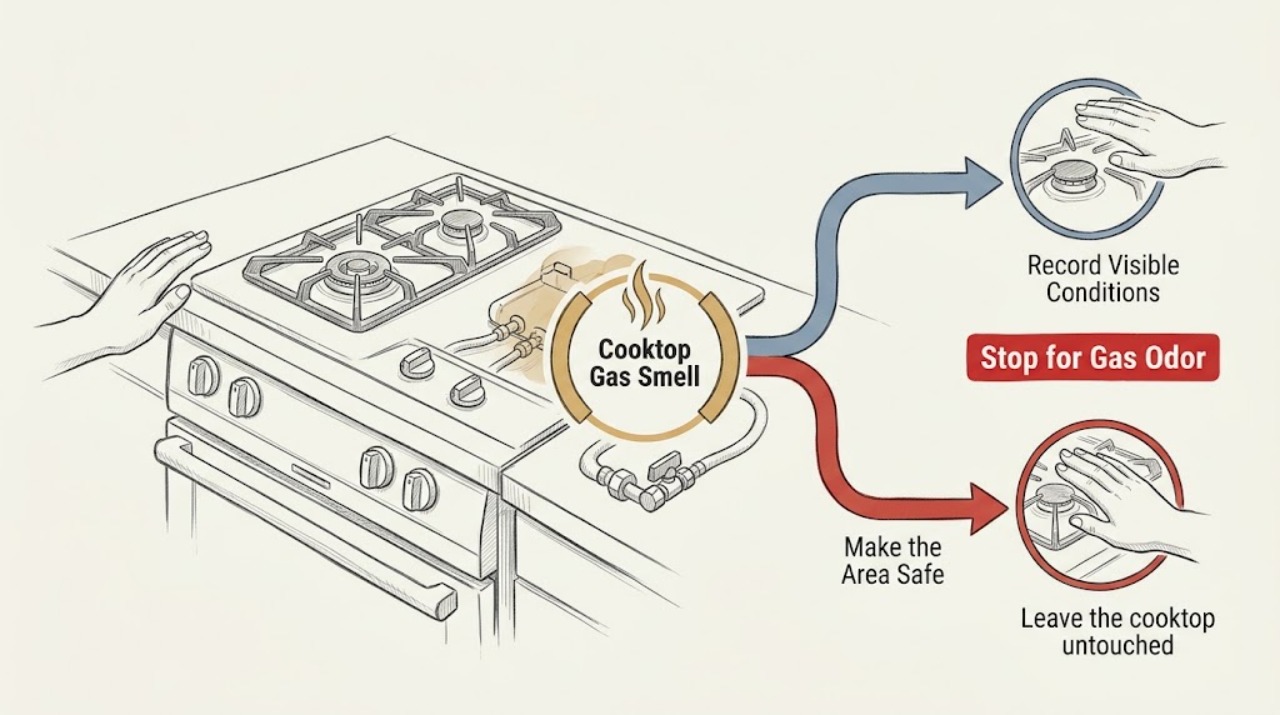
Treat a gas smell around a Viking cooktop as a gas-safety emergency, not as a burner-adjustment problem. Stop using the cooktop, do not light any appliance, do not touch electrical switches or use a phone inside, and leave the area. From a safe location outside or with a neighbor, contact the gas supplier or local emergency service and follow its instructions. Do not retry ignition, move the cooktop, open a gas fitting, adjust pressure, or relight it after the odor fades; the appliance needs qualified gas-safety inspection and clearance before use.
Before you begin
Safety first
- Do not relight, reset, move, disassemble, leak-test, adjust gas pressure, or open gas or live electrical compartments. Emergency and gas-supplier instructions take priority over appliance service scheduling.
Work through in order
Diagnostic checks
Use only checks that match the exact appliance or system and its official guide.
-
Check 1
Stop cooking and leave the kitchen and building by the safest available route. Do not light any appliance, strike a match, touch a light switch, operate an electrical control, or use a phone inside the building.
Expected result: The odor is strong or persistent, there is hissing, anyone feels unwell, or the source and severity are uncertain; alternatively, the odor is no longer noticeable after you have left.
Next step: From outside or a neighbor's location, contact the gas supplier or local emergency service and follow its instructions. Keep people and ignition sources away until the area is declared safe.
Stop if: Stop all troubleshooting and do not re-enter if the odor persists, symptoms occur, smoke or fire is present, or the responder has not cleared the area.
Why this matters
Why: A vanished odor is not proof that gas is no longer present. The situation must be handled as a possible gas leak until the gas supplier or emergency responder gives instructions.
-
Check 2
Leave the Viking cooktop untouched. Do not retry ignition, rotate a knob to search for a flame, move the cooktop to inspect behind it, remove a burner or fitting to sniff for a leak, or attempt a flame or other leak test.
Expected result: The smell appears to be near a burner, under the cooktop, at a connector, or elsewhere in the room, but its exact source cannot be established safely from outside the hazard area.
Next step: Tell the gas supplier or responder where and when the odor was noticed, then let qualified personnel isolate and test the supply and appliance.
Stop if: Stop if inspection would require moving the appliance, opening a gas fitting, adjusting a regulator, or working on a connected gas line.
Why this matters
Why: Location by smell is not a reliable diagnosis, and moving or opening a gas appliance can worsen a leak or create an ignition source.
-
Check 3
After and only after qualified personnel declare the area safe, write down the exact Viking model, the room and location where the odor was noticed, which burner or function was in use, whether ignition clicked, and whether the odor appeared during use or after shutdown.
Expected result: The record shows an odor with no ignition attempt, an ignition attempt with no flame or delayed flame, an odor after a burner was turned off, or an odor not clearly linked to the cooktop.
Next step: Give the observations and the model information to the gas supplier, qualified installer, or appliance technician. Keep the cooktop off until that professional provides a safe, model-appropriate restart path.
Stop if: Do not return to smell closely, take close-up photos in a suspected gas area, relight a burner, or remove parts to improve the record.
Why this matters
Why: These are different facts for a technician or gas professional, but none identifies a failed part or makes a repeat ignition test safe.
-
Check 4
Do not conduct another ignition attempt. If the pre-clearance report mentions clicking without a flame, delayed ignition, an irregular flame, an odor after the knob was turned off, or automatic re-ignition activity, give that exact sequence to the qualified technician.
Expected result: The technician or gas professional receives a clear sequence: gas odor before operation, during an attempted ignition, after shutdown, or with a flame that was yellow, noisy, lifting, or otherwise abnormal.
Next step: Keep the cooktop out of service and follow the professional's documented inspection and repair instructions. Do not reset, relight, or adjust the appliance while waiting.
Stop if: Stop immediately for any renewed gas odor, hissing, delayed ignition, abnormal flame, smoke, or need to access gas or ignition components.
Why this matters
Why: The sequence helps the professional decide whether to examine building supply, shutoff and connector integrity, burner/ignition components, or combustion behavior; it is not a safe basis for replacing a part yourself.
-
Check 5
From a safe distance and only after the gas emergency response is complete, report any smoke, scorching, burning-plastic or electrical odor, sparks, damaged cord, heat damage, or repeated breaker trip along with the gas-smell report.
Expected result: The symptom is a fuel-like odor only, or it also includes smoke, an electrical/burning smell, visible damage, sparks, or an electrical trip.
Next step: Keep away from the appliance and contact emergency responders for fire or smoke, the gas authority for gas risk, and qualified appliance/electrical service for a cleared but damaged appliance.
Stop if: Do not reset a breaker, reconnect power, open the control area, or operate the cooktop when scorching, sparks, exposed wiring, or repeated trips are present.
Why this matters
Why: An electrical or fire hazard remains an immediate stop even if the gas odor is absent or has been cleared; it needs the appropriate emergency or qualified electrical/appliance response.
-
Check 6
Arrange a qualified Viking gas-cooktop inspection after the gas authority has handled any building-supply concern. Provide the model and the observed sequence, and ask what was inspected and what must be repaired before restart.
Expected result: The professional identifies a building-side supply problem, appliance connector or shutoff issue, burner/ignition or combustion issue, electrical damage, or no confirmed source.
Next step: Follow the qualified professional's written or verbal clearance and model-specific restart instructions. If no source is confirmed, keep the cooktop out of service until the responsible gas or appliance professional resolves the uncertainty.
Stop if: Stop use until qualified clearance if any gas odor, abnormal flame, hissing, smoke, scorching, exposed wiring, or uncontrolled ignition remains.
Why this matters
Why: Each result has a different owner and repair path. A no-fault finding from one inspection does not authorize a user to bypass another unresolved gas or electrical safety concern.
Use your observations
Decision map
Find the observation that best matches what you see, then follow the next safe action.
-
PATH 01Next step
What you see
A gas-like odor, hissing, or unexplained fuel smell is present now, or the user is unsure whether it is gas.
Do this next
Leave immediately, avoid flames, switches, and phones inside, and contact the gas supplier or emergency service from a safe location.
Why this path and its safety boundary
Why it matters: Treat it as an active gas-safety event.
-
PATH 02Next step
What you see
The odor faded after the cooktop was turned off or after the person left the room.
Do this next
Do not relight or reset the cooktop; report the event and obtain gas-safety and qualified appliance guidance before returning it to service.
Why this path and its safety boundary
Why it matters: The hazard is not cleared merely because the odor is no longer noticeable.
-
PATH 03Next step
What you see
The report includes clicking without flame, delayed ignition, odor after shutdown, automatic re-ignition, or an abnormal flame.
Do this next
Keep the cooktop off and provide the exact sequence to a qualified Viking appliance or gas professional; do not conduct a confirming ignition test.
Why this path and its safety boundary
Why it matters: There may be an appliance-side ignition, gas-flow, burner, or combustion problem, but the symptom does not identify a user-replaceable part.
-
PATH 04Next step
What you see
The gas professional suspects a building supply, shutoff, connector, or appliance source, or cannot yet distinguish them.
Do this next
Follow the gas authority's isolation and clearance instructions, then arrange qualified appliance service for any unresolved cooktop-side concern.
Why this path and its safety boundary
Why it matters: Source ownership must be established by qualified inspection; smell location alone is not enough.
-
PATH 05Next step
What you see
Smoke, fire, sparks, scorching, burning-electrical odor, exposed wiring, or repeated breaker trips are present.
Do this next
Leave and request emergency help for smoke or fire; do not reset, energize, open, or operate the cooktop until qualified service clears it.
Why this path and its safety boundary
Why it matters: This is also a fire or electrical safety stop, regardless of whether gas odor remains.
-
PATH 06Next step
What you see
The immediate area is declared safe, but the cooktop has not been inspected or a professional has not explained why the odor occurred.
Do this next
Keep the Viking cooktop out of service and arrange qualified gas-cooktop inspection before restart.
Why this path and its safety boundary
Why it matters: Emergency clearance is not the same as appliance repair clearance.
Helpful context
Understand the symptom
A gas odor changes the task to emergency response
A fuel-like smell can come from the cooktop, its connector, the building gas supply, or another nearby source. You do not need to identify which one before acting. If the smell is gas-like, strong, persistent, accompanied by hissing, or you are unsure, stop using the Viking cooktop and leave. An odor that disappears does not prove that the source is repaired.
Do not turn this into a home gas repair
Do not remove burner parts to look for a leak, use a flame to test a fitting, adjust a regulator, disconnect a connector, move the cooktop, or repeatedly turn knobs to see whether it will light. Viking places installation and service with qualified personnel, and CPSC cautions against moving a gas appliance to inspect its connector. The safe user contribution is to evacuate, communicate the observations from a safe location, and keep the appliance out of service until qualified clearance.
When the area is cleared, preserve the facts for the technician
Only after the gas supplier, emergency responder, or qualified professional says it is safe to return should you record the exact Viking model, where the odor was noticed, whether any burner had been used, whether ignition was attempted, and whether the smell returned after shutdown. These details help separate a supply-side event from an appliance-side fault; they do not justify a relight test.
Safety boundary
Stop conditions
- Any current or recurring gas odor, hissing, suspected unburned gas, or uncertainty about whether the smell is gas-like.
- Smoke, flames, sparks, scorching, burning-plastic or electrical odor, exposed wiring, or a hot or damaged connection.
- A request to move the cooktop, open a gas fitting, disconnect a connector, adjust a regulator or pressure, or bypass an ignition or safety control.
- Clicking without flame, delayed ignition, abnormal flame, odor after shutdown, or automatic re-ignition that has not been inspected by a qualified professional.
- A gas supplier, emergency responder, installer, or qualified technician has not cleared the area or appliance for use.
When checks do not resolve it
Need a professional?
Leave and contact the gas supplier or local emergency service from a safe location for any gas-like odor, hissing, suspected leak, or uncertainty., Request emergency assistance for smoke, fire, severe symptoms, or an immediate electrical hazard., After the gas authority clears the area, arrange qualified Viking gas-cooktop service for any unexplained odor, ignition problem, abnormal flame, connector concern, or recurring symptom., Use a qualified electrician or appliance technician for sparks, damaged wiring, scorching, or repeated breaker trips; do not open the appliance yourself.
Safety scope: Do not relight, reset, move, disassemble, leak-test, adjust gas pressure, or open gas or live electrical compartments. Emergency and gas-supplier instructions take priority over appliance service scheduling.
Common questions
FAQ
What should I do first if my Viking cooktop smells like gas?
Stop using it and leave the area. Do not light anything, touch electrical switches, or use a phone inside. From a safe location, contact the gas supplier or local emergency service and follow its instructions.
Can I relight the Viking burner to see whether the smell goes away?
No. A repeat ignition can add an ignition source to an unresolved gas hazard. Keep the cooktop off and have the gas and appliance condition assessed by the appropriate qualified professional.
What if the gas smell disappears after I turn the cooktop off?
Do not assume it is fixed. Report what happened, avoid returning the cooktop to service, and obtain gas-safety and qualified appliance guidance before operating it again.
Can I check the connector or shutoff behind my Viking cooktop?
Do not move the cooktop or open a gas connection to inspect it. Tell the gas supplier or technician what you noticed; qualified personnel must inspect, isolate, or repair the gas path.
Is a burning or electrical smell handled the same way as a gas smell?
It is also a stop condition. Leave if there is smoke or fire, and do not reset a breaker or open the appliance for sparks, scorching, exposed wiring, or a damaged connection. Request the appropriate emergency, electrical, or appliance help.
When can I use the cooktop again?
Only after the gas authority or qualified service professional has addressed the hazard and given a safe, model-appropriate clearance or restart instruction. Emergency-area clearance alone does not identify or repair an appliance fault.
Read the exact guide
Official sources
- Certain Older Gas Connectors May Be DangerousU.S. Consumer Product Safety Commission · CPSC gas-safety guidance for suspected appliance gas leaks; it is not a Viking model-specific repair manual.
- Viking Use & Care ManualViking Range Corporation · Official Viking manual for the built-in gas-rangetop family; exact model instructions and local gas-emergency guidance control if they differ.
Community feedback
Share a repair observation
Share a plain-text repair observation. Accepted observations are published automatically; this page may take a moment to update.