
On this page
Start here
Quick answer
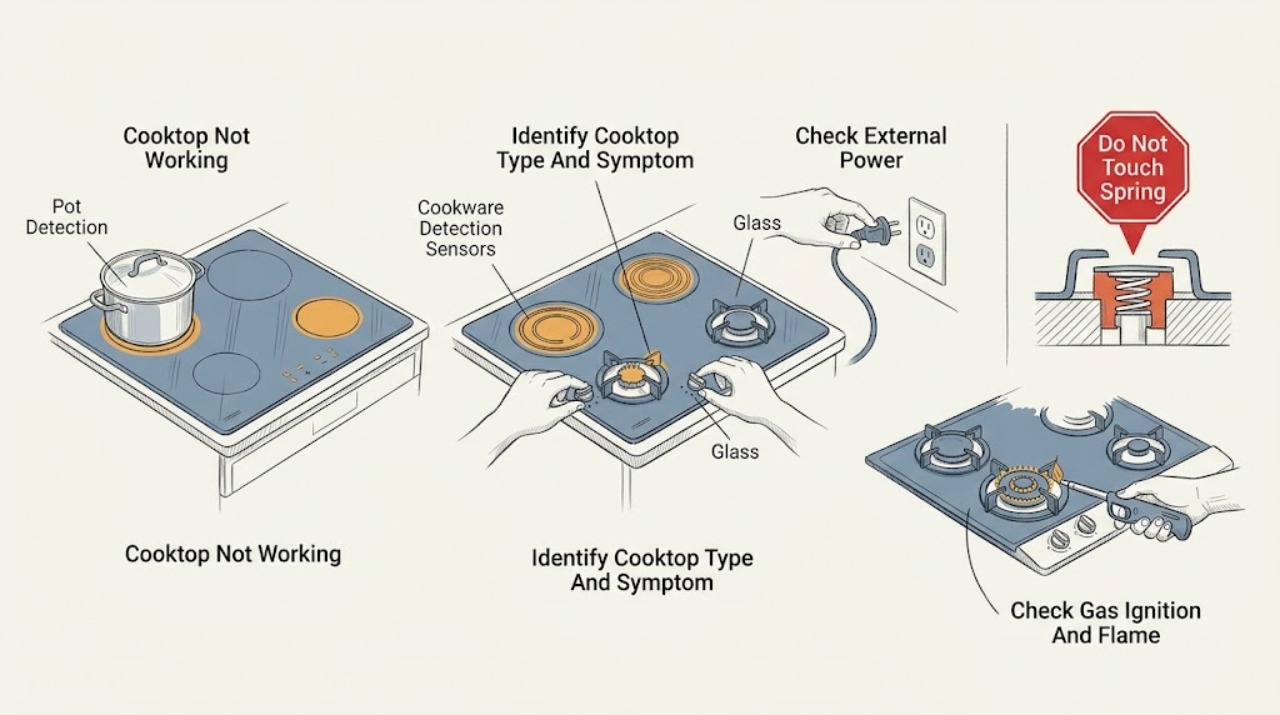
A Viking cooktop that is not working must first be identified as gas, electric radiant, induction, or a combination model. For every type, check whether the whole unit is without power or only one element or burner fails, and record the exact model and any indicator pattern. A gas cooktop may click several times before ignition, but gas odor, delayed ignition, abnormal flame, or failure to shut off is an immediate stop. On a radiant or induction model, a flashing indicator can mean a hot surface or, for induction, no suitable cookware; use a dry, flat magnetic pan on the correct zone and follow the model manual. Check only the external switch, outlet, fuse or breaker, cool controls, knob position, and visible cookware or burner condition. Do not open the cooktop or gas path. Stop for a cracked glass surface, smoke, burning smell, arcing, abnormal heat, water near electrical parts, or a breaker that trips again, then arrange qualified service.
Work through in order
Diagnostic checks
Use only checks that match the exact appliance or system and its official guide.
-
Check 1
With all controls off and the surface cool, identify the Viking model and whether it is gas, electric radiant, induction, or combination; note whether the whole unit is dark or only one burner or element fails, and record any flashing pattern or displayed indication.
Expected result: All indicators are dark; a gas burner clicks but does not establish a flame; a radiant element stays cold; an induction indicator flashes with or without a pan; or an internal error pattern is shown.
Next step: Use the matching power, gas, radiant, or induction branch. If there is gas odor, smoke, arcing, a crack, abnormal heat, or a repeat breaker trip, stop immediately instead of continuing the classification.
Why this matters
Why: The fuel and surface technology determine the next check. Viking's induction/radiant manual assigns different meanings to solid and flashing indicators, while the gas manual describes electric ignition and burner behavior.
-
Check 2
From outside the appliance, check the normal switch or isolator, a known household power interruption, and the labeled fuse or breaker position; inspect the accessible plug or cord only for visible damage, without opening a panel or touching wiring.
Expected result: The switch is off, power is interrupted, a breaker or fuse is open, the cord or outlet is damaged or hot, or the external supply appears normal but the cooktop remains unresponsive.
Next step: Restore an intentionally switched-off external switch only when safe and the cause is understood. Do not repeatedly reset a breaker; if it trips again or the unit remains dead, isolate it if safe and arrange an electrician or qualified Viking servicer.
Why this matters
Why: A whole-unit failure can be caused by an interrupted or incorrect supply, while a normal-looking external supply with no response points toward installation or appliance service. A hot or damaged power part is a safety stop, not a reset opportunity.
-
Check 3
For a gas Viking cooktop only, turn one control on briefly from a safe position and observe whether the igniter clicks and the burner lights promptly; if it lights, observe only the visible flame and then turn the control fully off.
Expected result: The igniter clicks and a stable flame establishes; there is no click; the burner clicks without lighting; the flame is large, distorted, yellow, or goes out; or gas is smelled.
Next step: If the burner does not light promptly or the flame is abnormal, turn the control off and stop retrying. For gas odor, leave the area and follow local gas-emergency guidance; arrange qualified gas service. Do not remove burner parts to inspect the gas path.
Why this matters
Why: Viking describes ignition clicking as part of the automatic ignition sequence and directs a no-click condition toward the plug, fuse, or breaker. A burner that does not light promptly, has an abnormal flame, or is accompanied by gas odor is not a normal ignition branch.
-
Check 4
For an induction or radiant model, select only the affected zone with controls off before placing a dry, flat pan; on induction, check that a magnet adheres to the pan base and center a suitable pan on the zone, while on radiant use the correct knob and watch the indicator from a safe distance.
Expected result: The induction indicator becomes solid with suitable cookware; it flashes with no pan or an unsuitable pan; the radiant indicator shows heat but the element does not warm; or the zone remains inactive with the correct pan or setting.
Next step: Use the correct pan and zone once, then stop if the indicator continues to flash or the zone remains cold. Do not heat empty cookware, lift the glass, or access an internal element or coil.
Why this matters
Why: Viking's induction manual says a solid indicator means the element is on and sensing proper cookware, while a flashing indicator can mean no cookware, unsuitable cookware, or a hot surface. A zone that remains inactive after a known suitable pan or correct radiant control is a service branch.
-
Check 5
Record the complete indicator flash pattern or error message and note whether the cooktop had been used at high power, had a hot surface, or had all induction elements operating; compare it with the exact Viking manual.
Expected result: A documented hot-surface or over-temperature indication appears, a cookware-compatibility indication appears, an internal power or temperature-sensor flash pattern returns, or no code is present.
Next step: Let a hot surface cool and follow only the model manual's user instruction. If a flash pattern returns, all zones shut down, or the cooktop remains inoperative, stop use and arrange an authorized Viking servicer.
Why this matters
Why: Viking documents separate hot-surface, incompatible-cookware, internal power-device, coil-sensor, and ambient-temperature indications for applicable electric or induction models. A returning internal fault is a service decision, not a reason to keep cycling the controls.
-
Check 6
Stop immediately for cracked or broken glass, smoke, burning smell, visible arcing or sparking, abnormal heat, water near electrical parts, a hot or damaged cord or plug, a gas odor, an abnormal flame, delayed ignition, or a breaker that trips again.
Expected result: The hazard is present or the fault cannot be isolated without opening the cooktop, touching wiring, adjusting gas components, or exposing a hot or energized part.
Next step: Stop using the cooktop and keep people away. Isolate electrical power only if safe and dry; for suspected gas, leave the area and follow local gas-emergency guidance without operating switches. Arrange qualified service, using a Gas Safe registered engineer for domestic gas work where applicable.
Stop if: Stop and call qualified service; do not restore power or gas until the appliance is assessed.
Why this matters
Why: Broken glass can allow spills to reach electrical parts, and smoke, arcing, overheating, repeated trips, gas, or combustion symptoms can indicate fire, shock, burn, or explosion risk. These conditions exceed a user-level cooktop check.
Use your observations
Decision map
Find the observation that best matches what you see, then follow the next safe action.
-
PATH 01Next step
What you see
All controls and indicators are dark on a cooktop that previously worked.
Do this next
Check only the normal switch, known power interruption, and labeled fuse or breaker. A repeat trip, damaged cord, or persistent blank unit requires an electrician or qualified Viking servicer.
-
PATH 02Next step
What you see
A gas burner has no click, clicks without lighting, lights late, or shows an abnormal flame.
Do this next
Turn the control off and stop retrying. The ignition and gas path need qualified diagnosis; any gas odor requires leaving the area and following local gas-emergency guidance.
-
PATH 03Next step
What you see
An induction indicator flashes with no pan, an unsuitable pan, or a pan that is too small or off-center.
Do this next
Use a dry, flat, magnetic pan centered on the correct zone and compare its size with the model manual. A known suitable pan that remains undetected needs service.
-
PATH 04Next step
What you see
A radiant element remains cold, or an indicator remains on or flashes after cooking.
Do this next
Use the correct control and wait for the surface to cool before touching it. A zone that remains inoperative with the correct setting requires qualified service; do not lift the glass.
-
PATH 05Next step
What you see
The cooktop shut down after extended high use or shows a documented internal power, coil, or temperature-sensor flash pattern.
Do this next
Let the cooktop cool and follow the exact manual once. If the indication returns or the unit remains off, stop using it and arrange authorized service.
-
PATH 06Next step
What you see
Cracked glass, smoke, burning smell, arcing, abnormal heat, water near electrical parts, gas odor, abnormal flame, delayed ignition, or a repeat breaker trip occurs.
Do this next
Stop immediately, keep clear, isolate power only if safe and dry, and obtain qualified service. For suspected gas, leave the area and follow local emergency guidance without operating switches or retrying ignition.
Helpful context
Understand the symptom
Identify the surface technology before troubleshooting
Viking publishes separate documentation for gas, electric radiant, induction, and combination cooktops. A gas unit uses a burner, gas valve, and electric ignition; a radiant unit can show a hot-surface indicator even when an element is dark; an induction zone needs suitable magnetic cookware. Find the model label under or near the cooktop and use its manual rather than applying an induction check to a gas or radiant element.
Separate a whole-unit power fault from one failed zone
If every control and indicator is dark, begin with the external supply and a known power interruption. If the display or indicator works but one burner or element does not, focus on the knob, ignition, cookware, or that zone. Viking's manuals reserve installation, electrical, and gas adjustments for qualified service and provide model-specific troubleshooting indicators.
Use the correct low-risk check for each type
On a gas model, a series of ignition clicks can be normal while the burner lights, but the flame must establish promptly and be appropriate for the model. On induction, a flashing element indicator can mean no pan, an unsuitable pan, or a hot surface; a magnet attracted to a flat pan base is a useful compatibility check. On radiant elements, wait for the surface to cool before touching or cleaning it. Keep all tests at the controls and surface level.
Know when a surface or fuel hazard ends the diagnosis
Viking warns not to cook on a broken glass surface and directs users to a qualified technician. For gas appliances, HSE says not to use an appliance suspected to be unsafe until it is checked by a Gas Safe registered engineer. Smoke, burning odor, arcing, abnormal heat, repeated electrical trips, gas odor, delayed ignition, or an abnormal flame should never be treated as a routine power or cookware problem.
Only after diagnosis
Potential parts
- gas ignition or burner component
Consider only when a qualified gas technician confirms a no-click, delayed-ignition, or abnormal-flame fault after the user-level control and external power checks.
Gas-path work is professional service; confirm the complete Viking model and qualified diagnosis before any part is considered. - induction power module or coil assembly
Consider only when a known suitable pan is detected on other zones but one zone remains inoperative and a technician confirms an internal induction fault.
Confirm model-specific compatibility through Viking or the authorized servicer; do not select a power or coil part from a flashing indicator alone. - radiant heating element or control component
Consider only after a qualified technician confirms that the correct control and external supply are sound but a radiant zone remains cold.
Internal electrical and hot-surface work is professional service; confirm the exact model and approved part fit. - cooktop control or power assembly
Consider only when a recurring internal error indication or whole-unit no-response condition is confirmed after safe external checks.
Do not infer a failed control from a single outage or hot-surface indication; use model-specific service diagnosis.
When checks do not resolve it
Need a professional?
Arrange an authorized Viking servicer when the whole unit stays without power after external checks, a gas burner will not ignite normally, a radiant or induction zone remains inoperative with the correct control or cookware, an internal indicator pattern returns, or diagnosis would require the glass, wiring, heating element, induction coil, control, or gas path. Use a Gas Safe registered engineer for domestic gas work where applicable.
Common questions
FAQ
How do I tell whether my Viking cooktop is gas, radiant, or induction?
Use the model label and Viking's model-specific documentation. Gas units have burners and ignition; radiant units use electric elements and hot-surface indicators; induction zones require suitable magnetic cookware. Do not apply an induction pan test to a gas or radiant surface.
Why does my Viking gas cooktop click but not light?
Viking says the igniters may click during the automatic ignition sequence. If the burner does not light promptly, turn the control off and stop retrying. A gas odor, delayed ignition, or abnormal flame requires leaving the area when appropriate and qualified gas service.
Why is my Viking induction cooktop flashing instead of heating?
On applicable Viking induction models, a flashing indicator can mean no cookware, unsuitable cookware, or a hot surface. Use a dry, flat pan with a magnetic base, center it on the correct zone, and follow the exact manual. A suitable pan that remains undetected needs service.
What should I check when the whole Viking cooktop is dead?
Check only the normal switch or isolator, a known power interruption, and the labeled fuse or breaker position. If the breaker trips again, the cord or outlet is hot or damaged, or the cooktop remains blank, isolate it if safe and arrange an electrician or qualified Viking servicer.
Can I use a Viking cooktop with cracked glass?
No. Viking warns not to cook on a broken cooking surface because spills can penetrate and create electric-shock risk. Stop using it and contact a qualified technician; do not clean, lift, or test the damaged glass.
Read the exact guide
Official sources
- Viking Use & Care Manual: Designer DGVU Built-In Gas CooktopsViking Range Corporation · Viking built-in gas cooktop ignition, burner flame, power-failure, gas-safety, and qualified-service guidance
- Viking Use & Care Manual: Built-In Electric Induction/Radiant CooktopViking Range Corporation · Viking built-in electric, induction, and radiant cooktop operation, cookware detection, indicators, safety, and troubleshooting
- Viking Range, LLC | 30"W. Gas CooktopViking Range, LLC · Viking gas cooktop product design, sealed burners, automatic electric spark ignition, and automatic reignition
- Viking Range, LLC | Support and Docs | DocumentationViking Range, LLC · Viking cooktop product documentation archive and model-specific manuals for gas, electric, induction, and combination cooktops
- Gas safety - Home ownersHealth and Safety Executive · Domestic gas-appliance safety, suspected unsafe appliances, suspected gas leaks, and qualified gas-engineer boundaries
Community feedback
Share a repair observation
Share a plain-text repair observation. Accepted observations are published automatically; this page may take a moment to update.