
On this page
Start here
Quick answer
“Viking 200” is a family identity, not proof that a sensor has failed. Viking’s official documentation covers VDB200, DDB200 and FDB200 variants, and its recall page lists some Model 200 dishwashers made before December 1, 2010 because a heater electrical connector may create a fire risk. Read the full model and serial label at the left side of the door opening, check the recall criteria without opening the machine, and do not use an affected unit. If the dishwasher is not in that recall or the symptom remains unresolved, record what the controls and door do from the outside and arrange Viking-authorized service; do not open the door panel, probe wiring or replace a “sensor” based on the title alone.
Before you begin
Safety first
- Do not open the inner door or control panel, access the heater connector, probe wiring, enter hidden service mode, replace a sensor or repeatedly reset a tripping breaker. Use Viking-authorized service; use emergency help for smoke or fire risk.
Work through in order
Diagnostic checks
Use only checks that match the exact appliance or system and its official guide.
-
Check 1
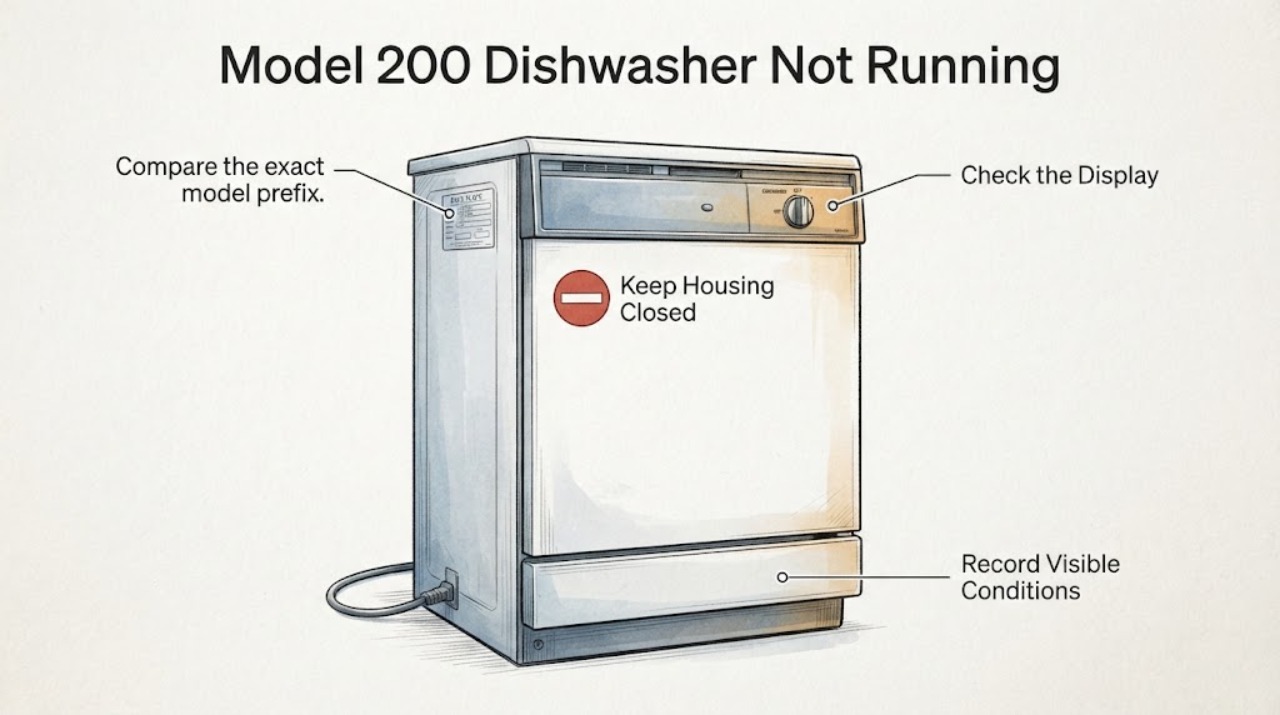
Open the door only as needed to read the identification plate on the left side of the dishwasher door opening. Record the complete model prefix, serial number and any date-code information without removing a panel or moving the built-in unit.
Expected result: The label shows VDB200, DDB200 or FDB200 with a serial/date that can be compared with Viking’s recall table, or the label is incomplete/unreadable.
Next step: If the label is incomplete, stop the identity decision and obtain a readable label or authorized service assessment. Do not infer the variant from the exterior or title.
Why this matters
Why: Viking’s recall criteria depend on the full model and the first six serial-number digits; the family word “200” alone cannot determine eligibility.
-
Check 2
Compare the exact model prefix and first six serial digits with Viking’s official Model 200 recall table. Do this as an information check only; do not remove covers or attempt to inspect the heater connector.
Expected result: The unit matches VDB200/DDB200/FDB200 and the serial date is before 120110, or it does not match the listed criteria.
Next step: For a match, stop using the dishwasher and contact Viking’s recall service route. For a non-match, continue only with external symptom documentation and authorized service.
Why this matters
Why: Viking identifies the listed pre-12/01/10 Model 200 units as a fire-risk recall population; a unit outside the listed criteria is not thereby proven safe or diagnosed.
-
Check 3
Without starting repeated cycles, note the external behavior: whether any control lights or display respond, whether the door closes normally, and whether the no-run symptom is constant or intermittent. Do not press hidden service combinations or remove the inner door/control panel.
Expected result: The controls are dark, the controls respond but the cycle does not begin, the door does not close normally, or the behavior changes intermittently.
Next step: Record the exact behavior and provide it to Viking-authorized service; do not convert an observation into a sensor diagnosis.
Why this matters
Why: These observations distinguish what the user can report but do not prove a sensor, door switch, control, motor, power or water fault. The opened official materials do not support mapping this symptom to a particular part.
-
Check 4
From a dry, safe position, observe whether there is water on the floor, a burning odor, unusual heat, smoke, visible damage or a breaker that trips when the dishwasher is used. Do not reach behind the unit, open the junction area or repeatedly reset a breaker.
Expected result: There is a leak, heat, odor, smoke, visible damage or a repeated electrical trip, or none of those warnings are present.
Next step: Stop using immediately for smoke, burning odor, unusual heat, water near electrical parts or repeated trips; move clear and use emergency or qualified electrical help as appropriate. Otherwise schedule authorized Viking service.
Why this matters
Why: A warning sign changes the situation to a stop-use/safety issue. The absence of a warning does not identify why the dishwasher will not run.
-
Check 5
Give the service provider the full model, serial number, purchase/date information, recall comparison, control/door observations and any safety warning. Do not replace a sensor, control, connector or other part solely because the title says “sensor failure.”
Expected result: The exact identity and symptom record are available, or the identity remains uncertain.
Next step: Arrange Viking-authorized service and keep the dishwasher unused if an electrical or recall warning is present.
Why this matters
Why: Viking’s official warranty page directs owners to authorized service and asks for model, serial and purchase information; the available official sources do not validate a user-level sensor repair.
Use your observations
Decision map
Find the observation that best matches what you see, then follow the next safe action.
-
PATH 01Next step
What you see
The full model is VDB200, DDB200 or FDB200 and the first six serial digits are earlier than 120110.
Do this next
Stop using it and contact Viking’s recall service route for authorized repair; do not investigate the connector yourself.
Why this path and its safety boundary
Why it matters: The unit falls within Viking’s listed Model 200 recall criteria for a heater electrical-connector fire risk.
-
PATH 02Next step
What you see
The label is incomplete, unreadable or only says “200,” without a full model prefix and serial/date information.
Do this next
Do not infer eligibility or sensor identity; obtain the label safely or have an authorized service provider identify the unit.
Why this path and its safety boundary
Why it matters: Recall eligibility and the exact product variant cannot be established from the family name alone.
-
PATH 03Next step
What you see
The unit is outside the listed recall criteria, but controls are dark or the dishwasher still will not run.
Do this next
Keep the symptom at external observation and arrange Viking-authorized service; do not open panels or replace a part by guesswork.
Why this path and its safety boundary
Why it matters: The recall check did not diagnose the current symptom; sensor, control, power, door and other causes remain unresolved.
-
PATH 04Next step
What you see
There is smoke, burning odor, unusual heat, water near electrical parts or a repeated breaker trip.
Do this next
Stop using, keep clear and use emergency or qualified electrical help as appropriate; do not re-energize or open the dishwasher.
Why this path and its safety boundary
Why it matters: This is a possible fire, shock or water/electrical hazard rather than a routine sensor troubleshooting case.
-
PATH 05Next step
What you see
The controls respond intermittently or the door/control behavior is abnormal, but no exact fault code or model-specific sensor definition is available.
Do this next
Record the behavior and arrange authorized service; do not use hidden service modes or perform internal tests.
Why this path and its safety boundary
Why it matters: The observation does not prove a failed sensor or any other component.
Helpful context
Understand the symptom
Separate the assigned identity from the title diagnosis
The assigned topic is a Viking dishwasher in the 200 family that is not running. “Sensor failure” is a hypothesis in the title, not a verified fault code or test result. The opened Viking family document identifies VDB200, DDB200 and FDB200 variants, while the opened support pages do not provide evidence that every 200 dishwasher with a no-run symptom has a failed sensor.
Check the Model 200 recall before troubleshooting operation
Viking says certain VDB200, DDB200 and FDB200 units manufactured before 12/01/10 are included in an expanded dishwasher recall because an electrical connector to the heater may fail and create a fire risk. This is a model/serial/date eligibility check, not a diagnosis of the current no-run symptom. An affected unit should not be used while recall service is arranged.
Keep unresolved no-run symptoms at the service boundary
If the unit is not confirmed affected by the recall but still does not run, external observations can document the symptom: whether any controls illuminate, whether the door closes normally, whether the symptom is constant or intermittent, and whether there is a smell, heat, smoke, water or a breaker event. These observations cannot identify a sensor, control, motor, connector or other part. Viking states that dishwasher warranty service must be performed by an authorized service agency or representative.
When checks do not resolve it
Need a professional?
Contact Viking recall service immediately if the full model/serial check matches the listed Model 200 recall. Otherwise arrange Viking-authorized service for a dishwasher that remains unable to run or has unexplained control/door behavior. Stop using for smoke, burning odor, unusual heat, water near electrical parts or repeated breaker trips; do not open or probe the machine.
Safety scope: Do not open the inner door or control panel, access the heater connector, probe wiring, enter hidden service mode, replace a sensor or repeatedly reset a tripping breaker. Use Viking-authorized service; use emergency help for smoke or fire risk.
Have this ready
- Provide the complete VDB200/DDB200/FDB200 model prefix, serial number and first six serial digits, purchase/date information, recall comparison, control/door behavior and any leak, odor, heat, smoke or breaker event.
Common questions
FAQ
Does “Viking 200” prove the dishwasher has a bad sensor?
No. Viking 200 is a family covering VDB200, DDB200 and FDB200 variants, and the title is not a verified fault code. The opened official sources do not establish a sensor failure from “not running” alone.
How do I check whether a Viking Model 200 dishwasher is recalled?
Read the model and serial plate on the left side of the dishwasher door opening. Viking lists VDB200, DDB200 and FDB200 units with first six serial digits before 120110 in the expanded recall criteria. A matching unit should not be used while recall service is arranged.
Can I open the door panel to test the sensor?
Do not. The official materials support model/serial identification and authorized service, not user access to the sensor, heater connector or internal wiring. Give the service provider the exact identity and external observations instead.
Read the exact guide
Official sources
- Viking Warranty InformationViking Range, LLC · Opened official Viking warranty information. It identifies dishwasher electronic controls, motor/pump and fill valve as service components and requires warranty service through a Viking authorized service agency or representative. It does not identify a sensor in this task or support a user repair.
- Viking Expanded Dishwasher RecallViking Range, LLC · Opened the official Viking recall page. It identifies VDB200, DDB200 and FDB200 dishwashers manufactured before 12/01/10 as included in the expanded recall, describes a heater electrical-connector fire risk, directs affected owners to stop using the dishwasher, and gives the identification-plate/service route. It does not say that a non-running dishwasher has a sensor failure.
- Viking Built-In 24-inch Dishwasher 200 Planning and Design GuideViking Range, LLC · Opened the official Viking 200-family document entry. It establishes that “200” is a family covering VDB200, DDB200 and FDB200 variants; it is used for identity scope only, not as evidence of a sensor failure or a repair procedure.
Community feedback
Share a repair observation
Share a plain-text repair observation. Accepted observations are published automatically; this page may take a moment to update.