
On this page
Start here
Quick answer
For the Amana ADB1300AFS1 dishwasher, “circulation pump error” is not a phrase listed in the opened Amana dishwasher error-code table, so it should be treated as an unconfirmed label rather than proof that the replacement pump is bad. Record the exact display or the two-part clean-light pattern, verify the model through Amana’s Owner Center, and first check only the external power state, door latch or Control Lock, accessible water supply, and visible leaks. A recent pump replacement establishes timing, not causation. If the exact code is F7E2, F6E1, or another code that returns after one permitted reset, stop repeated testing and have a qualified technician re-check the installation, connector or harness, pump fit, sump obstruction, and control output without opening energized parts.
Before you begin
Safety first
- Do not open the dishwasher base, junction box, control housing, or pump compartment; probe live wiring; bypass the door or float interlock; pull out the built-in unit; disconnect pressurized plumbing; or keep operating it with smoke, burning odor, a hot or damaged cord, repeated breaker trips, or water near electrical parts.
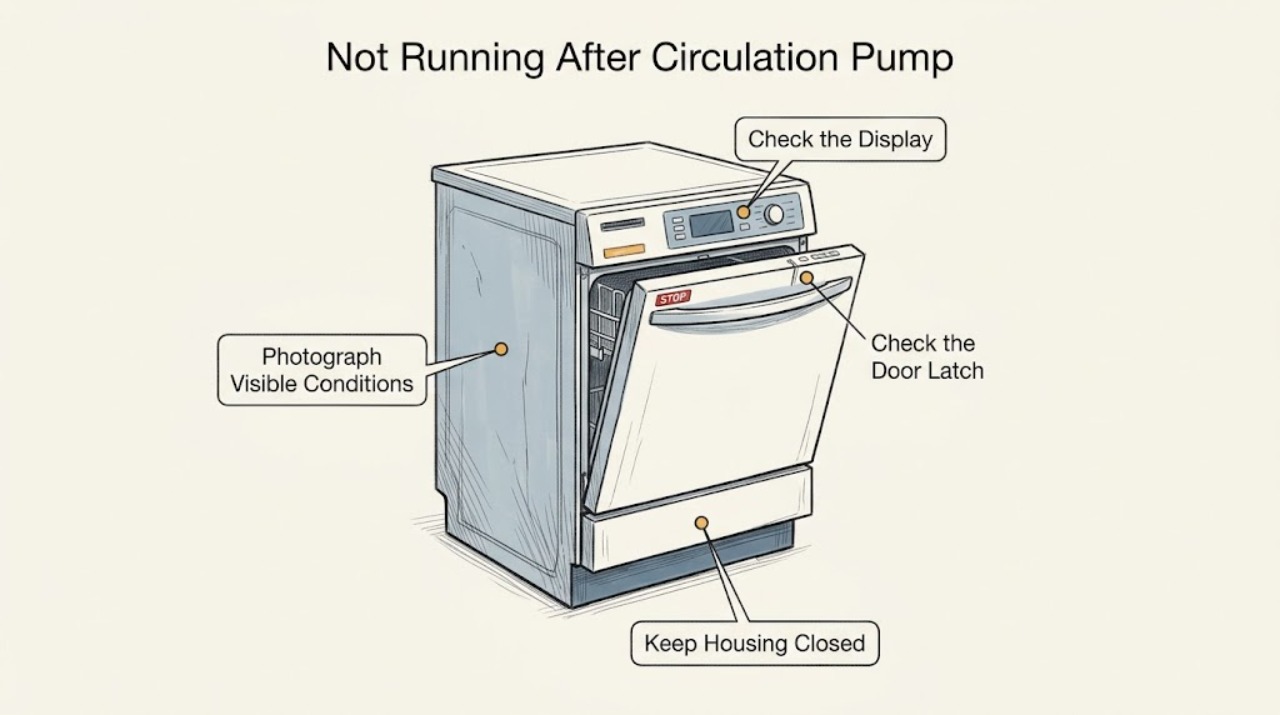
Work through in order
Diagnostic checks
Use only checks that match the exact appliance or system and its official guide.
-
Check 1
With the dishwasher stopped, photograph the display or count the complete clean-light sequence. If the clean light flashes, count the first rapid group, the short pause, the second group, and the longer pause before the pattern repeats; also record the cycle stage and whether the panel is blank, steady, or flashing.
Expected result: The panel shows a complete F#E# code, a repeatable two-part flash pattern, only the words “circulation pump error,” or no usable display at all.
Next step: Keep the exact characters or flash counts with a photo of the model plate and use the exact ADB1300AFS1 manual. Do not substitute a code from another Amana dishwasher series.
Why this matters
Why: Amana’s code guidance treats the full F#E# or two-part pattern as the identity of the fault. The literal phrase or a partial pattern is not enough to map the ADB1300AFS1 to a pump, motor, control, or sensor.
-
Check 2
Check the external power state without opening a panel: note whether the control lights respond, whether the dedicated breaker is on, and whether there is a hot plug, damaged cord, burning odor, water near electrical parts, or a breaker that trips again.
Expected result: The panel is completely dead, the breaker will not stay on, the cord or plug is hot or damaged, or there is smoke, burning odor, or water near electrical parts; alternatively, the panel is powered and stable.
Next step: For a hazard or repeated trip, stop use and isolate power only if safe; arrange qualified service. If the panel is stable, continue with the door and water checks. Do not open the junction box or perform a live test.
Why this matters
Why: A dead or hazardous power state takes priority over a pump label. A powered panel makes an external supply problem less likely, but it does not prove that the pump or control circuit is good.
-
Check 3
Close the door firmly and check whether the latch engages; look for an illuminated Control Lock, Standby, Sleep Mode, or Delay Wash indication, and press Start only as the exact model instructions allow.
Expected result: The latch does not engage, Control Lock is active, the dishwasher is in a delay or standby state, or the controls respond normally but the cycle still will not start.
Next step: Clear only the documented lock, standby, delay, or start condition in the matching manual. If the latch is damaged or the cycle remains stopped, stop and arrange service; do not bypass the interlock.
Why this matters
Why: Amana says an unlatched door can prevent a cycle from starting or resuming and that Control Lock disables the buttons. A normal latch and responsive control shift attention to the exact code and service review rather than proving a pump failure.
-
Check 4
From accessible positions, confirm the under-sink dishwasher water valve is open, the visible inlet hose is not kinked, and there is no water on the floor or around the unit. Do not pull out the built-in dishwasher or disconnect plumbing.
Expected result: The valve is closed or restricted, the visible hose is kinked, a new leak is present after the pump work, or the accessible water path and surrounding floor are dry.
Next step: Correct only a plainly accessible valve or hose position allowed by the manual. If water is present, stop use, isolate water and power safely, and request service to inspect the installation and leak source.
Why this matters
Why: Amana notes that a restricted water supply can prevent a dishwasher from starting or produce an error. Water after recent service is a separate safety and installation concern; a dry external check does not rule out a hidden base leak or an internal connection issue.
-
Check 5
If there is no hazard and the exact model permits a reset, cancel or drain the active cycle, disconnect power using the plug or dedicated breaker for the documented interval, restore power, close the door, and run one suitable test while watching the display; Amana’s general code guidance uses 30 seconds and its reset guide describes at least one minute.
Expected result: The unit runs normally, the same unconfirmed phrase or code returns, a different code appears, or the panel remains locked or unresponsive.
Next step: Stop after one abnormal retest. Give the technician the exact code, model, cycle stage, replacement date, visible checks, and reset result; do not enter service diagnostics or keep running a leaking or electrically unsafe unit.
Why this matters
Why: A one-time recovery can clear a transient control state but does not validate the replacement pump or installation. A recurring or changed code is evidence for a model-specific service diagnosis, not a reason for repeated resets.
-
Check 6
When service is arranged, provide the complete ADB1300AFS1 model, the exact display or light pattern, the old and replacement pump details if available, the work date, and whether the panel, door, water supply, and visible leak checks changed after the repair.
Expected result: The symptom began only after the pump work, existed before it, or cannot be reliably separated from the repair timeline.
Next step: Ask for an exact-model diagnosis that verifies pump fit and seating, connector or harness condition, sump obstruction, door-latch interlock, control output, and leak status before another part is selected. Keep the base, control, and live electrical work within the professional boundary.
Why this matters
Why: The timing helps a technician prioritize installation and connection verification, but it does not distinguish a bad pump from a harness, control, latch, sump, or water condition by itself.
Use your observations
Decision map
Find the observation that best matches what you see, then follow the next safe action.
-
PATH 01Next step
What you see
The only reported indication is the words “circulation pump error,” or the light pattern is incomplete, and no exact ADB1300AFS1 code can be matched.
Do this next
Capture the literal display or full two-part flash pattern and use the exact model manual or qualified service; do not repeat the pump replacement based on that phrase alone.
Why this path and its safety boundary
Why it matters: The opened Amana code table does not establish that phrase as an official dishwasher code. It is an unknown or shorthand label, so the pump cannot be selected as the diagnosis.
-
PATH 02Next step
What you see
The panel is dead, a breaker trips again, the plug or cord is hot or damaged, smoke or burning odor is present, or water is near electrical parts.
Do this next
Stop use, isolate power or water only when safe, keep the unit closed, and arrange qualified appliance service. Do not open the junction box, base, or control housing.
Why this path and its safety boundary
Why it matters: The immediate issue is an electrical or water hazard, regardless of what the pump label says.
-
PATH 03Next step
What you see
The panel is powered but the door does not latch, Control Lock or Delay Wash is active, or Start does not respond as expected.
Do this next
Follow only the exact model’s user instructions for the latch, lock, standby, or delay state. If the latch or controls remain abnormal, request service rather than bypassing the interlock.
Why this path and its safety boundary
Why it matters: An external operating or interlock state can prevent a cycle from beginning without proving a circulation-pump fault.
-
PATH 04Next step
What you see
The exact display is F7E2, F6E1, or another code that returns after the permitted reset, and the external power, door, water, and visible leak checks are normal.
Do this next
Arrange an exact-model service review of the pump installation, connector or harness, sump, latch, control output, and code history. Do not order a motor, pump, or board from the code label alone.
Why this path and its safety boundary
Why it matters: Amana’s opened table associates F7E2 with a wash motor error and F6E1 with a user-interface or main-control concern. These categories do not prove the newly installed circulation pump is the failed part.
-
PATH 05Next step
What you see
The same no-run symptom appeared immediately after the circulation-pump replacement, but there is no visible leak, electrical hazard, latch issue, or confirmed official code.
Do this next
Have a qualified technician re-verify the exact replacement and installation under safe conditions before authorizing another part. Do not pull out the dishwasher or expose internal wiring as a homeowner test.
Why this path and its safety boundary
Why it matters: The repair timeline is a useful correlation for service triage, not causal proof. Installation fit, seating, a connector or harness, a blocked sump, control output, or a pre-existing fault remain open possibilities.
Helpful context
Understand the symptom
Is “circulation pump error” an official Amana code?
The opened Amana dishwasher code table says exact codes vary by model and shows digital F#E# codes or a two-part clean-light pattern. Its listed examples include F8E4 for water in the drip tray, F7E2 for a wash motor error, F9E1 for a long drain, F6E1 for a user-interface or main-control concern, and H20 for water not detected. It does not list the literal phrase “circulation pump error.” That phrase may be a technician, app, or retailer description, but the exact ADB1300AFS1 display and model literature are still needed before assigning a component meaning.
Why the recent pump replacement does not prove the cause
The dishwasher stopping after a circulation-pump replacement creates an important service-review branch, not a confirmed diagnosis. A loose or incorrect connection, an installation or seating issue, a blocked sump, a door or water condition, a control-side fault, or an unrelated pre-existing problem can all leave the appliance unable to run. Use the replacement date and exactly what changed as evidence for the technician to re-check, but do not order another pump or a control solely because the symptom followed the repair.
Only after diagnosis
Potential parts
- Amana ADB1300AFS1 circulation or wash-pump assembly
Consider another pump or pump assembly only if an exact-model technician confirms fit, seating, connector continuity, obstruction status, and the control-side command after the external checks. “Circulation pump error” and replacement timing do not establish that the pump itself is defective.
Confirm the full ADB1300AFS1 model and the manufacturer or service documentation before ordering; do not infer part fit from a generic Amana dishwasher or from the phrase “circulation pump error.” - Amana dishwasher harness, connector, or main control
These are service-diagnosis possibilities only when the exact code or test procedure points to a control-side problem such as F6E1, or when a technician finds a connection or command fault after the pump replacement. They are not owner-selected alternatives to a pump based on a no-run symptom.
Use the exact model literature and service diagnosis; do not open or live-test the control area.
When checks do not resolve it
Need a professional?
Arrange Amana or qualified appliance service when the phrase cannot be matched to a complete official code, when the exact code returns after the documented user checks and one permitted reset, when the panel or latch remains unresponsive, or whenever the symptom followed pump work and installation or internal connections need verification.
Safety scope: Do not open the dishwasher base, junction box, control housing, or pump compartment; probe live wiring; bypass the door or float interlock; pull out the built-in unit; disconnect pressurized plumbing; or keep operating it with smoke, burning odor, a hot or damaged cord, repeated breaker trips, or water near electrical parts.
Have this ready
- Provide the complete model ADB1300AFS1, the exact display or two-part light pattern, a photo of the model plate, cycle and stop stage, replacement date, replacement part information if available, breaker or panel behavior, door and Control Lock status, water-valve and hose observations, and any visible leak or odor.
Common questions
FAQ
Does Amana officially use “circulation pump error” on the ADB1300AFS1?
The opened Amana dishwasher code table does not list that literal phrase. It lists model-varying examples such as F7E2, F6E1, F9E1, H20, and F8E4, so the exact display or clean-light pattern must be captured before assigning a meaning.
Does the pump need to be replaced again because the dishwasher stopped after the replacement?
Not from timing alone. The timing should prompt service to re-check the exact pump fit, seating, connector or harness, sump, door interlock, and control output. A second pump or another part should follow a diagnosis, not the symptom label.
What can I check when the Amana dishwasher will not run?
Record the exact code or light pattern, check for electrical or water hazards, confirm the panel and breaker state, verify the door latch and Control Lock, confirm the accessible water valve is open, and use one model-appropriate reset if allowed. Stop and arrange service if the problem returns.
Can I open the base to check the new circulation pump?
No. Opening the base or control area can expose water and energized wiring and can defeat safety protections. Give the technician the model, code history, repair timing, and external observations instead.
Read the exact guide
Official sources
- Clean Light Flashing - DishwasherAmana Product Help · Official Amana dishwasher guidance for recording the two-part flashing sequence; it does not define circulation pump error or identify an exact ADB1300AFS1 component.
- Stops Mid Cycle - DishwasherAmana Product Help · Official Amana dishwasher guidance used for door-resume, visible filter or hose checks, and reset boundaries; it does not define circulation pump error.
- Services | AmanaAmana · Official Amana service-resource page used to support exact-model manuals and service escalation; it does not define the unconfirmed circulation pump error phrase.
- Owners | AmanaAmana · Official Amana Owner's Center opened to establish the exact-model lookup boundary; the generic page does not itself define circulation pump error or confirm an ADB1300AFS1-specific code.
- Resetting the Dishwasher's Controls (Cycle Power)Amana Product Help · Official Amana dishwasher reset guidance. It is a general model-family instruction and must yield to the exact ADB1300AFS1 Owner's Manual.
- Dishwasher Error Codes - ReadingAmana Product Help · Official Amana dishwasher guidance. It does not list circulation pump error and states that exact codes vary by model, so it is used to establish the negative code finding and the need for exact-model confirmation rather than an ADB1300AFS1-specific code meaning.
- Not Starting or Operating - DishwasherAmana Product Help · Official Amana dishwasher operating guidance for accessible water supply, Control Lock, standby or delay, door latch, and reset checks; it does not establish a circulation pump error meaning.
Community feedback
Share a repair observation
Share a plain-text repair observation. Accepted observations are published automatically; this page may take a moment to update.