
On this page
Start here
Quick answer
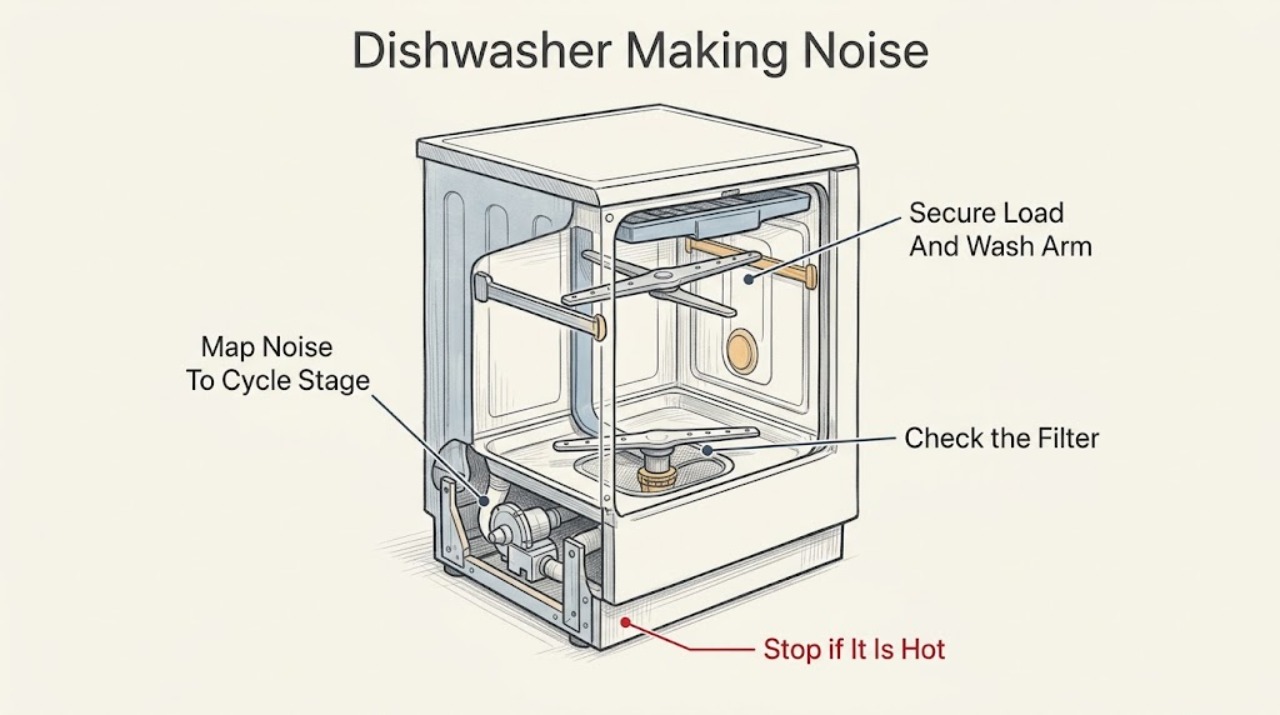
An Amana dishwasher can normally make a soft hum, rushing or swishing water sound, a periodic hiss, a detergent-dispenser snap, or a brief drain gurgle, depending on the cycle stage. First note whether the noise occurs during filling, spraying, draining, drying, or door movement. With the cycle stopped, secure dishes and utensils, check that nothing can contact a wash arm, and inspect the filter or foreign-object area only as your model manual allows. Grinding that persists after a complete cycle, a harsh or metallic sound, a loud new buzz, or noise with a leak, burning odor, smoke, or repeated breaker trip is not a sound-level setting issue; stop using the dishwasher and arrange qualified service.
Work through in order
Diagnostic checks
Use only checks that match the exact appliance or system and its official guide.
-
Check 1
Without opening any service area, note the sound location and the exact cycle stage: filling, washing or spraying, draining, drying, the detergent release, or opening the door. Stop the cycle if the sound is harsh or the machine shows a safety problem.
Expected result: Record a soft water rush or swish, a hum, a periodic hiss, a snap, a thump or rattle, a scrape or grind, a squeak while the door moves, or a loud buzz; also record whether the sound ends when that stage ends.
Next step: Use the matching sound branch below and avoid repeatedly restarting the dishwasher to reproduce a harsh noise. Keep the sound timing for the service handoff if it does not clearly match a normal stage.
Stop if: Stop immediately for smoke, burning odor, arcing, a hot enclosure, a sharp metallic impact, a leak near electrical equipment, or a repeated breaker trip.
Why this matters
Why: Stage-linked soft water, pump, valve, dispenser, or drying sounds can be normal. A sound that is metallic, rapidly worsening, present throughout the cycle, or unrelated to water movement is less consistent with routine operation and may involve an object, rack or door contact, installation vibration, pump, motor, or control fault.
-
Check 2
After stopping the cycle and waiting for spray to stop, inspect the racks and visible wash-arm path; reposition tall cookware, loose utensils, lids, and lightweight items so nothing extends into or can contact a wash arm.
Expected result: Record whether the thump, rattle, or repeated tapping disappears with the load removed or rearranged, or whether the same sound occurs with the racks clear.
Next step: Run one ordinary cycle only if the sound was clearly caused by the load and no safety sign is present. If the sound remains with a clear load, stop using the dishwasher and continue to the filter or service branch.
Stop if: Do not reach into a moving wash arm, force a rack, remove a guard, or put a hand into the pump or filter opening while the dishwasher is operating.
Why this matters
Why: Amana notes that lightweight items can rattle or vibrate if not secured, and that large cookware or an overloaded rack can amplify clatter during spraying. A noise that remains with a clear load is less likely to be caused by dish placement.
-
Check 3
With the dishwasher off and empty, inspect the normal user-accessible filter or foreign-object area using the exact Owner's Manual procedure for the model; look only for loose food, glass, bone, or another foreign object and do not remove a cover that requires tools.
Expected result: Record a clear filter area, visible debris or an object, a filter that is clogged, a maintenance-free filter system, or an area that cannot be accessed safely as described by the manual.
Next step: Remove only loose material the manual explicitly allows the owner to remove, reinstall the filter exactly as specified, and test once if no other warning exists. If grinding continues after a complete cycle or the area is inaccessible, arrange service.
Stop if: Do not reach into a sharp or wet opening, disassemble the wash module, use a tool to pry the filter, or operate without a correctly installed filter or cover.
Why this matters
Why: Amana says objects stuck in the filter area can cause grinding. Filter designs vary, and some models use a foreign-object cup or do not require routine filter maintenance, so a forced or improvised removal can create a new problem. A grinding sound with a clear area is not identified by this check.
-
Check 4
When the dishwasher is empty and not running, open and close the door slowly and observe whether it rubs the cabinet; then check from the front whether the tub or cabinetry vibrates or the unit appears unsupported, without pulling the dishwasher out.
Expected result: Record a squeak only during door movement, visible rubbing, a unit that rocks or transmits vibration, or a sound that occurs only while the pump or spray system runs.
Next step: Remove an obvious item contacting the door. If the unit rocks, the door remains misaligned, or the sound continues, stop and request an installer or qualified appliance technician to check leveling and mounting; do not adjust hidden hardware without the model instructions.
Stop if: Do not remove the toe kick, pull out the appliance, adjust structural mounting, or continue using the dishwasher if the door will not close and seal or water is escaping.
Why this matters
Why: Amana says a door rubbing against cabinets can cause grinding or squeaking, and that the dishwasher must be level, square, and supported to avoid sealing and vibration problems. A noise isolated to wash or drain operation points instead toward water flow, an object, pump, motor, or another internal cause.
-
Check 5
Compare the sound with the expected stage without changing hidden settings: listen for the drain-pump hum near draining, the periodic water-valve hiss during filling, the dispenser snap, and any fan or heater hum after the clean indication if the model provides heated or fan-assisted drying.
Expected result: Record a soft stage-limited sound that ends as expected, or a loud, continuous, newly changed, grinding, squealing, or buzzing sound that continues after the stage or after the cycle completes.
Next step: Treat only the documented, stage-limited sound as normal. For a persistent or worsening sound, leave the dishwasher off and provide the sound, stage, load state, drain result, and model information to service.
Stop if: Do not enter a service diagnostic mode, measure electricity, remove panels, touch the pump or heater, or attempt to silence an internal component.
Why this matters
Why: Amana identifies the stage-limited sounds as normal on applicable models. A changed or persistent sound is not proven to be a failed pump, valve, motor, or heater by listening alone, but it is a reason to stop guessing and seek model-specific diagnosis.
Use your observations
Decision map
Find the observation that best matches what you see, then follow the next safe action.
-
PATH 01Next step
What you see
The sound is a soft rush, swish, periodic hiss, dispenser snap, drain-pump hum, or brief gurgle and occurs only at the stage Amana describes for that sound, with normal washing and no safety warning.
Do this next
The sound is likely normal operation. Monitor it on the next ordinary cycle, using the model manual for any model-specific fan or drying behavior; arrange service if it becomes loud, changes character, or persists outside the expected stage.
-
PATH 02Next step
What you see
A thump or rattle occurs during spraying and disappears when tall or loose items are secured or removed from the wash-arm path.
Do this next
Keep the corrected loading pattern. If the noise returns with a clear load, stop using the dishwasher and request diagnosis rather than assuming the wash arm or pump is sound.
-
PATH 03Next step
What you see
Grinding or crunching is strongest during washing and debris is visible in the model's user-accessible filter or foreign-object area, or the sound continues with a clear area.
Do this next
Follow only the exact manual cleaning step for visible loose material. If the sound continues after a complete cycle, occurs with a clear filter area, or requires disassembly, leave the dishwasher off and arrange appliance service.
-
PATH 04Next step
What you see
Squeaking occurs during door movement, the door rubs cabinetry, or the unit rocks and transmits vibration to the surrounding cabinet.
Do this next
Remove an obvious contact at the door. Have an installer or qualified appliance technician correct leveling, squareness, support, or mounting when the issue remains; do not pull the unit out or adjust hidden hardware as a guess.
-
PATH 05Next step
What you see
A loud buzz, metallic grind, scraping, harsh vibration, or rapidly worsening sound continues with a clear load and filter area, or it occurs with poor draining, a leak, smoke, burning odor, heat, or a repeated breaker trip.
Do this next
Stop the dishwasher and keep it off. Request qualified appliance service; use appropriate electrical or emergency help for smoke, arcing, exposed wiring, a hot enclosure, or an active electrical hazard.
Helpful context
Understand the symptom
The stage and character of the noise matter
A dishwasher does not make one constant sound. Amana describes a gentle hum or whoosh during filling, rhythmic swishing while the spray arms operate, a drain-pump hum and brief gurgle near completion, and a low fan or heater hum on models with heated or fan-assisted drying. A periodic hiss can be the water valve, and a snap can be the detergent dispenser. A sound that is new, harsh, metallic, or present outside the expected stage deserves a different path than a normal operating sound.
Use the exact model instructions for the filter and controls
Amana dishwasher designs differ. Some models have removable filters at the bottom center; others use a foreign-object cup, and some filter systems are maintenance-free. The manufacturer says to use the Owner's Manual for the removal and cleaning procedure. The same caution applies to customer settings: sound-level controls and button sequences differ by model. Do not force a filter, remove a cover, or enter a service mode just to chase a noise.
When an ordinary adjustment is no longer enough
A thump that changes when a rack is rearranged can be a dish or utensil interfering with a wash arm. A squeak when the door moves can be the door rubbing against cabinetry, while a unit that is not level or securely supported can transmit vibration into the cabinets. If the sound continues after the accessible checks, occurs with an empty load, or comes with poor washing, standing water, a leak, or an electrical warning, leave the machine off and give a qualified technician the sound location and cycle stage.
Safety boundary
Stop conditions
- Stop immediately for smoke, fire, burning odor, arcing, a hot or buzzing enclosure, exposed wiring, water near electrical equipment, or a repeated breaker trip.
- Leave the dishwasher off for a harsh metallic grind, scraping, severe vibration, an active leak, poor draining with an abnormal noise, or a noise that persists after a complete cycle.
- Never reach into a moving wash arm, pump, heater, or filter opening; remove panels, pull out the appliance, perform electrical tests, or bypass a safety device as a homeowner.
When checks do not resolve it
Need a professional?
Arrange qualified appliance service when grinding, scraping, squealing, loud buzzing, or severe vibration persists after the safe loading, filter-area, and door checks; when the sound occurs with an empty load; or when there is standing water, a leak, poor draining, a recurring control problem, or a unit that is not stable. Stop immediately for smoke, burning odor, arcing, a hot enclosure, water near electrical equipment, or a repeated breaker trip.
Have this ready
- Provide the model if safely visible, the sound description and location, cycle stage and timing, whether the load was empty, filter or foreign-object observations, door-rubbing or vibration notes, drain result, visible water, and any control or breaker event.
Common questions
FAQ
What dishwasher noises are normal on an Amana dishwasher?
A soft water rush during filling, swishing during spray, a drain-pump hum, a brief drain gurgle, a periodic water-valve hiss, and a detergent-dispenser snap can be normal when they occur at the expected cycle stage. A harsh, persistent, or newly changed noise should be investigated instead of dismissed as normal.
Why is my Amana dishwasher making a grinding or thumping noise?
A thump can come from dishware or utensils interfering with a wash arm. Grinding can come from an object in the filter area, although some models have a built-in chopper that can make grinding during washing. Rearrange the load and inspect only the model's user-accessible filter area as the manual permits; persistent grinding needs service.
Can I change the Amana dishwasher sound setting to fix a loud mechanical noise?
The sound-level setting controls the dishwasher's alert sound on applicable models; it does not repair a pump, wash arm, filter, motor, or installation vibration. Button sequences vary by model, so use the manual only to identify that setting. Stop and arrange service for a mechanical noise that continues or worsens.
Read the exact guide
Official sources
- Squeaking - DishwasherAmana Product Help · Amana dishwasher guidance used for a squeak during door movement and for recognizing unit-level or cabinet-support vibration without prescribing hidden hardware adjustment.
- Hissing - DishwasherAmana Product Help · Amana dishwasher noise guidance used only for a periodic, stage-linked water-valve hiss; it does not diagnose a continuous or newly harsh buzz.
- Snapping - DishwasherAmana Product Help · Amana dishwasher noise guidance used to identify a distinct, stage-linked dispenser snap rather than an ongoing mechanical noise.
- Normal Dishwasher Sounds and NoiseAmana Product Help · Amana dishwasher guidance used to distinguish expected water, pump, spray, drying, loading, and installation sounds from symptoms needing attention.
- How to Change Sound Level of DishwasherAmana Product Help · Amana dishwasher control guidance used only to explain that sound-level settings and button sequences vary by model; it is not a repair instruction for mechanical noise.
- Grinding - DishwasherAmana Product Help · Amana dishwasher guidance used for safe inspection of the model-specific user-accessible filter or foreign-object area and for persistent grinding escalation.
- Humming - DishwasherAmana Product Help · Amana dishwasher noise guidance used for stage-specific humming and the distinction between normal hum and a persistent changed sound.
Community feedback
Share a repair observation
Share a plain-text repair observation. Accepted observations are published automatically; this page may take a moment to update.