
On this page
Start here
Quick answer
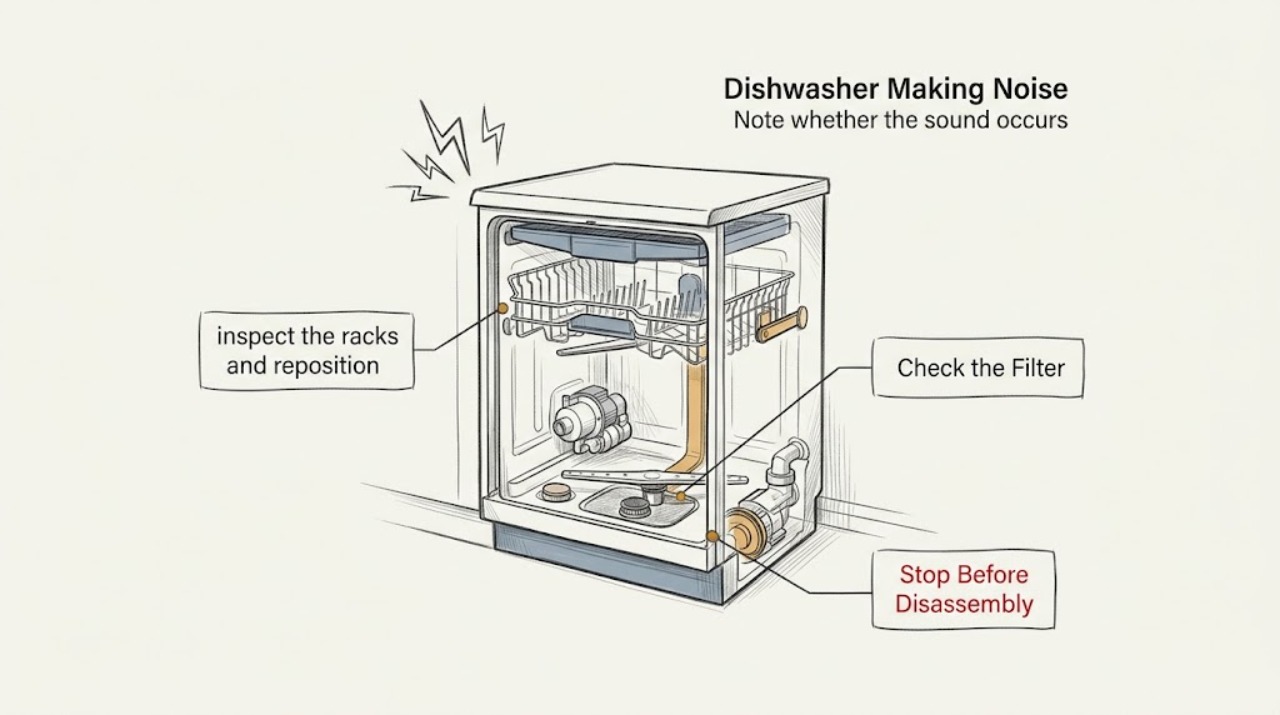
An AEG dishwasher can make normal humming, filling, spraying, draining, or light clicking sounds, so first match the noise to the programme phase. A repeated click or knock that follows spray-arm rotation can come from a plate, tray, or utensil; rattling can come from loose dishes; and grinding, metal scraping, persistent knocking, sudden excessive vibration, or noise with poor washing or draining is abnormal. With the dishwasher stopped, check the load, rotate the spray arms by hand, and inspect the removable filters and visible sump for debris using gloves. If the drain pump runs continuously with an i30 indication or leak, close the water tap and arrange service. Do not remove panels or reach into a pump or live wiring; stop using the dishwasher for persistent abnormal noise, a leak, damage, or an error that returns.
Work through in order
Diagnostic checks
Use only checks that match the exact appliance or system and its official guide.
-
Check 1
Note whether the sound occurs during filling, washing, draining, drying, or only when a dispenser operates. Listen from outside the closed appliance and do not put hands into the tub while a programme is running.
Expected result: The sound is a short hum or buzz at fill, swishing during wash, a pump-like hum near drain, or a brief click; or it is a new grinding, scraping, continuous knock, or excessive vibration.
Next step: If the sound matches a normal phase and washing and draining are normal, continue to the load check if the noise is bothersome. If it is harsh, continuous, suddenly louder, or accompanied by poor performance or an error, stop the programme and continue only with the safe checks below.
Why this matters
Why: Timing separates normal inlet, spray-arm, drain-pump, and dispenser sounds from a mechanical noise that is not explained by the programme phase.
-
Check 2
After the programme has stopped, inspect the racks and reposition plates, pans, glasses, and long utensils so nothing projects into the spray-arm path. Rotate each accessible spray arm by hand and confirm it turns freely without touching the load.
Expected result: The repeated click or knock occurs once per arm rotation, disappears after an item is moved, or remains with the racks empty and the arms unobstructed.
Next step: If moving the load stops the sound, run a short observation cycle with the items secured. If the sound remains with free-moving arms, stop testing and inspect only the filter and visible sump; do not remove the spray-arm assembly or panels to reach internal parts.
Why this matters
Why: AEG identifies basket items touching one another or a spray arm as common sources of rattling, tapping, clicking, or knocking; a noise that remains without contact is less likely to be a loading issue.
-
Check 3
With the dishwasher stopped and safe to access, remove and rinse the user-removable filters according to the model manual. Wearing protective gloves, look only at the visible sump area for glass, broken crockery, food debris, labels, stones, or plastic fragments; do not reach into a hidden pump opening.
Expected result: A foreign object or heavy debris is visible, the filters are clear but the grinding continues, or water remains with an abnormal drain sound.
Next step: Remove only loose debris that is safely accessible, refit the filters correctly, and observe one short programme if there is no hazard. If the object cannot be removed without tools, the noise persists, or the dishwasher will not drain normally, leave it out of service and arrange a technician.
Why this matters
Why: AEG says objects trapped in the filter or pump area can cause grinding, rattling, or clicking. Clear filters do not rule out a pump or circulation fault, especially when draining performance is affected.
-
Check 4
From a stable position, check whether the dishwasher rocks or is pressing against adjacent cabinets. Look at the accessible feet and installation gap only; do not pull out an integrated appliance or adjust hidden connections while it is connected.
Expected result: The cabinet or floor vibrates in time with the pump, the appliance is visibly out of level or loose, or the noise remains even when the unit is stable and clear of the cabinets.
Next step: If the cause is an obviously loose, accessible external contact, arrange correction through the installer or service route rather than forcing the appliance. If vibration is excessive or the installation cannot be checked safely, stop using it and request qualified service.
Why this matters
Why: AEG notes that an unlevel or unsecured appliance can transmit vibration to the surrounding cabinet or floor. Persistent noise after a stable installation points away from simple cabinet contact.
-
Check 5
If the noise is a constant low rumble during or after a fault, check the display and floor area for an i30 indication, repeated alarm, or water leak. From a safe position, close the dishwasher water tap if one is accessible without moving the appliance; do not remove the base or investigate a leak internally.
Expected result: The drain pump runs continuously and i30, beeps, or a flashing indicator appears; water is present; or there is no error and no leak.
Next step: For i30, a leak, or a returning alarm, keep the water supply closed, stop using the dishwasher, and arrange authorized service. If there is no error or leak, return to the sound-timing and mechanical checks instead of assuming a pump failure.
Why this matters
Why: AEG associates i30 with water collecting in the base and an anti-flood response that can keep the drain pump running. A continuous pump sound with a leak is not an ordinary noise condition.
-
Check 6
Record the exact model or PNC, programme, sound description, time in the cycle, error indication, and whether washing, filling, and draining still work. Use the matching AEG manual for any reset or programme-specific instruction; do not order a part from the sound alone.
Expected result: The noise is reproducible and isolated, intermittent, accompanied by a code or poor performance, or cannot be reproduced after the safe checks.
Next step: If the noise returns, becomes louder, affects cleaning or draining, or comes with a code, provide the record to AEG or a qualified appliance technician. Do not test live wiring, remove covers, or continue running the dishwasher to reproduce a grinding or leak condition.
Why this matters
Why: The same broad description can involve a normal hydraulic sound, load contact, an obstruction, installation vibration, or a pump or motor fault. Model and cycle context are needed before a component can be identified.
Use your observations
Decision map
Find the observation that best matches what you see, then follow the next safe action.
-
PATH 01Next step
What you see
The sound is a short fill hum, wash spray, drain-pump hum, or brief dispenser click, and the dishwasher completes the cycle without poor performance or an error.
Do this next
Keep the load secure and monitor it. Use the exact manual or AEG support if the sound changes or becomes disruptive.
Why this path and its safety boundary
Why it matters: This pattern is consistent with documented operating sounds rather than a confirmed component fault.
-
PATH 02Next step
What you see
A repeated click or knock tracks spray-arm rotation and stops when a plate, tray, or utensil is repositioned.
Do this next
Leave clearance around both spray arms and run a short cycle only if there is no leak, damage, or abnormal grinding.
Why this path and its safety boundary
Why it matters: Load interference is more likely than an internal pump fault.
-
PATH 03Next step
What you see
Grinding, scraping, or rattling remains after the load is removed, or a visible object is trapped near the filter or sump.
Do this next
Remove only loose, visible debris with gloves. Stop and arrange service if access would require tools, if the object is sharp or lodged, or if the noise persists.
Why this path and its safety boundary
Why it matters: A foreign object or pump-area problem is more likely; a clear filter does not prove that internal rotating parts are sound.
-
PATH 04Next step
What you see
The dishwasher shakes against cabinets, is visibly unstable, or the floor transmits vibration, but there is no error or leak.
Do this next
Use the installer or qualified service route to correct an unsafe or inaccessible installation; do not pull out a built-in unit while connected.
Why this path and its safety boundary
Why it matters: Installation level or external contact may be amplifying an otherwise normal pump or motor vibration.
-
PATH 05Next step
What you see
A constant drain rumble occurs with i30, a repeated alarm, water at the base, or a leak, or the noise is accompanied by smoke, burning smell, damaged wiring, or a hot cord.
Do this next
Close the water tap when safely accessible, stop using the dishwasher, and arrange qualified service. Leave electrical or internal leak investigation to the technician.
Why this path and its safety boundary
Why it matters: This is a safety or anti-flood symptom, not a normal-noise diagnosis.
Helpful context
Understand the symptom
The useful clue is when the sound occurs, not just whether the dishwasher is loud. AEG describes water entry, spray-arm circulation, drain-pump operation, and some dispenser clicks as normal operating sounds. A new sound that is harsh, repetitive, or tied to poor cleaning, filling, or draining deserves a closer check. Different AEG models can use different programmes and controls, so use the exact manual for any model-specific instruction.
Before opening the door or checking the tub, stop the programme normally and keep hands away from moving spray arms and hot water. If there is a leak, burning smell, smoke, damaged cord, exposed wiring, or a persistent error, stop using the appliance and arrange qualified service.
When checks do not resolve it
Need a professional?
Grinding, scraping, continuous knocking, or excessive vibration persists after the load, spray-arm, visible-filter, and installation checks., The noise is accompanied by an i30 indication, continuous drain pump, leak, poor washing, incomplete draining, or another error., There is smoke, burning smell, sparking, a damaged or hot cord, water near electrical parts, or any need to remove panels or test internal components.
Have this ready
- The exact AEG model or PNC and whether the dishwasher is integrated or freestanding.
- A description or safe recording of the sound, the programme phase, and whether it follows spray-arm rotation or drain operation.
- Any error or alarm, visible water, foreign object, change in washing or draining, and the safe checks already completed.
Common questions
FAQ
Is a humming sound from an AEG dishwasher normal?
Often, yes. AEG describes humming or pumping during filling, circulation, or draining as normal operating sound when the dishwasher completes the programme normally. A new loud hum, grinding, scraping, persistent knock, leak, error, or poor draining needs a stop-and-service decision.
Why does my AEG dishwasher click during a cycle?
A brief click can be the detergent dispenser releasing rinse aid, which AEG describes as normal. A repeated click or knock that matches spray-arm rotation can instead indicate a plate, tray, or utensil in the arm's path; stop the programme and check the load after it has stopped.
What should I do if the noise is grinding or scraping?
Stop the dishwasher and check the secured load, free movement of the spray arms, and only the removable filters and visible sump with protective gloves. If the sound persists, an object is lodged, or cleaning or draining is affected, do not remove panels or reach into the pump; arrange qualified service.
Does a constant drain-pump rumble mean the dishwasher is making normal noise?
Not if it is continuous and appears with i30, a repeated alarm, or a leak. AEG links i30 to water in the base and an anti-flood response that can keep the drain pump running. Close the water tap when safely accessible, stop using the appliance, and arrange service.
Can I replace a pump or motor because my AEG dishwasher is noisy?
Not from the noise description alone. The same symptom can be caused by normal hydraulic operation, a load contacting a spray arm, debris in the visible filter or sump, installation vibration, or an internal pump or motor condition. Give AEG or a technician the model or PNC, programme phase, sound pattern, error information, and performance changes before any part decision.
Read the exact guide
Official sources
- Download User Manuals - Support | AEGAEG · AEG UK documentation search; users outside the UK or Ireland should use the support site for the country of purchase
- Dishwasher emits clicking/ticking noise during cycleAEG · AEG dishwasher support article for clicking or ticking caused by the detergent dispenser releasing rinse aid
- Dishwasher Making Noises – Normal Sounds and Signs of a ProblemAEG · AEG integrated and freestanding dishwashers; symptom-level guidance is general and model-specific instructions remain controlling
- Normal noise (circulating pump, drain pump)AEG · AEG support article describing sounds that can occur during a wash; use the dishwasher model manual for model-specific behavior
- Dishwasher displays error code i30AEG · AEG dishwasher i30 guidance; the error-specific steps apply when the display, alarm, leak, or constant-pump symptom is present
Community feedback
Share a repair observation
Share a plain-text repair observation. Accepted observations are published automatically; this page may take a moment to update.