
On this page
Start here
Quick answer
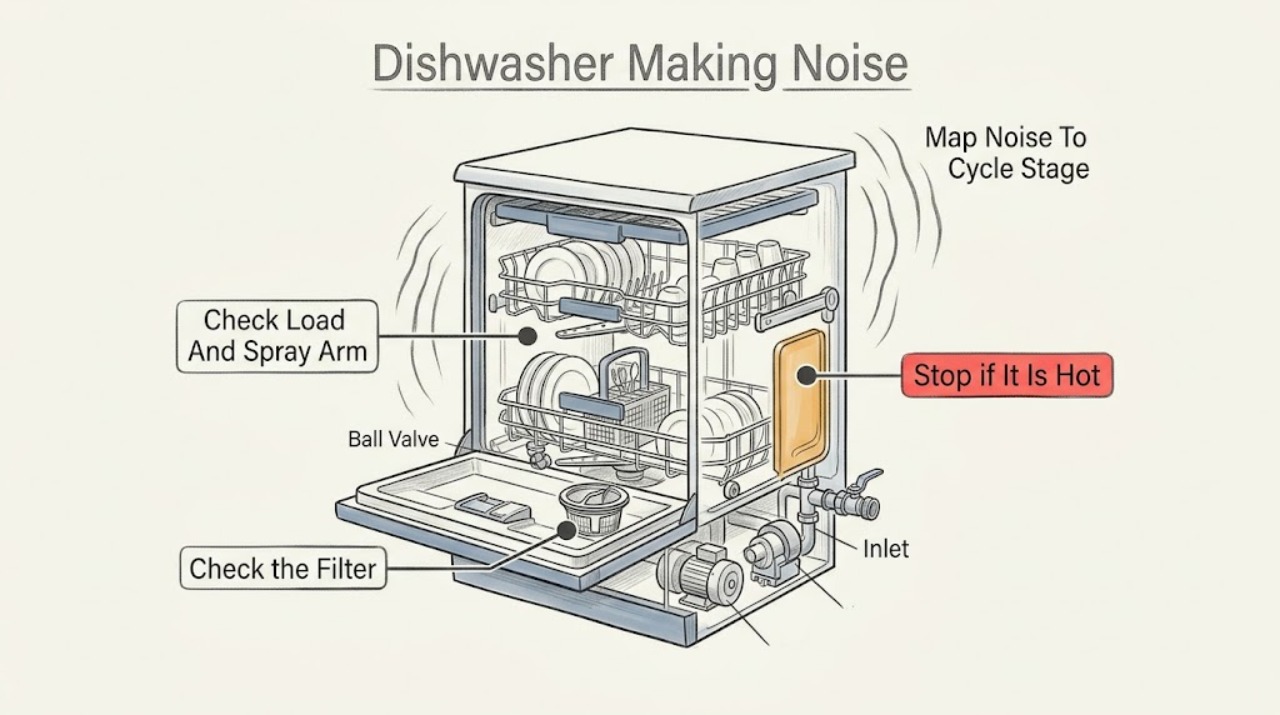
Identify when the Electrolux dishwasher makes the noise before treating it as a failure. Hissing during fill, water whooshing as spray arms alternate, a wash-pump hum, a drain-pump hum that changes as water leaves, a detergent-dispenser clunk, and a drying-fan sound on models equipped with that feature can be normal. A repeated knock often means a tall plate, pan, utensil, or loose dish is contacting a spray arm or another item. With the dishwasher stopped and disconnected from power, check the load, rotate accessible spray arms by hand for free movement, and clean the filters and spray arms only as the exact model manual allows; use gloves because broken glass may be present. A new grinding/scraping sound, persistent loud knocking, noise while the machine is off, excessive vibration, poor washing/draining, water leakage, burning smell, or an error message is a stop point. Do not reach into a running dishwasher, remove covers, dismantle the circulation/drain pump or motor, or perform live electrical tests. If the noise remains after the safe loading and user-cleanable checks, arrange qualified Electrolux service rather than ordering a guessed pump, impeller, bearing, or control board.
Before you begin
Safety first
- The user may map timing, stop the cycle, reposition accessible dishes, gently check accessible spray-arm movement, and clean user-removable filters/spray arms after disconnecting power and using appropriate gloves. Pumps, motors, impellers, bearings, heaters, wiring, controls, built-in electrical connections, and live testing are for qualified personnel.
Work through in order
Diagnostic checks
Use only checks that match the exact appliance or system and its official guide.
-
Check 1
Without opening the door of a running cycle or placing hands inside, note when the sound occurs: immediately during filling, during alternating spray, near draining, once when detergent releases, during drying, only with a particular load/programme, or while the dishwasher is switched off.
Expected result: The sound follows fill, wash circulation, drain, detergent release, or drying; changes with the programme; or continues while the appliance is off.
Next step: For a normal-timed sound, continue to the load and accessible-part checks. For noise while off or a new mechanical/electrical sound, stop using the dishwasher and arrange service without trying to reproduce it.
Stop if: Do not open the door into moving spray arms, reach into water or the sump during operation, or run repeated cycles solely to listen for a fault.
Why this matters
Why: Cycle-linked hissing, humming, whooshing, clunking, or fan noise can be normal operating sound. A noise while off, a sudden persistent sound, or a sound independent of cycle stage is less consistent with normal hydraulic operation.
-
Check 2
After the programme has stopped and the dishwasher is safe to open, inspect the racks for tall plates, pan handles, long utensils, loose lightweight items, or overloaded dishes that could touch each other or an accessible spray arm. Rotate the spray arms gently by hand and confirm they move freely without forcing a damaged assembly.
Expected result: A dish or utensil touches an arm, dishes rattle together, the racks are overloaded, an arm is blocked, or the load and arms are clear.
Next step: Reposition or secure the accessible items according to the model's loading diagram and make one attended cycle check. If the noise persists with an empty or correctly loaded rack, stop and continue with the filter/level check or service escalation.
Stop if: Do not bend a spray arm, force a rack, reach into a sharp or broken item, or test with hands inside the running dishwasher.
Why this matters
Why: Electrolux identifies spray-arm contact and dishes/cutlery moving against one another as common causes of knocking, clunking, or louder operation. If the arms are clear but the same noise continues, loading is less likely to be the root cause.
-
Check 3
Turn off the dishwasher and disconnect the main plug before cleaning. Following the exact model manual, remove and rinse the user-removable filters and inspect the accessible sump edge for food, plastic, labels, or broken glass; clean permitted spray-arm holes and refit every part until locked. Wear cut-resistant gloves and do not probe hidden pump passages.
Expected result: The filters/sump or spray-arm holes contain residue or a foreign object, or the accessible parts are clean and correctly refitted.
Next step: Remove only accessible debris, reinstall filters and spray arms exactly as the manual shows, then make one attended cycle check. If grinding, scraping, or the same noise returns, leave the dishwasher off and arrange service.
Stop if: Do not reach into the pump, dismantle pump parts, use sharp tools in hidden passages, operate without the filters, or clean while connected to power.
Why this matters
Why: Electrolux support says debris in filters or the pump area can cause abnormal sounds and reduced performance, while clogged spray-arm holes can affect circulation. A clean accessible path does not rule out a pump, impeller, motor, or control fault.
-
Check 4
With the dishwasher off, observe whether the cabinet vibrates against surrounding units, the floor is uneven, or the machine is visibly out of level. Note related symptoms such as poor filling, weak washing, standing water, leaks, poor drying, an error, or an electrical odor. Do not remove built-in panels to inspect installation or wiring.
Expected result: Vibration is transmitted to the cabinet/floor, the machine is not level, the noise is accompanied by poor performance/error/leakage, or installation and performance appear normal.
Next step: Correct only an obvious, manual-documented external leveling or contact issue; otherwise stop. A noise paired with water, electrical, filling, washing, draining, or drying trouble needs qualified diagnosis.
Stop if: Do not loosen built-in mounting, alter hoses or wiring, move a loaded appliance, or continue operation with a leak, electrical odor, or severe vibration.
Why this matters
Why: Electrolux guidance identifies leveling and secure installation as factors in vibration, while noise plus poor performance or an error makes a mechanical, hydraulic, or electronic fault more likely than simple loading.
-
Check 5
If the noise remains after the cycle-timing, loading, accessible spray-arm/filter, and safe installation checks, record the model/PNC, programme stage, noise description, water level, error messages, and related performance. Keep the dishwasher switched off and provide this information to Electrolux support or a qualified appliance technician.
Expected result: Grinding, metal scraping, continuous knocking, abnormal buzzing, noise while off, excessive vibration, or poor washing/draining persists; or the noise disappears after a documented load correction.
Next step: Use the dishwasher only if the model's manual and service provider confirm it is safe; otherwise leave it disconnected and arrange service. Do not purchase or install an internal part based only on the sound.
Stop if: Do not remove covers, test live voltage, dismantle pumps or motors, or continue operating after smoke, burning smell, water leakage, or electrical abnormality.
Why this matters
Why: A persistent or performance-linked sound can involve the circulation or drain pump, motor/impeller, bearings, spray-arm assembly, wiring, or electronic control. Sound alone cannot identify a safe replacement part.
Use your observations
Decision map
Find the observation that best matches what you see, then follow the next safe action.
-
PATH 01Safety boundary
What you see
The sound is a fill hiss, wash-pump hum, drain-pump hum, spray-arm whoosh, detergent-dispenser clunk, or optional drying-fan sound that occurs only at the expected cycle stage and the dishwasher performs normally.
Do this next
Monitor without opening the running dishwasher. If it becomes newly loud, changes character, or is joined by poor performance or an error, stop and reassess.
Why this path and its safety boundary
Why it matters: The sound is consistent with normal water, pump, spray-arm, dispenser, or fan operation rather than a proven failure.
Safety stop: Do not dismantle a normal-sounding pump or use an empty/running-hand test to investigate it.
-
PATH 02Safety boundary
What you see
A repeated knock, clunk, rattle, or whistling occurs with tall dishes, pan handles, long utensils, an overloaded rack, or an arm that cannot rotate freely.
Do this next
Stop the cycle, let parts settle, reposition the load and clear the accessible arm, then make one attended check. Escalate if the sound remains with a correct load.
Why this path and its safety boundary
Why it matters: Load interference or spray-arm contact is more likely than an internal motor fault.
Safety stop: Do not bend the arm, force dishes free, or reach into a running machine.
-
PATH 03Safety boundary
What you see
Grinding, rattling, clicking, poor washing, or drain noise accompanies visible food, plastic, labels, glass, or spray-arm-hole blockage in accessible areas.
Do this next
Disconnect power, use gloves, clean only the user-accessible filters and spray arms allowed by the exact manual, refit them, and stop if the noise returns.
Why this path and its safety boundary
Why it matters: A foreign object or accessible filter/spray restriction is plausible and can affect pumps or circulation.
Safety stop: Do not probe hidden pump passages, remove pump covers, or operate without the filters.
-
PATH 04Safety boundary
What you see
The dishwasher vibrates against cabinets/floor, is not level, or the sound changes when the surrounding installation is touched, without other fault symptoms.
Do this next
Check the exact installation instructions and arrange qualified installation adjustment if needed. Do not move a built-in or loaded dishwasher to chase the noise.
Why this path and its safety boundary
Why it matters: Leveling, secure installation, or cabinet contact is more likely than a failed pump, but built-in adjustment is model- and installation-specific.
Safety stop: Do not loosen mounting, alter electrical/water connections, or continue with severe vibration or leakage.
-
PATH 05Safety boundary
What you see
Grinding, scraping, continuous knocking, abnormal buzzing, noise while off, excessive vibration, water leakage, poor filling/washing/draining, an error, smoke, or electrical odor persists after safe checks.
Do this next
Stop using the dishwasher and arrange qualified Electrolux service. Provide the model/PNC, programme stage, noise pattern, and related symptoms.
Why this path and its safety boundary
Why it matters: An internal pump, motor, impeller, bearing, spray-arm assembly, wiring, control, or another fault is possible; symptoms do not identify the part.
Safety stop: Do not open covers, perform live tests, bypass protection, or continue cycling to reproduce the noise.
Helpful context
Understand the symptom
Timing and rhythm matter more than the word “loud”
A dishwasher changes sound as it fills, circulates water, drains, releases detergent, alternates spray arms, and dries. A steady hum at the start or end can therefore be normal, and a whoosh can change as the arms switch levels. Record whether the sound occurs only during fill, washing, draining, drying, or when the appliance is idle. A sudden new grinding or metal-on-metal sound, a noise that continues while switched off, or a sound paired with poor performance deserves service even if the machine still completes a cycle.
Start with the load, spray arms, filters, and level
Electrolux support points to dishes, pans, cutlery, and long handles striking the spray arms as a common source of knocks or clunks. When the machine is off, unload or reposition only accessible items, check that the spray arms turn freely without forcing them, and inspect the user-cleanable filters and sump for food or foreign objects. Disconnect the main plug before cleaning filters or spray arms, and use cut-resistant gloves around broken glass. A dishwasher that is not level can transmit vibration into cabinets or the floor; installation adjustments belong to the exact model instructions or a technician.
Do not confuse a normal pump sound with an internal fault
The official Electrolux guide describes wash-pump humming that starts and stops as spray arms alternate, and drain-pump humming that changes as water is pumped out. That timing is useful, but it cannot prove that a pump or motor is healthy. Persistent grinding, scraping, excessive vibration, a new electrical buzz, noise while off, leakage, an error, or poor filling/washing/draining moves the problem beyond a user adjustment. Keep the dishwasher off and let a qualified technician inspect the pump, motor, impeller, bearings, wiring, or control system.
Safety boundary
Stop conditions
- Do not reach into a running dishwasher or place hands near moving spray arms, pumps, heaters, or sharp items.
- Disconnect the main plug before cleaning filters or spray arms; wear cut-resistant gloves around possible broken glass and do not probe hidden pump passages.
- Stop for noise while the appliance is off, persistent grinding/scraping, severe vibration, water leakage, smoke, burning/electrical odor, damaged cord, or an error with poor performance.
- Do not remove covers, dismantle pumps/motors/impellers, alter wiring or mounting, bypass safety devices, or perform live electrical tests.
- Do not diagnose or order an internal part from sound alone; keep the dishwasher off and arrange qualified service when safe external checks do not resolve it.
When checks do not resolve it
Need a professional?
Contact Electrolux support or a qualified dishwasher technician when grinding, scraping, continuous knocking, abnormal buzzing, noise while the machine is off, excessive vibration, or noise with poor filling, washing, draining, drying, leakage, an error, smoke, or electrical odor persists after the loading, accessible filter/spray-arm, and documented installation checks. Provide the model/PNC, programme stage, sound pattern, and related symptoms.
Safety scope: The user may map timing, stop the cycle, reposition accessible dishes, gently check accessible spray-arm movement, and clean user-removable filters/spray arms after disconnecting power and using appropriate gloves. Pumps, motors, impellers, bearings, heaters, wiring, controls, built-in electrical connections, and live testing are for qualified personnel.
Common questions
FAQ
Which Electrolux dishwasher noises are usually normal?
Fill-valve hissing, water circulation and spray-arm whooshing, wash- or drain-pump humming, a detergent-dispenser clunk, and a drying-fan sound on models equipped with that feature can be normal when they follow the expected programme stage and performance is normal.
Why is my Electrolux dishwasher knocking?
Check for a tall dish, pan handle, long utensil, overloaded rack, or loose items touching the spray arm or one another. With the dishwasher stopped, reposition the load and gently check accessible arm movement. If knocking continues with a correct load, arrange service.
Can a dirty filter or spray arm make an Electrolux dishwasher noisy?
Yes. Food, plastic, labels, or broken glass in accessible filters/sump areas, or debris clogging spray-arm holes, can affect circulation and create abnormal sounds. Disconnect power, use gloves, and clean only the user-removable parts allowed by the exact manual; do not probe the pump.
What does a humming Electrolux dishwasher mean?
A hum during filling, wash circulation, or draining can be normal and changes with the stage. A new continuous hum, a hum with poor filling/draining or leakage, an electrical smell, or a hum while the appliance is off is not a safe normal-sound assumption and needs service.
When should I stop troubleshooting dishwasher noise?
Stop for grinding, scraping, continuous knocking, noise while off, severe vibration, smoke, burning/electrical odor, water leakage, an error, or poor washing/draining. Do not open the appliance or perform live tests; arrange qualified Electrolux service after recording the programme stage and sound pattern.
Read the exact guide
Official sources
- Dishwasher - Noise GuideElectrolux · General Electrolux dishwasher sound-stage guidance; exact model design and service instructions still govern.
- Dishwashers - What are normal dishwasher operations sounds?Electrolux · General dishwasher operation sounds; fan guidance applies only to models equipped with the stated drying system.
- Dishwasher is making unusual noisesElectrolux UK · General Electrolux dishwasher noise triage; loading and service steps remain model-specific.
- How to clean and maintain your Electrolux dishwasherElectrolux UK · General maintenance guidance; removable spray-arm and filter steps vary by model.
- Electrolux Dishwasher User ManualElectrolux Australia · The cited manual's exact dishwasher family; used for general examples of filters, spray arms, foreign-object and service boundaries, not universal model procedures.
Community feedback
Share a repair observation
Share a plain-text repair observation. Accepted observations are published automatically; this page may take a moment to update.