
On this page
Start here
Quick answer
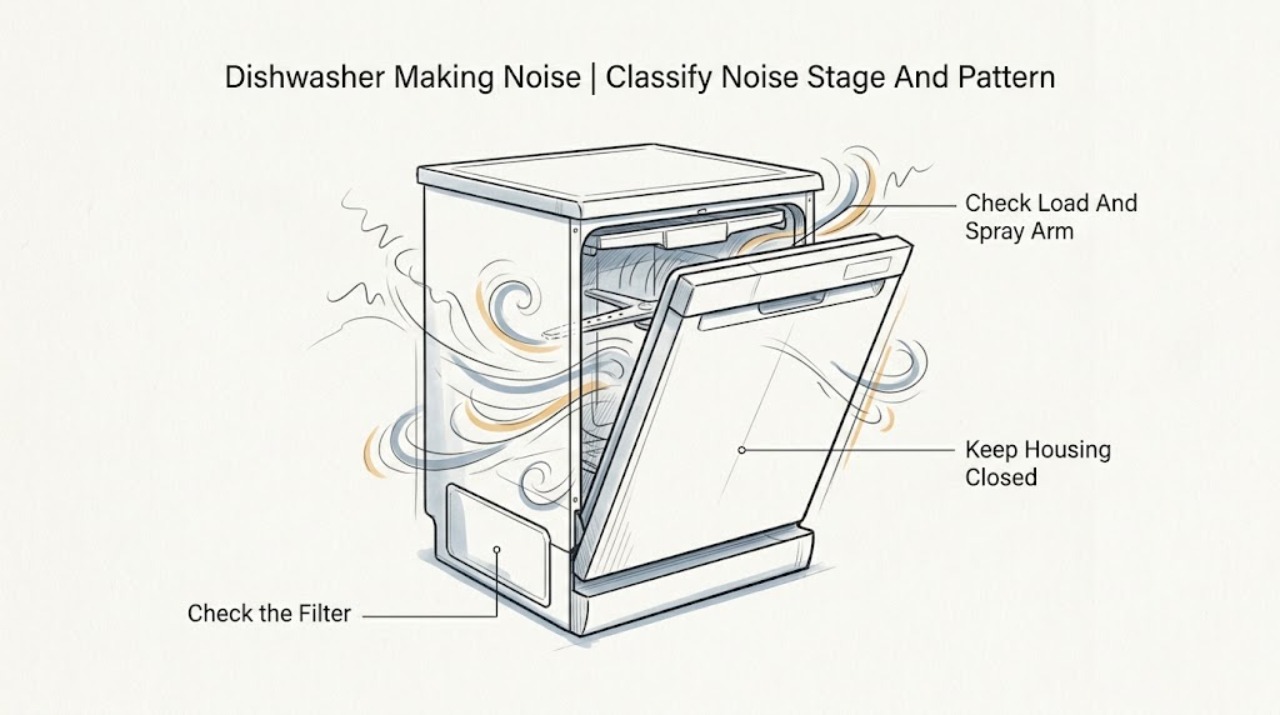
If a Bosch dishwasher is making noise, first note when the sound occurs: a beep at programme end, a hum or buzz while draining, rattling during spray, or a knock during water fill points to different checks. Stop the cycle, switch off the dishwasher, and isolate power before touching the racks, spray arms, filters, or any pump-area cover. Check that no dish or utensil can hit a spray arm, distribute a light load securely, and clean only the filter or pump area that the exact manual identifies as user-accessible; Bosch warns that sharp debris may be present. A very loud grinding sound, noise with an empty machine, repeated stopping, a leak, burning smell, or electrical trip is a stop condition. Do not reach into a running dishwasher or dismantle the pump, motor, or wiring; arrange Bosch service when safe loading and model-approved cleaning do not change the noise.
Before you begin
Safety first
- This article covers listening from outside, safe loading changes, and the exact manual's accessible filter or pump-area procedure with power disconnected and caution for sharp debris. A qualified professional must handle motor, pump, valve, wiring, mounting, built-in removal, live testing, and repairs beyond the manual's user steps.
Work through in order
Diagnostic checks
Use only checks that match the exact appliance or system and its official guide.
-
Check 1
From outside the dishwasher, note whether the sound is a normal end-of-programme beep, a hum or buzz while draining, a knock or rattle during spray, a knock during water fill, or a grinding, screeching, or repeated stop-start sound. Do not open the door or reach inside while moving parts or hot water may be present.
Expected result: The noise occurs only at programme end, during drain, during spray, during fill, or throughout the cycle and is present even with no dish contact.
Next step: Stop the cycle and use the stage-specific check below. Record whether the machine drains normally, leaves water behind, leaks, or changes sound when the racks are empty; do not run repeated cycles solely to compare sounds.
Stop if: Stop immediately for smoke, burning smell, sparks, a hot electrical smell, a leak onto electrical parts, repeated trips, or a harsh noise with the machine empty.
Why this matters
Why: Timing narrows the next safe check: an end beep is a setting or notification, drain noise keeps the pump and drain path in view, spray noise keeps loading and spray-arm clearance in view, and a fill knock may originate in the household water installation. Persistent noise independent of the load is less consistent with dish contact.
-
Check 2
After the dishwasher has stopped and is safe to open, inspect the racks for a plate, pan handle, utensil, or light item that can touch a spray arm. Rotate each accessible spray arm gently by hand only when the exact model permits it and the machine is not running; redistribute dishes so the arms can turn freely and secure light items.
Expected result: A dish or utensil is in the spray-arm path, the arm turns freely after rearranging, light dishes can move, the load is unusually small, or nothing contacts an arm but the rattle remains.
Next step: Rearrange or secure the load, close the door, and make one supervised cycle observation. If the noise remains with the racks empty or a spray arm does not turn freely without force, stop and arrange service.
Stop if: Do not reach into a running dishwasher, force a spray arm, remove a fixed arm, or put hands into hot water.
Why this matters
Why: Direct contact or moving lightware makes loading the stronger explanation. Bosch also notes that a low load can let water jets strike the tub, producing a different knocking sound. If the arms and load are clear but the noise persists, do not assume the spray arm is defective; continue to the filter or service decision.
-
Check 3
If the sound is loudest during draining, stop the dishwasher, disconnect it from power, and follow the exact manual to remove only the user-accessible racks, filter system, and pump cover. Sponge or scoop standing water as directed and use protective gloves; look for food remnants or foreign objects without probing deeper or forcing the cover.
Expected result: The filter or pump area contains debris, the pump cover is not seated, the area is clear, sharp fragments are present, or the cover or filter cannot be removed safely.
Next step: Remove only loose debris that the exact manual explicitly permits, refit the cover and filter correctly, and make one supervised drain observation. If grinding remains, draining is poor, the pump area is inaccessible, or a leak appears, leave the dishwasher disconnected and arrange service.
Stop if: Do not work with power connected, put bare fingers into unknown debris, use tools to pry beyond the manual's procedure, or dismantle the pump or motor.
Why this matters
Why: Bosch identifies foreign objects or food remnants as possible pump obstructions and says sharp debris such as glass can be present. A clear area does not rule out an impeller, motor, drain, or control fault. A stuck cover, sharp debris, or water that cannot be safely removed is a professional boundary.
-
Check 4
If the knock occurs only when the dishwasher takes in water, note whether water flow and the programme remain normal and whether the sound seems to come from the supply pipe or nearby plumbing rather than from inside the tub. Do not alter the water connection or remove an inlet valve cover.
Expected result: A brief knock occurs during fill with normal operation, the noise is loud or repeated and affects water flow, or the dishwasher also leaks, stops, or shows an error.
Next step: For a brief installation-related sound with normal operation, record it and consult a qualified plumber or installer if it is disruptive. For abnormal operation or a leak, stop the cycle, close the water supply if safe, isolate power, and arrange service.
Stop if: Do not loosen hoses, alter the inlet connection, reach behind a built-in dishwasher, or continue operation with a water leak.
Why this matters
Why: Bosch's manual says filling-valve knocking can be caused by the domestic installation and does not necessarily mean the dishwasher is defective. A change in water flow, leak, error, or persistent harsh noise makes the supply installation or appliance inlet system need professional assessment.
-
Check 5
After the load is clear, the filter and pump cover are correctly seated, and there has been no safety warning, make one normal supervised cycle observation. Note whether the sound remains with an empty rack, occurs at several stages, becomes louder, or is accompanied by poor draining, poor washing, a leak, or an error.
Expected result: The noise disappears after loading or filter correction, remains with an empty machine, becomes louder or metallic, repeats at more than one stage, or is accompanied by another operating fault.
Next step: If the noise persists or another fault is present, stop using the dishwasher and arrange Bosch service. Provide the exact model, noise timing and description, load state, filter or pump observations, draining result, and any leak or error history.
Stop if: Do not run multiple cycles to reproduce a harsh noise, remove the motor or pump, tilt the appliance, or perform live electrical checks.
Why this matters
Why: A noise that disappears after a documented user correction is consistent with dish contact or an accessible obstruction. Noise that remains empty, worsens, or accompanies poor operation makes a pump, motor, bearing, valve, mounting, or control fault more likely, but the sound cannot identify which part.
Use your observations
Decision map
Find the observation that best matches what you see, then follow the next safe action.
-
PATH 01Safety boundary
What you see
The sound is a brief programme-end beep, or a modest hum or buzz occurs only while water is being forced down the drain and the dishwasher drains normally.
Do this next
Use the exact manual to adjust an end-of-programme sound if desired. For drain noise, monitor one normal cycle and inspect the accessible filter only if the sound becomes unusually loud or draining changes.
Why this path and its safety boundary
Why it matters: A notification setting or normal drain-pump sound is more likely than a mechanical failure.
Safety stop: Stop if the sound becomes harsh or metallic, draining slows, water remains, a leak appears, or electrical or burning signs occur.
-
PATH 02Safety boundary
What you see
The noise is a knock or rattle during spraying, and a utensil, dish, light item, or low load can explain contact with the spray arm or direct water impact on the tub.
Do this next
Rearrange dishes so spray arms rotate freely, secure light items, and avoid an unusually sparse load. Make one supervised observation; service is needed if the sound remains with an empty or correctly loaded dishwasher.
Why this path and its safety boundary
Why it matters: Loading or water-jet contact is more likely than an internal motor fault.
Safety stop: Do not reach into the dishwasher while it is running or force a spray arm.
-
PATH 03Safety boundary
What you see
The sound is loudest during draining, the dishwasher drains poorly or leaves water behind, or the filter and pump area contains debris or a loose cover.
Do this next
With power disconnected, follow the exact manual's accessible filter or pump-cleaning procedure and use gloves for possible sharp debris. If the sound or poor draining persists, leave the dishwasher off and arrange service.
Why this path and its safety boundary
Why it matters: A drain obstruction or pump-area condition is more plausible, but a clear filter does not rule out an internal pump, impeller, motor, or control fault.
Safety stop: Do not pry a stuck cover, handle glass fragments bare-handed, reach beyond the manual's access point, or dismantle the pump.
-
PATH 04Safety boundary
What you see
A knock occurs during water fill with otherwise normal operation, or a harsh noise remains with the dishwasher empty, occurs at multiple stages, worsens, or accompanies a leak, error, poor washing, or repeated stopping.
Do this next
For a disruptive fill knock with normal appliance operation, have the household water installation assessed. For persistent, worsening, or fault-associated noise, close the water supply if safe, isolate power, and arrange Bosch appliance service.
Why this path and its safety boundary
Why it matters: A brief fill knock may come from the domestic water installation; persistent or multi-stage noise with another fault makes an appliance-side valve, motor, pump, mounting, or control issue more likely.
Safety stop: Do not alter hoses, pull out a built-in unit, open electrical covers, tilt the dishwasher, or continue with a leak, smoke, burning smell, sparks, or repeated electrical trips.
Helpful context
Understand the symptom
The stage of the cycle is more useful than the word loud
A dishwasher can make different sounds while filling, washing, draining, and finishing. Bosch describes a beep at the end of a programme, a grinding or buzzing sound as water is forced down the drain, and knocking or rattling when spray arms meet dishes or light items move. Record the stage, duration, and whether the sound changes with the racks loaded; do not choose a motor or pump part from the sound alone.
Loading can create a noise that is not an appliance fault
Bosch's noise guidance says spray arms can hit utensils when the dishwasher is loaded incorrectly, and its manual says noise varies with the type and position of dishes. A small load can let water jets strike the tub directly, while light dishes can move during the wash. Rearrange only after the dishwasher is stopped and safe to access, and keep all items clear of the spray-arm path.
Pump checks require the exact manual and a safety boundary
Bosch's official guidance allows a loud drain-related sound to prompt a pump-impeller check, while the Bosch manual says to disconnect power, remove racks and the filter system, remove standing water carefully, and watch for sharp debris before accessing the pump area. These steps are model-sensitive. If the cover is stuck, the pump area is inaccessible, water is still present, or the sound is accompanied by a leak or electrical warning, stop and use service instead of forcing anything.
Safety boundary
Stop conditions
- Stop the dishwasher and isolate power for smoke, sparks, burning smell, a hot electrical odor, a leak onto electrical parts, repeated trips, or a harsh metallic noise that continues with the machine empty.
- Do not reach into a running dishwasher or hot water, open electrical or motor covers, perform live measurements, tilt the appliance, or pull out a built-in unit for diagnosis.
- Do not force spray arms, pump covers, filters, hoses, or door hardware; sharp debris such as glass may be present in the pump area.
- If safe loading and the exact model's accessible filter or pump procedure do not change the noise, stop repeated testing and arrange Bosch or qualified service.
Only after diagnosis
Potential parts
- Bosch model-matched drain-pump or impeller assembly
Consider this category only after a qualified technician confirms a pump or impeller fault when loading, the accessible filter and pump area, and draining conditions do not explain persistent loud drain noise.
Confirm the full model, revision, and technician-approved component identification before ordering; pump access and replacement are professional work. - Bosch model-matched inlet valve or motor assembly
Consider this category only after a qualified technician determines that a fill-stage knock or persistent multi-stage noise comes from an appliance-side valve or motor rather than household plumbing, loading, or an accessible obstruction.
Confirm the exact model and diagnosis before ordering; do not infer a valve or motor failure from sound alone or work on water and electrical connections yourself.
When checks do not resolve it
Need a professional?
Safety scope: This article covers listening from outside, safe loading changes, and the exact manual's accessible filter or pump-area procedure with power disconnected and caution for sharp debris. A qualified professional must handle motor, pump, valve, wiring, mounting, built-in removal, live testing, and repairs beyond the manual's user steps.
Common questions
FAQ
Why is my Bosch dishwasher making a grinding or buzzing noise?
A modest buzz can occur as the dishwasher drains. If it is unusually loud, stop the cycle, disconnect power, and follow the exact manual for an accessible filter or pump-area check. Persistent grinding, poor draining, a leak, or a machine that sounds harsh when empty needs service.
Why is my Bosch dishwasher rattling during the wash?
Check after stopping the machine whether a utensil or dish can touch a spray arm, whether light dishes can move, or whether a very small load lets water strike the tub. Rearrange and secure the load; if the rattle remains with an empty dishwasher, arrange service.
Is a knocking sound while my Bosch dishwasher fills normal?
Bosch's manual says filling-valve knocking can come from the domestic installation and may not indicate a dishwasher fault. If the knock is disruptive, changes water flow, or accompanies a leak, stopping, or an error, have the plumbing or appliance checked by a qualified professional.
Can a blocked pump cause my Bosch dishwasher to make noise?
Food remnants or foreign objects can block the drain-pump area. With power disconnected, use only the exact manual's accessible filter and pump procedure and protect your hands from possible sharp debris. If the area is clear or cannot be accessed safely and the noise continues, call service.
When should I stop using a noisy Bosch dishwasher?
Stop for a harsh noise with an empty machine, worsening or multi-stage noise, poor draining, a leak, smoke, burning smell, sparks, water near electrical parts, or repeated electrical trips. Do not open the motor or wiring area; arrange Bosch or qualified service.
Read the exact guide
Official sources
- Use and Care Manual SHS53CM5NBosch · Official Bosch-hosted SHS53CM5N manual; apply its noise and pump-cleaning details to that model and use the exact manual for other Bosch dishwashers.
- Bosch Dishwasher Owner SupportBosch Home Appliances · Official Bosch dishwasher support page; use the exact owner manual and Bosch service path for model-specific repairs and unresolved faults.
- Dishwasher is making noiseBosch · Official Bosch dishwasher support page; it gives general noise patterns and links to model manuals, so the exact dishwasher manual controls access and safety steps.
Community feedback
Share a repair observation
Share a plain-text repair observation. Accepted observations are published automatically; this page may take a moment to update.