
On this page
Start here
Quick answer
A Beko dishwasher can click, clunk, hum, or snap as its controls, detergent dispenser, drain pump, or other cycle parts operate; those sounds can be normal when the dishwasher otherwise runs correctly. A continuous knock or rattle is more likely to involve dishes or a spray arm, while a bang or boom during filling can come from water hammer or a hose touching the appliance. First note the sound and when it occurs, stop the program before rearranging any load, and check that dishes and spray arms are clear. If the sound continues during an empty run, is unusually loud, or comes with poor operation, leaking, damage, or another fault, stop using the dishwasher and contact an authorized service agent or qualified plumber as appropriate.
Before you begin
Safety first
- This article covers listening and ordinary external load or hose observations only. Do not reach into moving parts, open panels, alter water connections, or attempt motor, pump, valve, or electrical repair.
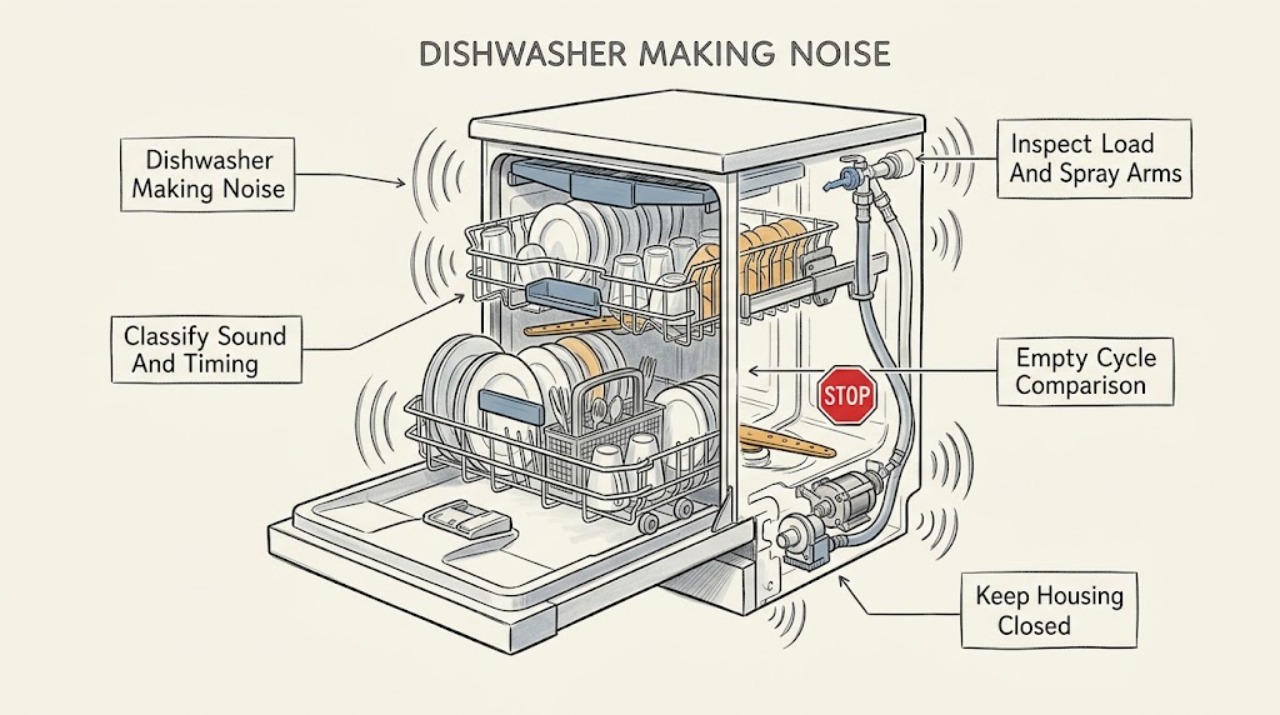
Work through in order
Diagnostic checks
Use only checks that match the exact appliance or system and its official guide.
-
Check 1
From a safe position, listen to one normal cycle without touching moving parts and record whether the sound is a brief click, clunk, hum, snap, continuous knock, rattle, or bang/boom, and whether it occurs during filling, washing, dispensing, draining, or door movement.
Expected result: Note whether the sound is brief and tied to the same cycle event, rhythmic or continuous, load-dependent, or accompanied by a change in filling, washing, draining, or other operation.
Next step: Use the sound pattern to choose the load-and-spray-arm check or the external hose/plumbing check; stop the appliance if the noise is harsh, escalating, or accompanied by a leak or other fault.
Stop if: Do not put hands into the tub, touch a moving spray arm, or open the door while moving parts are still in motion.
Why this matters
Why: A brief click, clunk, hum, or snap with normal operation can be a normal control, dispenser, or pump sound. A continuous knock or rattle, a bang or boom during filling, or any noise paired with abnormal operation needs the corresponding load, hose/plumbing, or service branch.
-
Check 2
After stopping the program and waiting for movement to cease, inspect the loaded racks from the front for dishes touching one another, a tall item projecting into the spray-arm path, or an item that could move during washing; rearrange only the accessible load so the spray arms have clear travel.
Expected result: Record whether the suspected contact is visible, whether the spray arms can rotate freely by the normal model-approved check, and whether the sound changes when the load is rearranged.
Next step: Run one short observation cycle only if the load is stable and the dishwasher has no leak or other abnormal behavior. If the noise remains or the sound returns with an empty load, stop and request authorized service.
Stop if: Do not force a spray arm, remove guards, reach below the filter while the machine is operating, or continue if glass, sharp fragments, or damaged dishes are present.
Why this matters
Why: A visible contact point or a sound that disappears after rearranging supports dish or spray-arm interference. No visible contact, a sound that remains, or a sound that occurs with an empty machine makes a motor, pump, or other appliance issue more likely.
-
Check 3
If the sound has returned on more than one load, run the dishwasher empty for a brief observation cycle using the normal controls and without adding detergent; stop it if the noise is severe or the appliance does not operate normally.
Expected result: Record whether the noise disappears when no dishes are present, occurs at the same cycle phase, or remains as a continuous or unusual sound with the tub empty.
Next step: If the empty run is quiet, reload with clearance around the spray arms. If the noise persists empty or the dishwasher is not operating normally, stop further tests and provide the recording and cycle timing to authorized service.
Stop if: Do not repeat empty runs indefinitely, run the machine with a suspected loose component, or dismantle the motor, pump, spray arm, or tub.
Why this matters
Why: A quiet empty run makes dish-to-dish or load-to-spray-arm contact more likely. A persistent sound on an empty run points away from the load and toward a motor, pump, valve, or other internal cause that cannot be selected safely from sound alone.
-
Check 4
When the sound is a bang or boom during filling or when the water valve closes, observe from outside whether an accessible hose at the back is visibly contacting the cabinet or wall; do not pull out a built-in dishwasher or loosen a water connection.
Expected result: Record whether the sound is synchronized with water entering or stopping, whether a hose visibly strikes the appliance, and whether walls or household pipes vibrate or show any sign of damage.
Next step: Keep the appliance in place and arrange a qualified plumber when the noise is loud, plumbing vibration persists, a hose cannot be safely viewed, or damage is suspected. Do not alter the water connection as a test.
Stop if: Stop for a leak, wet cabinetry, bulging or damaged hose, flooding, or any need to move the appliance or open a plumbing connection.
Why this matters
Why: Timing at valve closure with pipe vibration is consistent with a household water-hammer branch; a hose touching the cabinet can add impact noise. Severe noise or suspected wall or pipe damage requires plumbing assessment rather than an appliance part.
-
Check 5
Compare the noisy cycle with the dishwasher's normal behavior by noting whether it fills, sprays, drains, and completes the selected program, without opening panels or attempting an internal repair.
Expected result: Record normal completion, interrupted operation, standing water, a warning or code, leaking, poor cleaning, or a noise that is too loud or unusual even though the cycle completes.
Next step: Give the service agent the sound description, timing, load versus empty result, program behavior, model, and any code. Use a qualified plumber instead when the evidence points to water pipes or wall damage.
Stop if: Stop operating the dishwasher for smoke, burning odor, an active leak, exposed electrical parts, repeated tripping, or damage to the appliance or surrounding structure.
Why this matters
Why: A familiar short sound with normal operation may be part of the cycle. A noise paired with interrupted operation or any other fault, or a noise that remains too loud or unusual, is not established as normal from sound alone and needs authorized service.
Use your observations
Decision map
Find the observation that best matches what you see, then follow the next safe action.
-
PATH 01Next step
What you see
The dishwasher makes an occasional click, clunk, hum, or snap at a repeatable cycle event and otherwise fills, washes, drains, and completes normally.
Do this next
Monitor without dismantling the appliance. Request service if the sound becomes continuous, unusually loud, or is joined by abnormal operation.
Why this path and its safety boundary
Why it matters: Beko describes these sounds as possible normal operation from controls, the detergent dispenser, or the drain pump.
-
PATH 02Next step
What you see
A continuous knock or rattle changes with the load, and a dish or tall item is near another dish or the spray-arm path.
Do this next
Stop the program, wait for movement to cease, rearrange the load with clearance around moving parts, and observe one cycle. Stop and request service if the sound returns with an empty machine.
Why this path and its safety boundary
Why it matters: Dish-to-dish movement or spray-arm contact is more likely than a motor fault.
-
PATH 03Next step
What you see
The same rattle, knock, or unusual sound remains when the dishwasher is run empty, or it occurs on every cycle despite a correctly arranged load.
Do this next
Stop repeated testing and contact an authorized service agent with the sound recording and cycle timing.
Why this path and its safety boundary
Why it matters: The load is less likely to be the source; a motor, pump, valve, or another internal cause needs professional diagnosis.
-
PATH 04Next step
What you see
A bang or boom occurs as water enters or the dishwasher valve closes, with visible hose contact or vibration in household pipes.
Do this next
Arrange qualified plumbing assessment when the sound is loud, persistent, or associated with wall or pipe damage. Do not loosen the inlet connection as a test.
Why this path and its safety boundary
Why it matters: Beko identifies water hammer and hoses striking the appliance as possible causes; the issue may be in household plumbing rather than the dishwasher.
-
PATH 05Safety boundary
What you see
Any noise is accompanied by interrupted operation, a leak, poor draining, smoke, burning odor, repeated power trips, or another abnormal condition.
Do this next
Stop using the dishwasher, preserve the code and symptom record, and contact authorized appliance service; use a qualified plumber for a water-pipe leak or suspected plumbing damage.
Why this path and its safety boundary
Why it matters: The sound cannot be treated as a normal cycle noise when the appliance is not operating normally.
Safety stop: Do not continue cycles to reproduce a fault or open the appliance cabinet.
Helpful context
Understand the symptom
Sound timing matters more than loudness alone
Listen for the phase of the cycle: filling, washing, draining, detergent dispensing, or the moment the door is opened. Beko describes several short clicks, clunks, hums, and snaps as normal cycle sounds when the appliance is otherwise operating normally. A new, continuous, rhythmic, or unusually loud sound deserves a different path from an occasional sound that repeats at the same normal cycle event.
Separate a load contact from an appliance fault
Dishes can rattle against one another or be struck by a rotating spray arm when they are loaded too close to moving parts. Use the controls to stop the program and wait for movement to cease before opening the door. If the sound is linked to one load, rearrange items so the arms can rotate freely; if it returns on every cycle or remains with an empty dishwasher, the sound is less likely to be ordinary load contact and should be assessed by authorized service.
Treat pipe banging as a plumbing branch
A bang or boom as the dishwasher fills or its water valve closes may be water hammer in the household pipes. Beko also advises checking whether hoses at the back of the appliance are banging against it. Keep the check external and visible; if the noise is severe or appears to damage a wall or water pipe, stop troubleshooting the appliance and ask a qualified plumber to assess the plumbing.
Safety boundary
Stop conditions
- Do not reach into the tub, touch a moving spray arm, or open the door while moving parts are still in motion.
- Stop for smoke, burning odor, an active leak, wet electrical equipment, repeated power trips, damaged hoses, or suspected wall or pipe damage.
- Do not pull out a built-in dishwasher, loosen water connections, dismantle the pump or motor, or remove guards to chase a sound.
- Do not keep rerunning an empty or loaded cycle when the noise is severe, escalating, or paired with abnormal operation.
When checks do not resolve it
Need a professional?
Contact an authorized Beko service agent when the sound is too loud or unusual, continues with an empty dishwasher, returns every cycle after the load is rearranged, or occurs with interrupted operation, a leak, standing water, smoke, burning odor, or another fault. Contact a qualified plumber when a bang or boom appears to come from water hammer, hose impact, or damaged household pipes or walls.
Safety scope: This article covers listening and ordinary external load or hose observations only. Do not reach into moving parts, open panels, alter water connections, or attempt motor, pump, valve, or electrical repair.
Common questions
FAQ
Is clicking from a Beko dishwasher normal?
It can be. Beko says clicking may come from the electronic control panel or timer during a cycle. If the click is rhythmic, the appliance is not operating normally, or the sound is new and unusually loud, stop the cycle and arrange authorized service rather than assuming it is normal.
Why is my Beko dishwasher making a knocking noise?
A continuous knock can be a spray arm hitting a dish. Stop the program, wait for movement to cease, and rearrange items so the arms can rotate freely. If the sound occurs every cycle, compare an empty run; persistent noise needs authorized service.
Why does my Beko dishwasher rattle?
Dishes may be moving against one another. Stop the appliance and rearrange the load if items could be damaged. If the sound remains on an empty run, Beko says it may involve the motor and should be assessed by an authorized service agent.
What causes a bang or boom when my Beko dishwasher fills?
Beko identifies water hammer in household pipes and hoses striking the appliance as possible causes. Observe the timing and any visible hose contact without moving the machine. Use a qualified plumber if the noise is severe or you suspect damage to walls or water pipes.
Should I replace a dishwasher part because it is noisy?
Not from sound alone. First classify the sound, compare the loaded and empty results, and note whether the dishwasher operates normally. A persistent or unusual sound needs model-specific diagnosis before a pump, motor, spray arm, or other part is selected.
Read the exact guide
Official sources
- My dishwasher is making a clunking noise. Is this normal?Beko · Beko U.S. dishwasher troubleshooting FAQ; exact model instructions and local authorized service guidance control where they differ.
Community feedback
Share a repair observation
Share a plain-text repair observation. Accepted observations are published automatically; this page may take a moment to update.