
On this page
Start here
Quick answer
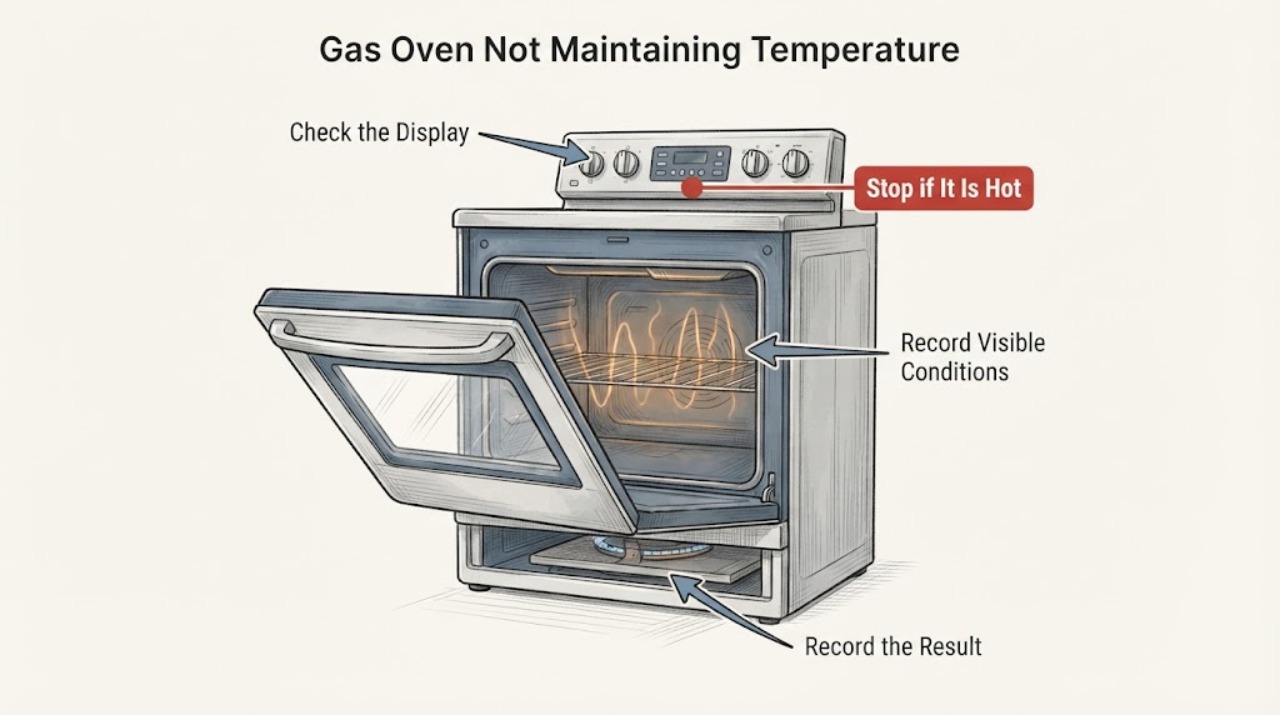
A Viking gas oven that cannot hold its set temperature needs the exact model, selected function, preheat behavior, and temperature pattern separated before any part is considered. With the oven cool and no gas smell or electrical hazard, confirm the model-matched Bake or Convection Bake setting, allow the documented preheat, keep the door closed, and record whether the oven is consistently too hot or too cool or is swinging widely. A steady offset may need model-specific adjustment or service; a failed ignition, abnormal flame, gas odour, smoke, or uncontrolled heat is a stop condition. Do not open the range, adjust gas hardware, bypass a control, or order a sensor or burner from the symptom alone.
Work through in order
Diagnostic checks
Use only checks that match the exact appliance or system and its official guide.
-
Check 1
With the oven off and cool, record the exact Viking model and serial information, whether the appliance is a gas range or a gas wall oven, the gas type if known, the oven cavity, selected function, set temperature, and the symptom pattern. Note whether the food is always undercooked or overbrowned, whether the problem follows one mode, whether recovery after opening the door is slow, and whether any display message, gas smell, smoke, or unusual flame has appeared. Do not remove panels or approach the appliance if there is a gas or electrical hazard.
Expected result: The model and function are clear and the problem is a repeatable temperature offset or swing; the model or mode is uncertain; or the complaint is accompanied by gas odour, smoke, sparking, a damaged cord, an abnormal flame, or uncontrolled heat.
Next step: Continue only with a clear identity and no hazard. Use the matching Viking manual for the next setting check. For an uncertain identity, arrange model-specific support rather than guessing. For a hazard, leave the appliance off and use qualified or emergency help from a safe location.
Stop if: Do not return to the oven for a label or test if gas smell, smoke, abnormal heat, arcing, or an alarm remains.
Why this matters
Why: The exact Viking documentation determines the control sequence and acceptable operating behavior. A repeatable temperature pattern can be evaluated as an operating or service issue, while a hazard is outside a normal temperature check.
-
Check 2
For a cool, safe oven, compare the selected control position with the exact model manual. Confirm that Bake is selected for conventional baking or that Convection Bake is selected intentionally, set the requested temperature, place the rack as the manual recommends, and close the door. Allow the oven to complete its normal preheat before judging the result; avoid repeated door opening and do not place food in the oven early just to test it.
Expected result: The oven reaches a normal preheat after the correct mode is selected; the symptom occurs only in one mode or rack arrangement; or the oven still behaves incorrectly after the model-matched mode and preheat procedure are followed.
Next step: If the result changes when the mode, rack, or preheat procedure is corrected, use that documented setup. If the symptom persists across the correct procedure, record the pattern and continue to the safe temperature comparison; do not open the cabinet.
Stop if: Stop if the oven will not ignite, a flame is large, distorted, or yellow, gas is smelled, or smoke, sparks, or uncontrolled heating appears.
Why this matters
Why: Viking documents different heat and airflow behavior for Natural Airflow Bake and Convection Bake, and its baking guidance identifies mode, rack position, door opening, and preheat as factors in results. A fault that remains after those controls are correct is less likely to be a simple mode or preheat mistake.
-
Check 3
Only when the oven is operating normally and you already have a suitable oven thermometer, use it according to its own instructions to record the cavity temperature over one supervised preheat and bake cycle. Keep the thermometer on the rack, do not touch burners, probe wiring, or remove panels, and record whether the reading settles near the setting or repeatedly overshoots and undershoots. If you do not have a suitable thermometer, use the repeatable food or recovery pattern as the observation instead of improvising a measurement.
Expected result: The reading is consistently above or below the setpoint; it swings widely; it is reasonable after a complete preheat; or the oven cannot complete the cycle normally.
Next step: Save the model, mode, setpoint, thermometer reading, elapsed preheat, and door-opening history. Check the exact manual for any supported adjustment; otherwise send this record to Viking support or a qualified appliance servicer.
Stop if: Do not calibrate from a generic value, bypass a control, adjust a gas valve or air shutter, or continue testing after gas odour, abnormal flame, smoke, arcing, or uncontrolled heat.
Why this matters
Why: A stable offset points toward model-specific adjustment or service, while a wide swing, failure to recover, or a failed cycle points toward a control, sensing, ignition, burner, or related fault that cannot be identified from the symptom alone. A normal reading with uneven food keeps rack, pan, mode, and recipe factors in consideration.
-
Check 4
Prepare the service handoff without opening the appliance: provide the exact model and serial information, purchase or installation details if available, cavity and selected mode, setpoint, measured or observed temperature pattern, preheat result, and any ignition or flame behavior. Tell the servicer whether the issue is a steady offset, a wide swing, no heat, slow recovery, or mode-specific.
Expected result: The symptom persists after correct mode and preheat checks, returns across more than one supervised cycle, prevents normal baking, or requires inspection of the burner, igniter, sensor, valve, wiring, or controls.
Next step: Use Viking's customer support or authorized-servicer route with the recorded evidence and the exact model documentation. Keep the oven off when the fault is persistent or any unsafe sign is present.
Stop if: Do not remove covers, make live measurements, relight repeatedly, adjust gas hardware, bypass a safety device, or order a temperature sensor, burner, igniter, valve, or control board based only on the complaint.
Why this matters
Why: Viking's manual treats internal adjustments and repair as qualified service work and asks for model and serial information plus a clear problem description. The symptom alone does not establish a compatible replacement part.
Use your observations
Decision map
Find the observation that best matches what you see, then follow the next safe action.
-
PATH 01Next step
What you see
The correct model-matched Bake or Convection Bake function, rack position, closed door, and full preheat produce a stable but repeatable temperature offset without gas smell, abnormal flame, smoke, or electrical symptoms.
Do this next
Check the exact Viking manual for a supported temperature-adjustment procedure; if none applies or the offset remains, arrange qualified service with the recorded readings and model information.
Why this path and its safety boundary
Why it matters: The basic operating setup is now controlled, so a persistent offset is less likely to be explained by selecting the wrong function or judging before preheat. The exact model may support a specific adjustment, but a generic calibration value is not safe to assume.
-
PATH 02Next step
What you see
The oven reaches preheat but then swings widely, fails to recover, behaves differently between modes, or cannot maintain temperature over a supervised cycle after the mode and door checks are correct.
Do this next
Keep the evidence log and contact Viking support or a qualified appliance servicer for model-specific diagnosis. Do not continue repeated cycles to force a diagnosis.
Why this path and its safety boundary
Why it matters: The pattern is more consistent with a temperature-control, sensing, ignition, burner, airflow, or related service issue than with a single recipe or rack choice. The visible symptom does not identify which component has failed.
-
PATH 03Next step
What you see
The temperature complaint is accompanied by a gas smell, failed or delayed ignition, a large, distorted, or yellow flame, smoke, sparks, arcing, a hot connection, or uncontrolled heating.
Do this next
Stop using the oven. Leave the area if gas odour is strong or persistent, avoid operating switches or appliance controls near the odour, and contact the local gas utility or emergency service from a safe location. Arrange qualified appliance service before reuse.
Why this path and its safety boundary
Why it matters: This has crossed from ordinary temperature troubleshooting into a possible gas, combustion, fire, burn, or electrical hazard. A reset, calibration attempt, or replacement part cannot make that condition safe.
-
PATH 04Next step
What you see
The temperature reading is reasonable after a complete preheat, but food is uneven or the complaint appears only with one pan, rack, recipe, or convection choice.
Do this next
Repeat the exact model-matched recipe and rack setup once, with the documented preheat and a closed door. If the symptom then appears across different foods and setups, use the service branch rather than changing parts.
Why this path and its safety boundary
Why it matters: The oven may be operating within the chosen mode while cookware, rack placement, door opening, or the recipe is changing the cooking result. Viking's manual gives separate conventional and convection guidance and cautions against frequent door opening.
Helpful context
Understand the symptom
Start by separating setup from a true temperature fault
Temperature complaints can mean a consistent offset, slow recovery after the door is opened, uneven food caused by rack or mode selection, or a burner/control problem. Viking's opened gas-range manual uses separate Natural Airflow Bake and Convection Bake procedures and gives different rack and airflow guidance. The exact model manual controls the details, so record the model before applying any model-specific setting or calibration instruction.
Do not turn temperature troubleshooting into gas or electrical repair
The user checks below stay outside the cabinet and stop at visible or documented operating behavior. Viking's manual says that repairs, adjustments, gas conversions, and other servicing belong to a qualified servicer unless a specific user instruction applies. A gas smell, abnormal flame, smoke, sparking, or uncontrolled heating overrides ordinary temperature testing.
When checks do not resolve it
Need a professional?
Arrange Viking or qualified appliance service when a Viking gas oven still fails to maintain temperature after the exact model-matched mode, rack, closed-door, and preheat checks, when the temperature is consistently offset or swings widely, or when the oven needs inspection of a sensor, thermostat, igniter, bake burner, valve, wiring, or control. Provide the exact model and serial information, mode, setpoint, preheat result, measured or observed pattern, and any ignition behavior. Do not select a replacement part from the symptom alone. Stop immediately for gas odour, delayed ignition, a large or yellow flame, smoke, sparks, arcing, hot wiring, or uncontrolled heat.
Common questions
FAQ
Why does my Viking gas oven temperature swing while baking?
First control the variables: identify the model, select the model-matched Bake or Convection Bake function, allow full preheat, use the recommended rack, and keep the door closed. If a supervised temperature record still shows a wide swing or failure to recover, arrange model-specific service; the symptom does not identify one failed part.
Could the wrong Viking oven mode make the temperature seem wrong?
Yes. Viking's opened gas-range manual describes separate Natural Airflow Bake and Convection Bake functions with different airflow and rack guidance. Confirm the mode in the exact manual and allow preheat before deciding that the temperature control has failed.
Should I calibrate or replace the Viking oven sensor myself?
Do not use a generic calibration value or replace a sensor, thermostat, burner, igniter, valve, or control board from the symptom alone. Check the exact model manual for a documented user adjustment; otherwise give the model, serial information, and temperature pattern to a qualified servicer.
When should I stop using the Viking gas oven?
Stop for gas odour, delayed or failed ignition, a large, distorted, or yellow flame, smoke, sparks, arcing, a hot connection, or uncontrolled heating. Leave the area for a strong or persistent gas smell and contact the local gas utility or emergency service from safety; arrange qualified appliance service before reuse.
Read the exact guide
Official sources
- 3 Series Freestanding 30” Gas Self-Clean Sealed Burner Range Use & CareViking Range, LLC · Opened from Viking's official product documentation page for the RVGR3302 3 Series gas range. The assigned topic has no model, so control details are examples from this official Viking gas-range manual and the exact model manual remains controlling.
- Viking Range, LLC | Support and Docs | Support CenterViking Range, LLC · Official Viking support route used for persistent or model-specific temperature faults and qualified service handoff; it does not authorize user cabinet repair or identify a replacement part.
Community feedback
Share a repair observation
Share a plain-text repair observation. Accepted observations are published automatically; this page may take a moment to update.