
On this page
Start here
Quick answer
First classify what is escaping. Clear water, grease, cleaner residue, or a short-lived burst of cooking steam can follow a spill or the oven vent. A rotten-egg gas odor, hissing, an unusual flame, a carbon-monoxide alarm, or smoke is an emergency: if it is safe to do so, turn the oven controls fully off, leave the area, avoid flames and electrical switches, and contact the gas supplier or emergency service from a safe location. Do not search for the leak, test fittings, or remove gas parts. If the fluid is ordinary liquid and there is no gas warning, turn the oven off, let it cool, and inspect only visible door, gasket, vent, and spill paths; recurring liquid, liquid near controls, or any uncertain source needs a qualified Viking gas-appliance technician.
Work through in order
Diagnostic checks
Use only checks that match the exact appliance or system and its official guide.
-
Check 1
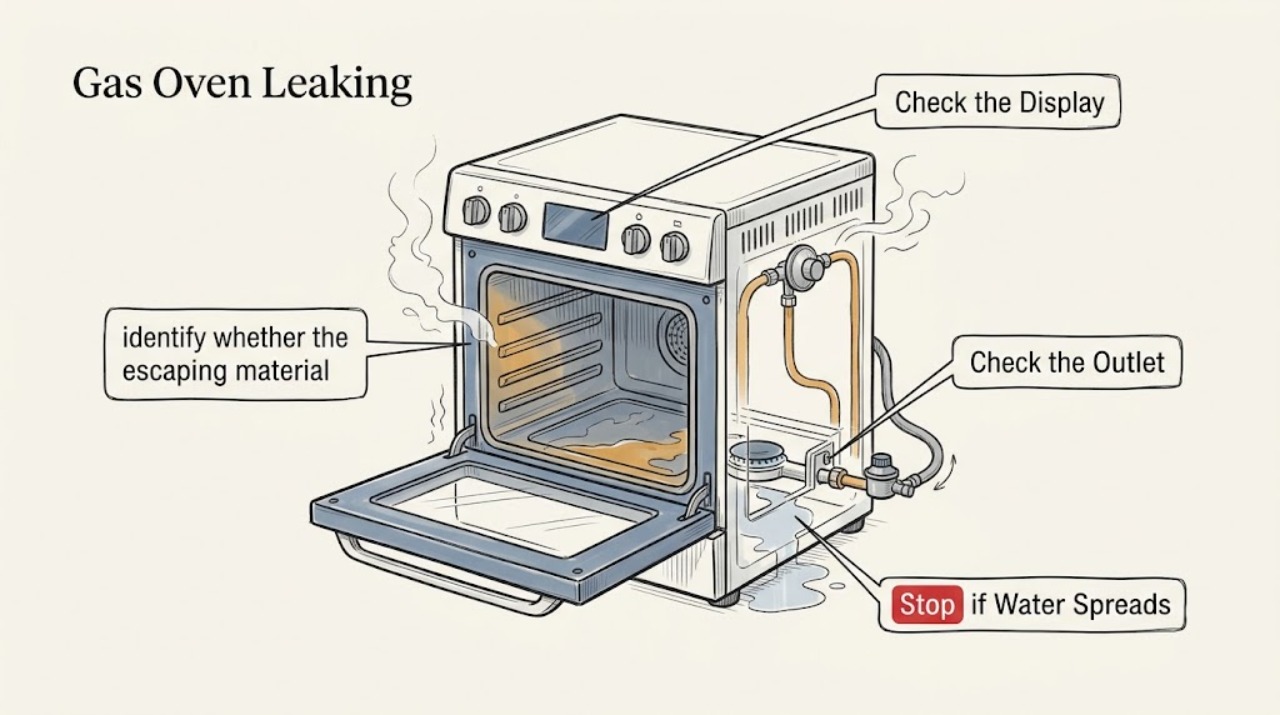
From a safe distance, identify whether the escaping material is clear liquid, greasy or cleaner-like residue, visible vapor, or a fuel odor; note any hissing, unusual flame, alarm, or smoke without leaning into the oven.
Expected result: Liquid or brief steam without a fuel odor points toward a spill or vent path. A rotten-egg odor, hissing, abnormal flame, carbon-monoxide alarm, or smoke is a hazard signal.
Next step: For any gas, alarm, smoke, or uncertain hazard signal, follow the gas-emergency branch. For ordinary liquid or steam, continue only after the appliance is off and cool.
Why this matters
Why: The material determines whether a cool-down and visible inspection is reasonable or whether the room must be left immediately.
-
Check 2
If fuel odor, hissing, an abnormal flame, or a carbon-monoxide alarm is present, turn the oven controls fully off only if you can do so without approaching the suspected source; otherwise leave at once.
Expected result: The odor or sound continues, an alarm remains active, or anyone has headache, dizziness, weakness, nausea, confusion, or breathing trouble.
Next step: Leave people and animals outside the affected area, do not operate switches or use a flame, and contact the gas supplier or emergency service from well away from the appliance. Do not return until the area is cleared.
Why this matters
Why: Fuel or combustion risk cannot be safely diagnosed from the kitchen, and carbon monoxide has no reliable odor.
-
Check 3
After an ordinary liquid event and a complete cool-down, trace only the visible wet path: door edge, lower front, cavity floor, vent outlet, side trim, or the floor below; do not tilt the oven or remove panels.
Expected result: A mark begins at an overfilled dish or the door edge; it begins at the vent after cooking; or it appears under the appliance with no visible spill path.
Next step: Wipe only cool external surfaces with a suitable damp cloth. If the path reaches controls, wiring, the outlet, or the floor below, stop using the oven and use the liquid-near-electricity branch.
Why this matters
Why: A contained spill may be external cleanup, steam may be a normal cooking by-product, while liquid emerging from below or an unexplained path needs service assessment.
-
Check 4
With the oven cool, look at the door alignment, visible gasket, hinges, and the area where a tray or dish meets the door; check for a displaced seal, a bent door, food blocking closure, or a spill that can run forward.
Expected result: The door closes evenly and the gasket looks seated, or the seal, glass, hinge, or alignment is visibly damaged or the door does not close normally.
Next step: Remove only a cool, loose obstruction. Do not pull out the gasket, force the door, or use the oven with damaged glass or a door that will not close; arrange qualified service.
Why this matters
Why: A sound door and small spill support a cleanup explanation; a damaged seal or door can let heat and vapor escape and is not an owner repair target on a hot gas appliance.
-
Check 5
For steam or condensation, note when it appears, whether it stops after cooking and cooling, whether it is a light film or pooling water, and whether it returns during a dry preheat; keep hands clear of hot vapor.
Expected result: A brief amount follows moist food or cooling and leaves no pool, or moisture persists, drips into trim, damages cabinetry, or returns during a dry cycle.
Next step: Do not block the vent. Stop using the oven and request service if moisture persists, reaches controls, or causes cabinet damage; do not run repeated tests to reproduce it.
Why this matters
Why: Short-lived steam can follow cooking and the vent path, while persistent pooling or moisture in an unexpected place indicates a door, vent, installation, or service issue.
-
Check 6
If liquid is near the control panel, power cord, outlet, or any other electrical connection, keep clear of the wet area and isolate power only from a dry, safe position; do not touch wet equipment.
Expected result: There is no moisture near electrical equipment and no smoke, spark, hot plug, burning odor, or breaker trip, or one of those electrical warning signs is present.
Next step: For smoke, sparks, a hot connection, burning odor, or a trip, stop and obtain qualified electrical or appliance service. Do not restore power repeatedly or open the appliance.
Why this matters
Why: Dry visible surfaces do not prove that hidden wiring is safe. Electrical warning signs require the appliance to remain out of service.
-
Check 7
Write down the model, gas type, location and color of the material, cooking mode, whether a burner was operating, timing, odor or sound, door condition, and any prior cleaning or spill before contacting service.
Expected result: The event is repeatable only in one mode or location, follows a spill, or has no safe visible explanation.
Next step: Keep the oven out of service when the cause is uncertain and provide the recorded details to a qualified Viking gas-appliance technician.
Why this matters
Why: A precise history helps a technician choose the model manual and distinguish a spill path from a gas, vent, door, or electrical fault without unsafe owner testing.
Use your observations
Decision map
Find the observation that best matches what you see, then follow the next safe action.
-
PATH 01Next step
What you see
Fuel odor, hissing, abnormal flame, or suspected gas release
Do this next
If safe, turn controls fully off, leave the area, avoid flames and electrical switches, and contact the gas supplier or emergency service from outside or another safe location. Do not search for the source or test connections.
-
PATH 02Next step
What you see
Carbon-monoxide alarm or compatible symptoms
Do this next
Leave immediately for fresh air and seek emergency help from a safe location. Do not re-enter to reset the alarm or continue cooking; have the gas appliance and venting assessed by qualified personnel.
-
PATH 03Next step
What you see
Clear or greasy liquid starts at the door or cavity after a spill
Do this next
Turn the oven off, allow a complete cool-down, wipe only visible external surfaces, and arrange service if the door, gasket, glass, or alignment is damaged or the liquid returns.
-
PATH 04Next step
What you see
Brief steam or light condensation follows moist cooking
Do this next
Keep the vent clear and monitor only after the oven is cool. Persistent pooling, cabinet damage, or moisture during a dry cycle requires service.
-
PATH 05Next step
What you see
Liquid reaches controls, wiring, outlet, or the floor below
Do this next
Stop use, keep away from wet equipment, and isolate power only from a dry safe position. Obtain qualified appliance or electrical service; do not tilt or open the unit.
-
PATH 06Next step
What you see
The material, source, or fuel behavior is uncertain
Do this next
Leave the appliance off and request assessment by a qualified Viking gas-appliance technician. Treat a new odor, sound, flame change, smoke, or alarm as the gas-emergency branch.
Helpful context
Understand the symptom
What a leak may mean
A gas oven can appear to leak several different materials. Cooking liquid or grease may run toward the door or the lower edge after a spill. Steam can leave through the designed vent while food cooks or while the oven cools. A gas leak is different: odorized fuel may smell like rotten eggs, and a hissing sound or abnormal flame raises the risk even when no liquid is visible. Treat the last group as a gas emergency rather than as a cleaning problem.
Use the model manual for fit and operation
Viking publishes model-specific use, care, and installation documentation. Record the model and fuel type before asking for help; a gas range, a dual-fuel unit, and a gas wall oven can have different access panels, vents, and shutoff arrangements. Do not remove a door gasket, open a gas connection, or alter a burner or regulator merely to locate moisture.
Safety boundary
Stop conditions
- Stop immediately and leave the area for a rotten-egg gas odor, hissing, an abnormal flame, a carbon-monoxide alarm, smoke, or symptoms consistent with carbon-monoxide exposure.
- Do not operate flames, electrical switches, or other ignition sources while gas may be present, and do not search for or test a suspected gas leak.
- Do not use the oven with damaged glass, a door that will not close, a displaced gasket, liquid near electrical equipment, a hot connection, sparks, a burning odor, or repeated breaker trips.
- Do not remove gas connections, burner parts, regulators, panels, or door hardware to locate the source.
Only after diagnosis
Potential parts
- oven door gasket or seal
Consider this category only if the exact model documentation or a technician confirms a damaged or displaced door seal after the leak is classified as vapor or liquid rather than fuel.
Confirm the exact Viking model and manufacturer fit information before any part decision; do not remove a seal from a hot oven. - gas valve, connector, or regulator
This category is relevant only when qualified service confirms a fuel-path fault. It is not an owner diagnostic or replacement step.
A qualified gasfitter must identify the fuel type, model, and approved component; do not open or test the gas path. - burner ignition or control component
Consider only after a technician links abnormal flame, ignition behavior, or control operation to the exact model and confirms that the appliance is safe to service.
Confirm model-specific fit and approved service procedure; do not test exposed gas or live electrical parts.
When checks do not resolve it
Need a professional?
Call a qualified Viking gas-appliance technician when the source is not a simple cool external spill, when liquid returns, when the door or gasket is damaged, when moisture reaches controls or cabinetry, or whenever gas operation, venting, combustion, or electrical safety is uncertain.
Common questions
FAQ
Is water under a Viking gas oven always a gas leak?
No. A spill, condensation, or a vent-related path can produce liquid or vapor. Treat any fuel odor, hissing, abnormal flame, smoke, or carbon-monoxide alarm as an emergency and do not try to identify the source yourself.
Can I use a soap solution to find the leaking connection?
No. Leave gas-path inspection and testing to a qualified gasfitter. If fuel odor or hissing is present, leave the area, avoid ignition sources and electrical switches, and obtain help from a safe location.
When is steam from a gas oven normal?
A brief amount can follow moist food or cooling and may leave through the designed vent. Persistent pooling, drips into trim or controls, cabinet damage, or moisture during dry preheat is not a reason to keep testing; stop use and request service.
What should I record for a Viking service visit?
Record the exact model and fuel type, where the material appeared, its appearance and odor, the cooking mode and stage, door and gasket condition, and any alarm, hissing, flame change, spill, or prior cleaning. Do this only from a cool safe position.
Read the exact guide
Official sources
- Using natural gas and LPG safelyQueensland Government · Household natural-gas and LPG safety, suspected leak response, ignition avoidance, and evacuation
- Recognizing and Responding to Pipeline EmergenciesU.S. Department of Transportation, Pipeline and Hazardous Materials Safety Administration · Natural-gas emergency recognition and safe response in a home or workplace
- Carbon Monoxide Poisoning BasicsCenters for Disease Control and Prevention · Carbon-monoxide hazards, symptoms, detection, and safe servicing of fuel-burning appliances
- Viking Range, LLC | Support and Docs | DocumentationViking Range, LLC · Viking cooking appliances, including model-specific use, care, and installation documentation
- Professional Freestanding Gas Open Burner RangesViking Range, LLC · Viking professional freestanding gas range operation and safety guidance
Community feedback
Share a repair observation
Share a plain-text repair observation. Accepted observations are published automatically; this page may take a moment to update.