
On this page
Start here
Quick answer
Treat a gas-oven leak as a safety triage problem, not a part-replacement problem. If you smell gas, hear hissing, see an abnormal flame, or suspect unburned gas, leave immediately without operating switches, flames, or a phone inside; contact the gas utility or emergency services from a safe location. Do not move the range, search for the leak, relight anything, or remove panels. If there is no gas warning, keep the oven off and cool, then distinguish a cooking spill or grease from water, cleaner, steam, heat escaping around the door, or a drip from behind the appliance. Observe only from a safe, dry position. Liquid near electrical parts, smoke, scorching, a damaged door seal, persistent steam, or any uncertain source requires qualified appliance service. Gas appliances also create carbon-monoxide risk, so leave and seek help for symptoms or an alarm.
Before you begin
Safety first
- Do not move the range, look for a gas leak, relight or manually ignite anything, operate switches in a suspect gas area, add water to grease, remove panels or the door, touch wet electrical parts, or bypass a safety interlock. Evacuate for gas odor, combustion danger, carbon-monoxide symptoms or alarm, fire, smoke, or uncontrolled heat.
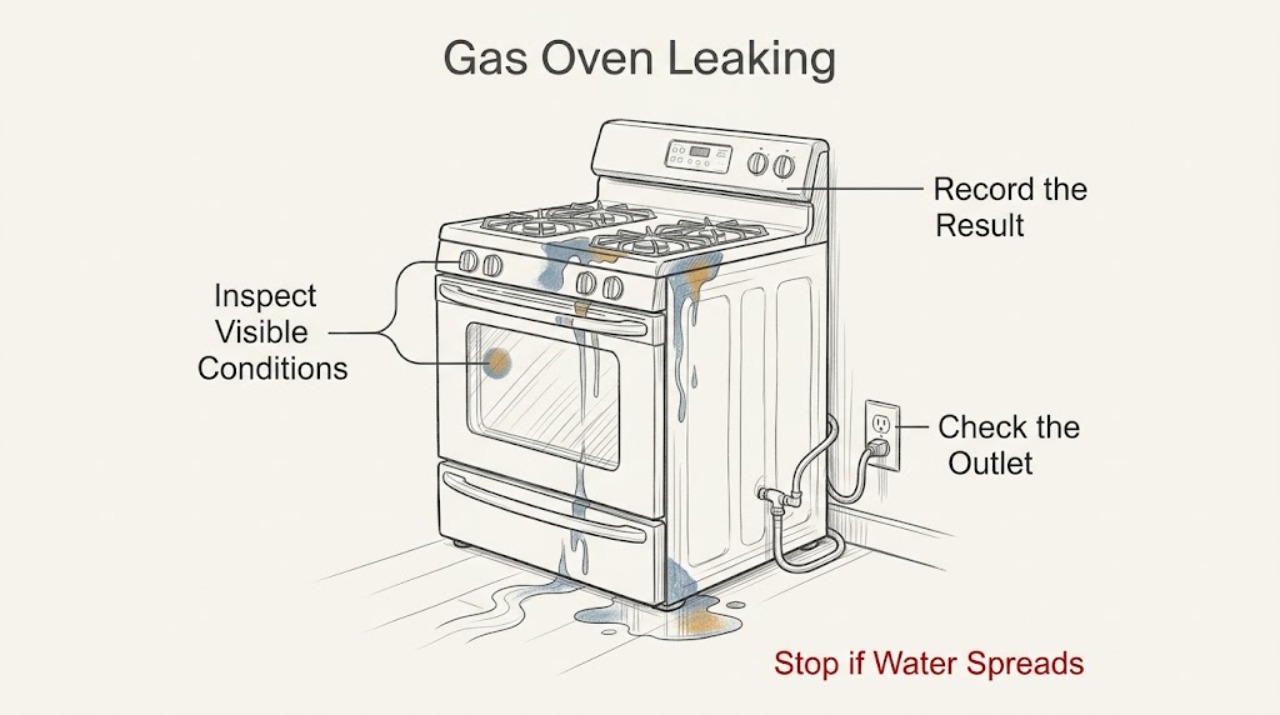
Work through in order
Diagnostic checks
Use only checks that match the exact appliance or system and its official guide.
-
Check 1
Stop cooking and observe from a safe position for a rotten-egg or gas-like odor, hissing or whistling, an abnormal or unlit flame, smoke, visible fire, a hot connection, or carbon-monoxide symptoms or alarm. Do not make another ignition attempt while any warning sign is present.
Expected result: There is no warning sign, or there is gas odor, hissing, an abnormal flame, smoke, fire, unusual heat, a carbon-monoxide concern, or an alarm.
Next step: For any warning sign, leave the area and warn others only if that can be done without entering the hazard. From a safe location, contact the gas utility, emergency services, or the fire service. If no warning sign is present, keep the oven off and continue only with dry external observations.
Stop if: Stop immediately for gas odor, hissing, abnormal flame, smoke, fire, a carbon-monoxide concern, or a hot or arcing connection; do not restart to reproduce it.
Why this matters
Why: The second result indicates a gas, combustion, fire, or electrical emergency rather than a routine liquid or seal issue.
-
Check 2
If gas is not suspected, turn the oven controls off and allow the appliance and any spill to cool. From a dry position, identify whether the material is food or grease in the cavity, clear water or cleaner, condensation, or an unknown liquid; do not touch liquid near wiring, an outlet, a control, or another electrical appliance.
Expected result: The material is a contained cool cooking spill, a small amount of moisture with no electrical contact, water or cleaner outside the oven, grease that is smoking or burning, or an unknown liquid near electrical parts.
Next step: After the oven is fully cool, follow only the model manual for safe cleaning of a contained spill. Keep the oven off and arrange service for an outside drip, an unknown source, liquid near electrical parts, or any continuing leak. Never add water to burning grease; leave and seek emergency help for an uncontrolled fire.
Stop if: Stop for active grease fire, smoke, hot liquid, liquid entering electrical areas, an inability to isolate water safely, or any shock risk; do not reach into the oven or wet area.
Why this matters
Why: A contained cool spill may be a cleaning issue governed by the exact manual. Smoke, burning grease, unknown liquid, or liquid near electricity is a fire, contamination, or shock hazard.
-
Check 3
With the oven cold and untouched internally, observe the floor, cabinet edges, and the visible front and side areas for the first wet point and when it appears: only during cooking, after cleaning, after cooling, or while the oven is idle. Do not pull or rotate a gas range to see behind it.
Expected result: The wetness begins inside after a spill, appears at the front of the door, comes from below or behind, follows cleaning or condensation, or its source cannot be identified.
Next step: Document the location and timing from a safe distance, keep the oven off, and have a qualified appliance professional identify an under-appliance or rear leak. If the source is unknown or any gas sign appears, use the gas-emergency branch and do not continue observing.
Stop if: Stop for gas odor, hissing, a liquid reaching electrical parts, a wet floor that could cause a slip, or any need to move the range or open a wall or cabinet.
Why this matters
Why: Timing and the first visible point help separate a contained spill or door-area moisture from a supply, plumbing, installation, or internal-appliance fault, but they do not prove a gas leak or make moving the appliance safe.
-
Check 4
During a later safe observation only if there was no gas, fire, smoke, or electrical warning, note whether the reported escape is steam or heat around the door or vent, a visible liquid trail, or smoke and scorching. Keep the door closed if it is hot, and do not force a latch, remove the door, or wet the gasket.
Expected result: Only a small amount of model-dependent steam or warmth is seen with no scorching, or there is persistent steam, a visible liquid trail, smoke, scorching, flame, or a door that does not close normally.
Next step: Compare the observation with the exact Use and Care Guide without operating an unsafe oven. Keep the oven off and request qualified service for a damaged or displaced seal, poor door closure, persistent escape, scorching, smoke, or any uncertainty. Do not attempt to realign the door or replace a gasket by guesswork.
Stop if: Stop for smoke, scorching, flame, uncontrolled heat, a hot or jammed door, broken glass, or any need to force the latch or door.
Why this matters
Why: A limited warm or steamy area may be part of normal cooking airflow on some models, while persistent escape, scorching, smoke, flame, liquid, or a failed door seal or latch indicates a condition needing model-specific service.
-
Check 5
From outside the suspected area, record whether the odor or sound is present while the oven is off, only during ignition, only while a burner is running, or after shutdown. Do not relight the oven, manually light a burner, operate a switch in the suspect area, or perform any leak-finding procedure.
Expected result: The odor or hiss occurs while off, appears during attempted ignition, is absent when the appliance is isolated, or cannot be reliably characterized.
Next step: Leave the oven off. For any suspected gas pattern, evacuate and contact gas or emergency professionals from safety. A qualified professional must inspect the connector, shutoff, valve, burner, and ignition system; do not move the appliance to expose them.
Stop if: Stop for any gas odor, hissing, delayed ignition, boom, abnormal flame, or uncertainty about whether gas is present; do not repeat the ignition sequence.
Why this matters
Why: Gas present while off, failed ignition, or an uncertain gas pattern must be treated as a possible gas leak or combustion fault; an appliance that seems quiet does not prove that the connector or valve is safe.
-
Check 6
If there is no gas or fire warning, note whether the reported moisture is near the oven cavity, door edge, floor, wall, cabinet, or an adjacent sink or appliance. Look only from a dry, stable position and do not touch pooled liquid, exposed conductors, a connector, or a wet control.
Expected result: The moisture is limited to a cool cavity spill, tracks from the door edge, appears under or behind the oven, comes from a nearby source, or is close to electrical equipment.
Next step: Keep the appliance off and arrange appliance service for an internal, door, under-appliance, or rear leak; involve a plumber for a confirmed adjacent water source. Isolate water only when the shutoff is safely accessible and dry. If electricity may be wet, stay clear and arrange qualified electrical help.
Stop if: Stop for water near a live-looking electrical part, standing water, a wet or unstable floor, a source that cannot be isolated safely, or any gas sign.
Why this matters
Why: The location changes the likely service path, but a rear or under-appliance liquid can coexist with a gas or electrical hazard and cannot be diagnosed safely by pulling the oven forward.
-
Check 7
Prepare a service record without reopening the hazard: exact model and fuel type, where the first wet point or odor was observed, when it occurs, whether the oven was on or off, any display message, door or seal condition, and any smoke, flame, hissing, alarm, or breaker event. Keep the oven unused until the responsible professional has assessed it.
Expected result: The source is clearly a cool contained spill with no damage, or the leak, odor, door, combustion, or electrical symptom persists or is uncertain.
Next step: Request qualified appliance service for a persistent, recurring, or unexplained leak; request gas or emergency help for suspected gas or combustion danger and electrical help for wet or repeatedly tripping electrical equipment. Follow the exact model manual only after the appliance is declared safe.
Stop if: Stop and leave for suspected gas, carbon-monoxide symptoms or alarm, smoke, flame, electrical arcing, burning odor, severe heat, or an unsafe wet area.
Why this matters
Why: A complete record helps the technician choose the correct manual and service path. Persistent or uncertain leakage cannot be cleared by a visual guess or a single restart.
Use your observations
Decision map
Find the observation that best matches what you see, then follow the next safe action.
-
PATH 01Next step
What you see
Gas odor, hissing or whistling, an unlit or abnormal flame, or suspected unburned gas is present.
Do this next
Leave immediately, warn others only without entering the hazard, and contact the gas utility or emergency professionals from outside or another safe location. Do not operate switches, flames, engines, or a phone inside the suspect area, and do not move the oven.
Why this path and its safety boundary
Why it matters: Treat this as a possible gas emergency, not as a door-seal or liquid diagnosis.
-
PATH 02Next step
What you see
Smoke, visible flame, scorching, burning grease, an electrical arc, or rapidly increasing heat is present.
Do this next
Stop using the appliance, leave if the situation is not immediately controllable without risk, and contact emergency services from a safe location. Do not use water on a grease fire or reach into a hot oven.
Why this path and its safety boundary
Why it matters: This is a fire or electrical emergency; adding water to grease or continuing to operate the oven can worsen it.
-
PATH 03Next step
What you see
A cool, contained cooking spill is visible inside the cavity and there is no odor, smoke, flame, or electrical concern.
Do this next
Keep the oven off until cool, then follow the exact model guide for cleaning. If liquid returns without a spill or reaches the door, floor, controls, or wiring, stop and arrange service.
Why this path and its safety boundary
Why it matters: The report may be a spill rather than a leak from the gas or appliance system, but the exact model cleaning instructions still control.
-
PATH 04Next step
What you see
Water or cleaner is under or behind the oven, near an electrical area, or the first wet point is not identifiable.
Do this next
Keep the oven off, stay out of standing water, isolate a nearby water source only if the control is safely accessible and dry, and arrange appliance, plumbing, or electrical service as indicated. Do not pull the gas range forward.
Why this path and its safety boundary
Why it matters: The source may be an appliance, plumbing, or installation problem, and wet electrical parts add shock and fire risk.
-
PATH 05Next step
What you see
Only model-dependent warmth or steam is seen around the door or vent, with no liquid trail, scorching, smoke, flame, odor, or door failure.
Do this next
Use the exact model manual to compare the observation. If steam persists when the oven is off, becomes forceful, damages nearby materials, or is accompanied by a door or seal problem, keep the oven off and request service.
Why this path and its safety boundary
Why it matters: A limited warm or steamy area can be a normal operating characteristic on some models, but this cannot be generalized across gas ovens.
-
PATH 06Next step
What you see
The door will not close normally, the gasket is visibly damaged or displaced, or moisture repeatedly escapes at the door.
Do this next
Do not force the latch, remove the door, or operate the oven to compare the leak. Keep it off and request qualified appliance service with the exact model information.
Why this path and its safety boundary
Why it matters: A door, seal, or latch fault can release heat and steam and can affect safe operation; it does not establish a gas leak.
-
PATH 07Next step
What you see
Headache, dizziness, nausea, unusual fatigue, breathing difficulty, or a carbon-monoxide alarm occurs near the gas oven.
Do this next
Leave immediately for fresh air and seek emergency help from a safe location. Do not return to operate or diagnose the oven until qualified professionals have assessed the situation.
Why this path and its safety boundary
Why it matters: Carbon monoxide is odorless and colorless; symptoms or an alarm must not be explained away as steam or a cooking smell.
Helpful context
Understand the symptom
The word leaking can describe several different hazards
A gas smell or hiss is an emergency response, not a troubleshooting branch. A puddle may instead be cooking liquid, cleaner, condensation, or water from an adjacent source. Steam and warmth around a door or vent can occur during cooking on some models, but visible scorching, smoke, flame, a door that will not close, or a persistent abnormal escape is not something to normalize. Because the exact oven, fuel setup, door construction, and venting differ, use the model manual only after the area is safe and the oven is cool.
Limit the inspection to safe external observations
Do not move a gas range to inspect a connector or the wall connection. Do not remove the door, panels, burner parts, regulator, or gas fittings, and do not use a flame or another method to look for a leak. A qualified gas or appliance professional must handle suspected gas-path, connector, valve, ignition, or internal electrical faults. Keep people and pets away from a wet or contaminated area, and never add water to a grease fire.
Safety boundary
Stop conditions
- Stop immediately for gas odor, hissing, an abnormal or unlit flame, delayed ignition, smoke, visible fire, or suspected unburned gas. Leave, avoid switches, flames, engines, and phones in the suspect area, and contact gas or emergency professionals from a safe location.
- Stop for carbon-monoxide symptoms or an alarm. Leave for fresh air and seek emergency help; do not use or diagnose the oven until professionals clear it.
- Stop for liquid near electrical parts, standing water, a wet or unstable floor, arcing, a hot connection, a burning odor, a breaker trip, or any shock risk. Keep clear and arrange qualified electrical or appliance service.
- Do not move the gas oven to inspect its connector or wall connection. Do not search for a leak, use a flame to test for one, relight a burner, remove panels or the door, adjust gas fittings, or perform internal gas or electrical work.
- Stop for a door that will not close, a damaged seal, scorching, persistent steam, broken glass, or uncontrolled heat. Keep the oven off and request qualified appliance service.
When checks do not resolve it
Need a professional?
Keep the gas oven off and arrange service when the source is not a clearly contained cool spill, when liquid appears under or behind the appliance, when a door or gasket does not operate normally, or when steam, heat, odor, ignition, flame, smoke, or an error returns.
Safety scope: Do not move the range, look for a gas leak, relight or manually ignite anything, operate switches in a suspect gas area, add water to grease, remove panels or the door, touch wet electrical parts, or bypass a safety interlock. Evacuate for gas odor, combustion danger, carbon-monoxide symptoms or alarm, fire, smoke, or uncontrolled heat.
Common questions
FAQ
Is heat or steam around a gas-oven door always a gas leak?
No. A limited warm or steamy area can be model-dependent during cooking, but gas odor, hissing, an abnormal flame, smoke, scorching, persistent escape, liquid, or a door or seal fault is not a normality test. Stop and use the appropriate safety or service branch.
Can I pull the gas oven forward to see where it is leaking?
No. Do not move a gas range to inspect its connector or wall connection. Observe only from a safe distance and have a qualified professional handle gas-path inspection and repair.
What should I do if the leak is water near the oven?
Keep the oven off, stay out of standing water, and do not touch wet controls, wiring, or other electrical parts. Isolate a nearby water source only if its control is safely accessible and dry; arrange qualified appliance, plumbing, or electrical service according to the first wet point.
Can I use the oven to warm the room while I investigate?
No. A gas oven should never be used to heat a home. Carbon monoxide is odorless and colorless, so leave and seek help for symptoms or a carbon-monoxide alarm.
Read the exact guide
Official sources
- Protect Your Family from Carbon Monoxide PoisoningU.S. Consumer Product Safety Commission · General residential carbon-monoxide safety; product-specific ventilation and installation instructions still apply.
- GasU.S. Consumer Product Safety Commission · General household gas safety; the exact appliance installation and local emergency procedure still control.
- Recognizing and Responding to Pipeline EmergenciesU.S. Department of Transportation Pipeline and Hazardous Materials Safety Administration · Pipeline-emergency guidance used here for general ignition, evacuation, and no-contact boundaries; appliance-specific service remains model dependent.
- Gas SafetyPacific Gas and Electric Company · General gas-safety guidance for the utility service area; local emergency instructions may differ.
Community feedback
Share a repair observation
Share a plain-text repair observation. Accepted observations are published automatically; this page may take a moment to update.