
On this page
Start here
Quick answer
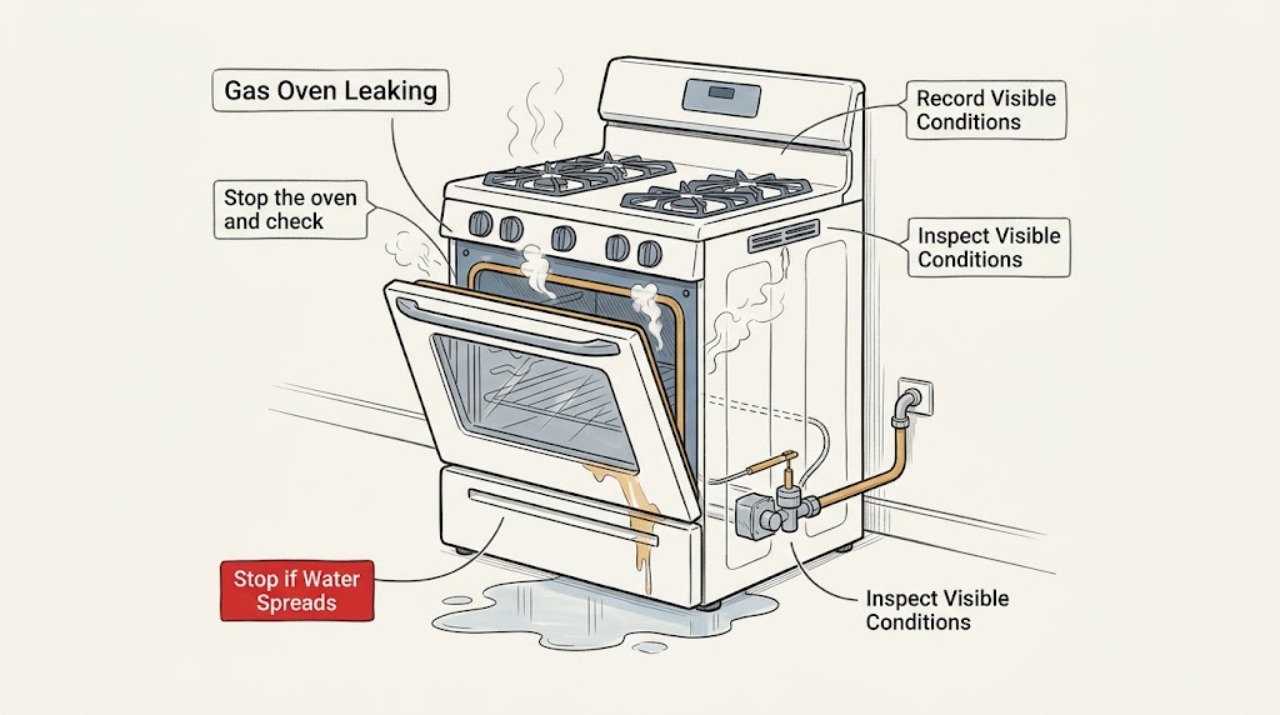
First identify what is leaking and where: clear liquid in the cavity or on the floor, steam or droplets on cool door glass, or a sulfur-like gas odor/hissing. Maytag explains that moisture on the door of a gas oven can be normal condensation from combustion steam, and that high-moisture food or a model-specific Steam Bake feature can add moisture. A puddle, liquid escaping from the door or control area, water near electrical parts, or moisture that persists after the oven cools is not the same as normal condensation. A gas smell when the oven is off, a lingering odor, hissing, abnormal flame, delayed ignition, a boom, smoke, headache, or dizziness is a gas-safety event: do not try to find the leak, light the oven, or operate switches; leave and seek local gas or emergency help from outside. For a non-gas liquid or steam issue, turn the oven off, let it cool, remove only an obvious spill as the exact manual permits, and arrange qualified service if the source is not clear or the leak returns.
Work through in order
Diagnostic checks
Use only checks that match the exact appliance or system and its official guide.
-
Check 1
Stop the oven and check only from a safe position for a sulfur or rotten-egg odor, hissing, delayed ignition, a loud boom, abnormal flame, smoke, carbon-monoxide alarm, headache or dizziness, water at electrical parts, sparks, or a hot/damaged cord. Do not start another cycle to reproduce the symptom.
Expected result: There is no immediate hazard, or there is a gas odor/hiss, abnormal flame or ignition, smoke, illness symptom, electrical danger, or water contacting energized equipment.
Next step: With no hazard, continue only after turning the oven off and allowing it to cool. With suspected gas, leave immediately without operating electronics and seek local gas or emergency assistance from outside; with smoke or electrical/water danger, keep clear and arrange the appropriate qualified response.
Stop if: Stop immediately for gas odor, hissing, delayed ignition, boom, abnormal flame, smoke, carbon-monoxide alarm, severe heat, sparks, or water near electrics.
Why this matters
Why: A gas, fire, carbon-monoxide, shock, or wet-appliance risk takes priority over diagnosing whether liquid came from food or a seal.
-
Check 2
After the oven is off and cool, record the model, cycle, and exact location and timing of the symptom: inside the cavity, on the door glass or gasket, below the door, around a control or outlet, or on the floor. Note whether it is clear water, food-colored or greasy liquid, white vapor, droplets, or odor without visible liquid.
Expected result: Moisture is only on cool glass during preheat or moist cooking, water is confined to a model-specific reservoir or spill area, liquid escapes the door or cabinet, or an odor is present without liquid.
Next step: Follow the matching branch. If the source or substance cannot be identified safely, leave the oven off and request service rather than tasting, touching hot residue, or using another cycle.
Why this matters
Why: Location and timing separate normal steam/condensation and an intentional water feature from a liquid leak, a door-seal problem, or a gas-supply/ignition hazard.
-
Check 3
If droplets are limited to the inside or between the door glass during a gas-oven cycle, keep the door closed, let the oven reach its normal temperature, and observe whether the moisture dissipates as Maytag describes. Do not wipe hot glass or open the door repeatedly.
Expected result: The droplets reduce as the oven warms and no liquid reaches the floor, controls, or electrical parts, or moisture continues to pool, run down the door, or remain after cooling.
Next step: If it dissipates and no other symptom exists, monitor normal use according to the model manual. If it persists, reaches the floor or controls, damages the gasket, or accompanies poor heating, stop use and arrange appliance service.
Stop if: Do not use the oven if moisture reaches electrical controls, the outlet, wiring, or a damaged door seal.
Why this matters
Why: Steam from gas combustion and high-moisture food can condense on cooler glass; persistent pooling or escape is not established as normal condensation.
-
Check 4
When a model-specific Steam Bake or Steam Clean cycle was used, compare the water location with the manual's reservoir and oven-bottom instructions only after the oven has cooled. For an ordinary cooking spill, remove racks if the manual permits and wipe the accessible cool cavity with a soft cloth; do not pour additional water into an unknown oven.
Expected result: Water is confined to the documented reservoir or oven-bottom area, a spill is visibly under a pan, the reservoir is cracked or overfilled, or liquid is escaping from an unexpected seam or control area.
Next step: Empty or wipe only the user-serviceable area specified by the exact manual. If the source is a crack, seam, door, control area, or persistent floor leak, leave the appliance off and request service.
Stop if: Do not clean hot liquid, pour water into the cavity, remove panels, or use the oven with liquid near electrical parts.
Why this matters
Why: A designated steam feature or food spill can explain limited liquid, while a cracked reservoir, overflow, cabinet leak, or fluid near electrics requires service and should not be generalized across Maytag models.
-
Check 5
With the appliance cool, inspect the door gasket, frame, hinges, latch, and visible vent openings for a displaced seal, dirt, damage, or a blocked vent. Confirm the door closes evenly and that no foil, liner, rack, or bakeware is obstructing the burner or vent; do not force the door or remove the gasket.
Expected result: The gasket and door close evenly with no damage, an obstruction or displaced gasket is visible, steam escapes at an unusual location, or liquid enters the door or control area.
Next step: Remove only an obvious cool obstruction and follow the model manual for a gasket that is clearly out of position. For torn seals, bent hinges, a damaged frame, or persistent escape, stop use and arrange service.
Stop if: Do not tape the door, force the latch, cut or glue the gasket, cover the burner area, or run with damaged glass or a blocked vent.
Why this matters
Why: A door or vent condition can redirect steam or spill residue and affect combustion or heat retention. Maytag warns that the gasket is essential to a good seal and that covering the oven bottom can restrict air or gas flow.
-
Check 6
If the symptom is an odor rather than visible liquid, note whether it occurs only briefly at a normal ignition or persists while cooking or when the oven is off. Do not relight, manually ignite, move the range, inspect the regulator, or operate any electrical switch while gas odor is present.
Expected result: There is no gas odor, a brief odor is replaced by normal operation without other symptoms, or an odor lingers, returns when off, is accompanied by hissing/abnormal flame, or occurs with poor heating.
Next step: For a lingering, off-cycle, or abnormal odor, leave immediately and seek local gas or emergency assistance from outside. For no odor, continue the cool liquid/condensation branch; do not use gas checks to diagnose a liquid leak.
Stop if: Stop for any suspected gas leak, unburned gas, delayed ignition, flame outside the burner area, smoke, headache, or dizziness.
Why this matters
Why: Maytag distinguishes a brief ignition odor from a suspected leak or faulty ignition condition; an odor that lingers or occurs while off cannot be safely classified as a water or steam issue.
-
Check 7
If there is no gas odor and the oven is not heating normally after a liquid or steam symptom, confirm from outside the appliance that the door is closed, the selected mode is correct, the main supply and power are available, and no control lock or delayed-start state is active. Use only model instructions for any regulator or supply check; do not move a hard-piped range.
Expected result: The oven mode or timer was wrong, the door was open, a supply or power condition is uncertain, or the oven starts but the leak/poor-heating symptom returns.
Next step: Correct only an obvious control-state issue and run no more than one supervised check if the area is safe and dry. If heating, moisture escape, odor, or leakage returns, leave the oven off and request service.
Stop if: Do not adjust gas pressure, open gas tubing, slide a hard-piped range, or test ignition after any gas odor or abnormal flame.
Why this matters
Why: Maytag identifies mode, delayed start, power, door, main gas, and regulator states as model-specific causes of a gas oven that does not operate; poor heating after a leak-like symptom can indicate a service fault.
-
Check 8
After a clearly identified cool spill is removed or a normal condensation event has dissipated, perform at most one supervised normal cycle with the door closed and the area dry and ventilated as the manual requires. Watch for renewed liquid, unusual vapor, odor, flame, smoke, or electrical instability.
Expected result: The oven completes normally with no renewed liquid or hazard, or the symptom returns, reaches the floor or controls, produces gas odor/abnormal flame, or causes smoke or electrical protection to operate.
Next step: If the symptom returns, turn the oven off, leave it out of service, and provide the service professional with the model, substance, location, cycle, and safety observations.
Stop if: Stop immediately for gas odor, delayed ignition, abnormal flame, smoke, CO alarm, water near electrics, sparks, repeated breaker trips, or uncontrolled heat.
Why this matters
Why: One normal cycle supports a corrected spill or expected condensation explanation but does not clear an intermittent leak, seal, gas, ignition, or electrical fault.
Use your observations
Decision map
Find the observation that best matches what you see, then follow the next safe action.
-
PATH 01Next step
What you see
A sulfur-like gas odor, hissing, lingering odor, delayed ignition, boom, abnormal flame, smoke, carbon-monoxide alarm, headache, or dizziness is present.
Do this next
Stop immediately, do not operate switches or ignite anything, leave the building, and seek local gas or emergency help from outside. Do not search for or repair the leak yourself.
-
PATH 02Next step
What you see
Moisture appears only as droplets on cool gas-oven glass during preheating or moist cooking and dissipates as the oven warms.
Do this next
Treat it as likely steam condensation, keep the door closed while hot, and monitor the next normal cycle. Persistent pooling, floor moisture, or an unexpected escape requires service.
-
PATH 03Next step
What you see
Water is confined to a model-specific Steam Bake or Steam Clean reservoir/oven-bottom area or is an obvious cool cooking spill.
Do this next
Wait for cooling and follow only the exact manual's cleanup or reservoir procedure. Do not add water to an unknown model or operate if the reservoir, cavity, or cabinet is damaged.
-
PATH 04Next step
What you see
Clear or greasy liquid pools, runs from the door or controls, reaches the floor, or remains after cooling without a documented steam or spill source.
Do this next
Leave the oven off and dry, keep liquid away from electrical parts, and arrange qualified appliance service. Do not remove panels or repeat a heating test.
-
PATH 05Next step
What you see
The door gasket, hinge, frame, vent, or burner-area cover is visibly damaged, displaced, or obstructed.
Do this next
Do not force the door, remove the gasket, cover the oven bottom, or operate the oven. Provide the model and visible condition to qualified service.
-
PATH 06Next step
What you see
No hazard is present, but an oven mode, timer, door, power, or model-specific gas-supply state prevents normal operation after the liquid/steam check.
Do this next
Use the exact model's control and installation guidance for one safe external correction. If the oven remains cold or the symptom returns, request service rather than adjusting gas components.
-
PATH 07Next step
What you see
The source cannot be safely identified or the leak-like symptom returns after one safe external correction.
Do this next
Leave the gas oven out of service and give qualified appliance service the model, cycle, substance, location, timing, heating behavior, and all odor, flame, smoke, electrical, and water observations.
Helpful context
Understand the symptom
Not every wet-looking symptom is a leak
Steam can condense on cool gas-oven glass, especially with high-moisture food, and a model with Steam Bake or Steam Clean may intentionally use a water reservoir. Those droplets should be tied to a cycle and should dissipate or be removable after cooling. A puddle, a stream escaping the door or control area, or moisture around an outlet is a different branch and should not be tested by running another cycle.
Treat gas odor as gas danger, not as a water leak
A gas oven can have normal brief odor during ignition, but Maytag says an odor that lingers, occurs when the appliance is off, or is accompanied by leak signs requires professional attention. Do not light burners, operate switches, open the oven, move a hard-piped range, or search for a leak. Leave from a safe route and seek local gas or emergency help away from the building.
Only after diagnosis
Potential parts
- oven door gasket or seal
Only consider this category if the exact model's gasket is visibly damaged or qualified diagnosis confirms that the seal is allowing abnormal vapor or liquid escape.
Confirm exact model fitment; do not cut, glue, or stretch a gasket to compensate for a misaligned door. - oven door hinge or latch
Only consider this category if a qualified inspection finds hinge or latch misalignment behind an uneven door gap or failed seal.
Door hardware can store spring force and differs by model; use qualified service. - steam reservoir or water-handling component
Only consider this category if the exact model has a steam feature and the documented reservoir or water path is cracked, overflowing, or leaking.
Steam features are model-specific; confirm the manual and fitment before replacement. - gas ignition or safety component
Only consider this category after qualified diagnosis of delayed ignition, flame loss, or poor heating with no active gas-leak hazard.
Do not test, adjust, or replace gas components as a user; exact model diagnosis and qualified installation are required.
Common questions
FAQ
Is moisture on a Maytag gas oven door a leak?
Not necessarily. Maytag says gas-combustion steam can condense on cooler door glass, especially with high-moisture food, and should dissipate as the oven warms. A puddle, liquid escaping the door or controls, moisture near electrics, or water that persists after cooling is not a normal condensation conclusion and needs service.
What should I do if my Maytag gas oven smells like gas?
Do not try to find the leak, light an appliance, move a hard-piped range, or operate switches. If the odor lingers, occurs while the oven is off, or comes with hissing, abnormal flame, delayed ignition, smoke, headache, or dizziness, leave immediately and seek local gas or emergency help from outside.
Can I wipe up water inside a Maytag gas oven?
Only after the oven is off and completely cool, and only when the source is an obvious spill or a model-specific steam feature described by the exact manual. Do not pour more water into an unknown model, remove panels, or wipe liquid near electrical parts. An unexplained or returning leak requires qualified service.
Read the exact guide
Official sources
- Oven Not Working - Gas - Product Help | MaytagMaytag Product Help · Maytag gas-oven power, grounding, main gas valve, and installation-related operation checks
- Moisture On Door - Range - Product Help | MaytagMaytag Product Help · Maytag gas-range door moisture, condensation, high-moisture food, and steam-feature guidance
- FREESTANDING GAS RANGE OWNER’S MANUALMaytag · Maytag freestanding gas-range steam-cleaning water, cooling, and model-specific safety instructions
- Oven Not Working - Cooktop Working - Not Clicking - Product Help | MaytagMaytag Product Help · Maytag gas-range oven door, burner airflow, pressure-regulator shut-off, and ignition-path checks
- CPSC Urges Flood Victims to Take Steps to Prevent CO Poisoning, Electrocution, Explosion and FiresU.S. Consumer Product Safety Commission · Gas-leak departure and wet-appliance electrical safety guidance
- How to Check the Gas Regulator Shut-Off Valve on an Oven - Product Help | MaytagMaytag Product Help · Maytag oven gas-regulator shut-off explanation and model/installation-specific service boundary
- Nothing is Working - Gas - Product Help | MaytagMaytag Product Help · Maytag gas-range main valve, delayed start, demo mode, and control-state checks
- Why Does My Oven Smell Like Gas?Maytag · Maytag gas-oven odor, ignition, persistent gas smell, and leak-safety guidance
Community feedback
Share a repair observation
Share a plain-text repair observation. Accepted observations are published automatically; this page may take a moment to update.