
On this page
Start here
Quick answer
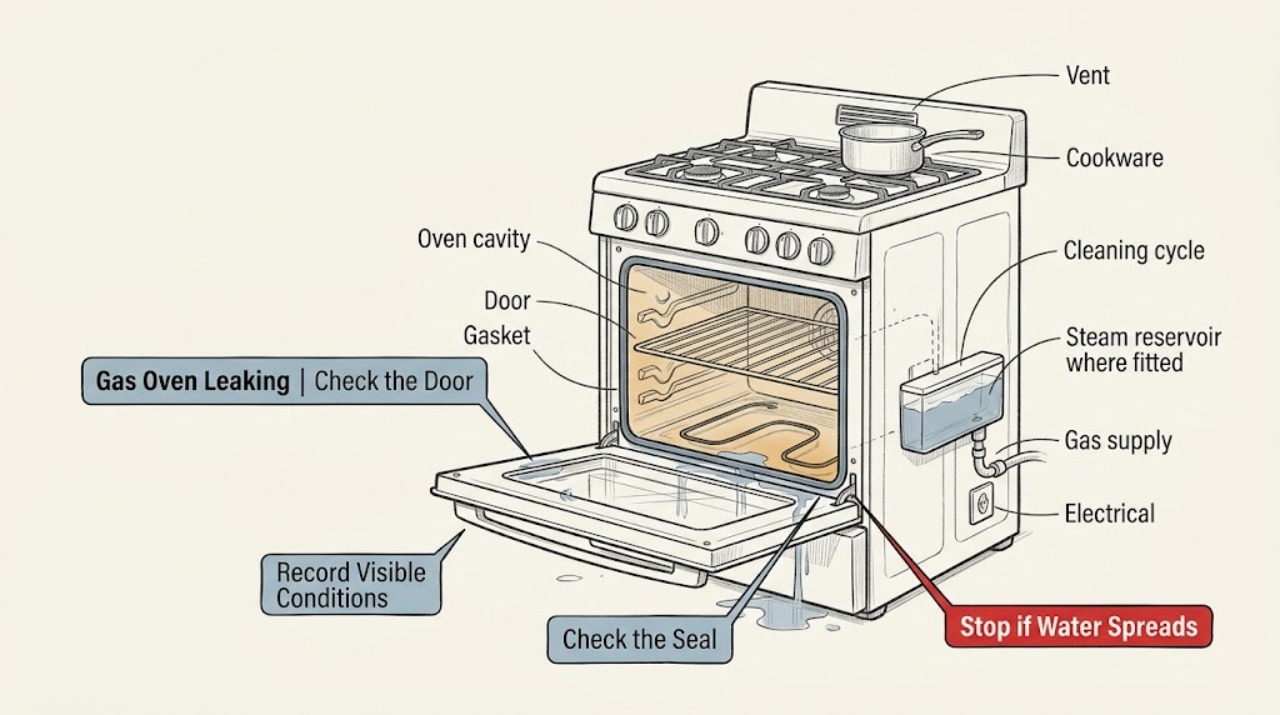
First identify what is actually leaking and when: steam or condensation on the door, food liquid, water left by a model-specific steam or cleaning function, or liquid outside the cavity. A standard gas oven does not automatically have a plumbed water line, so do not assume a hidden tank or drain. KitchenAid notes that gas combustion and high-moisture food can create temporary moisture on the door, while a steam-enabled model can retain water in its specified reservoir after a cycle. Let hot surfaces cool before wiping or handling any residue, keep the vent clear, and do not remove panels or door glass. If the liquid is near an outlet or wiring, there is smoke, a burning smell, an abnormal flame, or any gas odor, stop using the oven; leave immediately for suspected gas and contact help from a safe location. Persistent pooling, liquid from behind the cabinet, a damaged door seal, or repeat leakage after safe external checks needs qualified service.
Work through in order
Diagnostic checks
Use only checks that match the exact appliance or system and its official guide.
-
Check 1
Before touching the oven, classify the liquid: clear water, greasy or colored food liquid, condensate, cleaning residue, or an unknown liquid. Note whether it is on the inner door glass, at the door edge, on the cavity floor, at the vent, under the front, or behind the cabinet, and whether it appears during preheat, cooking, cleaning, or after cooling.
Expected result: Thin moisture on the door during gas heating or with high-moisture food is consistent with condensation. Food-colored or greasy liquid suggests a spill. Liquid pooling under the oven, coming from behind the cabinet, or returning after the cavity is cool is not explained by ordinary door condensation.
Next step: Keep the oven off until hot surfaces cool, then continue with the model and feature check. Do not remove panels or reach through the door.
Why this matters
Why: Location and timing distinguish a normal vapor phase from a spill, model-specific water feature, door-seal issue, or hidden leak without assuming that a standard gas oven has plumbing.
-
Check 2
After the oven is completely cool and the gas controls are off, inspect only visible cookware, racks, the door edge, and the cavity floor for a spill, overfilled dish, damaged gasket, or obstruction at the door closure. Wipe accessible residue with the method in the owner manual; do not pour water into the oven or scrub, move, or remove the gasket unless the manual expressly allows it.
Expected result: A spill that stops after the cookware is corrected and the cooled cavity is cleaned supports a food-liquid branch. A wet or displaced gasket, a door that does not close evenly, or fresh liquid with no spill points toward a door, vent, cleaning-feature, or service branch.
Next step: Correct only a clear cookware or closure issue using the manual. Arrange service if liquid returns, the gasket is damaged, or the door cannot seal.
Why this matters
Why: Ordinary food liquid can look like an appliance leak, while a door or seal problem can direct condensate outward. The safe owner check is limited to visible, cool, accessible surfaces.
-
Check 3
Check the model manual to see whether this KitchenAid unit actually has Steam Bake, a water reservoir, or a special cleaning cycle. If it does, record the reservoir level and cycle used; after the oven cools, follow only the manual's drain, removal, or disposal procedure. If it does not, do not add water or search for a drain.
Expected result: A small amount of water left in a documented steam reservoir after its cycle may be expected. Water from a non-steam model, an overflowing reservoir, water that reaches the controls, or a leak unrelated to the reservoir indicates a fault or misuse branch.
Next step: Stop the feature and arrange service if the reservoir overflows, the water path is not described by the manual, or liquid reaches wiring or the floor. Never open the cabinet to trace it.
Why this matters
Why: KitchenAid documents residual reservoir water only for applicable steam features; that evidence cannot be generalized to every gas oven.
-
Check 4
Observe the oven vent and door area from a safe distance during a normal, supervised cycle only if there is no gas odor, smoke, burning smell, abnormal flame, or electrical concern. Confirm the vent is not blocked and note whether visible vapor dissipates as the oven reaches temperature. Do not place hands in the vapor or block the vent.
Expected result: Vapor that appears with heating or moist food and dissipates is consistent with condensation. Water droplets that stream onto the floor, liquid from the control area, persistent heavy vapor, or a flame that is yellow, unstable, delayed, or accompanied by popping is not a normal condensation result.
Next step: Stop the cycle for persistent liquid, abnormal flame, or any odor or smoke. Leave gas-system and internal repairs to qualified service.
Why this matters
Why: A clear vent and normal combustion help separate steam from a leak, but observation cannot verify gas pressure, burner adjustment, or internal seals.
-
Check 5
Inspect the surrounding floor and accessible plug or disconnect area from a dry position without moving the range. Check whether liquid is near an outlet, cord, control area, or other electrical part. Do not touch wet electrical equipment, pull a plug while standing in water, or restart the oven to reproduce the leak.
Expected result: Water near electrical parts, a wet or damaged cord, a hot control area, or repeated breaker trips changes the issue from a cleaning question to an electrical safety branch. A dry area with only cooled cavity condensation supports continued model-specific observation, not internal repair.
Next step: Keep the oven off and isolate power only from a safe, dry location. Arrange qualified appliance or electrical service for water contact, damaged wiring, or recurring trips.
Why this matters
Why: Liquid can travel away from its source; the visible puddle location does not prove a plumbing or gas fault. Electrical exposure must be isolated before any further use.
-
Check 6
Classify the final stop condition before using the oven again: gas odor, delayed ignition, abnormal flame, smoke, burning or electrical smell, sparks or arcing, hot liquid, water near electrics, liquid from behind the cabinet, or a leak that returns after the oven is cool. Do not perform another heat or ignition test to confirm a concern.
Expected result: Any listed hazard requires immediate stop. A clean, cool oven with temporary door condensation or a corrected food spill may be monitored, but persistent or unexplained liquid requires service even if the oven still heats.
Next step: For suspected gas, avoid switches and phones near the odor, leave, and contact emergency help from safety. For smoke, fire, arcing, water contact, or hot wiring, isolate power only if safely reachable and obtain emergency or qualified help.
Why this matters
Why: A leaking appearance can coexist with a combustion or electrical hazard; continuing to run the oven solely to identify the source can worsen burns, fire, shock, or gas exposure.
Use your observations
Decision map
Find the observation that best matches what you see, then follow the next safe action.
-
PATH 01Next step
What you see
Moisture is limited to the door or cavity during gas heating or high-moisture cooking and dissipates as the oven heats.
Do this next
Treat it as potentially normal condensation, keep the vent clear, and wipe only after the oven cools. Arrange service if it becomes a stream, puddle, or persistent leak.
-
PATH 02Next step
What you see
Greasy or colored liquid follows an overfilled dish or spill and stops after the cool cavity and accessible surfaces are cleaned.
Do this next
Correct the cookware and follow the model's cleaning instructions. Do not line the oven bottom, pour water into it, or use a cleaning cycle that the manual does not support.
-
PATH 03Next step
What you see
The exact model has a documented steam feature or reservoir and residual water remains after that cycle.
Do this next
Wait for cooling and follow the manual's reservoir removal or drain procedure. Stop and call service for overflow, an unexplained water path, or water reaching electrics.
-
PATH 04Next step
What you see
Liquid appears under the oven, behind the control area, from a door edge with a damaged seal, or after the oven is cool with no spill or documented water feature.
Do this next
Keep the oven off, do not move the range or open panels, and arrange qualified appliance service. Provide photos and the leak timing and location.
-
PATH 05Next step
What you see
Water is near an outlet, cord, control, or other electrical part, or the breaker trips after the leak.
Do this next
Do not touch wet equipment or pull a plug while standing in water. Isolate power only from a safe, dry position and obtain qualified electrical or appliance help.
-
PATH 06Next step
What you see
Gas odor, delayed ignition, popping, abnormal flame, smoke, burning odor, sparks, arcing, or uncontrolled heat is present.
Do this next
Stop immediately. Do not operate switches, phones, or flames near suspected gas; leave the area and contact emergency help from a safe location. Do not return to test the oven until professionals clear it.
Helpful context
Understand the symptom
Water on the door is not the same as a cabinet leak
On a KitchenAid gas oven, steam can condense on a cool door during normal heating, especially with high-moisture food. Food, grease, or cleaning residue can also run toward the door or bottom. A puddle under the appliance, liquid emerging from behind the control area, or repeated water after the oven is cool is a different branch. Note the location, amount, color, odor, and timing before cleaning it.
Do not invent a water system
Only some models have a steam feature or reservoir. Use the model manual to confirm that feature and its drain or cleaning procedure. For an ordinary gas oven, do not pour water into the cavity, remove the bottom panel, or search for a drain. Hot liquid can burn, and water reaching electrical parts can create a shock or fire hazard.
Gas odor and combustion warnings override leak diagnosis
A gas smell, delayed ignition, popping, abnormal yellow or unstable flame, smoke, or a burning or electrical odor is a stop condition. Turn controls off only if safely reachable, do not operate electrical switches or phones near suspected gas, leave the area, and contact emergency help from a safe location.
When checks do not resolve it
Need a professional?
Arrange qualified appliance service for liquid from behind the cabinet or control area, a damaged door seal, unexplained pooling, repeated leakage after cooling, or a leak on a model without a documented water feature., Keep the oven off and obtain electrical help for water near the cord, outlet, control, or wiring, a damaged cord, or a breaker that trips again., Do not move the range to inspect its gas connector, open panels, remove door glass, bypass a safety control, pour water into a conventional gas oven, or alter gas pressure., For gas odor, delayed ignition, abnormal flame, smoke, burning odor, sparks, arcing, or uncontrolled heat, stop immediately and obtain emergency or qualified help from a safe location.
Common questions
FAQ
Is water on a KitchenAid gas-oven door normal?
Often, temporary door moisture is steam from gas combustion or high-moisture food and should dissipate as the oven heats. A puddle, stream, liquid under the oven, or water that remains after cooling is a different service branch.
Does a gas oven have a drain or water line?
Do not assume it does. Only use a water reservoir or drain procedure when the exact model manual identifies a steam or cleaning feature. Never pour water into a conventional gas oven or remove panels to search for a leak.
What if water leaks from under the oven?
Keep the oven off and do not move the range or open its cabinet. If water is near an outlet, cord, or control, do not touch it; isolate power only from a safe, dry location and arrange qualified service.
Can I keep using the oven if it has a small spill?
After the oven cools, clean only accessible residue using the model instructions. Do not keep using it if liquid returns, reaches electrics, the door will not seal, or there is smoke, burning odor, abnormal flame, or a breaker trip.
What should I do if the leak smells like gas?
Do not try to light an appliance or operate electrical switches or a phone near the odor. Leave immediately and contact emergency help from a safe location. Do not return to test the oven until it is professionally cleared.
What information should I give the technician?
Give the model number, gas configuration, liquid location and appearance, when it starts, whether a steam or cleaning feature was used, door and gasket condition, and any gas odor, flame change, smoke, burning smell, spark, water near electrics, or power trip.
Read the exact guide
Official sources
- Odors and Smoke in OvenKitchenAid Product Help · KitchenAid oven first-use and heavy-soil odor or smoke guidance, safe cool-down cleaning, and service boundary
- Moisture On Door - RangeKitchenAid Product Help · KitchenAid range moisture, gas-oven condensation, steam reservoir limits, and cool-down handling for applicable Steam Bake models
- Odors or SmellsKitchenAid Product Help · KitchenAid gas-appliance odor response, flame and gas-type cautions, and burner-cap safety guidance
- Moisture on the Inner WindowKitchenAid Product Help · KitchenAid gas-oven door moisture, combustion steam, high-moisture food, and model-manual guidance
- Recognizing and Responding to Pipeline EmergenciesU.S. Department of Transportation, Pipeline and Hazardous Materials Safety Administration · Natural-gas odor emergency response and evacuation precautions
Community feedback
Share a repair observation
Share a plain-text repair observation. Accepted observations are published automatically; this page may take a moment to update.