
On this page
Start here
Quick answer
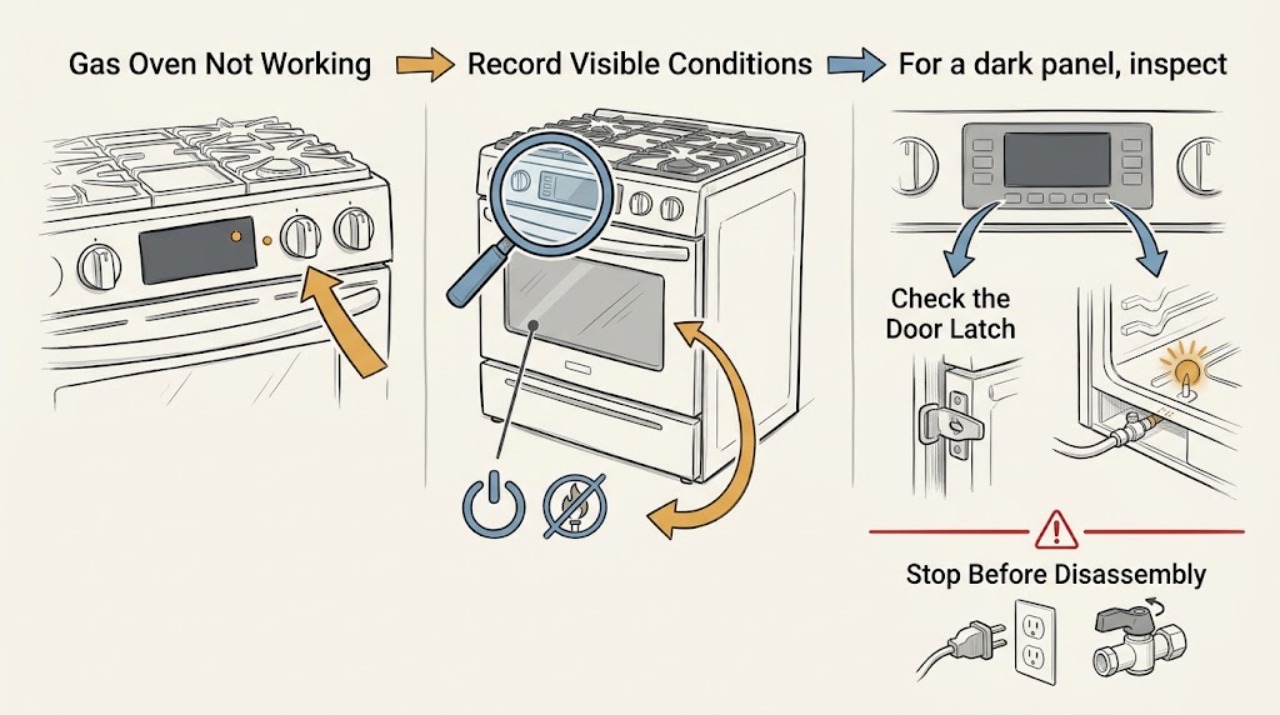
Break a Viking gas oven that is not working into the symptom you can observe: a completely dark panel, a lit panel that will not start, a start with no ignition, ignition with no heat, or an error or control problem. Check only safe external conditions: power and breaker status, door and control settings, the selected mode, and the model-specific manual. Do not bypass a door lock, open panels, adjust gas parts, or repeat ignition tests. A gas odor, delayed ignition or boom, abnormal flame, smoke, carbon-monoxide alarm or symptoms, visible arc, hot connection, or repeated breaker trip means stop immediately, leave or isolate the area as appropriate, and seek qualified help. Check Viking's recall information with the exact model and serial number before using a recalled range oven.
Work through in order
Diagnostic checks
Use only checks that match the exact appliance or system and its official guide.
-
Check 1
From a cool, dry, safe position, record the complete Viking model and serial number, fuel configuration, and whether the panel is dark, lit, displaying a lock, or showing an error.
Expected result: The panel is completely dark, the panel lights but Start is ignored, or a code or lock indicator is present.
Next step: Use the matching branch below and check Viking recall information without operating a potentially affected oven; do not remove panels or force controls.
Why this matters
Why: A dark panel points to power or control power. A lit panel points to door, control, mode, delay, gas, ignition, or error logic rather than a simple loss of household power.
-
Check 2
For a dark panel, inspect the plug and visible cord for looseness or heat damage and check household power or breaker status only from a dry, safe position; do not repeatedly reset a tripped breaker.
Expected result: The plug or household circuit is unavailable, the breaker trips again, the connection is hot or discolored, or household power appears normal but the Viking panel stays dark.
Next step: Stop immediately for smoke, burning odor, heat damage, water contact, or repeated trips. Otherwise leave the oven off and arrange qualified appliance or electrical service.
Why this matters
Why: A household supply issue can explain no display. A repeated trip, heat damage, or normal supply with a dark panel supports an electrical or control fault that needs professional assessment.
-
Check 3
For a lit panel, verify the oven door is fully closed, the selected cooking mode and temperature are valid, and no visible control or delay lock is active; do not force the door or bypass its latch.
Expected result: The door does not register closed, a lock or delay is active, the oven responds after a correct mode and Start sequence, or the panel still ignores Start.
Next step: Use only the exact model manual's unlock, delay-cancel, or Start sequence. If the latch or control still fails, stop repeated attempts and request service.
Why this matters
Why: Door interlock and control settings can prevent a gas oven from beginning. A normal door and valid setting with no response shifts suspicion to the control, interlock, or power path.
-
Check 4
If the oven starts but does not ignite, observe from outside for the expected ignition response without opening panels or repeatedly commanding Bake or Broil; note whether other gas functions were already known to work, without lighting another appliance to test supply when gas is suspected.
Expected result: There is no ignition response, the igniter or control clicks but no flame establishes, ignition is delayed, or a flame is yellow, unstable, or outside its expected area.
Next step: Stop for odor, delay, popping, abnormal flame, smoke, or any uncertainty. Keep the oven off and arrange qualified gas-appliance service; do not adjust gas pressure, ports, air shutters, or ignition parts.
Why this matters
Why: Viking troubleshooting separates power or igniter operation, interrupted gas supply, and abnormal flame or burner conditions. Delayed ignition, a loud pop, or an abnormal flame can allow gas to accumulate and is unsafe to retest.
-
Check 5
If ignition occurs but the oven does not heat or hold heat, record the mode, preheat behavior, indicator state, vent behavior, and whether the symptom affects Bake, Broil, or every mode; do not touch hot surfaces or continue a hazardous cycle.
Expected result: Only one mode fails, the oven begins heating and stops, the indicator remains on without expected heat, or heat is accompanied by smoke, odor, a flare, or a trip.
Next step: Stop for any hazard or repeated failure and provide the exact sequence to qualified service. Do not remove the oven bottom, burner, sensor, or control panel.
Why this matters
Why: Mode-specific behavior can narrow the issue to a burner, igniter, control, sensor, or heating path, but smoke, odor, flare, or a trip changes the situation to a stop-use condition.
-
Check 6
Read and record any error message, alert, or unusual control behavior exactly, together with the mode and when it appeared; do not enter service diagnostics or repeatedly clear the message.
Expected result: The alert clears once under the model manual, returns, the display is blank or erratic, or the oven turns on by itself or cannot be stopped normally.
Next step: Leave the oven off and request qualified service; if there is gas odor, smoke, flame, or electrical danger, use the immediate safety path from outside.
Why this matters
Why: A returning alert supports an unresolved control, power, ignition, or safety fault. An appliance that operates unexpectedly or cannot be stopped is not safe to keep testing.
-
Check 7
Only when there has been no gas odor, delayed ignition, abnormal flame, smoke, visible arc, heat damage, water contact, or repeated trip, perform one reset explicitly authorized by the exact Viking manual.
Expected result: The oven recovers and remains stable, or the no-start, no-heat, error, ignition, or trip symptom returns.
Next step: Do not repeat the reset or resume normal use when the symptom returns. Preserve the model, mode, code, and sequence for qualified service.
Why this matters
Why: A one-time model-approved reset can clear a temporary control state but cannot prove that a gas valve, igniter, burner, wiring, interlock, or control fault is repaired.
Use your observations
Decision map
Find the observation that best matches what you see, then follow the next safe action.
-
PATH 01Next step
What you see
The panel is dark, household power is unavailable or the breaker trips, or the visible connection is hot or damaged.
Do this next
Do not keep resetting the circuit. Leave the oven off and obtain qualified electrical or appliance service; use the emergency route for smoke or active fire.
Why this path and its safety boundary
Why it matters: The problem is on the power or control-power path, with a possible electrical or fire hazard.
-
PATH 02Next step
What you see
The panel is lit, but the door does not register closed, a lock or delay is active, or the Start sequence was not completed.
Do this next
Use the exact model manual to close, unlock, or cancel the setting once. Never force or bypass the door latch; request service if it still will not start.
Why this path and its safety boundary
Why it matters: A normal interlock or control setting may be preventing operation, or the interlock may be faulty.
-
PATH 03Next step
What you see
The oven calls for heat but does not ignite, clicks without a flame, ignites late, or shows a yellow, unstable, or displaced flame.
Do this next
Stop operation and do not relight or repeat Bake or Broil. Leave for gas odor, popping, smoke, or flame danger and obtain qualified gas-appliance service.
Why this path and its safety boundary
Why it matters: Gas supply, ignition, burner, or combustion conditions may be unsafe or unresolved.
-
PATH 04Next step
What you see
Ignition occurs but one heating mode fails, the oven does not reach expected heat, or the symptom returns after a safe model-authorized reset.
Do this next
Keep the oven off and provide the mode, timing, indicator behavior, model, and code to qualified service; do not remove hot or internal components.
Why this path and its safety boundary
Why it matters: A mode-specific burner, igniter, sensor, control, or heating-path fault is possible.
-
PATH 05Next step
What you see
There is a gas odor, delayed ignition or boom, smoke, fire, carbon-monoxide alarm or symptoms, visible arc, burning odor, or repeated breaker trip.
Do this next
Leave without operating switches or creating a flame, seek gas or emergency help from a safe location, and do not return to test the oven.
Why this path and its safety boundary
Why it matters: Treat the appliance as an immediate gas, fire, carbon-monoxide, or electrical hazard.
-
PATH 06Next step
What you see
The exact model or serial number matches Viking recall information or cannot be safely checked because the range is hot or hazardous.
Do this next
Do not operate the affected oven functions. Check the recall instructions only when safe or ask Viking or qualified service to identify the unit.
Why this path and its safety boundary
Why it matters: The oven may have a model-specific safety restriction or needs professional identification before use.
Helpful context
Understand the symptom
Name the failure before testing
Not working can mean no display, no response to Start, no gas ignition, no heat after ignition, a door or control lock, or an error. Record the exact model, whether the unit is a freestanding gas range or another Viking gas oven configuration, and what you can observe without opening the appliance. That split determines whether a safe check concerns household power, controls, gas supply, ignition, or heating.
Gas and fire safety comes first
A gas odor, hissing, delayed ignition, a loud pop, flame outside its expected area, smoke, or carbon-monoxide concern is not a troubleshooting invitation. Leave without operating switches or creating a flame, and seek local gas or emergency help from a safe location. Do not return to relight the oven, inspect a gas connection, or reproduce the symptom.
Model and recall checks are part of diagnosis
Viking publishes manuals and recall information by product family, model, and serial number. Some recall conditions concern gas tubing that supplies oven functions, so a range may look normal at the surface while the oven must remain out of service. Check the model and serial only when the appliance is cool and safe to approach, and follow Viking's current safety instructions.
Safety boundary
Stop conditions
- Stop immediately for gas odor, hissing, delayed ignition, a loud pop or boom, abnormal or displaced flame, smoke, fire, carbon-monoxide alarm or symptoms, or an oven that cannot be stopped normally.
- Stop for a visible arc, burning odor, hot or discolored plug, cord, control, or cabinet, water near electrical equipment, or a repeated breaker trip.
- Do not bypass a door or lid interlock, open panels, touch hot or energized parts, adjust gas pressure, alter gas connections, clean burner ports internally, or repeat ignition tests.
- Do not operate bake, broil, or other oven functions if the exact Viking model is covered by a recall or the safety status is unknown after a gas-related failure.
Only after diagnosis
Potential parts
- oven igniter or ignition electrode
Consider only if qualified diagnosis identifies the model-specific ignition component as the cause of no ignition or delayed ignition.
Confirm the complete model, gas type, and service diagnosis before selecting a part. - gas valve or burner assembly
Consider only when qualified service confirms a gas-flow or burner fault; do not infer a valve fault from no heat alone.
Gas components require model-specific fitment and qualified installation; do not adjust or disconnect the gas system. - control or safety interlock component
Consider only after qualified diagnosis links an ignored start command, code, or door condition to the control or interlock.
Do not select or install electrical or safety components from the symptom alone; verify model fit and professional diagnosis.
When checks do not resolve it
Need a professional?
Request qualified Viking or gas-appliance service when the panel stays dark with normal household power, the door or control interlock fails, ignition does not establish normally, one or more heating modes fail, an error returns, or the oven is affected by a recall. Use the immediate safety route for gas odor, delayed ignition, abnormal flame, smoke, carbon-monoxide concern, visible arc, heat damage, or repeated trips.
Common questions
FAQ
Why is my Viking gas oven completely dark?
Check the plug, visible cord, outlet, and household breaker only from a dry, safe position. If household power is normal but the panel remains dark, leave the oven off and request qualified service rather than opening the control panel.
Why does my Viking gas oven click but not light?
The cause can involve gas supply, ignition, or a model-specific burner condition. Do not keep trying to light it: stop immediately for odor, delay, popping, or an unusual flame and arrange qualified gas-appliance service.
What if the Viking oven lights but does not heat?
Record whether the issue affects Bake, Broil, or every mode and whether the indicator changes. Smoke, gas odor, abnormal flame, heat damage, or a repeated trip requires immediate stop; otherwise a persistent mode failure needs qualified diagnosis.
Should I check whether my Viking range is recalled?
Yes, but only when the range is cool and safe to approach. Use the exact model and serial number with Viking's official recall information, and do not operate oven functions if the unit is covered or its safety status is uncertain after a gas-related fault.
Read the exact guide
Official sources
- Use & CareViking Range, LLC · Viking professional gas-range power, ignition, gas supply, flame, oven heat, and service troubleshooting
- Viking Range, LLC | 30"W. Self-Cleaning Gas RangeViking Range, LLC · Viking gas-range and gas-oven identity, fuel configuration, oven burner, and SureSpark ignition system
- Range and Oven SafetyU.S. Consumer Product Safety Commission · Household range and oven fire-safety information
- Viking Range, LLC | Support and Docs | Recall informationViking Range, LLC · Viking gas-range recall identification and stop-use safety instructions
Community feedback
Share a repair observation
Share a plain-text repair observation. Accepted observations are published automatically; this page may take a moment to update.