
On this page
Start here
Quick answer
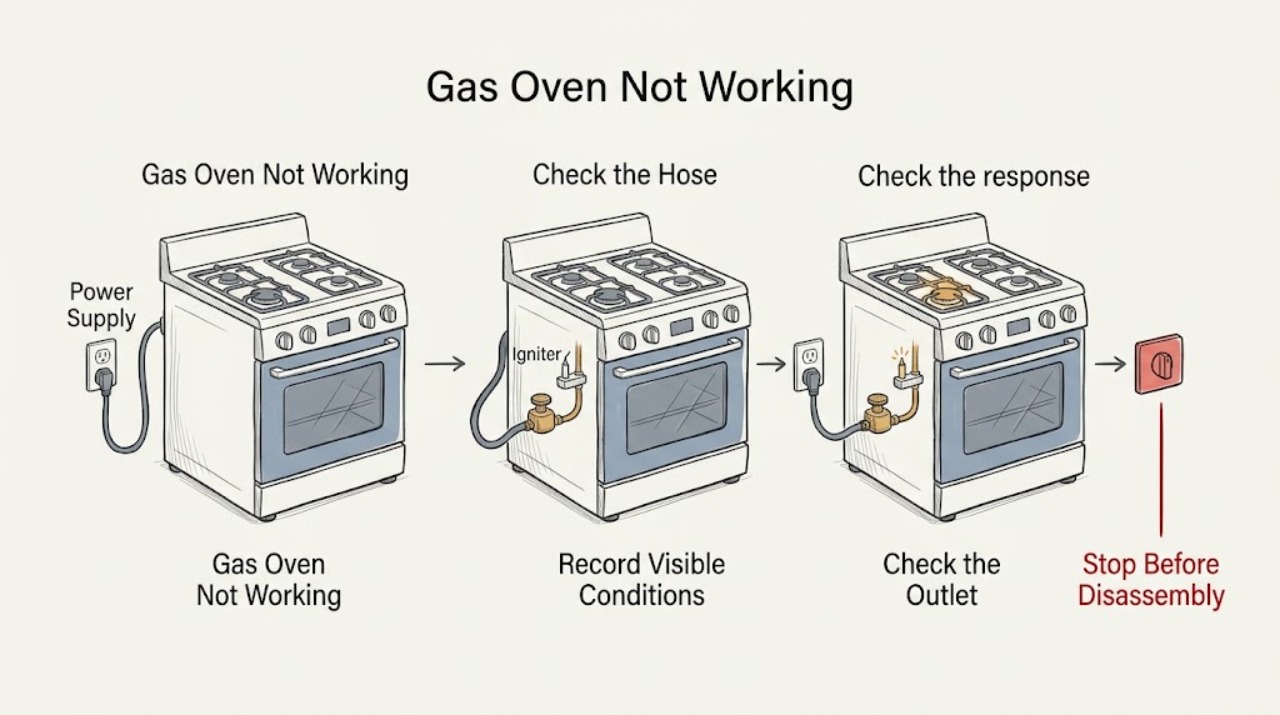
Define what ‘not working’ means before testing: a dark display, controls that will not start, a door or lock issue, no ignition, a flame that goes out, or an oven that ignites but does not heat. Record the exact model and code, then check only the accessible grounded outlet, household breaker or fuse, control lock/delay/demo state, door closure, and main gas supply as the Maytag model instructions permit. A cooktop that works does not prove that the oven ignition or oven regulator path works. Observe the ignition sequence once only when there is no gas odor or other hazard. Stop immediately for gas odor, hissing, delayed ignition, a boom, abnormal flame, smoke, carbon-monoxide alarm, sparks, a hot cord, or repeated breaker trips. Do not open gas or electrical components; if the safe checks do not restore normal operation, leave the oven off and arrange qualified service.
Work through in order
Diagnostic checks
Use only checks that match the exact appliance or system and its official guide.
-
Check 1
Stop the appliance and check from a safe position for sulfur-like gas odor, hissing, delayed ignition, a loud boom, abnormal flame, smoke, carbon-monoxide alarm, sparks, a hot or damaged cord, or a breaker that has opened. Do not start another cycle to reproduce any of those symptoms.
Expected result: There is no hazard sign, or there is gas odor, abnormal ignition/flame, smoke, an alarm, electrical danger, or repeated protective-device operation.
Next step: With no hazard, continue to identify the failed stage. With suspected gas, leave immediately without operating electronics and seek local gas or emergency help from outside; for smoke, sparks, or electrical danger, keep clear and use qualified service.
Stop if: Stop immediately for gas odor, hissing, delayed ignition, boom, abnormal flame, smoke, carbon-monoxide alarm, sparks, exposed wiring, or repeated breaker trips.
Why this matters
Why: A gas, fire, carbon-monoxide, shock, or electrical fault must be made safe before any ordinary no-start or no-heat check.
-
Check 2
Record the complete model and serial information, whether the display and oven light work, whether cooktop burners work, the selected mode and temperature, the door state, and any exact error or lock indication. Use the Maytag model-support and manual path before applying a control or ignition procedure.
Expected result: The range is completely dark, the display is active but controls do not respond, the cooktop works while the oven does not, or a code/indicator is present.
Next step: Follow only the branch matching the exact model and observed state. If the model cannot be confirmed, limit checks to accessible controls and arrange model-specific service.
Why this matters
Why: These observations separate household power, control-state, door, oven-specific gas, ignition, and temperature paths; the same ‘not working’ wording does not identify one failed component.
-
Check 3
With no hazard, confirm the range cord is connected to the grounded operational outlet specified by the model, check the accessible breaker or fuse once, and inspect the display for Control Lock, Delayed Start, Demo/Showroom mode, or a timer state. Clear only a documented control state and select the model's normal Bake mode.
Expected result: The outlet or breaker is the problem, a lock/delay/demo state was active, the display accepts a normal mode, or controls remain unresponsive.
Next step: Correct an obvious control state and start one normal cycle. If supply is uncertain, a breaker trips again, or the panel stays unresponsive, leave the oven off and use qualified electrical or appliance service.
Stop if: Do not open the console, bypass a control lock, probe live wiring, or repeatedly reset a breaker.
Why this matters
Why: Maytag identifies grounded power, delay, demo, and control-lock states as causes of a gas range that appears not to operate; a normal control state with no response points toward service.
-
Check 4
With the oven cool, confirm the door closes fully and the gasket is not folded or damaged. Remove only obvious cool obstructions such as a rack, foil, pan, storage-drawer item, or food residue that the exact manual identifies as interfering with the door, igniter, vent, or burner area.
Expected result: The door closes normally after an obstruction is removed, the latch or gasket is damaged, the door remains open, or no obstruction is found.
Next step: If the door closes normally and no hazard exists, continue to the supply and ignition branch. If the hinge, latch, glass, gasket, or frame is damaged, leave the oven off and arrange service.
Stop if: Do not force the door, remove the gasket, cover the oven bottom, or operate with broken glass or a failed seal.
Why this matters
Why: Maytag notes that an open door can prevent elements from operating and that items in the storage drawer or an oven-bottom liner can interfere with ignition or gas flow. A damaged door or gasket is not corrected by force.
-
Check 5
Only when there is no gas odor and the exact installation instructions allow an accessible external check, confirm the main gas shut-off is on. If the cooktop works but the oven does not, use the model instructions to determine whether an oven pressure-regulator shut-off check is appropriate; do not move a hard-piped range or adjust gas pressure.
Expected result: The main valve is closed, the range was recently installed or reconnected, the cooktop works but the oven path is unavailable, or gas and installation state appear normal.
Next step: Correct only an obvious accessible state described by the exact manual. If the supply is uncertain, the range is hard-piped, or the oven remains inactive, stop and arrange qualified gas-appliance service.
Stop if: Do not slide a hard-piped range, kink a flexible line, open a regulator, adjust pressure, or perform this check after any gas odor.
Why this matters
Why: Maytag says air can be present after reconnection and that an oven-specific regulator shut-off can allow cooktop gas while blocking the oven. A normal supply does not prove an igniter, valve, or burner is good.
-
Check 6
When the oven is cool, the area is free of gas odor, and the model instructions permit it, start one normal Bake cycle and observe from a safe position for the documented ignition indication. Do not manually light gas, place hands inside, or keep clicking/retrying.
Expected result: The oven ignites and remains stable, there is no ignition indication, ignition occurs without a flame, the flame lights and goes out, or ignition is delayed or accompanied by a boom.
Next step: If a stable flame appears, continue to temperature behavior. If ignition fails, is delayed, repeats, or produces abnormal flame, turn the oven off and arrange qualified service.
Stop if: Stop immediately for unburned-gas odor, delayed ignition, boom, yellow/lifting flame, flame outside the burner area, smoke, or repeated failed ignition.
Why this matters
Why: The sequence separates a successful start from an ignition, flame-safety, gas-flow, or control fault, but it does not identify a replacement part without model-specific diagnosis.
-
Check 7
If a stable flame is present but cooking remains cold or slow, confirm the selected mode, temperature, rack placement, door closure, and unobstructed vent/burner area against the exact manual. Do not touch hot surfaces or adjust the thermostat, regulator, burner, or igniter.
Expected result: The mode or temperature was wrong, the door was open, the oven heats slowly but cycles, or it remains persistently cold despite a valid start.
Next step: Correct only an obvious cool setup issue and run one supervised normal cycle. If heat remains absent or the flame is abnormal, leave the oven off and request qualified service.
Stop if: Do not adjust gas pressure, remove burner parts, bypass flame safety, or use the oven with smoke, abnormal heat, or damaged seals.
Why this matters
Why: A control or door condition can mimic a heating failure, and gas ovens may cycle their burner. Persistent no-heat after correct setup suggests a sensor, igniter, burner, safety valve, regulator, or control fault.
-
Check 8
If the range shows an error, lock, or service indicator, write down the exact code and when it appears. After the appliance is cool and safe, use only the exact model's documented cancellation or reset once; do not repeatedly power-cycle an unexplained gas or electrical fault.
Expected result: The indication clears and a normal cycle begins, the same code returns, the code is not described for the model, or it is accompanied by odor, smoke, abnormal flame, heat, sparks, or a breaker event.
Next step: Leave the oven out of service when the code returns or any hazard occurred, and provide the model, code, cycle stage, power, door, gas, and ignition observations to service.
Stop if: Stop for recurring errors, gas warnings, smoke, CO alarm, abnormal flame, electrical trips, or any reset that requires opening the appliance.
Why this matters
Why: Maytag directs owners to model manuals and service for persistent gas-oven problems; a recurring or unknown code is evidence for qualified diagnosis, not a reason to guess at a component.
-
Check 9
After a clearly corrected control, accessible supply, or door condition, run at most one supervised normal Bake cycle with the oven door closed and the area ventilated as required by the manual. Watch for stable ignition, normal heat cycling, odor, smoke, flame, and electrical stability.
Expected result: The oven completes normally, or it stays cold, loses flame, ignites late, produces abnormal heat or odor, leaks gas, smokes, or opens electrical protection.
Next step: If the symptom returns, turn the oven off, leave it out of service, and provide service with the exact model, code, selected mode, and all observations.
Stop if: Stop immediately for gas odor, delayed ignition, abnormal flame, smoke, CO alarm, sparks, uncontrolled heat, or repeated breaker trips.
Why this matters
Why: One normal cycle supports a corrected setup but does not clear an intermittent gas, ignition, temperature, door, or electrical fault. A returning symptom is a service boundary.
Use your observations
Decision map
Find the observation that best matches what you see, then follow the next safe action.
-
PATH 01Next step
What you see
Gas odor, hissing, delayed ignition, a boom, abnormal flame, smoke, carbon-monoxide alarm, headache, dizziness, sparks, or repeated breaker trips is present.
Do this next
Stop immediately. Do not operate switches, light burners, or search for the leak. Leave the area and seek local gas, emergency, electrical, or qualified appliance help from a safe location outside as appropriate.
-
PATH 02Next step
What you see
The range display is dark or the controls have no response and no hazard is present.
Do this next
Check the accessible grounded outlet, breaker or fuse, cord, control lock, delay/demo state, and Start command once. Persistent loss of power or a repeated trip needs qualified electrical or appliance service.
-
PATH 03Next step
What you see
The display works but the oven will not start, while a lock, delayed start, demo mode, open door, or obstruction is found.
Do this next
Clear only the model-documented control state or obvious cool obstruction, close the door gently, and start one normal cycle. If the condition persists, stop and request service.
-
PATH 04Next step
What you see
The cooktop works but the oven does not click or ignite, with no gas odor.
Do this next
Use the exact installation instructions for any accessible main-valve or oven-regulator check, without moving hard-piped equipment or opening gas parts. A persistent oven-only failure requires qualified service.
-
PATH 05Next step
What you see
The oven ignites but the flame goes out, heating remains absent, or the oven overheats.
Do this next
Turn the oven off and leave it out of service. Do not adjust the regulator, bypass flame safety, or replace an igniter/valve without qualified model-specific diagnosis.
-
PATH 06Next step
What you see
An error, lock, or service indication returns after one model-specific user reset.
Do this next
Record the exact code and cycle stage and arrange qualified Maytag appliance service. Do not keep clearing the indication or open the control panel.
-
PATH 07Next step
What you see
The symptom cannot be classified safely or returns after the external checks.
Do this next
Leave the oven off and provide service with the model, display state, mode, door and supply observations, ignition behavior, and any odor, flame, smoke, heat, electrical, or gas event.
Helpful context
Understand the symptom
Separate control, supply, and ignition failures
A dark display is a power path problem; a lit display that will not start can be a delay, lock, demo, door, or control state; a started cycle with no flame is an ignition or gas path problem. Maytag's support pages are model-specific, so record the code and exact model before checking a regulator or interpreting a flame.
The gas-safety boundary is firm
A brief odor during normal ignition can differ from an odor that lingers, appears when the oven is off, or comes with hissing or abnormal flame. Do not keep trying to ignite the oven, move a hard-piped range, adjust pressure, or search for a leak. Leave from a safe route and seek the local gas or emergency response from outside the building.
Only after diagnosis
Potential parts
- oven igniter or ignition component
Only consider this category after qualified diagnosis confirms the exact model commands ignition but does not establish a safe flame.
Confirm exact model fitment and qualified installation; do not perform live ignition testing. - oven burner or flame-safety component
Only consider this category when qualified diagnosis finds a stable supply but failed flame establishment or retention.
Gas and flame-safety parts are model-specific and require qualified service. - temperature sensor or control
Only consider this category if the oven starts and ignites but temperature regulation or a model-specific error remains abnormal.
Use the exact model's diagnostic procedure and verify fitment before replacement. - gas safety valve or pressure regulator
Only consider this category after qualified testing identifies an oven gas-flow fault; no heat alone is not proof of valve or regulator failure.
Do not adjust or open gas controls as a user; exact model diagnosis and qualified installation are required.
Common questions
FAQ
Why does my Maytag gas oven have power but not work?
A lit display does not prove that a bake cycle has started or that the oven has gas and ignition. Check the model-specific lock, delay/demo state, mode, door, grounded outlet, and accessible gas supply. If there is no safe ignition or the problem returns, leave the oven off and arrange qualified service.
Can the Maytag cooktop work while the oven does not?
Yes. Maytag explains that an oven pressure-regulator shut-off can block gas to the oven while the cooktop still receives gas. Use the exact installation instructions for any safe accessible check, do not move hard-piped equipment or adjust pressure, and request qualified service if the oven remains inactive.
What should I do if my Maytag oven smells like gas?
A brief odor during normal ignition should fade quickly, but an odor that lingers, occurs when the oven is off, or comes with hissing, delayed ignition, abnormal flame, smoke, headache, or dizziness is not a routine no-start symptom. Do not light or switch anything; leave immediately and seek local gas or emergency help from outside.
Read the exact guide
Official sources
- CPSC Urges Flood Victims to Take Steps to Prevent CO Poisoning, Electrocution, Explosion and FiresU.S. Consumer Product Safety Commission · Gas-leak departure and wet-appliance electrical safety guidance
- Why Does My Oven Smell Like Gas?Maytag · Maytag gas-oven odor, ignition, persistent gas smell, and leak-safety guidance
- Nothing is Working - Gas - Product Help | MaytagMaytag Product Help · Maytag gas-range control lock, delayed start, demo mode, main gas, and no-operation guidance
- Oven Not Working - Cooktop Working - Not Clicking - Product Help | MaytagMaytag Product Help · Maytag gas-range door, air/gas flow, regulator shut-off, main valve, and ignition checks
- How to Check the Gas Regulator Shut-Off Valve on an Oven - Product Help | MaytagMaytag Product Help · Maytag oven pressure-regulator shut-off explanation and hard-piped installation caution
- Oven Not Working - Gas - Product Help | MaytagMaytag Product Help · Maytag gas-oven power, grounding, main gas valve, reconnection, and service guidance
Community feedback
Share a repair observation
Share a plain-text repair observation. Accepted observations are published automatically; this page may take a moment to update.