
On this page
Start here
Quick answer
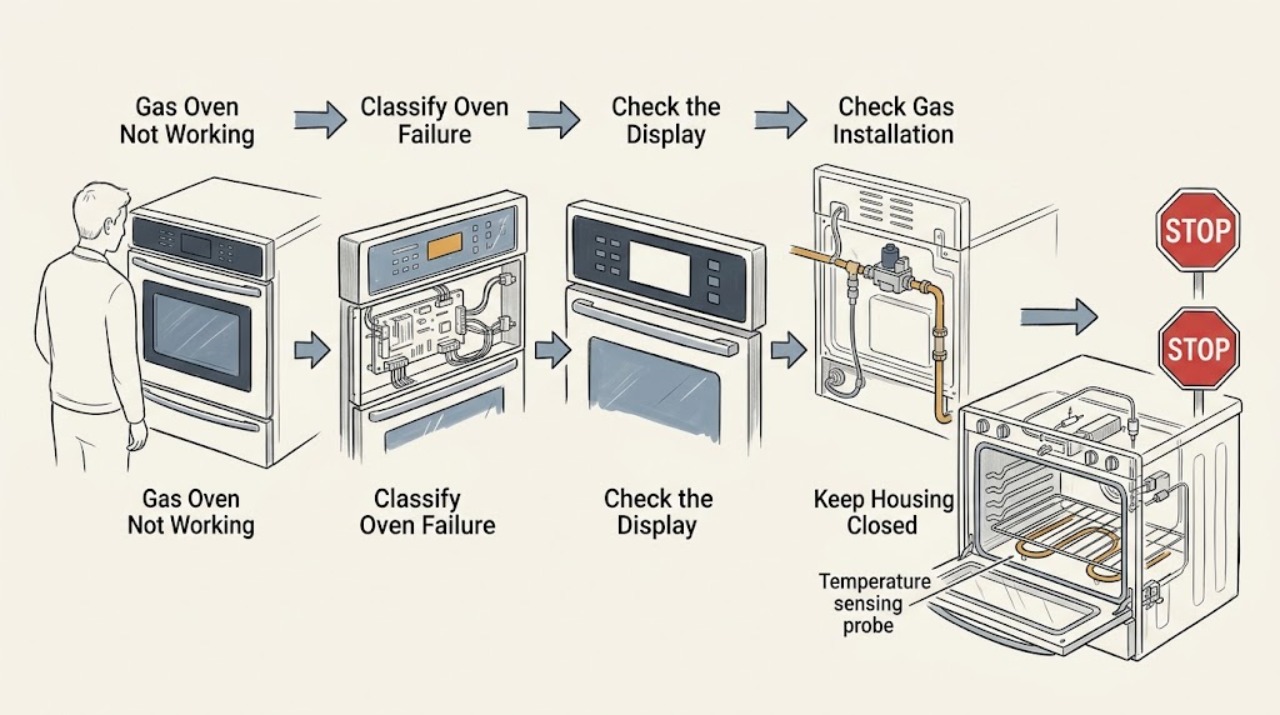
A Frigidaire gas oven that will not work needs to be split into a control problem, a gas-supply/ignition problem, or a heating-control problem. Record the exact model, whether the display responds, whether the cooktop burners work, and whether the oven fails to start, fails to ignite, or ignites but does not heat normally. Check only ordinary-access items: the oven is not locked or in a special mode, the gas shutoff is accessible and open as the installation requires, the power cord is connected, and visible burner components are clean and correctly seated. Use the exact Owner's Manual for any ignition or reset instruction; Frigidaire documents a 30-second power reset for certain oven error conditions, but a reset is not a repair and should not be repeated when a fault returns. Stop immediately for gas odor, yellow or unstable flame, delayed ignition, smoke, burning smell, arcing, damaged wiring, or repeated breaker trips, and arrange qualified gas-appliance service.
Before you begin
Safety first
- This article supports identification, ordinary-access control and installation checks, and one normal bake observation or documented reset only when safe. It does not authorize gas-path work, live electrical testing, panel removal, safety bypass, or part replacement.
Work through in order
Diagnostic checks
Use only checks that match the exact appliance or system and its official guide.
-
Check 1
Record the exact model, display state, selected mode and temperature, and whether the gas oven fails to respond, fails to ignite, or ignites but does not heat; note whether the cooktop burners work normally.
Expected result: Classify the symptom as no display/control response, bake selection rejected, no ignition, delayed or unstable flame, or heat that is weak, excessive, or absent after ignition.
Next step: Use the exact model and symptom in Frigidaire's Owner Center/manual route before doing any repair check; keep a photograph of any code or unusual flame.
Stop if: Stop immediately for gas odor, delayed ignition, yellow or unstable flame, smoke, burning smell, arcing, exposed wiring, damaged glass, or a breaker that trips.
Why this matters
Why: Different symptom groups point toward controls/power, gas supply/ignition, or heating-control diagnosis. A working cooktop does not prove the oven circuit is healthy, and a display message is not enough to select a part.
-
Check 2
From ordinary access, confirm the range has power, the control display is responsive, the oven is not locked or in a special mode identified by the exact manual, and a normal bake selection is accepted; do not remove panels.
Expected result: Record whether the display is blank, a lock or mode indicator is shown, buttons respond but the oven does not start, or the breaker trips when a cycle is selected.
Next step: Follow only the exact model's unlock or mode instructions; if power or controls remain abnormal, arrange qualified appliance or electrical service.
Stop if: Do not open the control panel, bypass a door or safety lock, use an extension cord, or restore a breaker that trips again.
Why this matters
Why: A blank or unresponsive control can be a supply or control issue; a documented lock or mode may be user-cleared by the manual. A repeated breaker trip is an electrical fault boundary, not a reason to increase fuse capacity or keep resetting.
-
Check 3
Without moving the range or disconnecting the gas line, confirm from ordinary access that the gas shutoff and connector are accessible, appear intact, and match the installed fuel arrangement; check that the power cord is connected.
Expected result: Record whether the shutoff is closed or inaccessible, the connector shows corrosion or damage, the appliance is newly installed or moved, or the power connection is loose or absent.
Next step: Do not operate or move the range when the connection is damaged, uncertain, or recently installed incorrectly; contact the installer or a qualified gas-appliance technician.
Stop if: Stop for gas odor, hissing, a corroded or damaged connector, inaccessible shutoff, or any need to disconnect the gas line or tip the range.
Why this matters
Why: A closed/uncertain supply or installation problem can prevent ignition, but a visual check cannot prove gas pressure, regulator, valve, or burner safety. Frigidaire's installation guidance places gas connections and propane conversion within qualified installation boundaries.
-
Check 4
Only if the manual permits normal surface operation and there is no gas odor or flame hazard, observe one surface burner; verify the knob reaches the normal light position and that the visible cap is seated level and the ports are not visibly blocked.
Expected result: Record whether no surface burner lights, all surface burners light normally, only one burner fails, or a flame is delayed, yellow, unstable, or unusually high.
Next step: Clean only as the exact manual directs and reseat only visible caps; arrange service for a persistent failure or any abnormal flame rather than adjusting gas components.
Stop if: Do not use an open flame to test gas, repeatedly click ignition, remove jets or burner valves, or continue with gas odor or abnormal flame.
Why this matters
Why: Frigidaire identifies correctly seated caps and clear burner ports as ordinary gas-ignition checks. If all burners fail, a supply or range-level issue is plausible; if surface burners work but the oven does not, the oven's own ignition/control path still needs model-specific diagnosis.
-
Check 5
With no gas odor, smoke, damaged wiring, or other hazard, use the exact manual's normal bake procedure once and observe from the intended user position whether the display accepts the setting, ignition begins, a stable flame appears, and heat starts to build.
Expected result: Record no response, repeated clicking, no visible ignition, delayed ignition, unstable/yellow flame, ignition followed by shutoff, or normal ignition followed by weak or excessive heating.
Next step: Turn the oven off normally, preserve the symptom record, and arrange qualified gas-appliance service for any result other than normal operation.
Stop if: Stop immediately for delayed ignition, flame rollout, yellow/unstable flame, gas odor, smoke, burning smell, unexpected heating, arcing, or a breaker trip.
Why this matters
Why: The observation narrows the service report but does not identify an igniter, bake burner, sensor, valve, control board, or wiring part. Delayed or abnormal ignition is a gas-safety issue, and heat that is excessive may be a temperature-control fault.
-
Check 6
Only when the exact Frigidaire guide permits a power reset for the displayed condition and no hazard is present, disconnect power for the documented interval and restore it once; do not repeat resets to keep a gas oven running.
Expected result: Record whether the display clears and the oven responds, the same code returns, the controls remain blank, or the breaker trips again.
Next step: If the problem returns or operation remains abnormal, stop using the oven and provide the model, code, reset result, and flame/heat observations to Frigidaire or a qualified technician.
Stop if: Do not reset again, bypass a safety device, or continue operation after a recurring error, overheating, gas symptom, burning smell, or breaker trip.
Why this matters
Why: A one-time clear can remove a temporary control state, but it does not prove the gas ignition or temperature system is repaired. A recurring code, blank control, or trip requires service.
Use your observations
Decision map
Find the observation that best matches what you see, then follow the next safe action.
-
PATH 01Safety boundary
What you see
The display is present and the exact model manual identifies a lock, demo/special mode, or documented control state that prevents normal bake operation.
Do this next
Follow only the matching manual's user procedure, then test normal bake once without bypassing a lock or safety control.
Why this path and its safety boundary
Why it matters: The oven may be blocked by an operating state rather than a failed gas component.
Safety stop: Stop if the mode cannot be cleared as documented, the controls remain unresponsive, or the breaker trips.
-
PATH 02Safety boundary
What you see
No surface burner lights normally and the oven also fails to ignite, without any gas odor or abnormal flame.
Do this next
Stop repeated ignition attempts and arrange qualified gas-appliance service; provide the model, fuel type, installation history, and surface/oven symptom pattern.
Why this path and its safety boundary
Why it matters: A range-level power, gas-supply, ignition-control, or installation issue is possible, but a visual check cannot establish gas pressure or valve safety.
Safety stop: Do not use an open flame to test supply, adjust gas pressure, disconnect the line, or continue when a connector is damaged or gas is smelled.
-
PATH 03Safety boundary
What you see
Surface burners operate normally, but the oven does not respond, ignite, or maintain heat.
Do this next
Use the exact Owner's Manual and arrange qualified service rather than selecting an igniter, sensor, burner, or control from the symptom alone.
Why this path and its safety boundary
Why it matters: The oven's own control, ignition, burner, sensor, valve, or wiring path needs diagnosis; surface-burner operation does not clear those possibilities.
Safety stop: Stop for delayed ignition, abnormal flame, smoke, burning smell, unexpected heating, arcing, or repeated breaker trips.
-
PATH 04Safety boundary
What you see
A model-documented, one-time power reset clears a control error and the oven operates normally without gas or electrical symptoms.
Do this next
Keep the code and reset record; monitor and request service if the display or failure returns.
Why this path and its safety boundary
Why it matters: A transient control state is possible, but the reset does not verify an internal repair.
Safety stop: Do not perform repeated resets or use the oven if the error returns, heat is abnormal, or the breaker trips.
-
PATH 05Safety boundary
What you see
There is gas odor, hissing, delayed ignition, flame rollout, yellow/unstable flame, smoke, burning smell, arcing, exposed wiring, damaged glass, or repeated breaker operation.
Do this next
Stop using the range, leave the area and follow local emergency gas guidance when gas is suspected, or isolate power only if safe; arrange qualified gas-appliance/electrical service.
Why this path and its safety boundary
Why it matters: This is an immediate gas, fire, electrical, or thermal safety condition, not a routine no-start adjustment.
Safety stop: Do not operate another burner, use a switch or flame near suspected gas, restore a tripping breaker, or open the range.
Helpful context
Understand the symptom
First identify what ‘not working’ means
A gas oven can appear dead because the display or controls do not respond, fail to start a bake cycle, fail to ignite, or ignite but never reach normal heat. Write down the model and serial information, the selected mode and temperature, any display message, and whether the cooktop burners still operate. Do not assume a burner problem and an oven problem share the same cause, and do not use a code list from another model. Frigidaire's Owner Center provides model-specific manuals and troubleshooting routes.
Check controls and the gas installation without opening the range
Confirm that the oven is not in a lock, demo, or other mode described by the exact manual, that a bake selection was accepted, and that the control display is normal. From ordinary access, verify the power cord is connected and the gas shutoff and connector are accessible and in good condition; do not disconnect the gas line or move the appliance. Frigidaire's installation guidance says gas-range installation involves an accessible shutoff and suitable gas connection, and recommends qualified help where installation or supply is uncertain.
Use the cooktop only as a limited comparison
If the model's instructions allow it and there is no gas odor, observe whether a surface burner lights normally. If no burners light, a supply, control, or ignition issue is more plausible than an oven-only heating fault. If surface burners work but the oven does not, do not conclude that the oven igniter, bake burner, sensor, or control is defective without diagnosis. Frigidaire's gas-range support specifically calls for correctly seated burner caps, clear ports, and ordinary power checks for burner ignition; it does not authorize gas-path disassembly.
Observe one normal bake start only when safe
With the room free of gas odor and combustible items, use the exact manual's normal bake-start procedure once. Note whether the display changes, an ignition sequence begins, a flame appears, the flame stays stable, and heat begins to build. Do not bypass a safety control, repeatedly ignite, reach into the burner area, or remove the oven floor or rear panel to see hidden components. A failure to ignite, a delayed ignition, or abnormal flame is a service boundary, not a cue to adjust the gas valve.
Reset only for a documented control condition
If the exact Frigidaire guide identifies a displayed error or false control state and permits a power reset, disconnect power for the documented interval and restore it once. The Frigidaire error guide describes a 30-second reset for certain oven errors and says to consult the Use and Care guide. If the oven remains dead, the code returns, heat runs away, or the breaker trips, stop testing and arrange service.
Safety boundary
Stop conditions
- Stop immediately for gas odor, hissing, delayed ignition, flame rollout, yellow or unstable flame, smoke, burning smell, arcing, exposed wiring, damaged glass, unexpected heating, or a breaker that trips again.
- Do not use a match or lighter to test gas, adjust the regulator or gas valve, disconnect the gas line, remove jets, or bypass an oven safety control.
- Do not open the control panel, remove the oven floor or rear panel, probe live terminals, or select an igniter, sensor, burner, valve, or control part from the symptom alone.
- Do not repeatedly ignite or reset the oven; a power reset is appropriate only once when the exact model guidance permits it and no hazard is present.
- Do not keep using an oven that remains unresponsive, repeatedly fails to ignite, overheats, or has a damaged or uncertain installation.
Only after diagnosis
Potential parts
- model-specific oven igniter or ignition component
Consider this category only when qualified diagnosis confirms an ignition component fault after safe supply and control checks.
Confirm the complete Frigidaire model, fuel configuration, electrical rating, and manufacturer fit information; do not order from a visual match or generic symptom. - model-specific bake burner or gas-control component
Consider this category only when a technician isolates the no-heat or no-ignition condition to the bake burner or gas-control path.
Gas components require exact model and fuel verification and qualified installation; never substitute or adjust a gas part by guesswork. - model-specific oven sensor or control assembly
Consider this category only after diagnosis confirms a sensing or control fault, especially when the oven responds but does not regulate heat normally.
Verify exact model/revision, electrical safety, and installation procedure with Frigidaire or a qualified technician before ordering.
When checks do not resolve it
Need a professional?
Arrange Frigidaire or qualified gas-appliance service when the exact manual does not resolve the no-start, no-ignition, or no-heat condition; the display or controls remain abnormal; the gas supply or installation is uncertain; surface burners work but the oven does not; the code returns after one documented reset; or the oven flame or temperature is abnormal. Treat gas odor, smoke, arcing, burning smell, flame rollout, damaged wiring, and repeat breaker trips as urgent safety boundaries.
Safety scope: This article supports identification, ordinary-access control and installation checks, and one normal bake observation or documented reset only when safe. It does not authorize gas-path work, live electrical testing, panel removal, safety bypass, or part replacement.
Common questions
FAQ
Why is my Frigidaire gas oven not working while the cooktop still works?
Surface burners and the oven have different control and ignition paths, so working burners do not clear an oven-side fault. Record whether the oven responds, ignites, and heats, then use the exact manual and request qualified service rather than guessing at an igniter, sensor, burner, or control.
What should I check first when a Frigidaire gas oven will not start?
Record the model and symptom, confirm the display accepts a normal bake selection, check for a documented lock or special mode, and verify ordinary-access power and gas-installation conditions without moving or opening the range. Use Frigidaire's model-specific manual for the next step.
Can I reset a Frigidaire gas oven that is not working?
Only when the exact Frigidaire guide permits a power reset for the displayed condition and no gas or electrical hazard is present. Frigidaire documents a 30-second reset for certain oven errors. Perform it once; a returning fault or abnormal heat requires service.
What if the Frigidaire gas oven clicks but does not ignite?
Do not keep trying to ignite it or use a flame to test gas. Check only the exact manual's ordinary-access items, such as visible burner-cap seating and ports where applicable, and stop for gas odor or delayed ignition. A persistent no-ignition condition needs qualified gas-appliance service.
When is a nonworking gas oven an emergency?
Stop immediately for gas odor, hissing, delayed ignition, flame rollout, yellow or unstable flame, smoke, burning smell, arcing, exposed wiring, damaged glass, unexpected heating, or a breaker that trips again. Follow local emergency gas guidance or arrange qualified appliance/electrical service.
Read the exact guide
Official sources
- Gas Range / Cooktops - Burners are not lightingFrigidaire · Official Frigidaire gas-range and gas-cooktop support; used for surface-burner comparison only, not as a diagnosis of the oven burner.
- What To Do If Your Gas Range Won't StartFrigidaire · Official Frigidaire support article for gas ranges; exact model instructions and qualified gas service control the repair.
- Owner Center Resource LibraryFrigidaire · Official Frigidaire resource library; used to direct model-specific lookup rather than supply universal repair facts.
- Delivery and Installation Guide - Duel Fuel or Gas RangeFrigidaire · Official Frigidaire installation guidance for gas ranges; it is not a substitute for local code or a qualified gas technician.
- Gas Cooktop Ignition Port Cleaning GuideFrigidaire · Official cleaning guidance for gas cooktops and gas ranges; only visible burner cleaning allowed by the exact manual should be used.
- Oven Error Codes and Alarms GuideFrigidaire · Official Frigidaire oven error guidance; reset details and code meanings vary by model and are not a general gas-oven repair procedure.
Community feedback
Share a repair observation
Share a plain-text repair observation. Accepted observations are published automatically; this page may take a moment to update.